Introduction to Geothermal Comfort Systems
Defining “Geothermal” Energy Dictionary definition Relating to the internal heat of the earth The Earth acts as a giant solar collector, absorbing approximately 50% of the energy emitted by the Sun. Air temperatures may fluctuate as much as 50  F above and below the annual average. However, only a few feet below the surface, the changes in earth temperatures are much less severe.
Defining “Geothermal” Energy “ High Temperature” Geothermal Refers to heat temperatures from typically hundreds of feet deep within the earth, sometimes exceeding 300  F.  These include geysers and other hydro-geothermal reservoirs. “ Low Temperature” Geothermal Refers to shallow earth temperatures found anywhere, utilizing a mechanical device (geothermal heat pump) to transfer heat to and from the ground.
Laws of Thermodynamics First Law Conservation of Energy (Basically, you can’t get more energy out than you put in.) Second Law Heat energy flows from an area of high heat to a area of low heat.  You cannot stop this process, only speed it up or slow it down.
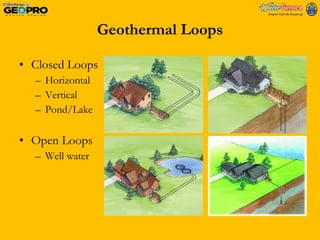
The Basic Ground Source Heat Pump System The earth loop is placed in the ground either horizontally or vertically, or it can be placed in a pond. Water and anti-freeze is circulated through the pipe, transporting heat to the heat pump during the heating mode and away from the heat pump during the cooling mode. The heat transfer takes place inside the heat pump in a water-to-refrigerant heat exchanger.
Energy Source During the heating season, the earth serves as a heat source. (HE - Heat of extraction) During the cooling season, the earth serves as a heat sink. (HR - Heat of rejection)
Equipment Performance Ratings Geothermal and ground water heat pumps are tested under ISO Standard 13256-1, which replaces the former standards of ARI-330 (ground loop), ARI-325 (ground water/open loop) and ARI-320 (water loop/boiler-tower).
Equipment Performance Ratings ARI has designated the efficiency ratings for water-to-air heat pumps as: Energy Efficiency Ratio (EER) EER = BTU output divided by power watt input For cooling operation under steady state test conditions Coefficient of Performance (COP) COP = BTU output divided by BTU input For heating operation under steady state test conditions
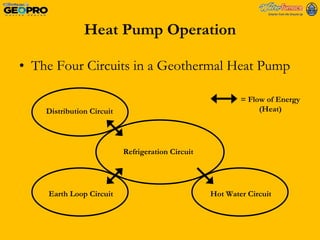
Heat Pump Operation Geothermal heat pumps consist of four circuits: Distribution circuit The system that distributes the conditioned air or water solution throughout the home or building and returns it to the unit. Refrigerant circuit A sealed and pressurized circuit of refrigerant including compressor, expansion valve, water-to-refrigerant heat exchanger(s), air coil, reversing valve. The refrigerant is either R-22 or R-410A.
Heat Pump Operation Geothermal heat pumps consist of four circuits: Ground loop circuit The piping system buried in the ground has fluid that is circulated by pumps to and from the geothermal unit. Hot water circuit Domestic water can be heated in a geothermal unit with a device called a desuperheater. A piping connection is made from the geothermal unit to the water heater.
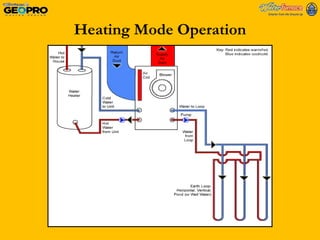
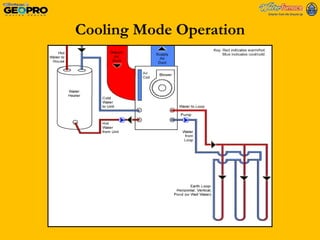
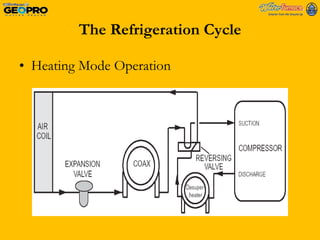
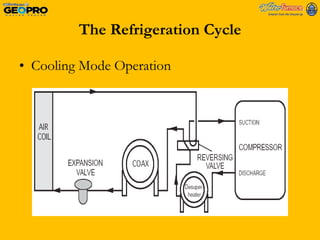
Heat Pump Operation Each of these circuits is closed and sealed from the others—there is no direct mixing.  However, heat energy  does  transfer from the refrigeration circuit to the other three circuits. The refrigerant flow will change direction when the unit changes modes (heating or cooling).
Heat Pump Operation The Four Circuits in a Geothermal Heat Pump Distribution Circuit Earth Loop Circuit Refrigeration Circuit Hot Water Circuit = Flow of Energy (Heat)
Heating Mode Operation
Cooling Mode Operation
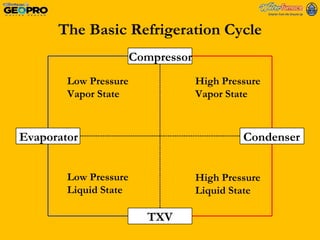
The Basic Refrigeration Cycle Compressor Condenser Evaporator TXV High Pressure Vapor State High Pressure Liquid State Low Pressure Liquid State Low Pressure Vapor State
The Refrigeration Cycle Heating Mode Operation
The Refrigeration Cycle Cooling Mode Operation
Geothermal Loops Closed Loops Horizontal Vertical Pond/Lake Open Loops Well water
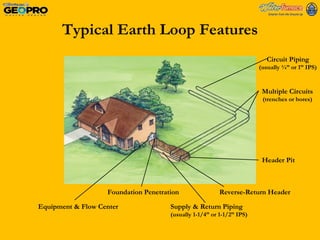
Typical Earth Loop Features Circuit Piping (usually ¾” or 1” IPS) Multiple Circuits (trenches or bores) Header Pit Reverse-Return Header Supply & Return Piping (usually 1-1/4” or 1-1/2” IPS) Foundation Penetration Equipment & Flow Center
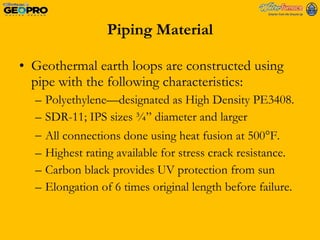
Piping Material Geothermal earth loops are constructed using pipe with the following characteristics:  Polyethylene—designated as High Density PE3408. SDR-11; IPS sizes ¾” diameter and larger All connections done using heat fusion at 500  F. Highest rating available for stress crack resistance.  Carbon black provides UV protection from sun Elongation of 6 times original length before failure.
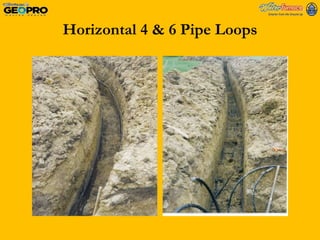
Horizontal 4 & 6 Pipe Loops
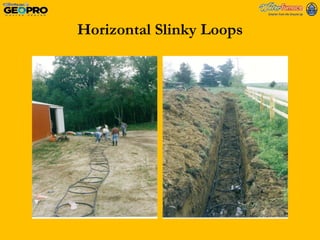
Horizontal Slinky Loops
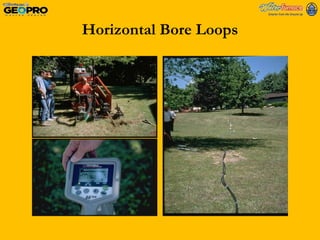
Horizontal Bore Loops
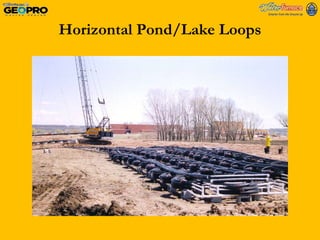
Horizontal Pond/Lake Loops
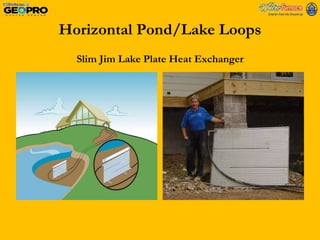
Horizontal Pond/Lake Loops Slim Jim Lake Plate Heat Exchanger
Vertical Loops
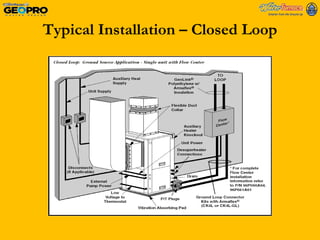
Typical Installation – Closed Loop
Closed Loop Freeze Protection In climates with moderate to dominant heating loads, anti-freeze is used for freeze protection.  Various types and concentrations of antifreezes are used.  Environol Methanol Propylene glycol
Typical Installation – Open Loop
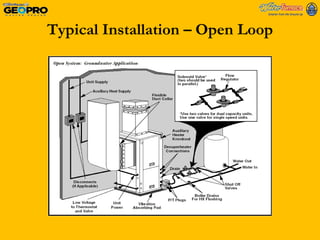
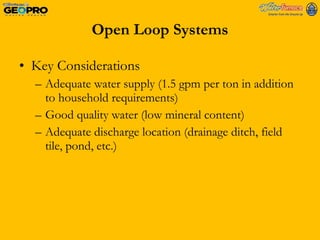
Open Loop Systems Key Considerations Adequate water supply (1.5 gpm per ton in addition to household requirements) Good quality water (low mineral content) Adequate discharge location (drainage ditch, field tile, pond, etc.)
Key Benefits of Geothermal Systems Energy savings for heating, cooling and DHW  Quiet operation No outdoor condensing unit required Less maintenance Long life Safe and clean-- No flames, fumes, flues Environmentally Friendly Decreases peak demands for electricity
Other Applications Commercial applications (offices, retail, hotels, apartments/condos, resorts) Institutional applications (schools, hospitals, nursing homes) Industrial applications (process water heating & cooling, manufacturing plants) Pools and spas Snow melt / ice melt Radiant floor heating

Geothermal 101

  • 1.
  • 2.
    Defining “Geothermal” EnergyDictionary definition Relating to the internal heat of the earth The Earth acts as a giant solar collector, absorbing approximately 50% of the energy emitted by the Sun. Air temperatures may fluctuate as much as 50  F above and below the annual average. However, only a few feet below the surface, the changes in earth temperatures are much less severe.
  • 3.
    Defining “Geothermal” Energy“ High Temperature” Geothermal Refers to heat temperatures from typically hundreds of feet deep within the earth, sometimes exceeding 300  F. These include geysers and other hydro-geothermal reservoirs. “ Low Temperature” Geothermal Refers to shallow earth temperatures found anywhere, utilizing a mechanical device (geothermal heat pump) to transfer heat to and from the ground.
  • 4.
    Laws of ThermodynamicsFirst Law Conservation of Energy (Basically, you can’t get more energy out than you put in.) Second Law Heat energy flows from an area of high heat to a area of low heat. You cannot stop this process, only speed it up or slow it down.
  • 5.
    The Basic GroundSource Heat Pump System The earth loop is placed in the ground either horizontally or vertically, or it can be placed in a pond. Water and anti-freeze is circulated through the pipe, transporting heat to the heat pump during the heating mode and away from the heat pump during the cooling mode. The heat transfer takes place inside the heat pump in a water-to-refrigerant heat exchanger.
  • 6.
    Energy Source Duringthe heating season, the earth serves as a heat source. (HE - Heat of extraction) During the cooling season, the earth serves as a heat sink. (HR - Heat of rejection)
  • 7.
    Equipment Performance RatingsGeothermal and ground water heat pumps are tested under ISO Standard 13256-1, which replaces the former standards of ARI-330 (ground loop), ARI-325 (ground water/open loop) and ARI-320 (water loop/boiler-tower).
  • 8.
    Equipment Performance RatingsARI has designated the efficiency ratings for water-to-air heat pumps as: Energy Efficiency Ratio (EER) EER = BTU output divided by power watt input For cooling operation under steady state test conditions Coefficient of Performance (COP) COP = BTU output divided by BTU input For heating operation under steady state test conditions
  • 9.
    Heat Pump OperationGeothermal heat pumps consist of four circuits: Distribution circuit The system that distributes the conditioned air or water solution throughout the home or building and returns it to the unit. Refrigerant circuit A sealed and pressurized circuit of refrigerant including compressor, expansion valve, water-to-refrigerant heat exchanger(s), air coil, reversing valve. The refrigerant is either R-22 or R-410A.
  • 10.
    Heat Pump OperationGeothermal heat pumps consist of four circuits: Ground loop circuit The piping system buried in the ground has fluid that is circulated by pumps to and from the geothermal unit. Hot water circuit Domestic water can be heated in a geothermal unit with a device called a desuperheater. A piping connection is made from the geothermal unit to the water heater.
  • 11.
    Heat Pump OperationEach of these circuits is closed and sealed from the others—there is no direct mixing. However, heat energy does transfer from the refrigeration circuit to the other three circuits. The refrigerant flow will change direction when the unit changes modes (heating or cooling).
  • 12.
    Heat Pump OperationThe Four Circuits in a Geothermal Heat Pump Distribution Circuit Earth Loop Circuit Refrigeration Circuit Hot Water Circuit = Flow of Energy (Heat)
  • 13.
  • 14.
  • 15.
    The Basic RefrigerationCycle Compressor Condenser Evaporator TXV High Pressure Vapor State High Pressure Liquid State Low Pressure Liquid State Low Pressure Vapor State
  • 16.
    The Refrigeration CycleHeating Mode Operation
  • 17.
    The Refrigeration CycleCooling Mode Operation
  • 18.
    Geothermal Loops ClosedLoops Horizontal Vertical Pond/Lake Open Loops Well water
  • 19.
    Typical Earth LoopFeatures Circuit Piping (usually ¾” or 1” IPS) Multiple Circuits (trenches or bores) Header Pit Reverse-Return Header Supply & Return Piping (usually 1-1/4” or 1-1/2” IPS) Foundation Penetration Equipment & Flow Center
  • 20.
    Piping Material Geothermalearth loops are constructed using pipe with the following characteristics: Polyethylene—designated as High Density PE3408. SDR-11; IPS sizes ¾” diameter and larger All connections done using heat fusion at 500  F. Highest rating available for stress crack resistance. Carbon black provides UV protection from sun Elongation of 6 times original length before failure.
  • 21.
    Horizontal 4 &6 Pipe Loops
  • 22.
  • 23.
  • 24.
  • 25.
    Horizontal Pond/Lake LoopsSlim Jim Lake Plate Heat Exchanger
  • 26.
  • 27.
  • 28.
    Closed Loop FreezeProtection In climates with moderate to dominant heating loads, anti-freeze is used for freeze protection. Various types and concentrations of antifreezes are used. Environol Methanol Propylene glycol
  • 29.
  • 30.
    Open Loop SystemsKey Considerations Adequate water supply (1.5 gpm per ton in addition to household requirements) Good quality water (low mineral content) Adequate discharge location (drainage ditch, field tile, pond, etc.)
  • 31.
    Key Benefits ofGeothermal Systems Energy savings for heating, cooling and DHW Quiet operation No outdoor condensing unit required Less maintenance Long life Safe and clean-- No flames, fumes, flues Environmentally Friendly Decreases peak demands for electricity
  • 32.
    Other Applications Commercialapplications (offices, retail, hotels, apartments/condos, resorts) Institutional applications (schools, hospitals, nursing homes) Industrial applications (process water heating & cooling, manufacturing plants) Pools and spas Snow melt / ice melt Radiant floor heating