Introduction of Geosynthetics
and its Characteristics
1. Definition of Geosynthetics
Geosynthetics = Geo(earth) +
synthetics
a planar product, manufactured from
polymeric material used with soil,
rock, earth, or other geotechnical
engineering related material as an
integral part of a man-made project,
structure, or system; ASTM D4354,
D4759, D4873, D5617, D5818
Geotextiles  Geosynthetics
Organizations in Geosynthetics
International Geosynthetics Society
(IGS); with many national chapters, e.g.,
(KGSS)
Geosynthetics Materials Assoc. (GMA)
ASTM & ISO Standards Organizations
Geosynthetic Institute (GSI); incl. GRI
2. History
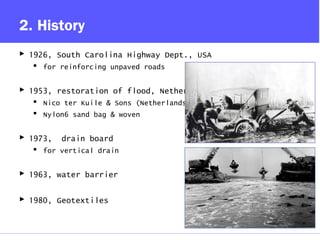
 1926, South Carolina Highway Dept., USA
 for reinforcing unpaved roads
 1953, restoration of flood, Netherlands
 Nico ter Kuile & Sons (Netherlands)
 Nylon6 sand bag & woven
 1973, drain board
 for vertical drain
 1963, water barrier
 1980, Geotextiles
3. Function of Geosyntehtics
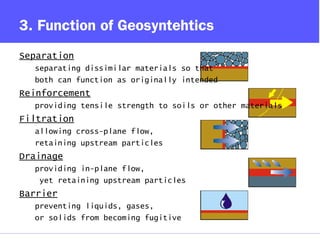
Separation
separating dissimilar materials so that
both can function as originally intended
Reinforcement
providing tensile strength to soils or other materials
Filtration
allowing cross-plane flow,
retaining upstream particles
Drainage
providing in-plane flow,
yet retaining upstream particles
Barrier
preventing liquids, gases,
or solids from becoming fugitive
Reinforcement
4. Types of Geosynthetics
 Geotextiles
 Geogrids
 Geomembranes
 Geocynthetic clay liners
 Geonets
 Geopipes
 Geotextile tubes
 Erosion Control Mats
 Geocomposite
 Geocells
 Prefabricated drain board
GEOPIPES
Drain geocomposite
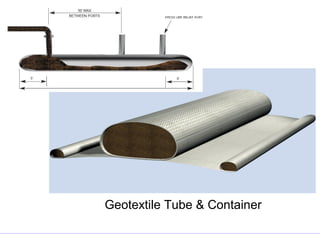
Geotextile Tube & Container
GEOCELLS
Plastic Drain Board(PDB)
5. Applications
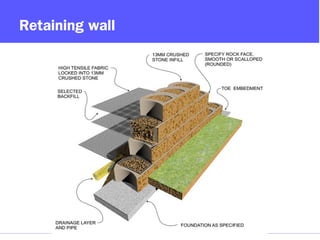
Retaining wall
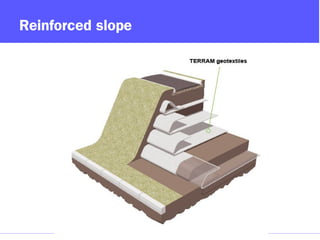
Reinforced slope
drainage geocomposite
Drainage
Vertical drain
Canals
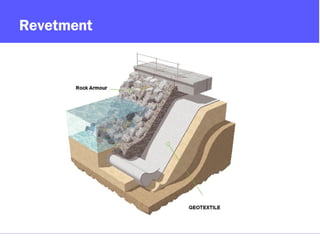
Revetment
Waste landfills

Geosynthetic 1