Clapping with One Hand? 
Sociology’s response to the National 
Strategy for Quantitative Skills 
Consultation. 
Mainstreaming 
Professor Geoff Payne Quantitative Methods 
School of Geography, Politics and Sociology Cardiff Q-Step Centre 
1st Annual Conference 
18 September 2014
High Level Strategy Group for Quantitative Skills 
Universities UK 
2
HLSG’s National Strategy to address the UK’s deficit in 
Quantitative Skills 
‘a long term plan for coordinated action’ with four priority areas (or ‘themes’) 
Making the case 
Coordination 
Building the evidence base 
Investing in the supply chain 
Specific activities to include 
• creating a consistent message which reinforces the importance of QS; 
• giving support for existing activities, not least through helping to coordinate 
them; 
• monitoring QS levels in schools and universities; 
• providing expert advice and joint interventions where appropriate; 
• identifying the ‘research and investment opportunities that will have the greatest 
impact’. 
3
Theme One: ‘Making the case’; 
maximising ‘reach and impact by developing consistent key messages 
championing the need and importance of QS to new and existing 
stakeholders’. 
For existing stakeholders 
(students, HEIs, and government) 
• ‘Agree key messages and deliver 
consistently’ 
• ‘Develop case studies and an evidence 
base on demand / employability’ 
• ‘STEM skills for no-STEM (sic) 
students’ 
For new audiences 
(employers and the wider public) 
• Messages framed for non-experts, 
aimed at raising public awareness 
• (e.g. Big Data and the importance of 
statistical literacy) 
• Identify employers with a need for QS 
engage them as advocates. 
4
a consistent message 
A collective understanding of the causes and nature of the problem, 
expressed through a shared conceptual framework and consensual 
language, and 
an agreement on what the best solutions are 
Different interest groups? 
language 
‘stakeholders’ and ‘STEM subjects’ 
‘levers’, ‘drivers’, ‘benchmarks’, ‘league tables’, ‘student satisfaction surveys’ 
rendering unto Caesar what is Caesar’s? 
5
Theme Two: ‘Coordination’ 
Share resources, expertise and best practice 
utilising 
• websites, mailing lists, workshops, outreach, forums, materials, and 
publications; 
Facilitate engagement between key sectors to establish support 
networks; 
Influence the development of policy and practice relating to statistics 
in education by: 
• engaging and lobbying BIS and DfE; 
• developing a manifesto; and 
• responding to policy consultations 
6
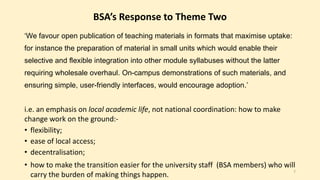
BSA’s Response to Theme Two 
‘We favour open publication of teaching materials in formats that maximise uptake: 
for instance the preparation of material in small units which would enable their 
selective and flexible integration into other module syllabuses without the latter 
requiring wholesale overhaul. On-campus demonstrations of such materials, and 
ensuring simple, user-friendly interfaces, would encourage adoption.’ 
i.e. an emphasis on local academic life, not national coordination: how to make 
change work on the ground:- 
• flexibility; 
• ease of local access; 
• decentralisation; 
• how to make the transition easier for the university staff (BSA members) who will 
carry the burden of making things happen. 7
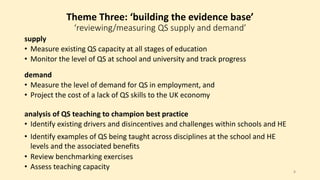
Theme Three: ‘building the evidence base’ 
‘reviewing/measuring QS supply and demand’ 
supply 
• Measure existing QS capacity at all stages of education 
• Monitor the level of QS at school and university and track progress 
demand 
• Measure the level of demand for QS in employment, and 
• Project the cost of a lack of QS skills to the UK economy 
analysis of QS teaching to champion best practice 
• Identify existing drivers and disincentives and challenges within schools and HE 
• Identify examples of QS being taught across disciplines at the school and HE 
levels and the associated benefits 
• Review benchmarking exercises 
• Assess teaching capacity 
8
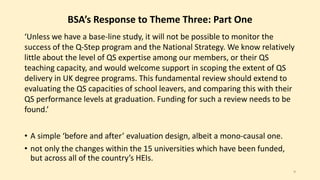
BSA’s Response to Theme Three: Part One 
‘Unless we have a base-line study, it will not be possible to monitor the 
success of the Q-Step program and the National Strategy. We know relatively 
little about the level of QS expertise among our members, or their QS 
teaching capacity, and would welcome support in scoping the extent of QS 
delivery in UK degree programs. This fundamental review should extend to 
evaluating the QS capacities of school leavers, and comparing this with their 
QS performance levels at graduation. Funding for such a review needs to be 
found.’ 
• A simple ‘before and after’ evaluation design, albeit a mono-causal one. 
• not only the changes within the 15 universities which have been funded, 
but across all of the country’s HEIs. 
9
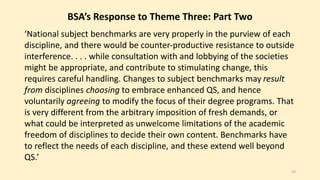
BSA’s Response to Theme Three: Part Two 
‘National subject benchmarks are very properly in the purview of each 
discipline, and there would be counter-productive resistance to outside 
interference. . . . while consultation with and lobbying of the societies 
might be appropriate, and contribute to stimulating change, this 
requires careful handling. Changes to subject benchmarks may result 
from disciplines choosing to embrace enhanced QS, and hence 
voluntarily agreeing to modify the focus of their degree programs. That 
is very different from the arbitrary imposition of fresh demands, or 
what could be interpreted as unwelcome limitations of the academic 
freedom of disciplines to decide their own content. Benchmarks have 
to reflect the needs of each discipline, and these extend well beyond 
QS.’ 
10
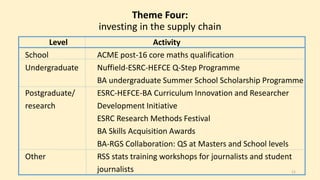
Theme Four: 
investing in the supply chain 
Level Activity 
School ACME post-16 core maths qualification 
Undergraduate Nuffield-ESRC-HEFCE Q-Step Programme 
BA undergraduate Summer School Scholarship Programme 
Postgraduate/ ESRC-HEFCE-BA Curriculum Innovation and Researcher 
research Development Initiative 
ESRC Research Methods Festival 
BA Skills Acquisition Awards 
BA-RGS Collaboration: QS at Masters and School levels 
Other RSS stats training workshops for journalists and student 
journalists 11
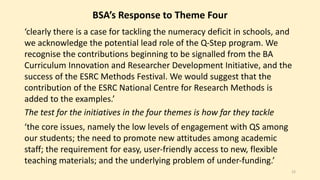
BSA’s Response to Theme Four 
‘clearly there is a case for tackling the numeracy deficit in schools, and 
we acknowledge the potential lead role of the Q-Step program. We 
recognise the contributions beginning to be signalled from the BA 
Curriculum Innovation and Researcher Development Initiative, and the 
success of the ESRC Methods Festival. We would suggest that the 
contribution of the ESRC National Centre for Research Methods is 
added to the examples.’ 
The test for the initiatives in the four themes is how far they tackle 
‘the core issues, namely the low levels of engagement with QS among 
our students; the need to promote new attitudes among academic 
staff; the requirement for easy, user-friendly access to new, flexible 
teaching materials; and the underlying problem of under-funding.’ 
12
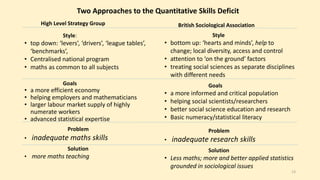
Two Approaches to the Quantitative Skills Deficit 
High Level Strategy Group 
Style: 
• top down: ‘levers’, ‘drivers’, ‘league tables’, 
‘benchmarks’, 
• Centralised national program 
• maths as common to all subjects 
Goals 
• a more efficient economy 
• helping employers and mathematicians 
• larger labour market supply of highly 
numerate workers 
• advanced statistical expertise 
Problem 
• inadequate maths skills 
Solution 
• more maths teaching 
British Sociological Association 
Style 
• bottom up: ‘hearts and minds’, help to 
change; local diversity, access and control 
• attention to ‘on the ground’ factors 
• treating social sciences as separate disciplines 
with different needs 
Goals 
• a more informed and critical population 
• helping social scientists/researchers 
• better social science education and research 
• Basic numeracy/statistical literacy 
Problem 
• inadequate research skills 
Solution 
• Less maths; more and better applied statistics 
grounded in sociological issues 
13
Alternative Baseline questions 
• Why do we need to produce a more numerate population? 
• How are school and university students actually going to use their 
enhanced QS in their later lives? 
• What range of QS expertise is needed for different groups in society? 
• What is the precise content of ‘QS’? 
• Are QS the same as mathematical literacy? 
• Where, and how, in the educational system are QS to be taught? 
• Which QS skills do social science undergraduates and postgraduates 
need? 
14
What QS do social science students require? 
‘QM is more about the logic of evidence handling than fancy 
maths. However, students still need to be comfortable enough 
with the numbers to keep their focus on what it is that they 
are doing with them and why, not the machinery of the 
calculations. There are some basics that students do need a 
firm grasp of, but they are all in GCSE Maths: fractions, 
decimals; rules of addition, subtraction, division and 
multiplication; powers and the concept of an equation. That’s 
it.’ (MacInnes 2014, 3-4) 
15
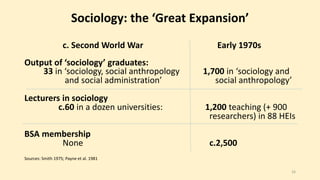
Sociology: the ‘Great Expansion’ 
c. Second World War Early 1970s 
Output of ‘sociology’ graduates: 
33 in ‘sociology, social anthropology 1,700 in ‘sociology and 
and social administration’ social anthropology’ 
Lecturers in sociology 
c.60 in a dozen universities: 1,200 teaching (+ 900 
researchers) in 88 HEIs 
BSA membership 
None c.2,500 
Sources: Smith 1975; Payne et al. 1981 
16
Other reasons QS was devalued in Sociology 
• subject specialization in English Sixth Forms: no number work after age of 
16 
• emphasis on non-empirical ‘grand theories’ of society and human life 
• interest in topics which lent themselves to ‘qualitative’ methods of data 
collection and interpretation 
• convenience and cheapness of small-scale projects compared to large-scale 
surveys 
• absence of formal research training for postgraduates 
• expansion of sociology in HEIs funded as a cheap Humanities ‘reading’ 
subject, not a lab-based subject 
• attachment to ‘new’ methodologies by young sociologists seeking to 
legitimize their place in the profession 
• employability of sociology graduates in an expanding service sector, due 
to other, non-quantitative skills like communication and critical thinking. 
17
Why has the failure to include QS been tolerated 
for so long? 
‘These reasons must go beyond the pedagogical, technical or 
intellectual challenges of teaching statistics. They must also account for 
why, for most university social science faculty, teaching statistics has 
not been any kind of priority. They must account for why, for most 
students, this has not only been no disappointment, but rather a 
source of relief. And they must account for why those who employ 
social science graduates have been content to recruit those with few 
quantitative skills.’ (MacInnes 2014, 1) 
18

Cardiff Q-Step Inaugural Event – Thursday 18th September 2014 Geoff.Payne

  • 1.
    Clapping with OneHand? Sociology’s response to the National Strategy for Quantitative Skills Consultation. Mainstreaming Professor Geoff Payne Quantitative Methods School of Geography, Politics and Sociology Cardiff Q-Step Centre 1st Annual Conference 18 September 2014
  • 2.
    High Level StrategyGroup for Quantitative Skills Universities UK 2
  • 3.
    HLSG’s National Strategyto address the UK’s deficit in Quantitative Skills ‘a long term plan for coordinated action’ with four priority areas (or ‘themes’) Making the case Coordination Building the evidence base Investing in the supply chain Specific activities to include • creating a consistent message which reinforces the importance of QS; • giving support for existing activities, not least through helping to coordinate them; • monitoring QS levels in schools and universities; • providing expert advice and joint interventions where appropriate; • identifying the ‘research and investment opportunities that will have the greatest impact’. 3
  • 4.
    Theme One: ‘Makingthe case’; maximising ‘reach and impact by developing consistent key messages championing the need and importance of QS to new and existing stakeholders’. For existing stakeholders (students, HEIs, and government) • ‘Agree key messages and deliver consistently’ • ‘Develop case studies and an evidence base on demand / employability’ • ‘STEM skills for no-STEM (sic) students’ For new audiences (employers and the wider public) • Messages framed for non-experts, aimed at raising public awareness • (e.g. Big Data and the importance of statistical literacy) • Identify employers with a need for QS engage them as advocates. 4
  • 5.
    a consistent message A collective understanding of the causes and nature of the problem, expressed through a shared conceptual framework and consensual language, and an agreement on what the best solutions are Different interest groups? language ‘stakeholders’ and ‘STEM subjects’ ‘levers’, ‘drivers’, ‘benchmarks’, ‘league tables’, ‘student satisfaction surveys’ rendering unto Caesar what is Caesar’s? 5
  • 6.
    Theme Two: ‘Coordination’ Share resources, expertise and best practice utilising • websites, mailing lists, workshops, outreach, forums, materials, and publications; Facilitate engagement between key sectors to establish support networks; Influence the development of policy and practice relating to statistics in education by: • engaging and lobbying BIS and DfE; • developing a manifesto; and • responding to policy consultations 6
  • 7.
    BSA’s Response toTheme Two ‘We favour open publication of teaching materials in formats that maximise uptake: for instance the preparation of material in small units which would enable their selective and flexible integration into other module syllabuses without the latter requiring wholesale overhaul. On-campus demonstrations of such materials, and ensuring simple, user-friendly interfaces, would encourage adoption.’ i.e. an emphasis on local academic life, not national coordination: how to make change work on the ground:- • flexibility; • ease of local access; • decentralisation; • how to make the transition easier for the university staff (BSA members) who will carry the burden of making things happen. 7
  • 8.
    Theme Three: ‘buildingthe evidence base’ ‘reviewing/measuring QS supply and demand’ supply • Measure existing QS capacity at all stages of education • Monitor the level of QS at school and university and track progress demand • Measure the level of demand for QS in employment, and • Project the cost of a lack of QS skills to the UK economy analysis of QS teaching to champion best practice • Identify existing drivers and disincentives and challenges within schools and HE • Identify examples of QS being taught across disciplines at the school and HE levels and the associated benefits • Review benchmarking exercises • Assess teaching capacity 8
  • 9.
    BSA’s Response toTheme Three: Part One ‘Unless we have a base-line study, it will not be possible to monitor the success of the Q-Step program and the National Strategy. We know relatively little about the level of QS expertise among our members, or their QS teaching capacity, and would welcome support in scoping the extent of QS delivery in UK degree programs. This fundamental review should extend to evaluating the QS capacities of school leavers, and comparing this with their QS performance levels at graduation. Funding for such a review needs to be found.’ • A simple ‘before and after’ evaluation design, albeit a mono-causal one. • not only the changes within the 15 universities which have been funded, but across all of the country’s HEIs. 9
  • 10.
    BSA’s Response toTheme Three: Part Two ‘National subject benchmarks are very properly in the purview of each discipline, and there would be counter-productive resistance to outside interference. . . . while consultation with and lobbying of the societies might be appropriate, and contribute to stimulating change, this requires careful handling. Changes to subject benchmarks may result from disciplines choosing to embrace enhanced QS, and hence voluntarily agreeing to modify the focus of their degree programs. That is very different from the arbitrary imposition of fresh demands, or what could be interpreted as unwelcome limitations of the academic freedom of disciplines to decide their own content. Benchmarks have to reflect the needs of each discipline, and these extend well beyond QS.’ 10
  • 11.
    Theme Four: investingin the supply chain Level Activity School ACME post-16 core maths qualification Undergraduate Nuffield-ESRC-HEFCE Q-Step Programme BA undergraduate Summer School Scholarship Programme Postgraduate/ ESRC-HEFCE-BA Curriculum Innovation and Researcher research Development Initiative ESRC Research Methods Festival BA Skills Acquisition Awards BA-RGS Collaboration: QS at Masters and School levels Other RSS stats training workshops for journalists and student journalists 11
  • 12.
    BSA’s Response toTheme Four ‘clearly there is a case for tackling the numeracy deficit in schools, and we acknowledge the potential lead role of the Q-Step program. We recognise the contributions beginning to be signalled from the BA Curriculum Innovation and Researcher Development Initiative, and the success of the ESRC Methods Festival. We would suggest that the contribution of the ESRC National Centre for Research Methods is added to the examples.’ The test for the initiatives in the four themes is how far they tackle ‘the core issues, namely the low levels of engagement with QS among our students; the need to promote new attitudes among academic staff; the requirement for easy, user-friendly access to new, flexible teaching materials; and the underlying problem of under-funding.’ 12
  • 13.
    Two Approaches tothe Quantitative Skills Deficit High Level Strategy Group Style: • top down: ‘levers’, ‘drivers’, ‘league tables’, ‘benchmarks’, • Centralised national program • maths as common to all subjects Goals • a more efficient economy • helping employers and mathematicians • larger labour market supply of highly numerate workers • advanced statistical expertise Problem • inadequate maths skills Solution • more maths teaching British Sociological Association Style • bottom up: ‘hearts and minds’, help to change; local diversity, access and control • attention to ‘on the ground’ factors • treating social sciences as separate disciplines with different needs Goals • a more informed and critical population • helping social scientists/researchers • better social science education and research • Basic numeracy/statistical literacy Problem • inadequate research skills Solution • Less maths; more and better applied statistics grounded in sociological issues 13
  • 14.
    Alternative Baseline questions • Why do we need to produce a more numerate population? • How are school and university students actually going to use their enhanced QS in their later lives? • What range of QS expertise is needed for different groups in society? • What is the precise content of ‘QS’? • Are QS the same as mathematical literacy? • Where, and how, in the educational system are QS to be taught? • Which QS skills do social science undergraduates and postgraduates need? 14
  • 15.
    What QS dosocial science students require? ‘QM is more about the logic of evidence handling than fancy maths. However, students still need to be comfortable enough with the numbers to keep their focus on what it is that they are doing with them and why, not the machinery of the calculations. There are some basics that students do need a firm grasp of, but they are all in GCSE Maths: fractions, decimals; rules of addition, subtraction, division and multiplication; powers and the concept of an equation. That’s it.’ (MacInnes 2014, 3-4) 15
  • 16.
    Sociology: the ‘GreatExpansion’ c. Second World War Early 1970s Output of ‘sociology’ graduates: 33 in ‘sociology, social anthropology 1,700 in ‘sociology and and social administration’ social anthropology’ Lecturers in sociology c.60 in a dozen universities: 1,200 teaching (+ 900 researchers) in 88 HEIs BSA membership None c.2,500 Sources: Smith 1975; Payne et al. 1981 16
  • 17.
    Other reasons QSwas devalued in Sociology • subject specialization in English Sixth Forms: no number work after age of 16 • emphasis on non-empirical ‘grand theories’ of society and human life • interest in topics which lent themselves to ‘qualitative’ methods of data collection and interpretation • convenience and cheapness of small-scale projects compared to large-scale surveys • absence of formal research training for postgraduates • expansion of sociology in HEIs funded as a cheap Humanities ‘reading’ subject, not a lab-based subject • attachment to ‘new’ methodologies by young sociologists seeking to legitimize their place in the profession • employability of sociology graduates in an expanding service sector, due to other, non-quantitative skills like communication and critical thinking. 17
  • 18.
    Why has thefailure to include QS been tolerated for so long? ‘These reasons must go beyond the pedagogical, technical or intellectual challenges of teaching statistics. They must also account for why, for most university social science faculty, teaching statistics has not been any kind of priority. They must account for why, for most students, this has not only been no disappointment, but rather a source of relief. And they must account for why those who employ social science graduates have been content to recruit those with few quantitative skills.’ (MacInnes 2014, 1) 18