By Paul Stanford
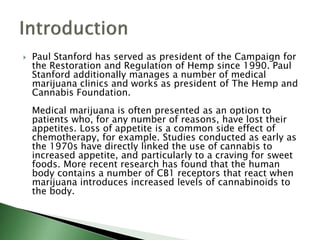
 Paul Stanford has served as president of the Campaign for
the Restoration and Regulation of Hemp since 1990. Paul
Stanford additionally manages a number of medical
marijuana clinics and works as president of The Hemp and
Cannabis Foundation.
Medical marijuana is often presented as an option to
patients who, for any number of reasons, have lost their
appetites. Loss of appetite is a common side effect of
chemotherapy, for example. Studies conducted as early as
the 1970s have directly linked the use of cannabis to
increased appetite, and particularly to a craving for sweet
foods. More recent research has found that the human
body contains a number of CB1 receptors that react when
marijuana introduces increased levels of cannabinoids to
the body.
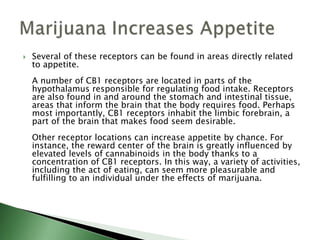
 Several of these receptors can be found in areas directly related
to appetite.
A number of CB1 receptors are located in parts of the
hypothalamus responsible for regulating food intake. Receptors
are also found in and around the stomach and intestinal tissue,
areas that inform the brain that the body requires food. Perhaps
most importantly, CB1 receptors inhabit the limbic forebrain, a
part of the brain that makes food seem desirable.
Other receptor locations can increase appetite by chance. For
instance, the reward center of the brain is greatly influenced by
elevated levels of cannabinoids in the body thanks to a
concentration of CB1 receptors. In this way, a variety of activities,
including the act of eating, can seem more pleasurable and
fulfilling to an individual under the effects of marijuana.

How Marijuana Increases Appetite

  • 1.
  • 2.
     Paul Stanfordhas served as president of the Campaign for the Restoration and Regulation of Hemp since 1990. Paul Stanford additionally manages a number of medical marijuana clinics and works as president of The Hemp and Cannabis Foundation. Medical marijuana is often presented as an option to patients who, for any number of reasons, have lost their appetites. Loss of appetite is a common side effect of chemotherapy, for example. Studies conducted as early as the 1970s have directly linked the use of cannabis to increased appetite, and particularly to a craving for sweet foods. More recent research has found that the human body contains a number of CB1 receptors that react when marijuana introduces increased levels of cannabinoids to the body.
  • 3.
     Several ofthese receptors can be found in areas directly related to appetite. A number of CB1 receptors are located in parts of the hypothalamus responsible for regulating food intake. Receptors are also found in and around the stomach and intestinal tissue, areas that inform the brain that the body requires food. Perhaps most importantly, CB1 receptors inhabit the limbic forebrain, a part of the brain that makes food seem desirable. Other receptor locations can increase appetite by chance. For instance, the reward center of the brain is greatly influenced by elevated levels of cannabinoids in the body thanks to a concentration of CB1 receptors. In this way, a variety of activities, including the act of eating, can seem more pleasurable and fulfilling to an individual under the effects of marijuana.