Developing more “universal”
methods in a core facility using
Suspension trapping and Peptide
Centric DIA (+ deep Learning)
UC DAVIS GENOME CENTER
PROTEOMICS CORE
PROTEOMICS.UCDAVIS.EDU
GENOME WEB 2019
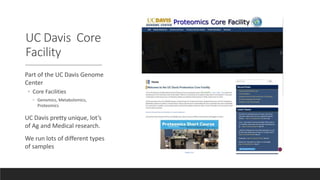
UC Davis Core
Facility
Part of the UC Davis Genome
Center
◦ Core Facilities
◦ Genomics, Metabolomics,
Proteomics
UC Davis pretty unique, lot’s
of Ag and Medical research.
We run lots of different types
of samples
•Human Hair & Skin &
Fingermarks & 11K year old
human teeth!
•Grape Sap
•Lettuce
•Yeast
•Fish livers
•Walnut Bark and Pellicle
(walnut skin)
•Tardigrades
•Horse Lung Lavage (Horse
Snot)
•Dog tissue
•Sea Otter hearts (diseased
cardiomyopathy, very fibrotic)
•Brain inclusion bodies
•Bovine uterine fluid
•Isolated HDL particles from
serum
•Wheat
•Human Milk
•Cow Milk
Species/Tissue
analyzed in our
Core Facility in
the last year
•BioID
•AP-MS
•Proteomic Profiling
• TMT
• DIA
•PTM’s
• Phospho
• Ubiq
• Glyco-peptides
• SILAC (I hate these)
Types of the
samples
analyzed
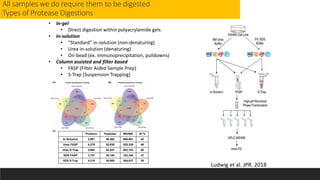
All samples we do require them to be digested
Types of Protease Digestions
• In-gel
• Direct digestion within polyacrylamide gels
• In-solution
• “Standard” in-solution (non-denaturing)
• Urea in-solution (denaturing)
• On-bead (ex. immunoprecipitation, pulldowns)
• Column assisted and filter based
• FASP (Filter Aided Sample Prep)
• S-Trap (Suspension Trapping)
Ludwig et al. JPR. 2018
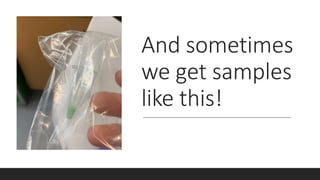
And sometimes
we get samples
like this!
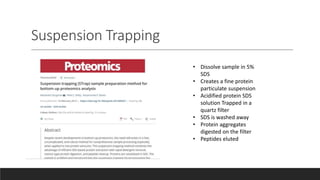
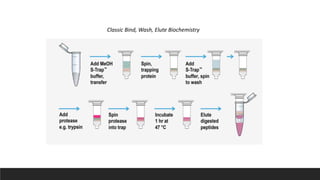
Suspension Trapping
• Dissolve sample in 5%
SDS
• Creates a fine protein
particulate suspension
• Acidified protein SDS
solution Trapped in a
quartz filter
• SDS is washed away
• Protein aggregates
digested on the filter
• Peptides eluted
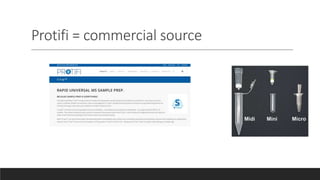
Protifi = commercial source
Classic Bind, Wash, Elute Biochemistry
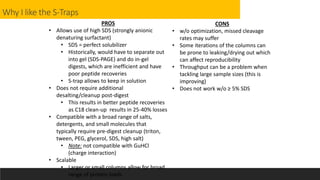
Why I like the S-Traps
PROS
• Allows use of high SDS (strongly anionic
denaturing surfactant)
• SDS = perfect solubilizer
• Historically, would have to separate out
into gel (SDS-PAGE) and do in-gel
digests, which are inefficient and have
poor peptide recoveries
• S-trap allows to keep in solution
• Does not require additional
desalting/cleanup post-digest
• This results in better peptide recoveries
as C18 clean-up results in 25-40% losses
• Compatible with a broad range of salts,
detergents, and small molecules that
typically require pre-digest cleanup (triton,
tween, PEG, glycerol, SDS, high salt)
• Note: not compatible with GuHCl
(charge interaction)
• Scalable
• Larger or small columns allow for broad
range of protein loads
CONS
• w/o optimization, missed cleavage
rates may suffer
• Some iterations of the columns can
be prone to leaking/drying out which
can affect reproducibility
• Throughput can be a problem when
tackling large sample sizes (this is
improving)
• Does not work w/o ≥ 5% SDS
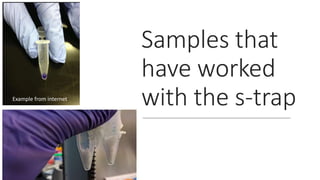
Samples that
have worked
with the s-trapExample from internet
Proteomic Profiling
Almost everything is quantitative now!
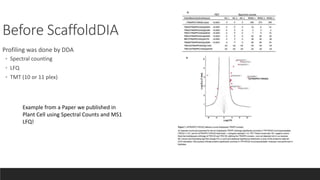
Before ScaffoldDIA
Profiling was done by DDA
◦ Spectral counting
◦ LFQ
◦ TMT (10 or 11 plex)
Example from a Paper we published in
Plant Cell using Spectral Counts and MS1
LFQ!
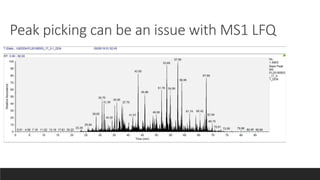
Peak picking can be an issue with MS1 LFQ
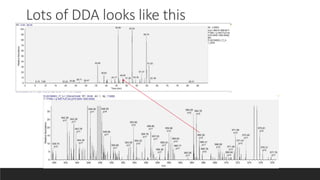
Lots of DDA looks like this
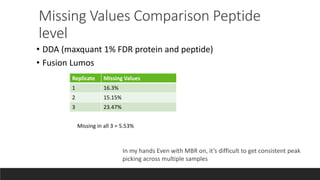
Missing Values Comparison Peptide
level
In my hands Even with MBR on, it’s difficult to get consistent peak
picking across multiple samples
• DDA (maxquant 1% FDR protein and peptide)
• Fusion Lumos
Replicate Missing Values
1 16.3%
2 15.15%
3 23.47%
Missing in all 3 = 5.53%
Peptide
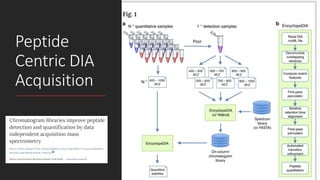
Centric DIA
Acquisition
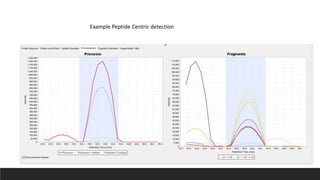
Random peptide KSDGIYIINLK ScaffoldDIAExample Peptide Centric detection
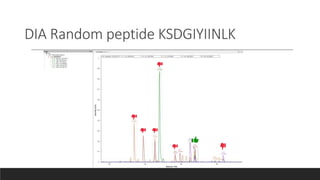
DIA Random peptide KSDGIYIINLK
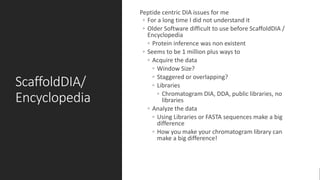
ScaffoldDIA/
Encyclopedia
Peptide centric DIA issues for me
◦ For a long time I did not understand it
◦ Older Software difficult to use before ScaffoldDIA /
Encyclopedia
◦ Protein inference was non existent
◦ Seems to be 1 million plus ways to
◦ Acquire the data
◦ Window Size?
◦ Staggered or overlapping?
◦ Libraries
◦ Chromatogram DIA, DDA, public libraries, no
libraries
◦ Analyze the data
◦ Using Libraries or FASTA sequences make a big
difference
◦ How you make your chromatogram library can
make a big difference!
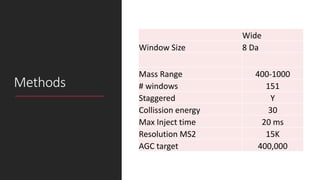
Methods
Wide
Window Size 8 Da
Mass Range 400-1000
# windows 151
Staggered Y
Collission energy 30
Max Inject time 20 ms
Resolution MS2 15K
AGC target 400,000
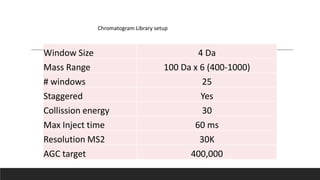
Chromatogram Library
Window Size 4 Da
Mass Range 100 Da x 6 (400-1000)
# windows 25
Staggered Yes
Collission energy 30
Max Inject time 60 ms
Resolution MS2 30K
AGC target 400,000
Chromatogram Library setup
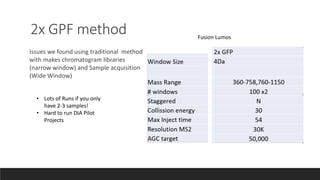
2x GPF method
Issues we found using traditional method
with makes chromatogram libraries
(narrow window) and Sample acquisition
(Wide Window)
• Lots of Runs if you only
have 2-3 samples!
• Hard to run DIA Pilot
Projects
Fusion Lumos
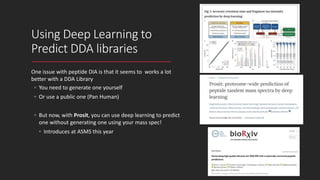
Using Deep Learning to
Predict DDA libraries
One issue with peptide DIA is that it seems to works a lot
better with a DDA Library
◦ You need to generate one yourself
◦ Or use a public one (Pan Human)
◦ But now, with Prosit, you can use deep learning to predict
one without generating one using your mass spec!
◦ Introduces at ASMS this year
Example
Human
Experiment
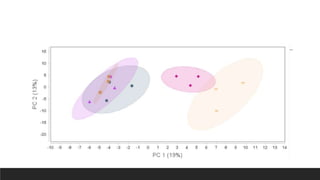
Human profiling experiment
◦ Several proteins knocked down in a few
conditions
◦ 5 Conditions
◦ 3 biological replicates per condition
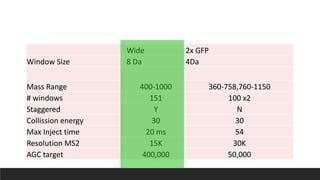
Methods
Wide 2x GFP
Window Size 8 Da 4Da
Mass Range 400-1000 360-758,760-1150
# windows 151 100 x2
Staggered Y N
Collission energy 30 30
Max Inject time 20 ms 54
Resolution MS2 15K 30K
AGC target 400,000 50,000
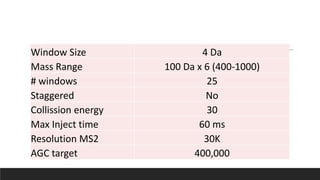
Chromatogram Library
Window Size 4 Da
Mass Range 100 Da x 6 (400-1000)
# windows 25
Staggered No
Collission energy 30
Max Inject time 60 ms
Resolution MS2 30K
AGC target 400,000
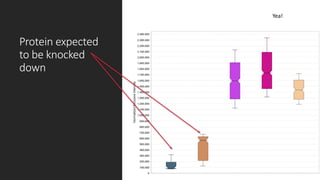
Experiment seemed to work!
Protein expected
to be knocked
down
Yea!
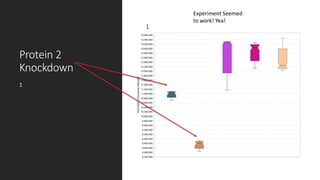
Protein 2
Knockdown
1
1
Experiment Seemed
to work! Yea!
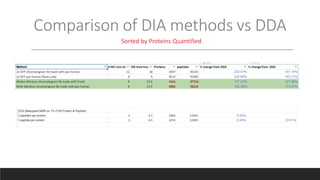
Comparison of DIA methods vs DDA
Sorted by Proteins Quantified
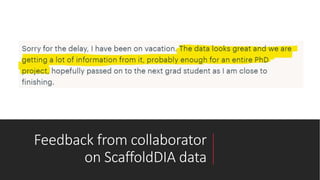
Feedback from collaborator
on ScaffoldDIA data
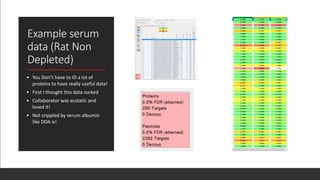
Example serum
data (Rat Non
Depleted)
• You Don’t have to ID a lot of
proteins to have really useful data!
• First I thought this data sucked
• Collaborator was ecstatic and
loved it!
• Not crippled by serum albumin
like DDA is!
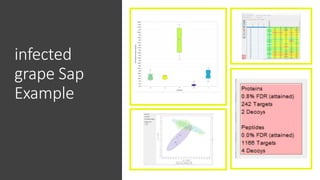
infected
grape Sap
Example
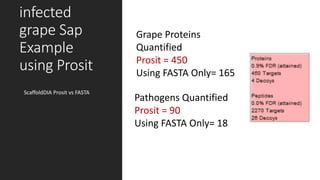
infected
grape Sap
Example
using Prosit
ScaffoldDIA Prosit vs FASTA
Pathogens Quantified
Prosit = 90
Using FASTA Only= 18
Grape Proteins
Quantified
Prosit = 450
Using FASTA Only= 165
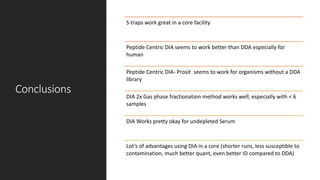
Conclusions
S-traps work great in a core facility
Peptide Centric DIA seems to work better than DDA especially for
human
Peptide Centric DIA- Prosit seems to work for organisms without a DDA
library
DIA 2x Gas phase fractionation method works well, especially with < 6
samples
DIA Works pretty okay for undepleted Serum
Lot’s of advantages using DIA in a core (shorter runs, less susceptible to
contamination, much better quant, even better ID compared to DDA)
Acknowledgements
UC Davis Proteomics Core
◦ Michelle Salemi
◦ Tony Herren
◦ Gabriela Grigorean
◦ Justin Hocke
◦ Danielle Asiain
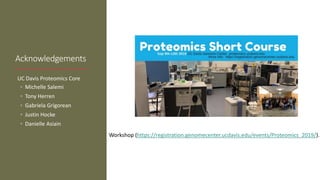
Workshop (https://registration.genomecenter.ucdavis.edu/events/Proteomics_2019/).

Genome web july 2019 presentation phinney

  • 1.
    Developing more “universal” methodsin a core facility using Suspension trapping and Peptide Centric DIA (+ deep Learning) UC DAVIS GENOME CENTER PROTEOMICS CORE PROTEOMICS.UCDAVIS.EDU GENOME WEB 2019
  • 2.
    UC Davis Core Facility Partof the UC Davis Genome Center ◦ Core Facilities ◦ Genomics, Metabolomics, Proteomics UC Davis pretty unique, lot’s of Ag and Medical research. We run lots of different types of samples
  • 3.
    •Human Hair &Skin & Fingermarks & 11K year old human teeth! •Grape Sap •Lettuce •Yeast •Fish livers •Walnut Bark and Pellicle (walnut skin) •Tardigrades •Horse Lung Lavage (Horse Snot) •Dog tissue •Sea Otter hearts (diseased cardiomyopathy, very fibrotic) •Brain inclusion bodies •Bovine uterine fluid •Isolated HDL particles from serum •Wheat •Human Milk •Cow Milk Species/Tissue analyzed in our Core Facility in the last year
  • 4.
    •BioID •AP-MS •Proteomic Profiling • TMT •DIA •PTM’s • Phospho • Ubiq • Glyco-peptides • SILAC (I hate these) Types of the samples analyzed
  • 5.
    All samples wedo require them to be digested Types of Protease Digestions • In-gel • Direct digestion within polyacrylamide gels • In-solution • “Standard” in-solution (non-denaturing) • Urea in-solution (denaturing) • On-bead (ex. immunoprecipitation, pulldowns) • Column assisted and filter based • FASP (Filter Aided Sample Prep) • S-Trap (Suspension Trapping) Ludwig et al. JPR. 2018
  • 6.
    And sometimes we getsamples like this!
  • 7.
    Suspension Trapping • Dissolvesample in 5% SDS • Creates a fine protein particulate suspension • Acidified protein SDS solution Trapped in a quartz filter • SDS is washed away • Protein aggregates digested on the filter • Peptides eluted
  • 8.
  • 9.
    Classic Bind, Wash,Elute Biochemistry
  • 10.
    Why I likethe S-Traps PROS • Allows use of high SDS (strongly anionic denaturing surfactant) • SDS = perfect solubilizer • Historically, would have to separate out into gel (SDS-PAGE) and do in-gel digests, which are inefficient and have poor peptide recoveries • S-trap allows to keep in solution • Does not require additional desalting/cleanup post-digest • This results in better peptide recoveries as C18 clean-up results in 25-40% losses • Compatible with a broad range of salts, detergents, and small molecules that typically require pre-digest cleanup (triton, tween, PEG, glycerol, SDS, high salt) • Note: not compatible with GuHCl (charge interaction) • Scalable • Larger or small columns allow for broad range of protein loads CONS • w/o optimization, missed cleavage rates may suffer • Some iterations of the columns can be prone to leaking/drying out which can affect reproducibility • Throughput can be a problem when tackling large sample sizes (this is improving) • Does not work w/o ≥ 5% SDS
  • 11.
    Samples that have worked withthe s-trapExample from internet
  • 12.
  • 13.
    Before ScaffoldDIA Profiling wasdone by DDA ◦ Spectral counting ◦ LFQ ◦ TMT (10 or 11 plex) Example from a Paper we published in Plant Cell using Spectral Counts and MS1 LFQ!
  • 14.
    Peak picking canbe an issue with MS1 LFQ
  • 15.
    Lots of DDAlooks like this
  • 16.
    Missing Values ComparisonPeptide level In my hands Even with MBR on, it’s difficult to get consistent peak picking across multiple samples • DDA (maxquant 1% FDR protein and peptide) • Fusion Lumos Replicate Missing Values 1 16.3% 2 15.15% 3 23.47% Missing in all 3 = 5.53%
  • 17.
  • 18.
    Random peptide KSDGIYIINLKScaffoldDIAExample Peptide Centric detection
  • 19.
    DIA Random peptideKSDGIYIINLK
  • 20.
    ScaffoldDIA/ Encyclopedia Peptide centric DIAissues for me ◦ For a long time I did not understand it ◦ Older Software difficult to use before ScaffoldDIA / Encyclopedia ◦ Protein inference was non existent ◦ Seems to be 1 million plus ways to ◦ Acquire the data ◦ Window Size? ◦ Staggered or overlapping? ◦ Libraries ◦ Chromatogram DIA, DDA, public libraries, no libraries ◦ Analyze the data ◦ Using Libraries or FASTA sequences make a big difference ◦ How you make your chromatogram library can make a big difference!
  • 21.
    Methods Wide Window Size 8Da Mass Range 400-1000 # windows 151 Staggered Y Collission energy 30 Max Inject time 20 ms Resolution MS2 15K AGC target 400,000
  • 22.
    Chromatogram Library Window Size4 Da Mass Range 100 Da x 6 (400-1000) # windows 25 Staggered Yes Collission energy 30 Max Inject time 60 ms Resolution MS2 30K AGC target 400,000 Chromatogram Library setup
  • 23.
    2x GPF method Issueswe found using traditional method with makes chromatogram libraries (narrow window) and Sample acquisition (Wide Window) • Lots of Runs if you only have 2-3 samples! • Hard to run DIA Pilot Projects Fusion Lumos
  • 24.
    Using Deep Learningto Predict DDA libraries One issue with peptide DIA is that it seems to works a lot better with a DDA Library ◦ You need to generate one yourself ◦ Or use a public one (Pan Human) ◦ But now, with Prosit, you can use deep learning to predict one without generating one using your mass spec! ◦ Introduces at ASMS this year
  • 25.
    Example Human Experiment Human profiling experiment ◦Several proteins knocked down in a few conditions ◦ 5 Conditions ◦ 3 biological replicates per condition
  • 26.
    Methods Wide 2x GFP WindowSize 8 Da 4Da Mass Range 400-1000 360-758,760-1150 # windows 151 100 x2 Staggered Y N Collission energy 30 30 Max Inject time 20 ms 54 Resolution MS2 15K 30K AGC target 400,000 50,000
  • 27.
    Chromatogram Library Window Size4 Da Mass Range 100 Da x 6 (400-1000) # windows 25 Staggered No Collission energy 30 Max Inject time 60 ms Resolution MS2 30K AGC target 400,000
  • 28.
  • 29.
    Protein expected to beknocked down Yea!
  • 30.
  • 31.
    Comparison of DIAmethods vs DDA Sorted by Proteins Quantified
  • 32.
  • 33.
    Example serum data (RatNon Depleted) • You Don’t have to ID a lot of proteins to have really useful data! • First I thought this data sucked • Collaborator was ecstatic and loved it! • Not crippled by serum albumin like DDA is!
  • 34.
  • 35.
    infected grape Sap Example using Prosit ScaffoldDIAProsit vs FASTA Pathogens Quantified Prosit = 90 Using FASTA Only= 18 Grape Proteins Quantified Prosit = 450 Using FASTA Only= 165
  • 36.
    Conclusions S-traps work greatin a core facility Peptide Centric DIA seems to work better than DDA especially for human Peptide Centric DIA- Prosit seems to work for organisms without a DDA library DIA 2x Gas phase fractionation method works well, especially with < 6 samples DIA Works pretty okay for undepleted Serum Lot’s of advantages using DIA in a core (shorter runs, less susceptible to contamination, much better quant, even better ID compared to DDA)
  • 37.
    Acknowledgements UC Davis ProteomicsCore ◦ Michelle Salemi ◦ Tony Herren ◦ Gabriela Grigorean ◦ Justin Hocke ◦ Danielle Asiain Workshop (https://registration.genomecenter.ucdavis.edu/events/Proteomics_2019/).