Generics in JAVA
-Jai Marathe
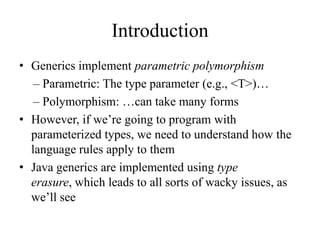
Introduction
• Generics implement parametric polymorphism
– Parametric: The type parameter (e.g., <T>)…
– Polymorphism: …can take many forms
• However, if we’re going to program with
parameterized types, we need to understand how the
language rules apply to them
• Java generics are implemented using type
erasure, which leads to all sorts of wacky issues, as
we’ll see
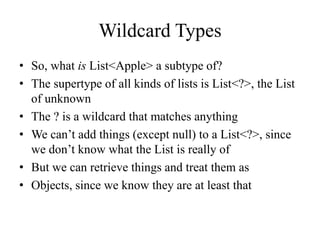
Wildcard Types
• So, what is List<Apple> a subtype of?
• The supertype of all kinds of lists is List<?>, the List
of unknown
• The ? is a wildcard that matches anything
• We can’t add things (except null) to a List<?>, since
we don’t know what the List is really of
• But we can retrieve things and treat them as
• Objects, since we know they are at least that
Josh Bloch’s Bounded Wildcards
Rule
• Use <? extends T> when parameterized instance is a
T producer (for reading/input)
• Use <? super T> when parameterized instance is a T
consumer (for writing/output)
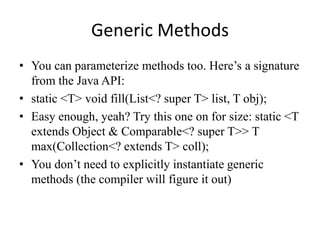
Generic Methods
• You can parameterize methods too. Here’s a signature
from the Java API:
• static <T> void fill(List<? super T> list, T obj);
• Easy enough, yeah? Try this one on for size: static <T
extends Object & Comparable<? super T>> T
max(Collection<? extends T> coll);
• You don’t need to explicitly instantiate generic
methods (the compiler will figure it out)
How Generics are Implemented
• Rather than change every JVM between Java 1.4 and
1.5, they chose to use erasure
• After the compiler does its type checking, it discards
the generics; the JVM never sees them!
• It works something like this:
– Type information between angle brackets is thrown
• out, e.g., List<String> -> List
– Uses of type variables are replaced by their upper
bound (usually Object)
– Casts are inserted to preserve type‐correctness
Bounded Wildcards
• Wildcard types can have upper and lower
bounds
• A List<? extends Fruit> is a List of items that
have unknown type but are all at least Fruits
– So it can contain Fruits and Apples but
not Peas
• A List<? super Fruit> is a List of items that
have unknown type but are all at most Fruits
– So it can contain Fruits and Objects but not Apples
Thank You…!!!

Generics of JAVA

  • 1.
  • 2.
    Introduction • Generics implementparametric polymorphism – Parametric: The type parameter (e.g., <T>)… – Polymorphism: …can take many forms • However, if we’re going to program with parameterized types, we need to understand how the language rules apply to them • Java generics are implemented using type erasure, which leads to all sorts of wacky issues, as we’ll see
  • 3.
    Wildcard Types • So,what is List<Apple> a subtype of? • The supertype of all kinds of lists is List<?>, the List of unknown • The ? is a wildcard that matches anything • We can’t add things (except null) to a List<?>, since we don’t know what the List is really of • But we can retrieve things and treat them as • Objects, since we know they are at least that
  • 4.
    Josh Bloch’s BoundedWildcards Rule • Use <? extends T> when parameterized instance is a T producer (for reading/input) • Use <? super T> when parameterized instance is a T consumer (for writing/output)
  • 5.
    Generic Methods • Youcan parameterize methods too. Here’s a signature from the Java API: • static <T> void fill(List<? super T> list, T obj); • Easy enough, yeah? Try this one on for size: static <T extends Object & Comparable<? super T>> T max(Collection<? extends T> coll); • You don’t need to explicitly instantiate generic methods (the compiler will figure it out)
  • 6.
    How Generics areImplemented • Rather than change every JVM between Java 1.4 and 1.5, they chose to use erasure • After the compiler does its type checking, it discards the generics; the JVM never sees them! • It works something like this: – Type information between angle brackets is thrown • out, e.g., List<String> -> List – Uses of type variables are replaced by their upper bound (usually Object) – Casts are inserted to preserve type‐correctness
  • 7.
    Bounded Wildcards • Wildcardtypes can have upper and lower bounds • A List<? extends Fruit> is a List of items that have unknown type but are all at least Fruits – So it can contain Fruits and Apples but not Peas • A List<? super Fruit> is a List of items that have unknown type but are all at most Fruits – So it can contain Fruits and Objects but not Apples
  • 8.