4/29/2020
athithanvijay@jayamnetworks.com1
Topics
What is programming language?
Simple program in Python
Python – Data types
Python – Comments
Python
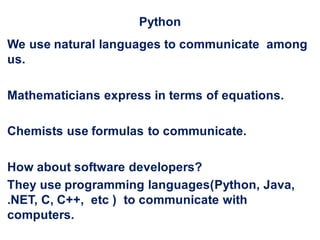
We use natural languages to communicate among
us.
Mathematicians express in terms of equations.
Chemists use formulas to communicate.
How about software developers?
They use programming languages(Python, Java,
.NET, C, C++, etc ) to communicate with
computers.
Python
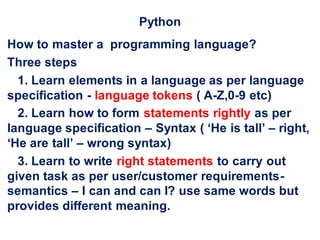
How to master a programming language?
Three steps
1. Learn elements in a language as per language
specification - language tokens ( A-Z,0-9 etc)
2. Learn how to form statements rightly as per
language specification – Syntax ( ‘He is tall’ – right,
‘He are tall’ – wrong syntax)
3. Learn to write right statements to carry out
given task as per user/customer requirements-
semantics – I can and can I? use same words but
provides different meaning.
Python
Python Language elements
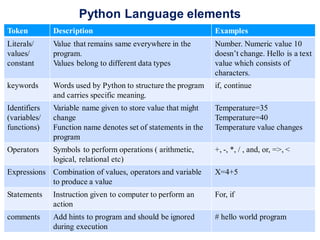
Token Description Examples
Literals/
values/
constant
Value that remains same everywhere in the
program.
Values belong to different data types
Number. Numeric value 10
doesn’t change. Hello is a text
value which consists of
characters.
keywords Words used by Python to structure the program
and carries specific meaning.
if, continue
Identifiers
(variables/
functions)
Variable name given to store value that might
change
Function name denotes set of statements in the
program
Temperature=35
Temperature=40
Temperature value changes
Operators Symbols to perform operations ( arithmetic,
logical, relational etc)
+, -, *, / , and, or, =>, <
Expressions Combination of values, operators and variable
to produce a value
X=4+5
Statements Instruction given to computer to perform an
action
For, if
comments Add hints to program and should be ignored
during execution
# hello world program
Let us write a shortest Python program to print the
word hello in screen.
Create a textfile in notepad or other text editor and
type the following line
print(“hello”)
then save the file in the following format.
Filename.py (eg. hello.py)
Then run the python program as below
python hello.py
It will print the text hello in the screen.
Is not simple to create and run a python program?
Python Language elements
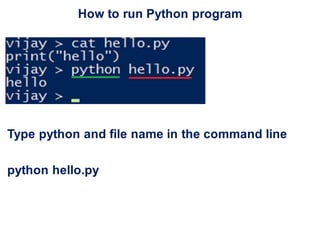
Type python and file name in the command line
python hello.py
How to run Python program
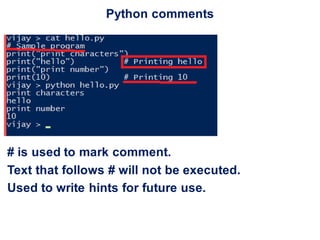
# is used to mark comment.
Text that follows # will not be executed.
Used to write hints for future use.
Python comments
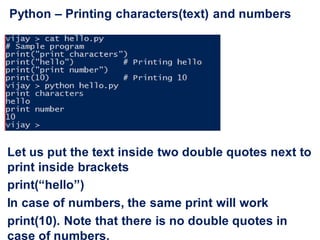
Let us put the text inside two double quotes next to
print inside brackets
print(“hello”)
In case of numbers, the same print will work
print(10). Note that there is no double quotes in
case of numbers.
Python – Printing characters(text) and numbers
print(10) is different from print(“ten”)
10 is a number. “ten” is set of
characters(text/string/chars).
We can perform different operations on
number.(Eg. 10 + 20, 10 -5, 10*5 etc)
Whereas chars support different set of operations
(Eg. Length of a given word, concatenating two
words, occurrence particular letter in a word etc)
Python supports specific set of operations on
different type of values.
Python – values
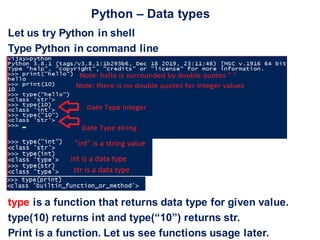
Let us try Python in shell
Type Python in command line
type is a function that returns data type for given value.
type(10) returns int and type(“10”) returns str.
Print is a function. Let us see functions usage later.
Python – Data types
Values, values attributes and operations form data
types.
Eg integer can represent numbers using digits.
Can do +,-,* etc.
Python – Data types
Numbers
• Integer
• Float
• Boolean
• Complex
Number
Mappings
• Dictionary
Sequence
• String
• List
• Tuple
• Bytes
Set types
• Sets
Python Data Types
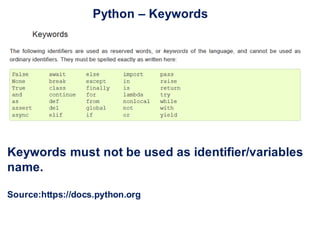
Keywords must not be used as identifier/variables
name.
Source:https://docs.python.org
Python – Keywords
Want to store some value during program execution in computer
memory and refer that value using a name as we wish – identifier
Variable is one type of identifier.
There is no need to mention datatype name while declaring variables in
python. In other languages we need to declare variables with data type.
marks= 80 // marks is an integer variable
Name = “vijay” // Name is a string variable
Variables promotes readability
print(marks) is better than print(80)
Variables promotes reusability
Python – Identifier
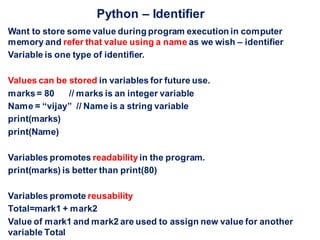
Want to store some value during program execution in computer
memory and refer that value using a name as we wish – identifier
Variable is one type of identifier.
Values can be stored in variables for future use.
marks= 80 // marks is an integer variable
Name = “vijay” // Name is a string variable
print(marks)
print(Name)
Variables promotes readability in the program.
print(marks) is better than print(80)
Variables promote reusability
Total=mark1 + mark2
Value of mark1 and mark2 are used to assign new value for another
variable Total
Python – Identifier
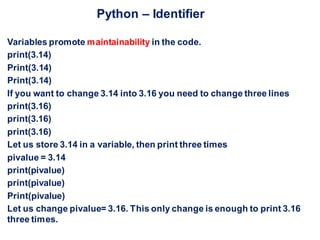
Variables promote maintainability in the code.
print(3.14)
Print(3.14)
Print(3.14)
If you want to change 3.14 into 3.16 you need to change three lines
print(3.16)
print(3.16)
print(3.16)
Let us store 3.14 in a variable, then print three times
pivalue = 3.14
print(pivalue)
print(pivalue)
Print(pivalue)
Let us change pivalue= 3.16. This only change is enough to print 3.16
three times.
Python – Identifier
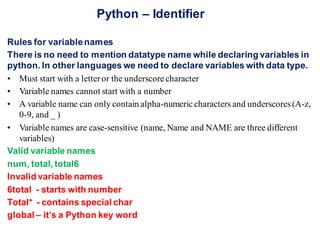
Rules for variablenames
There is no need to mention datatype name while declaring variables in
python. In other languages we need to declare variables with data type.
• Must start with a letteror the underscorecharacter
• Variable names cannot start with a number
• A variable name can only contain alpha-numericcharacters and underscores(A-z,
0-9, and _ )
• Variable names are case-sensitive (name, Name and NAME are three different
variables)
Valid variable names
num, total, total6
Invalid variable names
6total - starts with number
Total* - contains special char
global – it’s a Python key word
Python – Identifier
Next topic : Operators
Python – Identifier
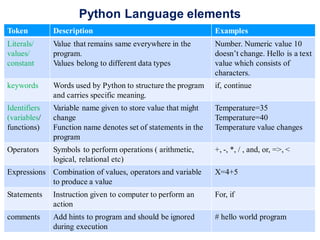
Python Language elements
Token Description Examples
Literals/
values/
constant
Value that remains same everywhere in the
program.
Values belong to different data types
Number. Numeric value 10
doesn’t change. Hello is a text
value which consists of
characters.
keywords Words used by Python to structure the program
and carries specific meaning.
if, continue
Identifiers
(variables/
functions)
Variable name given to store value that might
change
Function name denotes set of statements in the
program
Temperature=35
Temperature=40
Temperature value changes
Operators Symbols to perform operations ( arithmetic,
logical, relational etc)
+, -, *, / , and, or, =>, <
Expressions Combination of values, operators and variable
to produce a value
X=4+5
Statements Instruction given to computer to perform an
action
For, if
comments Add hints to program and should be ignored
during execution
# hello world program
4/29/2020
Vijay
athithanvijay@jayamnetworks.com
Please visit
https://www.jayamnetworks.com
for more learning contents
20

Python Data Types

  • 1.
  • 2.
    Topics What is programminglanguage? Simple program in Python Python – Data types Python – Comments Python
  • 3.
    We use naturallanguages to communicate among us. Mathematicians express in terms of equations. Chemists use formulas to communicate. How about software developers? They use programming languages(Python, Java, .NET, C, C++, etc ) to communicate with computers. Python
  • 4.
    How to mastera programming language? Three steps 1. Learn elements in a language as per language specification - language tokens ( A-Z,0-9 etc) 2. Learn how to form statements rightly as per language specification – Syntax ( ‘He is tall’ – right, ‘He are tall’ – wrong syntax) 3. Learn to write right statements to carry out given task as per user/customer requirements- semantics – I can and can I? use same words but provides different meaning. Python
  • 5.
    Python Language elements TokenDescription Examples Literals/ values/ constant Value that remains same everywhere in the program. Values belong to different data types Number. Numeric value 10 doesn’t change. Hello is a text value which consists of characters. keywords Words used by Python to structure the program and carries specific meaning. if, continue Identifiers (variables/ functions) Variable name given to store value that might change Function name denotes set of statements in the program Temperature=35 Temperature=40 Temperature value changes Operators Symbols to perform operations ( arithmetic, logical, relational etc) +, -, *, / , and, or, =>, < Expressions Combination of values, operators and variable to produce a value X=4+5 Statements Instruction given to computer to perform an action For, if comments Add hints to program and should be ignored during execution # hello world program
  • 6.
    Let us writea shortest Python program to print the word hello in screen. Create a textfile in notepad or other text editor and type the following line print(“hello”) then save the file in the following format. Filename.py (eg. hello.py) Then run the python program as below python hello.py It will print the text hello in the screen. Is not simple to create and run a python program? Python Language elements
  • 7.
    Type python andfile name in the command line python hello.py How to run Python program
  • 8.
    # is usedto mark comment. Text that follows # will not be executed. Used to write hints for future use. Python comments
  • 9.
    Let us putthe text inside two double quotes next to print inside brackets print(“hello”) In case of numbers, the same print will work print(10). Note that there is no double quotes in case of numbers. Python – Printing characters(text) and numbers
  • 10.
    print(10) is differentfrom print(“ten”) 10 is a number. “ten” is set of characters(text/string/chars). We can perform different operations on number.(Eg. 10 + 20, 10 -5, 10*5 etc) Whereas chars support different set of operations (Eg. Length of a given word, concatenating two words, occurrence particular letter in a word etc) Python supports specific set of operations on different type of values. Python – values
  • 11.
    Let us tryPython in shell Type Python in command line type is a function that returns data type for given value. type(10) returns int and type(“10”) returns str. Print is a function. Let us see functions usage later. Python – Data types
  • 12.
    Values, values attributesand operations form data types. Eg integer can represent numbers using digits. Can do +,-,* etc. Python – Data types Numbers • Integer • Float • Boolean • Complex Number Mappings • Dictionary Sequence • String • List • Tuple • Bytes Set types • Sets Python Data Types
  • 13.
    Keywords must notbe used as identifier/variables name. Source:https://docs.python.org Python – Keywords
  • 14.
    Want to storesome value during program execution in computer memory and refer that value using a name as we wish – identifier Variable is one type of identifier. There is no need to mention datatype name while declaring variables in python. In other languages we need to declare variables with data type. marks= 80 // marks is an integer variable Name = “vijay” // Name is a string variable Variables promotes readability print(marks) is better than print(80) Variables promotes reusability Python – Identifier
  • 15.
    Want to storesome value during program execution in computer memory and refer that value using a name as we wish – identifier Variable is one type of identifier. Values can be stored in variables for future use. marks= 80 // marks is an integer variable Name = “vijay” // Name is a string variable print(marks) print(Name) Variables promotes readability in the program. print(marks) is better than print(80) Variables promote reusability Total=mark1 + mark2 Value of mark1 and mark2 are used to assign new value for another variable Total Python – Identifier
  • 16.
    Variables promote maintainabilityin the code. print(3.14) Print(3.14) Print(3.14) If you want to change 3.14 into 3.16 you need to change three lines print(3.16) print(3.16) print(3.16) Let us store 3.14 in a variable, then print three times pivalue = 3.14 print(pivalue) print(pivalue) Print(pivalue) Let us change pivalue= 3.16. This only change is enough to print 3.16 three times. Python – Identifier
  • 17.
    Rules for variablenames Thereis no need to mention datatype name while declaring variables in python. In other languages we need to declare variables with data type. • Must start with a letteror the underscorecharacter • Variable names cannot start with a number • A variable name can only contain alpha-numericcharacters and underscores(A-z, 0-9, and _ ) • Variable names are case-sensitive (name, Name and NAME are three different variables) Valid variable names num, total, total6 Invalid variable names 6total - starts with number Total* - contains special char global – it’s a Python key word Python – Identifier
  • 18.
    Next topic :Operators Python – Identifier
  • 19.
    Python Language elements TokenDescription Examples Literals/ values/ constant Value that remains same everywhere in the program. Values belong to different data types Number. Numeric value 10 doesn’t change. Hello is a text value which consists of characters. keywords Words used by Python to structure the program and carries specific meaning. if, continue Identifiers (variables/ functions) Variable name given to store value that might change Function name denotes set of statements in the program Temperature=35 Temperature=40 Temperature value changes Operators Symbols to perform operations ( arithmetic, logical, relational etc) +, -, *, / , and, or, =>, < Expressions Combination of values, operators and variable to produce a value X=4+5 Statements Instruction given to computer to perform an action For, if comments Add hints to program and should be ignored during execution # hello world program
  • 20.