Why Generative AI is Essential for Business Growth
Generative AI is essential for business growth, offering automation, scalability, and improved efficiency. Learn how it can transform your business and drive success. For more information, visit Digiprima Artificial Intelligence Services.
Why Generative AI is Essential for Business Growth
1.
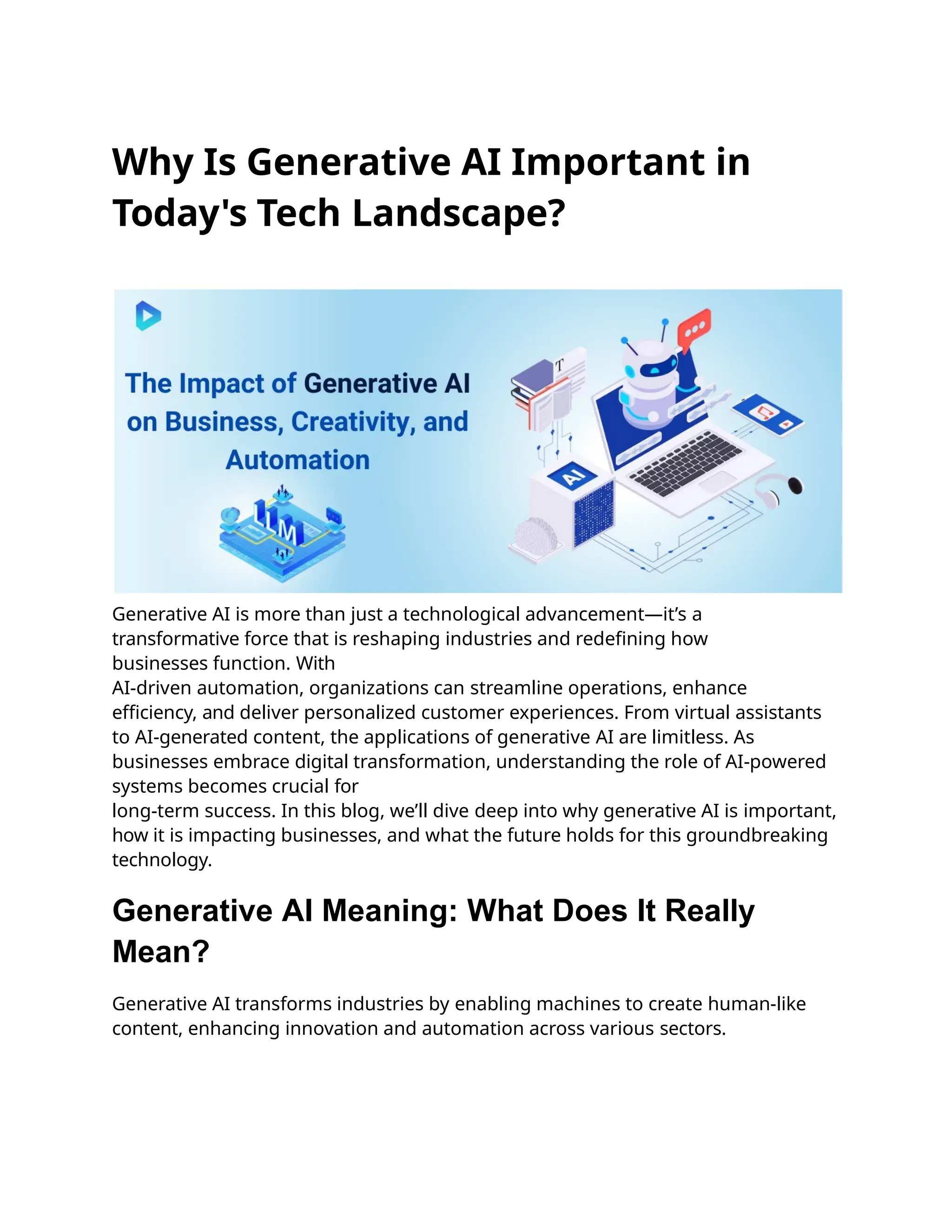
Why Is GenerativeAI Important in
Today's Tech Landscape?
Generative AI is more than just a technological advancement—it’s a
transformative force that is reshaping industries and redefining how
businesses function. With
AI-driven automation, organizations can streamline operations, enhance
efficiency, and deliver personalized customer experiences. From virtual assistants
to AI-generated content, the applications of generative AI are limitless. As
businesses embrace digital transformation, understanding the role of AI-powered
systems becomes crucial for
long-term success. In this blog, we’ll dive deep into why generative AI is important,
how it is impacting businesses, and what the future holds for this groundbreaking
technology.
Generative AI Meaning: What Does It Really
Mean?
Generative AI transforms industries by enabling machines to create human-like
content, enhancing innovation and automation across various sectors.
2.
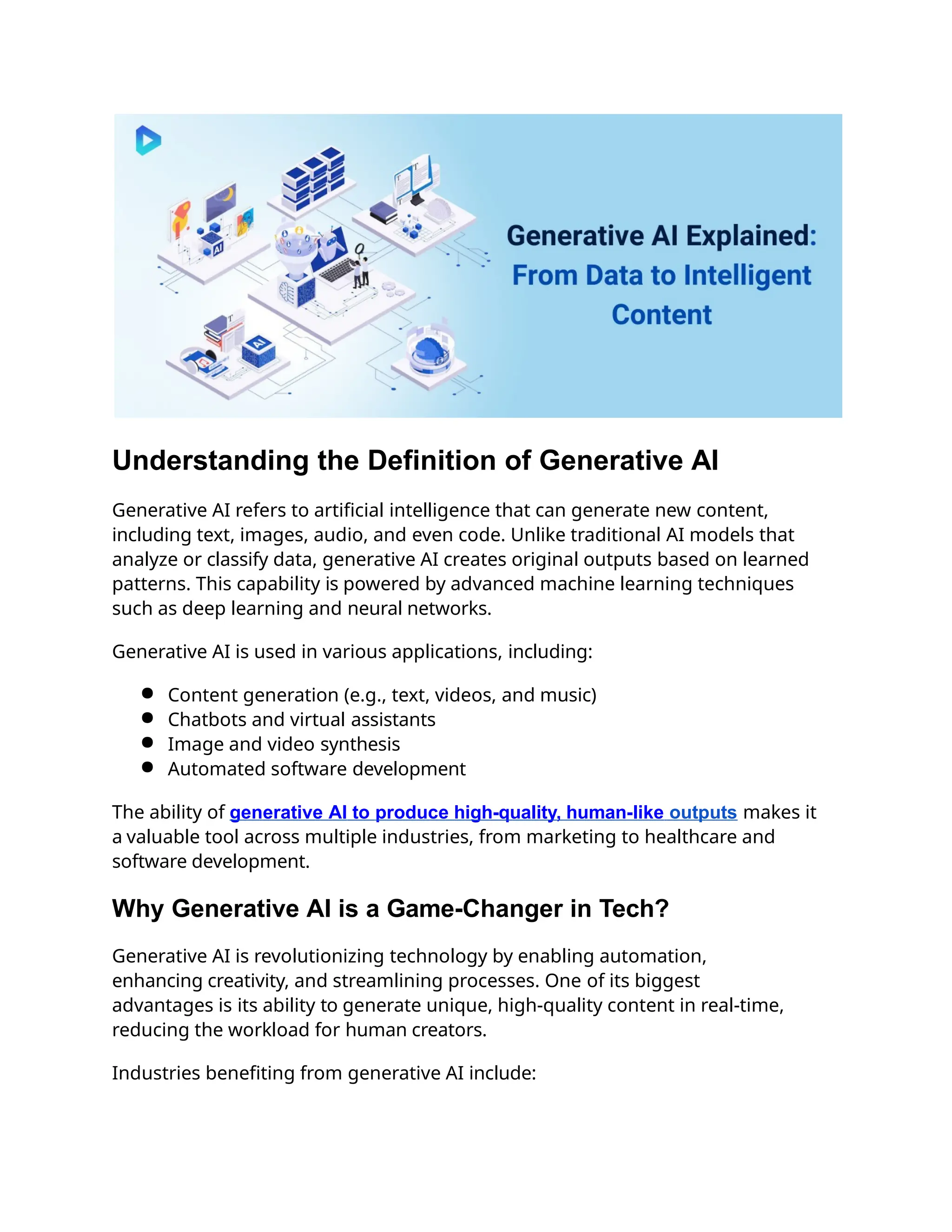
Understanding the Definitionof Generative AI
Generative AI refers to artificial intelligence that can generate new content,
including text, images, audio, and even code. Unlike traditional AI models that
analyze or classify data, generative AI creates original outputs based on learned
patterns. This capability is powered by advanced machine learning techniques
such as deep learning and neural networks.
Generative AI is used in various applications, including:
● Content generation (e.g., text, videos, and music)
● Chatbots and virtual assistants
● Image and video synthesis
● Automated software development
The ability of generative AI to produce high-quality, human-like outputs makes it
a valuable tool across multiple industries, from marketing to healthcare and
software development.
Why Generative AI is a Game-Changer in Tech?
Generative AI is revolutionizing technology by enabling automation,
enhancing creativity, and streamlining processes. One of its biggest
advantages is its ability to generate unique, high-quality content in real-time,
reducing the workload for human creators.
Industries benefiting from generative AI include:
3.
● Healthcare: AI-poweredmodels can generate synthetic medical data
for research without compromising patient privacy.
● Marketing & Advertising: Businesses use AI-generated content for social
media posts, blogs, and advertisements.
● Entertainment & Gaming: AI can create dynamic characters, storylines,
and realistic images.
● Software Development: AI assists in code generation, debugging, and
software testing.
With its potential to boost productivity and innovation, generative AI is paving
the way for a more automated and intelligent digital world.
Differences Between Generative AI and Traditional AI
Traditional AI and generative AI differ significantly in their capabilities and use
cases. While traditional AI focuses on analyzing and classifying existing data,
generative AI creates entirely new content based on patterns and training data.
Key differences include:
● Purpose: Traditional AI is designed for predictive analysis, while
generative AI creates new content.
● Data Processing: Traditional AI identifies trends in existing data,
while generative AI synthesizes new data.
● Applications: Traditional AI is commonly used for fraud detection,
recommendation systems, and diagnostics, whereas generative AI is
used for creative tasks such as content writing and art generation.
By understanding these differences, businesses can effectively implement AI
solutions tailored to their specific needs, leveraging generative AI to drive creativity
and efficiency.
Exploring Generative AI Models and Their
Capabilities
Generative AI models are transforming industries by enabling machines to
create human-like content.
4.
What Are GenerativeAI Models?
Generative AI models are advanced algorithms designed to produce new and
unique content. These models use machine learning techniques such as deep
learning and
neural networks to generate text, images, audio, and more. Unlike traditional AI,
which analyzes data to make decisions, generative AI creates new data based on
learned patterns. From chatbots to art generation, these models are shaping the
future of
artificial intelligence.
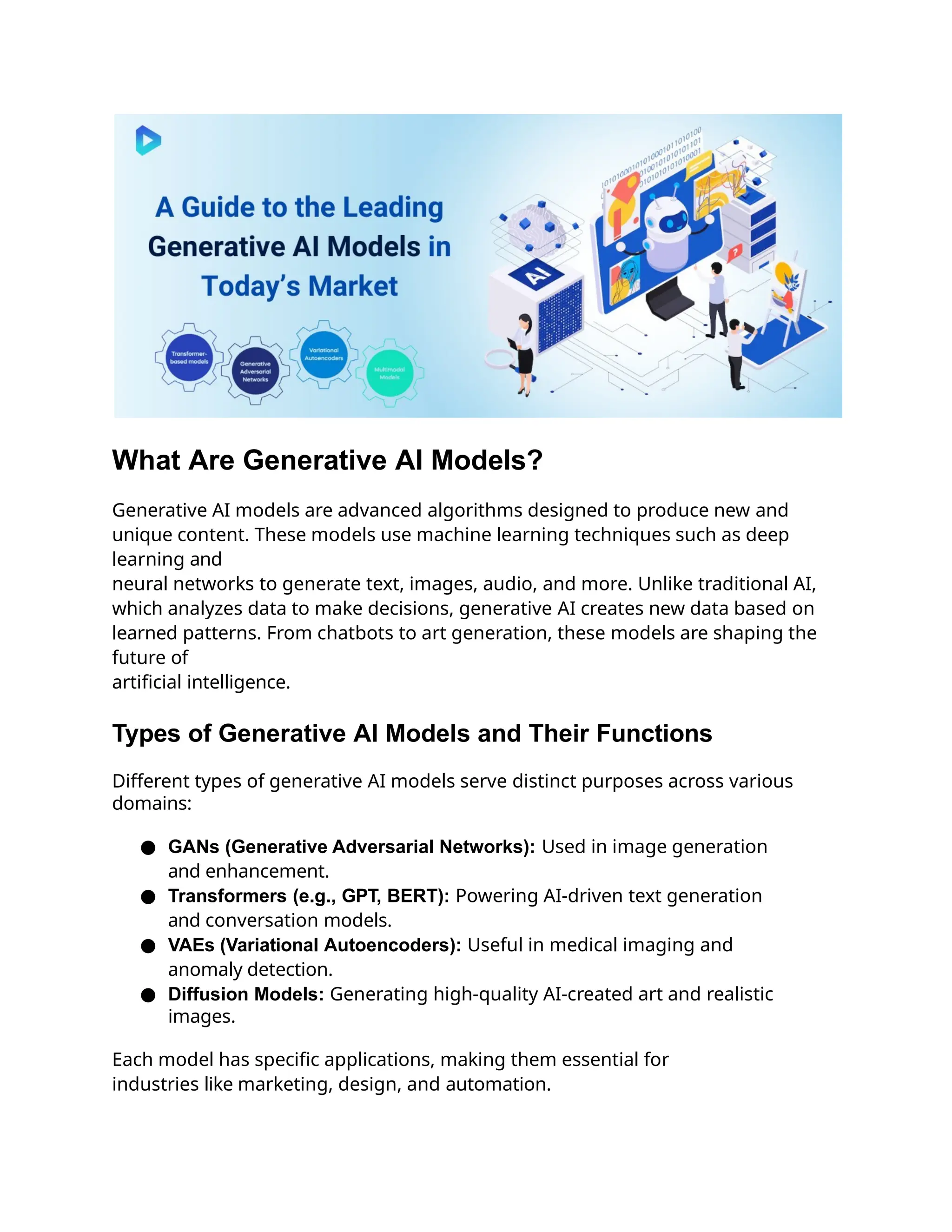
Types of Generative AI Models and Their Functions
Different types of generative AI models serve distinct purposes across various
domains:
● GANs (Generative Adversarial Networks): Used in image generation
and enhancement.
● Transformers (e.g., GPT, BERT): Powering AI-driven text generation
and conversation models.
● VAEs (Variational Autoencoders): Useful in medical imaging and
anomaly detection.
● Diffusion Models: Generating high-quality AI-created art and realistic
images.
Each model has specific applications, making them essential for
industries like marketing, design, and automation.
5.
How Do GenerativeAI Models Create Unique Outputs?
Generative AI models rely on complex neural networks to understand
patterns and generate content. They function through:
● Training on large datasets: Learning from existing data to identify
trends.
● Pattern recognition: Understanding relationships between different
data points.
● Predictive generation: Creating text, visuals, or other media based on
learned knowledge.
These models continuously evolve, making AI-generated content more natural
and realistic.
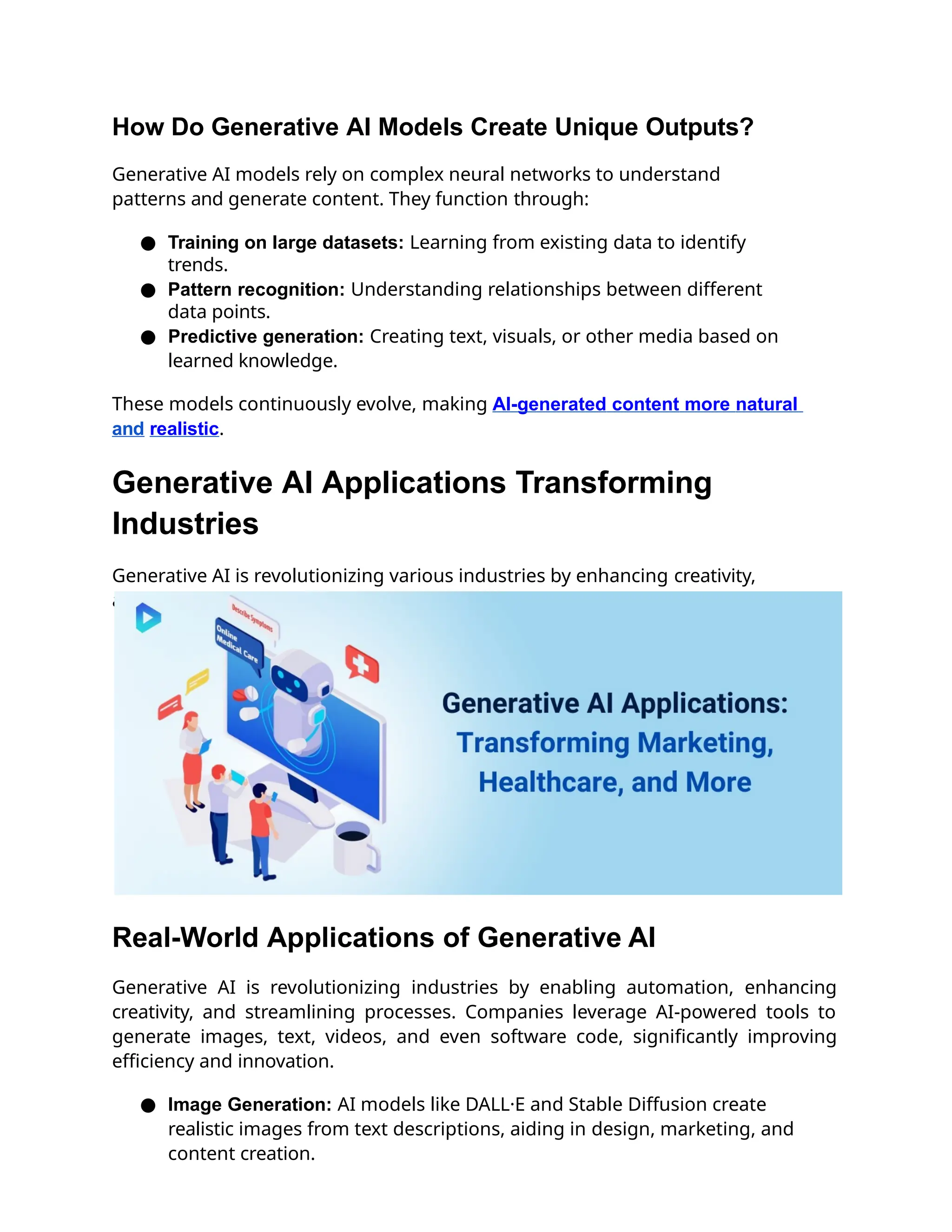
Generative AI Applications Transforming
Industries
Generative AI is revolutionizing various industries by enhancing creativity,
automating processes, and improving efficiency.
Real-World Applications of Generative AI
Generative AI is revolutionizing industries by enabling automation, enhancing
creativity, and streamlining processes. Companies leverage AI-powered tools to
generate images, text, videos, and even software code, significantly improving
efficiency and innovation.
● Image Generation: AI models like DALL·E and Stable Diffusion create
realistic images from text descriptions, aiding in design, marketing, and
content creation.
6.
● Content Writing:AI-powered tools such as ChatGPT, DeepSeek, and Jasper
generate blogs, articles, ad copies, and personalized emails, saving
businesses time and resources.
● Video Generation: AI-driven platforms like Synthesia and Runway
generate videos for marketing, training, and entertainment, reducing
production costs.
● Virtual Assistants: AI chatbots and voice assistants improve customer
support by providing instant responses and automating routine inquiries.
● Software Development: AI-powered coding assistants like GitHub
Copilot help developers write and debug code efficiently, accelerating
software development cycles.
From creative industries to technical fields, Generative AI is transforming
how businesses operate and innovate.
How do Companies Leverage Generative AI for
Innovation?
Organizations use generative AI to drive innovation and stay ahead in
competitive markets. Businesses integrate AI-powered chatbots for customer
service, reducing response times and improving user experiences. AI-
generated design tools allow companies to create branding materials
effortlessly. In e-commerce, generative AI enhances product
recommendations, personalizing the shopping experience.
Furthermore, AI-generated simulations help companies test new products before
market launch, reducing costs and improving efficiency. By leveraging generative
AI, businesses optimize operations and unlock new opportunities.
Why Generative AI Applications Are Essential Today?
The growing reliance on data-driven decisions makes generative AI indispensable.
With AI automating content creation, businesses save time and resources while
maintaining quality. The ability to generate realistic simulations and predictive
models enhances decision-making across industries. Moreover, generative AI
fosters innovation by offering unique solutions to complex problems. As AI
technology continues to evolve, its applications will become even more critical for
organizations striving for efficiency, creativity, and competitive advantage.
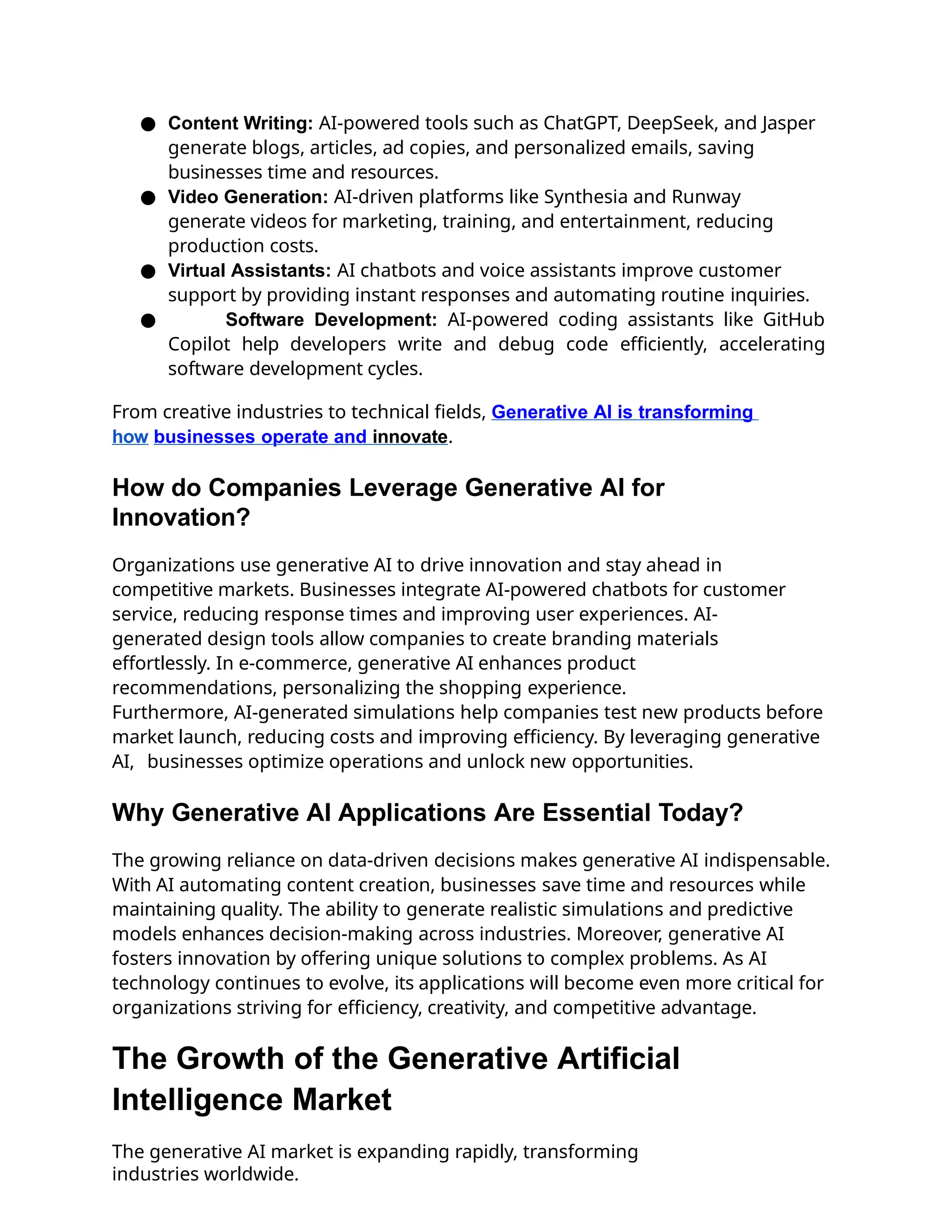
The Growth of the Generative Artificial
Intelligence Market
The generative AI market is expanding rapidly, transforming
industries worldwide.
7.
The Current Stateof the Generative AI Market
The generative AI market is experiencing unprecedented growth, driven by
advancements in AI technologies. Valued at billions of dollars, it spans industries
like healthcare, entertainment, retail, and finance. Companies are adopting
generative AI to automate tasks, enhance creativity, and improve decision-making.
Tools like ChatGPT, DeepSeek, DALL·E, and others are gaining widespread
popularity. Startups and enterprises alike are investing heavily in AI solutions to
stay competitive. The market is also witnessing increased funding and
partnerships, fueling innovation. As generative AI becomes more accessible, its
applications continue to grow, making it a cornerstone of modern business
strategies. This rapid adoption highlights its potential to reshape industries
globally.
Why is the Generative AI Market Booming?
The generative AI market is booming due to its transformative potential and
widespread applicability. Businesses are leveraging AI to automate content
creation, personalize customer experiences, and optimize operations. The rise of
cloud computing and big data has made AI tools more accessible and affordable.
Additionally, the demand for innovation in competitive markets drives adoption.
Key factors include:
● Increased efficiency and cost savings.
● Enhanced creativity and problem-solving capabilities.
● Growing investments in AI research and development.
8.
Startups and smallbusinesses are also embracing generative AI to level the
playing field. This surge in demand is propelling the market forward, making it
a key driver of technological progress.
Challenges and Opportunities in the Generative AI Market
While the generative AI market offers immense opportunities, it also faces
challenges. Ethical concerns, such as data privacy and misuse, need addressing.
High implementation costs and a lack of skilled professionals can hinder
adoption. However, these challenges present opportunities for innovation.
Companies developing ethical AI frameworks and user-friendly tools will thrive.
The market also offers growth potential in emerging sectors like education and
sustainability. By overcoming barriers, businesses can unlock the full potential of
generative AI, driving innovation and creating value in a rapidly evolving digital
landscape.
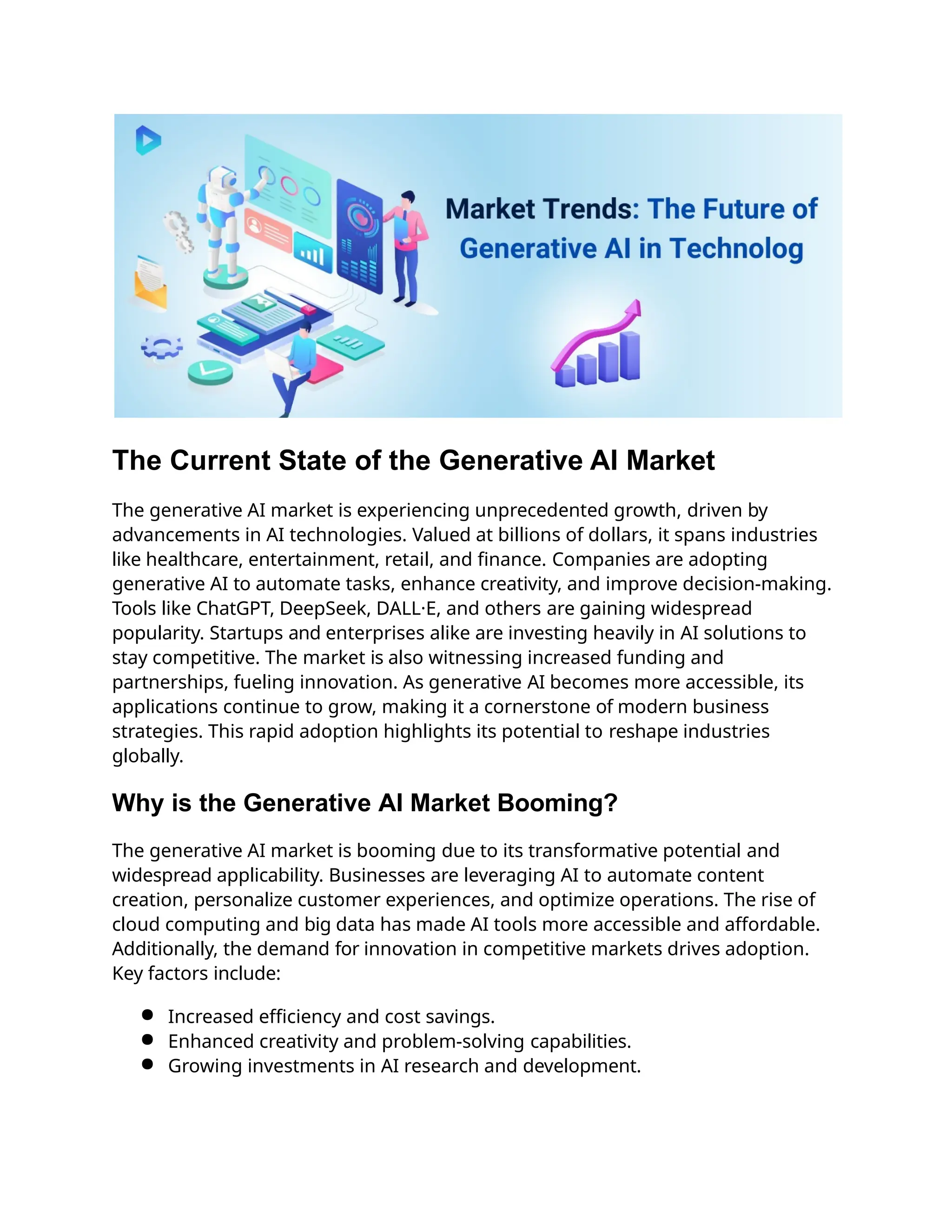
The Rise of Generative Artificial Intelligence
Chatbots
Generative AI chatbots are revolutionizing how businesses interact with
customers.
What Are Generative AI Chatbots?*
Generative AI chatbots are advanced tools that use artificial intelligence to
create human-like conversations. Unlike traditional chatbots, they generate
responses dynamically, making interactions more natural and engaging.
Powered by models like
9.
GPT, these chatbotsunderstand context, answer queries, and even perform tasks
like booking appointments or providing recommendations. They are widely used in
customer service, marketing, and e-commerce. Businesses leverage them to
automate communication, reduce response times, and improve user experiences.
With their ability to learn and adapt, generative AI chatbots are becoming
indispensable for organizations aiming to enhance customer engagement and
streamline operations.
Why Generative AI Chatbots Are Transforming Customer
Service?
Generative AI chatbots are transforming customer service by offering instant,
personalized support. They handle multiple queries simultaneously, reducing wait
times and improving efficiency. These chatbots provide 24/7 assistance, ensuring
customers receive help whenever needed. Key benefits include:
● Faster resolution of customer issues.
● Personalized interactions based on user data.
● Cost savings by reducing the need for large support teams.
Businesses can also use chatbots to gather insights from customer interactions,
helping them improve products and services. By enhancing customer satisfaction
and loyalty, generative AI chatbots are redefining the future of customer service.
Challenges and Limitations of AI Chatbots
Despite their advantages, generative AI chatbots face challenges. They may
struggle with complex queries or misunderstand user intent, leading to
inaccurate responses.
Ethical concerns, such as data privacy and bias, also arise. Additionally, developing
and maintaining these chatbots requires significant investment and expertise.
However, these limitations present opportunities for improvement. By addressing
these challenges, businesses can create more reliable and ethical AI solutions. As
technology advances, generative AI chatbots will continue to evolve, offering even
greater value to organizations and customers alike.
Real-World Generative AI Examples Driving
Innovation
Generative AI is transforming industries. Let’s explore real-world examples
of its impact.
10.
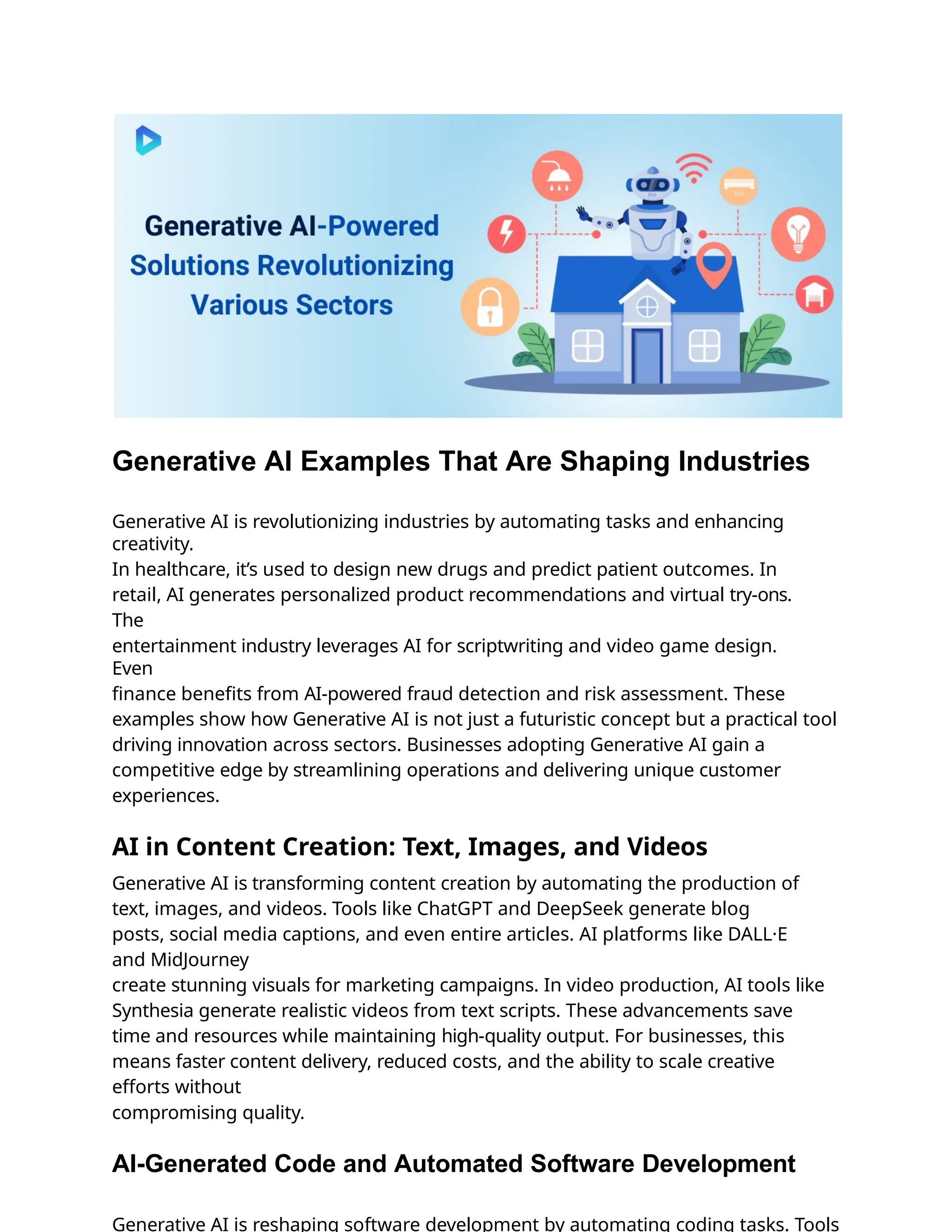
Generative AI ExamplesThat Are Shaping Industries
Generative AI is revolutionizing industries by automating tasks and enhancing
creativity.
In healthcare, it’s used to design new drugs and predict patient outcomes. In
retail, AI generates personalized product recommendations and virtual try-ons.
The
entertainment industry leverages AI for scriptwriting and video game design.
Even
finance benefits from AI-powered fraud detection and risk assessment. These
examples show how Generative AI is not just a futuristic concept but a practical tool
driving innovation across sectors. Businesses adopting Generative AI gain a
competitive edge by streamlining operations and delivering unique customer
experiences.
AI in Content Creation: Text, Images, and Videos
Generative AI is transforming content creation by automating the production of
text, images, and videos. Tools like ChatGPT and DeepSeek generate blog
posts, social media captions, and even entire articles. AI platforms like DALL·E
and MidJourney
create stunning visuals for marketing campaigns. In video production, AI tools like
Synthesia generate realistic videos from text scripts. These advancements save
time and resources while maintaining high-quality output. For businesses, this
means faster content delivery, reduced costs, and the ability to scale creative
efforts without
compromising quality.
AI-Generated Code and Automated Software Development
Generative AI is reshaping software development by automating coding tasks. Tools
11.
build entire applications.This speeds up development cycles and reduces human
error. Developers can focus on complex tasks while AI handles repetitive coding.
For businesses, this translates to faster product launches, lower development
costs, and
improved software quality. Startups and small businesses, in particular, benefit
from AI-generated code, as it allows them to compete with larger companies
without extensive resources.
LET’S DISCUSS YOUR IDEA
Call Us: +1 (347) 9739732, +91-90399-28143
Email Us: inquiry@digiprima.com, ashesh@digiprima.com