PHP vs JavaScript: Which Is the Right Tech for Your
Next Project?
In the realm of web development, two powerhouse technologies stand out: PHP and
JavaScript. Both of these technologies play a crucial role in building dynamic and
interactive web applications, yet they possess distinct characteristics and
functionalities.
PHP, a server-side scripting language, has long been a cornerstone of web
development, renowned for its versatility and efficiency in powering web servers and
generating dynamic content. On the other hand, JavaScript, a client-side scripting
language, empowers developers to create responsive and interactive user
experiences directly within web browsers.
The decision to choose between PHP and JavaScript can significantly impact the
performance, scalability, and success of your web application. Therefore, it is
essential to first understand the differences between PHP and JavaScript, as well as
their respective strengths and limitations.
This blog aims to delve deep into the distinction between JavaScript and PHP and
explore various aspects, including performance, scalability, ecosystem, and
developer expertise, to help you make an informed decision for your next web
development endeavor.
Shall we begin?
Understanding PHP
What is PHP?
PHP, an acronym for Hypertext Preprocessor, is an open-source server-side scripting
language primarily utilized for web development. It serves as a versatile tool in
offering dynamic web pages and web application development services.
One of PHP's key features is its embedded functionality within HTML, allowing PHP
developers to seamlessly mix PHP code with HTML markup to create dynamic
content. Additionally, PHP supports a wide range of databases, making it well-suited
for building database-driven web applications.
History and Evolution of PHP
The history of PHP dates back to 1994 when Rasmus Lerdorf developed a set of CGI
binaries in C for managing his homepage. These scripts evolved into PHP/FI (Personal
Home Page/Forms Interpreter), which was released in 1995.
With the release of PHP 3 in 1998, PHP became a full-fledged scripting language and
gained popularity among web developers. Subsequent versions, including PHP 4, PHP
5, PHP 7, and the latest PHP 8 series, introduced significant enhancements in
performance, security, and language features. PHP 7, in particular, brought
substantial improvements in speed and memory usage, making it a preferred choice
for high-performance web applications.
Use Cases and Strengths of PHP
PHP's versatility and ease of use make it suitable for a wide range of web
development tasks. Its primary strength lies in its ability to interact with databases,
process form data, and generate dynamic content.
PHP is commonly used for developing content management systems (CMS), such as
WordPress, Joomla, and Drupal, as well as e-commerce platforms like Magento and
WooCommerce. Its extensive library of built-in functions and frameworks, such as
Laravel, Symfony, and CodeIgniter, streamline development and provide solutions for
various web development challenges. Furthermore, PHP's compatibility with different
operating systems, web servers, and databases enhances its flexibility and adoption
in diverse development environments.
Limitations and Challenges of PHP
Despite its popularity, PHP is not without its limitations and challenges. One criticism
of PHP is its inconsistent function naming and parameter order across its standard
library, which can lead to confusion among developers. Additionally, PHP's
shared-nothing architecture, where each request is processed independently, may
pose scalability challenges for handling large volumes of concurrent users.
Furthermore, PHP's weak typing system and loose error handling can introduce
security vulnerabilities if not properly managed, such as SQL injection and cross-site
scripting (XSS) attacks. However, these challenges can be mitigated through best
practices, code reviews, and the use of security tools and frameworks specifically
designed for PHP development.
Understanding JavaScript
What is JavaScript?
JavaScript, often abbreviated as JS, is a high-level, interpreted programming
language primarily used for client-side web development.
Developed by Brendan Eich at Netscape Communications Corporation in 1995,
JavaScript was initially created to add interactivity and dynamic behavior to web
pages. Unlike server-side languages like PHP, JavaScript runs directly in the web
browser, allowing developers to manipulate the Document Object Model (DOM) and
respond to user interactions in real-time.
JavaScript is also widely used for server-side development (Node.js) and mobile app
development (React Native), further expanding its versatility beyond the web.
History and Evolution of JavaScript
JavaScript's evolution is closely intertwined with the history of web browsers and
internet technology. It was originally named "LiveScript," but was later renamed to
JavaScript to align with the popularity of Java.
With the release of JavaScript 1.0 in 1995, developers gained the ability to create
interactive web pages, such as form validation and dynamic content updates.
Subsequent versions, including ECMAScript 2, ECMAScript 3, ECMAScript 5, ECMAScript
6, ECMAScript 2016, ECMAScript 2017, ECMAScript 2018, ECMAScript 2019, ECMAScript
2020, ECMAScript 2021, ECMAScript 2022, and the latest ECMAScript 2023, introduced
significant improvements in language features, syntax, and performance.
The adoption of JavaScript frameworks and libraries, such as jQuery, AngularJS,
React, and Vue.js, further accelerated JavaScript's evolution and cemented its
position as a dominant force in web development.
Use Cases and Strengths of JavaScript
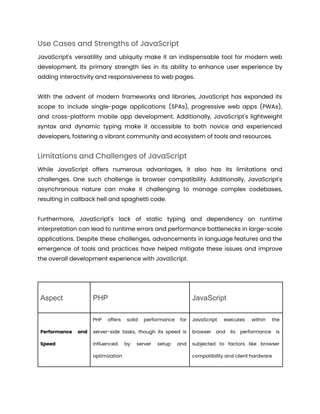
JavaScript's versatility and ubiquity make it an indispensable tool for modern web
development. Its primary strength lies in its ability to enhance user experience by
adding interactivity and responsiveness to web pages.
With the advent of modern frameworks and libraries, JavaScript has expanded its
scope to include single-page applications (SPAs), progressive web apps (PWAs),
and cross-platform mobile app development. Additionally, JavaScript's lightweight
syntax and dynamic typing make it accessible to both novice and experienced
developers, fostering a vibrant community and ecosystem of tools and resources.
Limitations and Challenges of JavaScript
While JavaScript offers numerous advantages, it also has its limitations and
challenges. One such challenge is browser compatibility. Additionally, JavaScript's
asynchronous nature can make it challenging to manage complex codebases,
resulting in callback hell and spaghetti code.
Furthermore, JavaScript's lack of static typing and dependency on runtime
interpretation can lead to runtime errors and performance bottlenecks in large-scale
applications. Despite these challenges, advancements in language features and the
emergence of tools and practices have helped mitigate these issues and improve
the overall development experience with JavaScript.
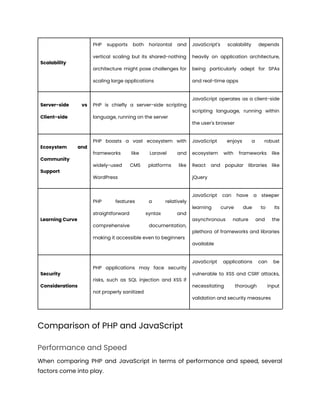
Aspect PHP JavaScript
Performance and
Speed
PHP offers solid performance for
server-side tasks, though its speed is
influenced by server setup and
optimization
JavaScript executes within the
browser and its performance is
subjected to factors like browser
compatibility and client hardware
Scalability
PHP supports both horizontal and
vertical scaling but its shared-nothing
architecture might pose challenges for
scaling large applications
JavaScript's scalability depends
heavily on application architecture,
being particularly adept for SPAs
and real-time apps
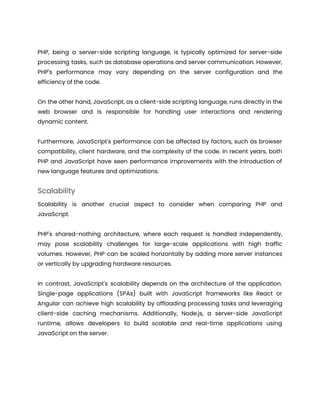
Server-side vs
Client-side
PHP is chiefly a server-side scripting
language, running on the server
JavaScript operates as a client-side
scripting language, running within
the user's browser
Ecosystem and
Community
Support
PHP boasts a vast ecosystem with
frameworks like Laravel and
widely-used CMS platforms like
WordPress
JavaScript enjoys a robust
ecosystem with frameworks like
React and popular libraries like
jQuery
Learning Curve
PHP features a relatively
straightforward syntax and
comprehensive documentation,
making it accessible even to beginners
JavaScript can have a steeper
learning curve due to its
asynchronous nature and the
plethora of frameworks and libraries
available
Security
Considerations
PHP applications may face security
risks, such as SQL injection and XSS if
not properly sanitized
JavaScript applications can be
vulnerable to XSS and CSRF attacks,
necessitating thorough input
validation and security measures
Comparison of PHP and JavaScript
Performance and Speed
When comparing PHP and JavaScript in terms of performance and speed, several
factors come into play.
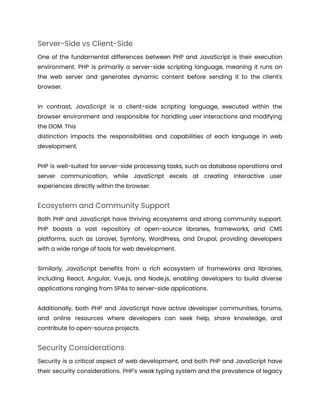
PHP, being a server-side scripting language, is typically optimized for server-side
processing tasks, such as database operations and server communication. However,
PHP's performance may vary depending on the server configuration and the
efficiency of the code.
On the other hand, JavaScript, as a client-side scripting language, runs directly in the
web browser and is responsible for handling user interactions and rendering
dynamic content.
Furthermore, JavaScript's performance can be affected by factors, such as browser
compatibility, client hardware, and the complexity of the code. In recent years, both
PHP and JavaScript have seen performance improvements with the introduction of
new language features and optimizations.
Scalability
Scalability is another crucial aspect to consider when comparing PHP and
JavaScript.
PHP's shared-nothing architecture, where each request is handled independently,
may pose scalability challenges for large-scale applications with high traffic
volumes. However, PHP can be scaled horizontally by adding more server instances
or vertically by upgrading hardware resources.
In contrast, JavaScript's scalability depends on the architecture of the application.
Single-page applications (SPAs) built with JavaScript frameworks like React or
Angular can achieve high scalability by offloading processing tasks and leveraging
client-side caching mechanisms. Additionally, Node.js, a server-side JavaScript
runtime, allows developers to build scalable and real-time applications using
JavaScript on the server.
Server-Side vs Client-Side
One of the fundamental differences between PHP and JavaScript is their execution
environment. PHP is primarily a server-side scripting language, meaning it runs on
the web server and generates dynamic content before sending it to the client's
browser.
In contrast, JavaScript is a client-side scripting language, executed within the
browser environment and responsible for handling user interactions and modifying
the DOM. This
distinction impacts the responsibilities and capabilities of each language in web
development.
PHP is well-suited for server-side processing tasks, such as database operations and
server communication, while JavaScript excels at creating interactive user
experiences directly within the browser.
Ecosystem and Community Support
Both PHP and JavaScript have thriving ecosystems and strong community support.
PHP boasts a vast repository of open-source libraries, frameworks, and CMS
platforms, such as Laravel, Symfony, WordPress, and Drupal, providing developers
with a wide range of tools for web development.
Similarly, JavaScript benefits from a rich ecosystem of frameworks and libraries,
including React, Angular, Vue.js, and Node.js, enabling developers to build diverse
applications ranging from SPAs to server-side applications.
Additionally, both PHP and JavaScript have active developer communities, forums,
and online resources where developers can seek help, share knowledge, and
contribute to open-source projects.
Security Considerations
Security is a critical aspect of web development, and both PHP and JavaScript have
their security considerations. PHP's weak typing system and the prevalence of legacy
codebases may expose applications to security vulnerabilities such as SQL injection,
cross-site scripting (XSS), and remote code execution (RCE) attacks if not properly
sanitized and validated. Additionally, PHP's server-side execution model requires
developers to implement secure coding practices and adhere to best practices for
web security.
On the other hand, JavaScript's client-side execution model introduces its own set of
security challenges, such as cross-site scripting (XSS), cross-site request forgery
(CSRF), and client-side data manipulation. Developers must implement proper
security measures, such as input validation, output encoding, and secure
communication protocols, to mitigate these risks when using JavaScript in web
development.
Interested in exploring the distinctions between Python and JavaScript? Delve deeper
into their differences with our comprehensive guide: Python vs Javascript: Key
Differences.
Decision Factors for Choosing Between PHP and
JavaScript
Project Requirements
When deciding between PHP and JavaScript for web development, project
requirements play a crucial role. Consider factors, such as the type of web
application being developed, the complexity of features required, and any specific
functionality needed.
Analyzing project requirements helps determine which language aligns better with
the project's objectives and technical specifications.
Team Expertise
Another important factor when deciding between PHP and JavaScript for web
development is the expertise of the development team. Assess the skills and
proficiency of the team members in PHP and JavaScript. Evaluate their experience,
familiarity with relevant frameworks and libraries, and ability to handle the specific
requirements of the project.
Choosing a technology stack that aligns with the team's expertise can streamline
development and ensure efficient execution of the project.
Future Scalability
Scalability is a key consideration, especially for long-term projects or those expected
to experience growth over time.
Evaluate the scalability of both PHP and JavaScript solutions in terms of handling
increased traffic, expanding functionality, and accommodating future updates and
enhancements. Furthermore, consider factors, such as performance optimization,
architectural flexibility, and the ability to scale resources both vertically and
horizontally.
Budget Considerations
Evaluate the cost implications of using PHP vs JavaScript for web development.
Consider factors, such as licensing fees, development resources, third-party
integrations, and ongoing maintenance and support costs.
Assess whether the chosen technology aligns with the project budget and offers the
best value proposition in terms of functionality, scalability, and return on investment.
Timeframe and Deadlines
Evaluate whether PHP or JavaScript offers a faster development cycle, better tooling
support, and the ability to meet project deadlines without compromising quality or
functionality.
Additionally, consider any external dependencies or constraints that may impact the
project timeline and choose a technology stack that can accommodate these
factors effectively.
Achieve Success in PHP and JavaScript Web Development
with Jellyfish Technologies
When it comes to choosing between PHP and JavaScript for your next web
development project, it's essential to consider factors, such as project requirements,
team expertise, scalability, budget, timeframe, and external dependencies. Both PHP
and JavaScript offer unique strengths and advantages, catering to different project
needs and objectives.
Whether you choose to leverage PHP's robust server-side capabilities or harness
JavaScript's dynamic client-side functionality, Jellyfish Technologies stands ready to
be your trusted partner in achieving web development success. We provide premier
PHP web application development services and JavaScript web application
development services, meticulously tailored to meet the unique requirements of your
project.
Contact us today to turn your ideas into reality and elevate your online presence to
new heights.

PHP vs JavaScript: Which Is the Right Tech for Your Next Project?

  • 1.
    PHP vs JavaScript:Which Is the Right Tech for Your Next Project? In the realm of web development, two powerhouse technologies stand out: PHP and JavaScript. Both of these technologies play a crucial role in building dynamic and interactive web applications, yet they possess distinct characteristics and functionalities. PHP, a server-side scripting language, has long been a cornerstone of web development, renowned for its versatility and efficiency in powering web servers and generating dynamic content. On the other hand, JavaScript, a client-side scripting language, empowers developers to create responsive and interactive user experiences directly within web browsers. The decision to choose between PHP and JavaScript can significantly impact the performance, scalability, and success of your web application. Therefore, it is
  • 2.
    essential to firstunderstand the differences between PHP and JavaScript, as well as their respective strengths and limitations. This blog aims to delve deep into the distinction between JavaScript and PHP and explore various aspects, including performance, scalability, ecosystem, and developer expertise, to help you make an informed decision for your next web development endeavor. Shall we begin? Understanding PHP What is PHP? PHP, an acronym for Hypertext Preprocessor, is an open-source server-side scripting language primarily utilized for web development. It serves as a versatile tool in offering dynamic web pages and web application development services.
  • 3.
    One of PHP'skey features is its embedded functionality within HTML, allowing PHP developers to seamlessly mix PHP code with HTML markup to create dynamic content. Additionally, PHP supports a wide range of databases, making it well-suited for building database-driven web applications. History and Evolution of PHP The history of PHP dates back to 1994 when Rasmus Lerdorf developed a set of CGI binaries in C for managing his homepage. These scripts evolved into PHP/FI (Personal Home Page/Forms Interpreter), which was released in 1995. With the release of PHP 3 in 1998, PHP became a full-fledged scripting language and gained popularity among web developers. Subsequent versions, including PHP 4, PHP 5, PHP 7, and the latest PHP 8 series, introduced significant enhancements in performance, security, and language features. PHP 7, in particular, brought substantial improvements in speed and memory usage, making it a preferred choice for high-performance web applications. Use Cases and Strengths of PHP PHP's versatility and ease of use make it suitable for a wide range of web development tasks. Its primary strength lies in its ability to interact with databases, process form data, and generate dynamic content. PHP is commonly used for developing content management systems (CMS), such as WordPress, Joomla, and Drupal, as well as e-commerce platforms like Magento and WooCommerce. Its extensive library of built-in functions and frameworks, such as Laravel, Symfony, and CodeIgniter, streamline development and provide solutions for various web development challenges. Furthermore, PHP's compatibility with different operating systems, web servers, and databases enhances its flexibility and adoption in diverse development environments.
  • 4.
    Limitations and Challengesof PHP Despite its popularity, PHP is not without its limitations and challenges. One criticism of PHP is its inconsistent function naming and parameter order across its standard library, which can lead to confusion among developers. Additionally, PHP's shared-nothing architecture, where each request is processed independently, may pose scalability challenges for handling large volumes of concurrent users. Furthermore, PHP's weak typing system and loose error handling can introduce security vulnerabilities if not properly managed, such as SQL injection and cross-site scripting (XSS) attacks. However, these challenges can be mitigated through best practices, code reviews, and the use of security tools and frameworks specifically designed for PHP development.
  • 5.
    Understanding JavaScript What isJavaScript? JavaScript, often abbreviated as JS, is a high-level, interpreted programming language primarily used for client-side web development. Developed by Brendan Eich at Netscape Communications Corporation in 1995, JavaScript was initially created to add interactivity and dynamic behavior to web pages. Unlike server-side languages like PHP, JavaScript runs directly in the web browser, allowing developers to manipulate the Document Object Model (DOM) and respond to user interactions in real-time. JavaScript is also widely used for server-side development (Node.js) and mobile app development (React Native), further expanding its versatility beyond the web. History and Evolution of JavaScript JavaScript's evolution is closely intertwined with the history of web browsers and internet technology. It was originally named "LiveScript," but was later renamed to JavaScript to align with the popularity of Java. With the release of JavaScript 1.0 in 1995, developers gained the ability to create interactive web pages, such as form validation and dynamic content updates. Subsequent versions, including ECMAScript 2, ECMAScript 3, ECMAScript 5, ECMAScript 6, ECMAScript 2016, ECMAScript 2017, ECMAScript 2018, ECMAScript 2019, ECMAScript 2020, ECMAScript 2021, ECMAScript 2022, and the latest ECMAScript 2023, introduced significant improvements in language features, syntax, and performance. The adoption of JavaScript frameworks and libraries, such as jQuery, AngularJS, React, and Vue.js, further accelerated JavaScript's evolution and cemented its position as a dominant force in web development.
  • 6.
    Use Cases andStrengths of JavaScript JavaScript's versatility and ubiquity make it an indispensable tool for modern web development. Its primary strength lies in its ability to enhance user experience by adding interactivity and responsiveness to web pages. With the advent of modern frameworks and libraries, JavaScript has expanded its scope to include single-page applications (SPAs), progressive web apps (PWAs), and cross-platform mobile app development. Additionally, JavaScript's lightweight syntax and dynamic typing make it accessible to both novice and experienced developers, fostering a vibrant community and ecosystem of tools and resources. Limitations and Challenges of JavaScript While JavaScript offers numerous advantages, it also has its limitations and challenges. One such challenge is browser compatibility. Additionally, JavaScript's asynchronous nature can make it challenging to manage complex codebases, resulting in callback hell and spaghetti code. Furthermore, JavaScript's lack of static typing and dependency on runtime interpretation can lead to runtime errors and performance bottlenecks in large-scale applications. Despite these challenges, advancements in language features and the emergence of tools and practices have helped mitigate these issues and improve the overall development experience with JavaScript. Aspect PHP JavaScript Performance and Speed PHP offers solid performance for server-side tasks, though its speed is influenced by server setup and optimization JavaScript executes within the browser and its performance is subjected to factors like browser compatibility and client hardware
  • 7.
    Scalability PHP supports bothhorizontal and vertical scaling but its shared-nothing architecture might pose challenges for scaling large applications JavaScript's scalability depends heavily on application architecture, being particularly adept for SPAs and real-time apps Server-side vs Client-side PHP is chiefly a server-side scripting language, running on the server JavaScript operates as a client-side scripting language, running within the user's browser Ecosystem and Community Support PHP boasts a vast ecosystem with frameworks like Laravel and widely-used CMS platforms like WordPress JavaScript enjoys a robust ecosystem with frameworks like React and popular libraries like jQuery Learning Curve PHP features a relatively straightforward syntax and comprehensive documentation, making it accessible even to beginners JavaScript can have a steeper learning curve due to its asynchronous nature and the plethora of frameworks and libraries available Security Considerations PHP applications may face security risks, such as SQL injection and XSS if not properly sanitized JavaScript applications can be vulnerable to XSS and CSRF attacks, necessitating thorough input validation and security measures Comparison of PHP and JavaScript Performance and Speed When comparing PHP and JavaScript in terms of performance and speed, several factors come into play.
  • 8.
    PHP, being aserver-side scripting language, is typically optimized for server-side processing tasks, such as database operations and server communication. However, PHP's performance may vary depending on the server configuration and the efficiency of the code. On the other hand, JavaScript, as a client-side scripting language, runs directly in the web browser and is responsible for handling user interactions and rendering dynamic content. Furthermore, JavaScript's performance can be affected by factors, such as browser compatibility, client hardware, and the complexity of the code. In recent years, both PHP and JavaScript have seen performance improvements with the introduction of new language features and optimizations. Scalability Scalability is another crucial aspect to consider when comparing PHP and JavaScript. PHP's shared-nothing architecture, where each request is handled independently, may pose scalability challenges for large-scale applications with high traffic volumes. However, PHP can be scaled horizontally by adding more server instances or vertically by upgrading hardware resources. In contrast, JavaScript's scalability depends on the architecture of the application. Single-page applications (SPAs) built with JavaScript frameworks like React or Angular can achieve high scalability by offloading processing tasks and leveraging client-side caching mechanisms. Additionally, Node.js, a server-side JavaScript runtime, allows developers to build scalable and real-time applications using JavaScript on the server.
  • 9.
    Server-Side vs Client-Side Oneof the fundamental differences between PHP and JavaScript is their execution environment. PHP is primarily a server-side scripting language, meaning it runs on the web server and generates dynamic content before sending it to the client's browser. In contrast, JavaScript is a client-side scripting language, executed within the browser environment and responsible for handling user interactions and modifying the DOM. This distinction impacts the responsibilities and capabilities of each language in web development. PHP is well-suited for server-side processing tasks, such as database operations and server communication, while JavaScript excels at creating interactive user experiences directly within the browser. Ecosystem and Community Support Both PHP and JavaScript have thriving ecosystems and strong community support. PHP boasts a vast repository of open-source libraries, frameworks, and CMS platforms, such as Laravel, Symfony, WordPress, and Drupal, providing developers with a wide range of tools for web development. Similarly, JavaScript benefits from a rich ecosystem of frameworks and libraries, including React, Angular, Vue.js, and Node.js, enabling developers to build diverse applications ranging from SPAs to server-side applications. Additionally, both PHP and JavaScript have active developer communities, forums, and online resources where developers can seek help, share knowledge, and contribute to open-source projects. Security Considerations Security is a critical aspect of web development, and both PHP and JavaScript have their security considerations. PHP's weak typing system and the prevalence of legacy
  • 10.
    codebases may exposeapplications to security vulnerabilities such as SQL injection, cross-site scripting (XSS), and remote code execution (RCE) attacks if not properly sanitized and validated. Additionally, PHP's server-side execution model requires developers to implement secure coding practices and adhere to best practices for web security. On the other hand, JavaScript's client-side execution model introduces its own set of security challenges, such as cross-site scripting (XSS), cross-site request forgery (CSRF), and client-side data manipulation. Developers must implement proper security measures, such as input validation, output encoding, and secure communication protocols, to mitigate these risks when using JavaScript in web development. Interested in exploring the distinctions between Python and JavaScript? Delve deeper into their differences with our comprehensive guide: Python vs Javascript: Key Differences. Decision Factors for Choosing Between PHP and JavaScript Project Requirements When deciding between PHP and JavaScript for web development, project requirements play a crucial role. Consider factors, such as the type of web application being developed, the complexity of features required, and any specific functionality needed. Analyzing project requirements helps determine which language aligns better with the project's objectives and technical specifications. Team Expertise Another important factor when deciding between PHP and JavaScript for web development is the expertise of the development team. Assess the skills and
  • 11.
    proficiency of theteam members in PHP and JavaScript. Evaluate their experience, familiarity with relevant frameworks and libraries, and ability to handle the specific requirements of the project. Choosing a technology stack that aligns with the team's expertise can streamline development and ensure efficient execution of the project. Future Scalability Scalability is a key consideration, especially for long-term projects or those expected to experience growth over time. Evaluate the scalability of both PHP and JavaScript solutions in terms of handling increased traffic, expanding functionality, and accommodating future updates and enhancements. Furthermore, consider factors, such as performance optimization, architectural flexibility, and the ability to scale resources both vertically and horizontally. Budget Considerations Evaluate the cost implications of using PHP vs JavaScript for web development. Consider factors, such as licensing fees, development resources, third-party integrations, and ongoing maintenance and support costs. Assess whether the chosen technology aligns with the project budget and offers the best value proposition in terms of functionality, scalability, and return on investment. Timeframe and Deadlines Evaluate whether PHP or JavaScript offers a faster development cycle, better tooling support, and the ability to meet project deadlines without compromising quality or functionality. Additionally, consider any external dependencies or constraints that may impact the project timeline and choose a technology stack that can accommodate these factors effectively.
  • 12.
    Achieve Success inPHP and JavaScript Web Development with Jellyfish Technologies When it comes to choosing between PHP and JavaScript for your next web development project, it's essential to consider factors, such as project requirements, team expertise, scalability, budget, timeframe, and external dependencies. Both PHP and JavaScript offer unique strengths and advantages, catering to different project needs and objectives. Whether you choose to leverage PHP's robust server-side capabilities or harness JavaScript's dynamic client-side functionality, Jellyfish Technologies stands ready to be your trusted partner in achieving web development success. We provide premier PHP web application development services and JavaScript web application development services, meticulously tailored to meet the unique requirements of your project. Contact us today to turn your ideas into reality and elevate your online presence to new heights.