The Roadmap to Success with Legacy
Application Modernization
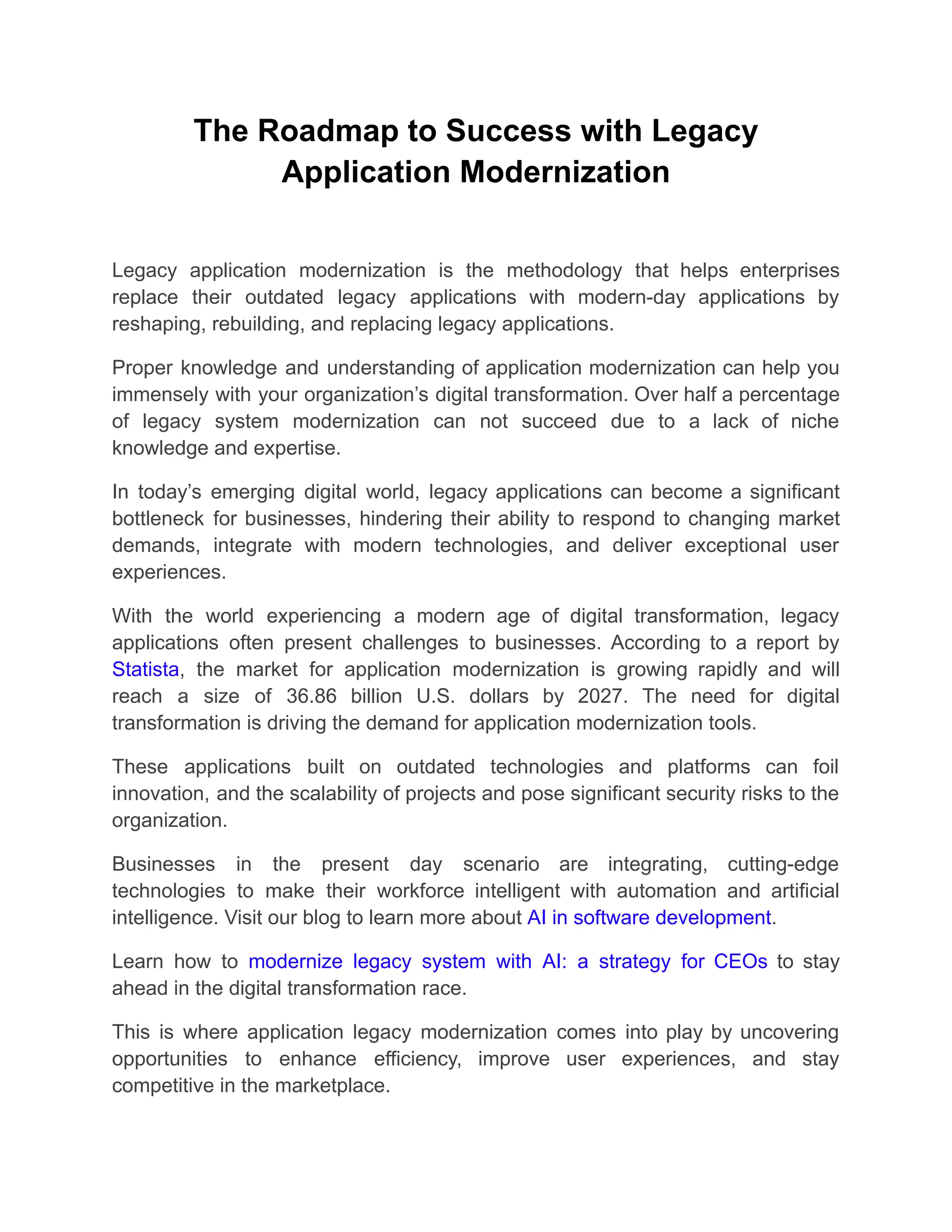
Legacy application modernization is the methodology that helps enterprises
replace their outdated legacy applications with modern-day applications by
reshaping, rebuilding, and replacing legacy applications.
Proper knowledge and understanding of application modernization can help you
immensely with your organization’s digital transformation. Over half a percentage
of legacy system modernization can not succeed due to a lack of niche
knowledge and expertise.
In today’s emerging digital world, legacy applications can become a significant
bottleneck for businesses, hindering their ability to respond to changing market
demands, integrate with modern technologies, and deliver exceptional user
experiences.
With the world experiencing a modern age of digital transformation, legacy
applications often present challenges to businesses. According to a report by
Statista, the market for application modernization is growing rapidly and will
reach a size of 36.86 billion U.S. dollars by 2027. The need for digital
transformation is driving the demand for application modernization tools.
These applications built on outdated technologies and platforms can foil
innovation, and the scalability of projects and pose significant security risks to the
organization.
Businesses in the present day scenario are integrating, cutting-edge
technologies to make their workforce intelligent with automation and artificial
intelligence. Visit our blog to learn more about AI in software development.
Learn how to modernize legacy system with AI: a strategy for CEOs to stay
ahead in the digital transformation race.
This is where application legacy modernization comes into play by uncovering
opportunities to enhance efficiency, improve user experiences, and stay
competitive in the marketplace.
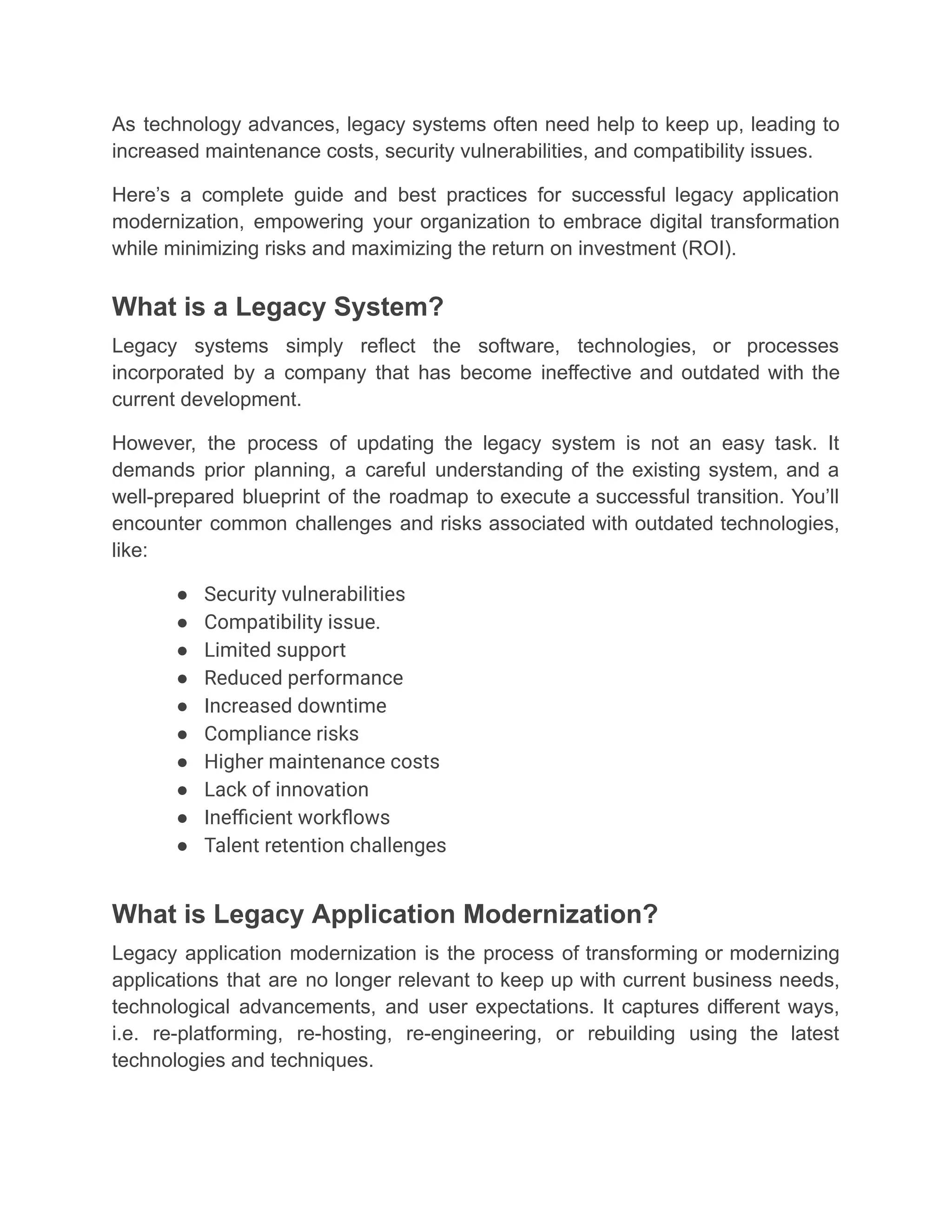
As technology advances, legacy systems often need help to keep up, leading to
increased maintenance costs, security vulnerabilities, and compatibility issues.
Here’s a complete guide and best practices for successful legacy application
modernization, empowering your organization to embrace digital transformation
while minimizing risks and maximizing the return on investment (ROI).
What is a Legacy System?
Legacy systems simply reflect the software, technologies, or processes
incorporated by a company that has become ineffective and outdated with the
current development.
However, the process of updating the legacy system is not an easy task. It
demands prior planning, a careful understanding of the existing system, and a
well-prepared blueprint of the roadmap to execute a successful transition. You’ll
encounter common challenges and risks associated with outdated technologies,
like:
●​ Security vulnerabilities
●​ Compatibility issue.
●​ Limited support
●​ Reduced performance
●​ Increased downtime
●​ Compliance risks
●​ Higher maintenance costs
●​ Lack of innovation
●​ Inefficient workflows
●​ Talent retention challenges
What is Legacy Application Modernization?
Legacy application modernization is the process of transforming or modernizing
applications that are no longer relevant to keep up with current business needs,
technological advancements, and user expectations. It captures different ways,
i.e. re-platforming, re-hosting, re-engineering, or rebuilding using the latest
technologies and techniques.
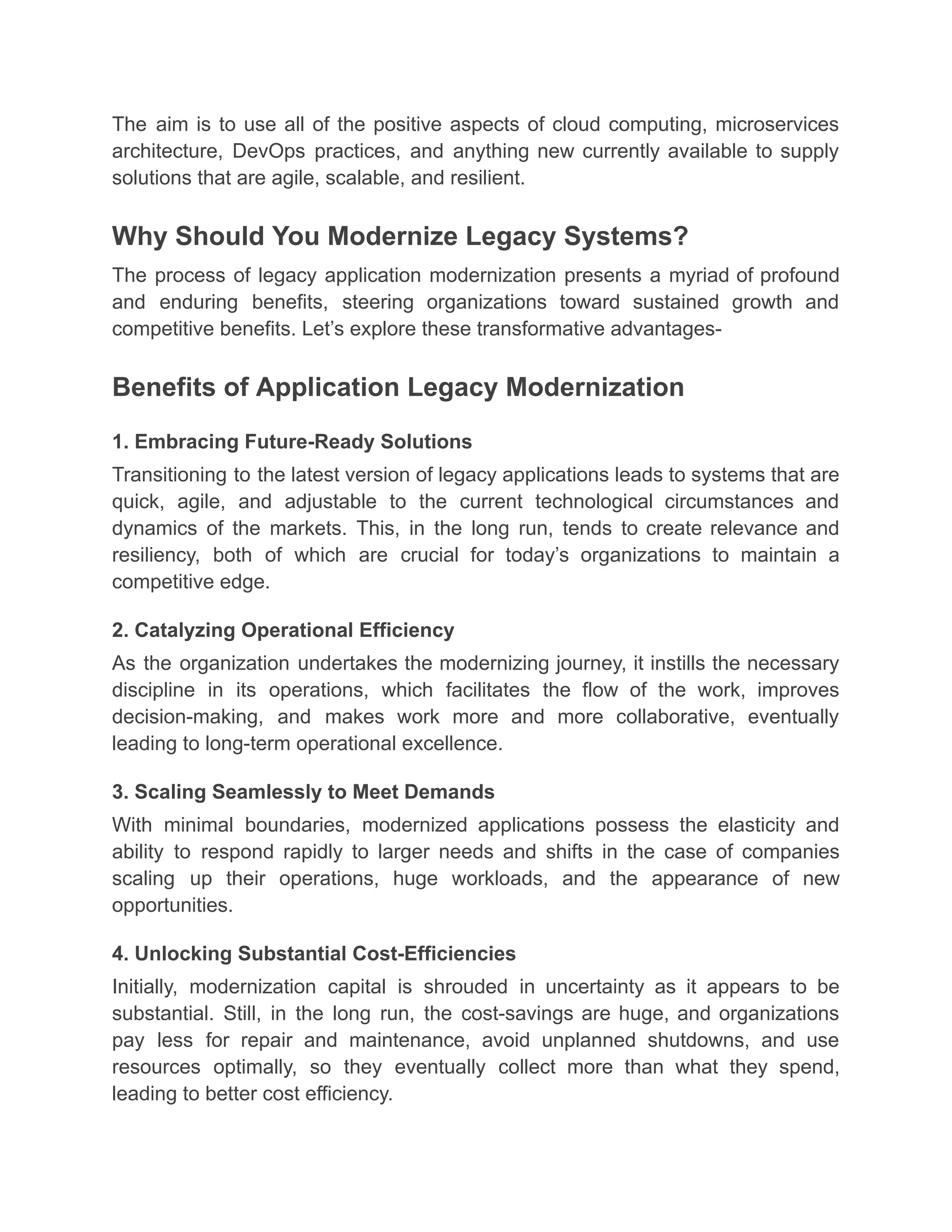
The aim is to use all of the positive aspects of cloud computing, microservices
architecture, DevOps practices, and anything new currently available to supply
solutions that are agile, scalable, and resilient.
Why Should You Modernize Legacy Systems?
The process of legacy application modernization presents a myriad of profound
and enduring benefits, steering organizations toward sustained growth and
competitive benefits. Let’s explore these transformative advantages-
Benefits of Application Legacy Modernization
1. Embracing Future-Ready Solutions
Transitioning to the latest version of legacy applications leads to systems that are
quick, agile, and adjustable to the current technological circumstances and
dynamics of the markets. This, in the long run, tends to create relevance and
resiliency, both of which are crucial for today’s organizations to maintain a
competitive edge.
2. Catalyzing Operational Efficiency
As the organization undertakes the modernizing journey, it instills the necessary
discipline in its operations, which facilitates the flow of the work, improves
decision-making, and makes work more and more collaborative, eventually
leading to long-term operational excellence.
3. Scaling Seamlessly to Meet Demands
With minimal boundaries, modernized applications possess the elasticity and
ability to respond rapidly to larger needs and shifts in the case of companies
scaling up their operations, huge workloads, and the appearance of new
opportunities.
4. Unlocking Substantial Cost-Efficiencies
Initially, modernization capital is shrouded in uncertainty as it appears to be
substantial. Still, in the long run, the cost-savings are huge, and organizations
pay less for repair and maintenance, avoid unplanned shutdowns, and use
resources optimally, so they eventually collect more than what they spend,
leading to better cost efficiency.
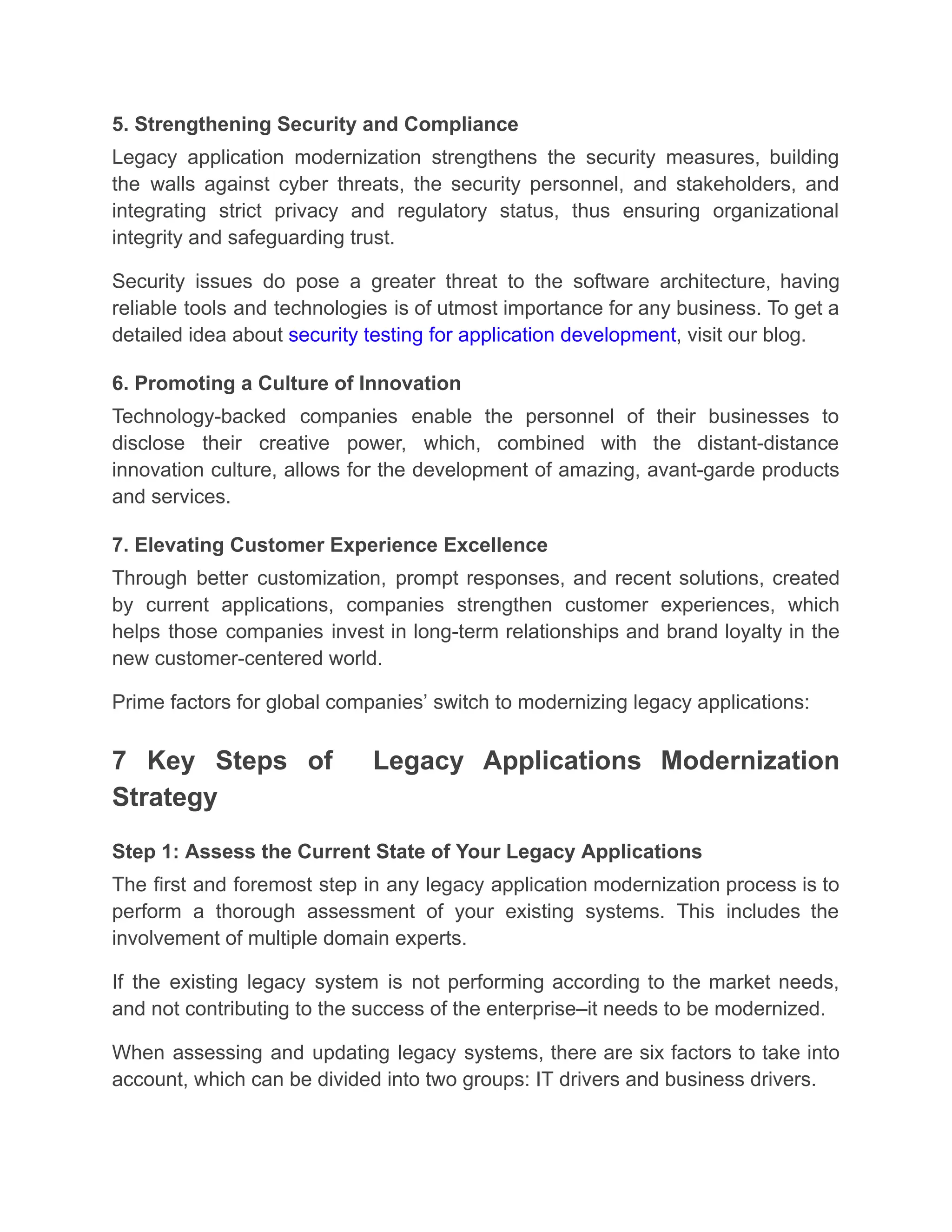
5. Strengthening Security and Compliance
Legacy application modernization strengthens the security measures, building
the walls against cyber threats, the security personnel, and stakeholders, and
integrating strict privacy and regulatory status, thus ensuring organizational
integrity and safeguarding trust.
Security issues do pose a greater threat to the software architecture, having
reliable tools and technologies is of utmost importance for any business. To get a
detailed idea about security testing for application development, visit our blog.
6. Promoting a Culture of Innovation
Technology-backed companies enable the personnel of their businesses to
disclose their creative power, which, combined with the distant-distance
innovation culture, allows for the development of amazing, avant-garde products
and services.
7. Elevating Customer Experience Excellence
Through better customization, prompt responses, and recent solutions, created
by current applications, companies strengthen customer experiences, which
helps those companies invest in long-term relationships and brand loyalty in the
new customer-centered world.
Prime factors for global companies’ switch to modernizing legacy applications:
7 Key Steps of Legacy Applications Modernization
Strategy
Step 1: Assess the Current State of Your Legacy Applications
The first and foremost step in any legacy application modernization process is to
perform a thorough assessment of your existing systems. This includes the
involvement of multiple domain experts.
If the existing legacy system is not performing according to the market needs,
and not contributing to the success of the enterprise–it needs to be modernized.
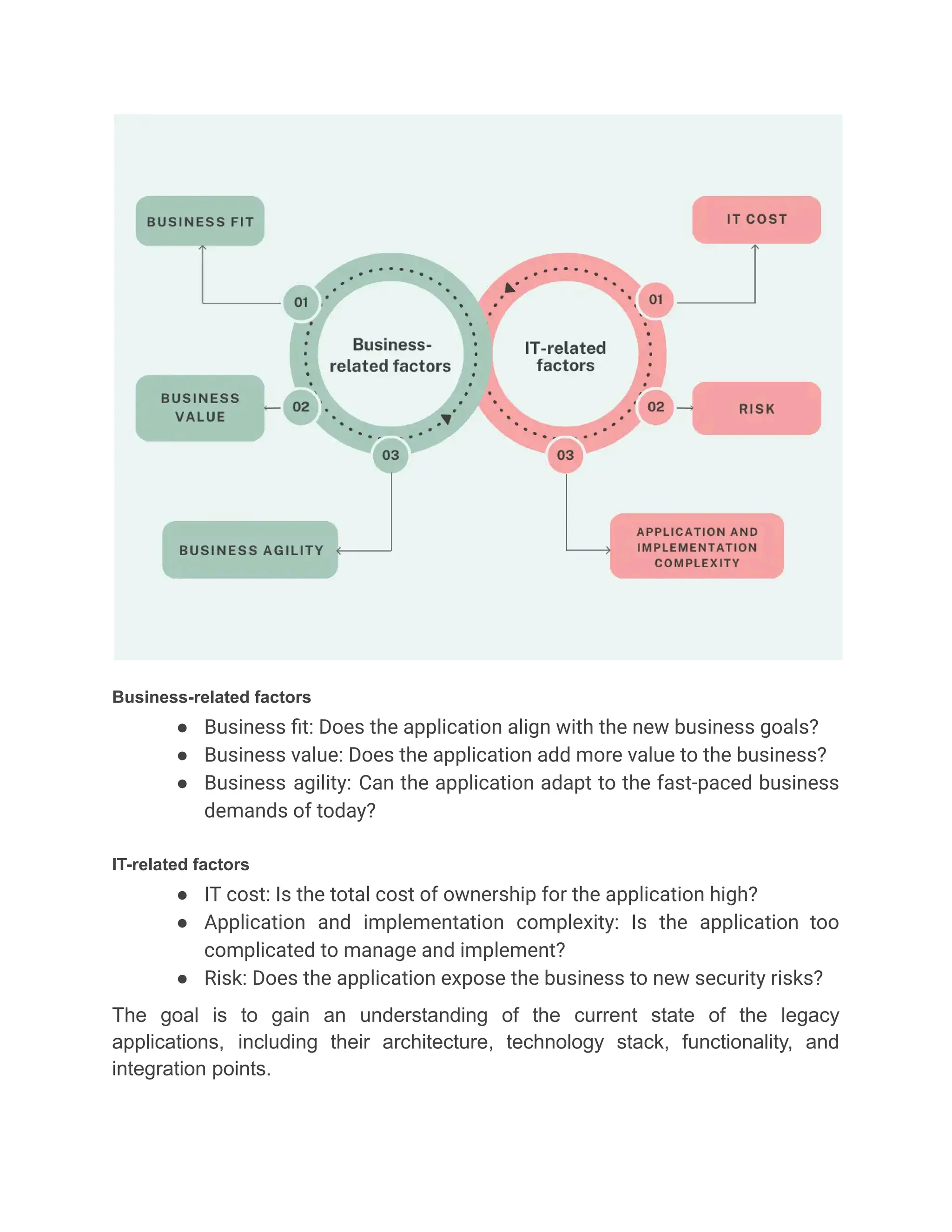
When assessing and updating legacy systems, there are six factors to take into
account, which can be divided into two groups: IT drivers and business drivers.
Business-related factors
●​ Business fit: Does the application align with the new business goals?
●​ Business value: Does the application add more value to the business?
●​ Business agility: Can the application adapt to the fast-paced business
demands of today?
IT-related factors
●​ IT cost: Is the total cost of ownership for the application high?
●​ Application and implementation complexity: Is the application too
complicated to manage and implement?
●​ Risk: Does the application expose the business to new security risks?
The goal is to gain an understanding of the current state of the legacy
applications, including their architecture, technology stack, functionality, and
integration points.
Step 2: Define the Target State and Modernization Approach
After having a prompt understanding of the current state of your legacy
applications, the next step is to define the goal and required approach for
modernization, including exploring the best legacy application modernization
approaches. This involves the declaration of functional requirements, project
architecture, and a technology stack that will work on modernized applications.
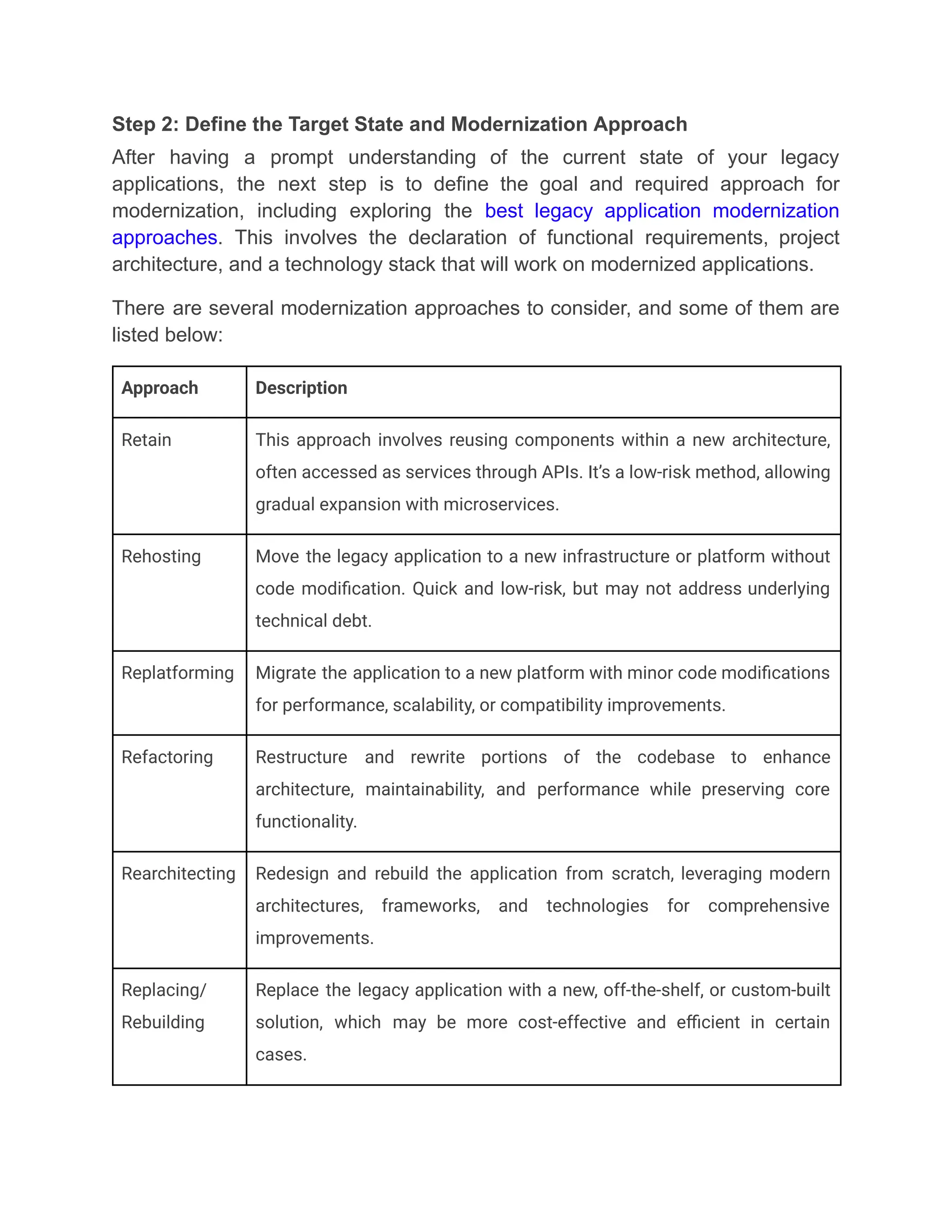
There are several modernization approaches to consider, and some of them are
listed below:
Approach Description
Retain This approach involves reusing components within a new architecture,
often accessed as services through APIs. It’s a low-risk method, allowing
gradual expansion with microservices.
Rehosting Move the legacy application to a new infrastructure or platform without
code modification. Quick and low-risk, but may not address underlying
technical debt.
Replatforming Migrate the application to a new platform with minor code modifications
for performance, scalability, or compatibility improvements.
Refactoring Restructure and rewrite portions of the codebase to enhance
architecture, maintainability, and performance while preserving core
functionality.
Rearchitecting Redesign and rebuild the application from scratch, leveraging modern
architectures, frameworks, and technologies for comprehensive
improvements.
Replacing/
Rebuilding
Replace the legacy application with a new, off-the-shelf, or custom-built
solution, which may be more cost-effective and efficient in certain
cases.
Step 3: Develop an App Modernization Plan of Action
Develop an app modernization roadmap that clearly outlines the specific steps,
project pace and timelines, and resources needed for the transition from the
legacy application to a modernized software solution.
Be updated with the future trends in software development technologies to
incorporate the tech stack that best fits your business requirements.
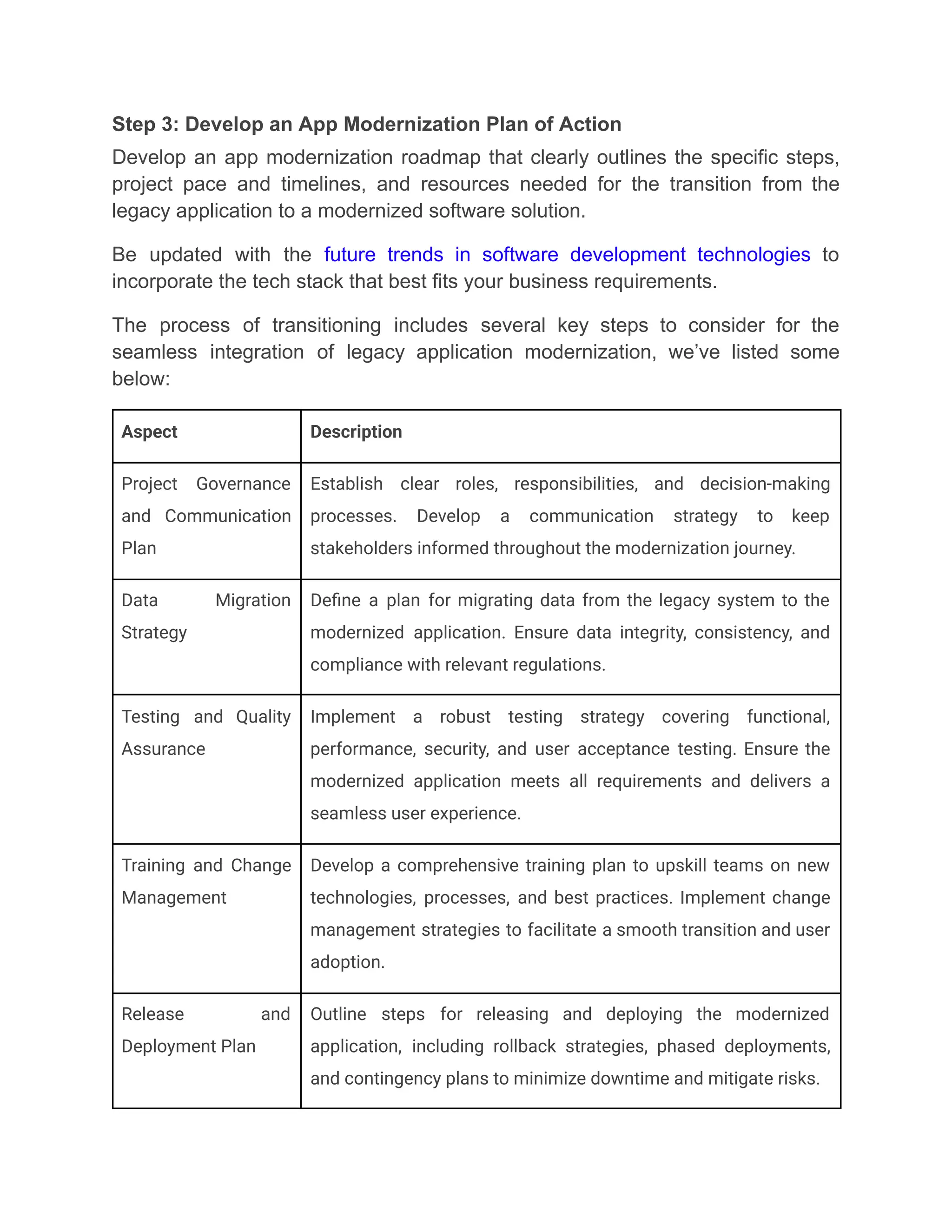
The process of transitioning includes several key steps to consider for the
seamless integration of legacy application modernization, we’ve listed some
below:
Aspect Description
Project Governance
and Communication
Plan
Establish clear roles, responsibilities, and decision-making
processes. Develop a communication strategy to keep
stakeholders informed throughout the modernization journey.
Data Migration
Strategy
Define a plan for migrating data from the legacy system to the
modernized application. Ensure data integrity, consistency, and
compliance with relevant regulations.
Testing and Quality
Assurance
Implement a robust testing strategy covering functional,
performance, security, and user acceptance testing. Ensure the
modernized application meets all requirements and delivers a
seamless user experience.
Training and Change
Management
Develop a comprehensive training plan to upskill teams on new
technologies, processes, and best practices. Implement change
management strategies to facilitate a smooth transition and user
adoption.
Release and
Deployment Plan
Outline steps for releasing and deploying the modernized
application, including rollback strategies, phased deployments,
and contingency plans to minimize downtime and mitigate risks.
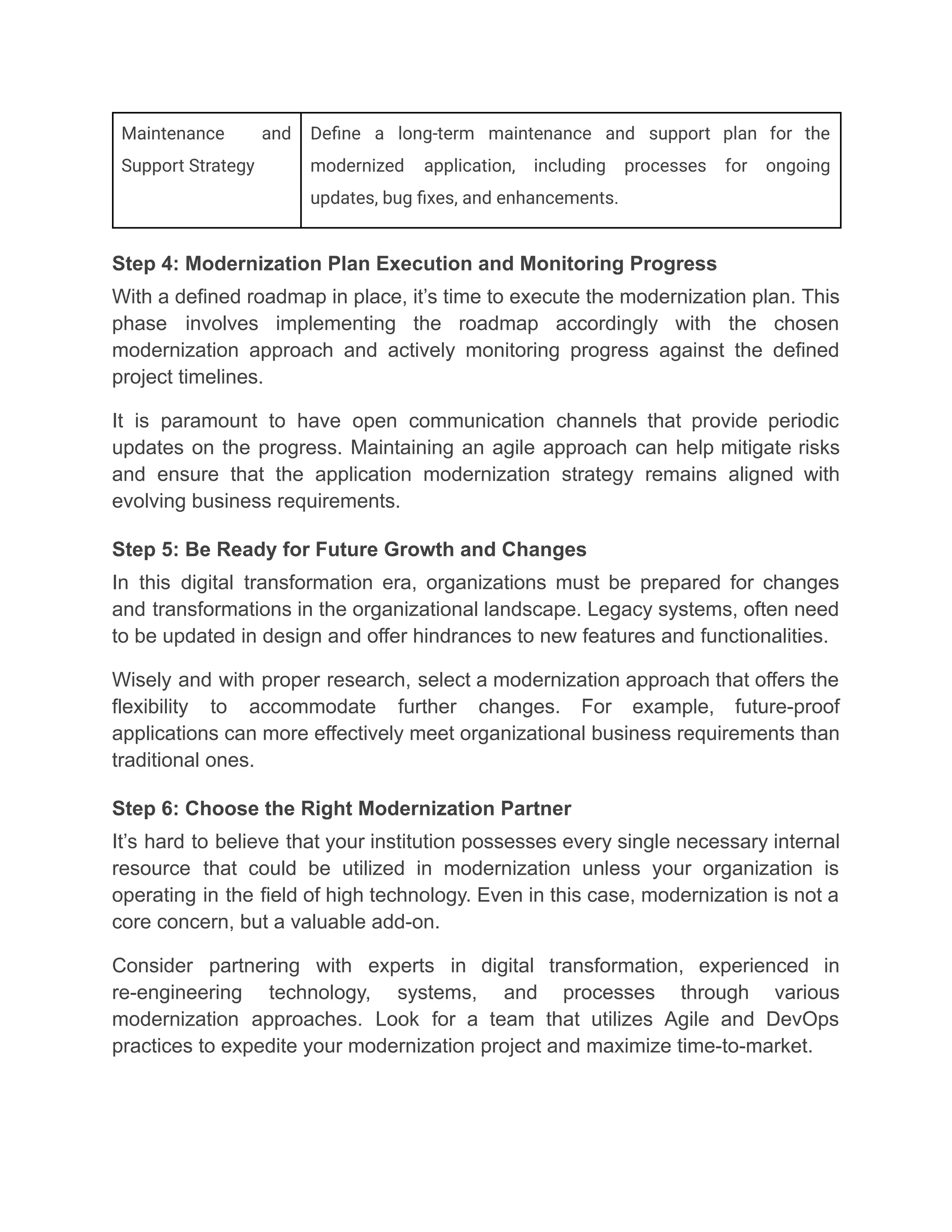
Maintenance and
Support Strategy
Define a long-term maintenance and support plan for the
modernized application, including processes for ongoing
updates, bug fixes, and enhancements.
Step 4: Modernization Plan Execution and Monitoring Progress
With a defined roadmap in place, it’s time to execute the modernization plan. This
phase involves implementing the roadmap accordingly with the chosen
modernization approach and actively monitoring progress against the defined
project timelines.
It is paramount to have open communication channels that provide periodic
updates on the progress. Maintaining an agile approach can help mitigate risks
and ensure that the application modernization strategy remains aligned with
evolving business requirements.
Step 5: Be Ready for Future Growth and Changes
In this digital transformation era, organizations must be prepared for changes
and transformations in the organizational landscape. Legacy systems, often need
to be updated in design and offer hindrances to new features and functionalities.
Wisely and with proper research, select a modernization approach that offers the
flexibility to accommodate further changes. For example, future-proof
applications can more effectively meet organizational business requirements than
traditional ones.
Step 6: Choose the Right Modernization Partner
It’s hard to believe that your institution possesses every single necessary internal
resource that could be utilized in modernization unless your organization is
operating in the field of high technology. Even in this case, modernization is not a
core concern, but a valuable add-on.
Consider partnering with experts in digital transformation, experienced in
re-engineering technology, systems, and processes through various
modernization approaches. Look for a team that utilizes Agile and DevOps
practices to expedite your modernization project and maximize time-to-market.
Step 7: Observe and Optimize
Continually, during your modernizing process, keep a close lookout, adjusting
and improving it. Step by step, run the periodic performance tests to seek and
work on the changes in the apps to streamline issues such as hosting the app,
licensing the software, connectivity to other services, and database integration.

The Roadmap to Success with Legacy Application Modernization

  • 1.
    The Roadmap toSuccess with Legacy Application Modernization Legacy application modernization is the methodology that helps enterprises replace their outdated legacy applications with modern-day applications by reshaping, rebuilding, and replacing legacy applications. Proper knowledge and understanding of application modernization can help you immensely with your organization’s digital transformation. Over half a percentage of legacy system modernization can not succeed due to a lack of niche knowledge and expertise. In today’s emerging digital world, legacy applications can become a significant bottleneck for businesses, hindering their ability to respond to changing market demands, integrate with modern technologies, and deliver exceptional user experiences. With the world experiencing a modern age of digital transformation, legacy applications often present challenges to businesses. According to a report by Statista, the market for application modernization is growing rapidly and will reach a size of 36.86 billion U.S. dollars by 2027. The need for digital transformation is driving the demand for application modernization tools. These applications built on outdated technologies and platforms can foil innovation, and the scalability of projects and pose significant security risks to the organization. Businesses in the present day scenario are integrating, cutting-edge technologies to make their workforce intelligent with automation and artificial intelligence. Visit our blog to learn more about AI in software development. Learn how to modernize legacy system with AI: a strategy for CEOs to stay ahead in the digital transformation race. This is where application legacy modernization comes into play by uncovering opportunities to enhance efficiency, improve user experiences, and stay competitive in the marketplace.
  • 2.
    As technology advances,legacy systems often need help to keep up, leading to increased maintenance costs, security vulnerabilities, and compatibility issues. Here’s a complete guide and best practices for successful legacy application modernization, empowering your organization to embrace digital transformation while minimizing risks and maximizing the return on investment (ROI). What is a Legacy System? Legacy systems simply reflect the software, technologies, or processes incorporated by a company that has become ineffective and outdated with the current development. However, the process of updating the legacy system is not an easy task. It demands prior planning, a careful understanding of the existing system, and a well-prepared blueprint of the roadmap to execute a successful transition. You’ll encounter common challenges and risks associated with outdated technologies, like: ●​ Security vulnerabilities ●​ Compatibility issue. ●​ Limited support ●​ Reduced performance ●​ Increased downtime ●​ Compliance risks ●​ Higher maintenance costs ●​ Lack of innovation ●​ Inefficient workflows ●​ Talent retention challenges What is Legacy Application Modernization? Legacy application modernization is the process of transforming or modernizing applications that are no longer relevant to keep up with current business needs, technological advancements, and user expectations. It captures different ways, i.e. re-platforming, re-hosting, re-engineering, or rebuilding using the latest technologies and techniques.
  • 3.
    The aim isto use all of the positive aspects of cloud computing, microservices architecture, DevOps practices, and anything new currently available to supply solutions that are agile, scalable, and resilient. Why Should You Modernize Legacy Systems? The process of legacy application modernization presents a myriad of profound and enduring benefits, steering organizations toward sustained growth and competitive benefits. Let’s explore these transformative advantages- Benefits of Application Legacy Modernization 1. Embracing Future-Ready Solutions Transitioning to the latest version of legacy applications leads to systems that are quick, agile, and adjustable to the current technological circumstances and dynamics of the markets. This, in the long run, tends to create relevance and resiliency, both of which are crucial for today’s organizations to maintain a competitive edge. 2. Catalyzing Operational Efficiency As the organization undertakes the modernizing journey, it instills the necessary discipline in its operations, which facilitates the flow of the work, improves decision-making, and makes work more and more collaborative, eventually leading to long-term operational excellence. 3. Scaling Seamlessly to Meet Demands With minimal boundaries, modernized applications possess the elasticity and ability to respond rapidly to larger needs and shifts in the case of companies scaling up their operations, huge workloads, and the appearance of new opportunities. 4. Unlocking Substantial Cost-Efficiencies Initially, modernization capital is shrouded in uncertainty as it appears to be substantial. Still, in the long run, the cost-savings are huge, and organizations pay less for repair and maintenance, avoid unplanned shutdowns, and use resources optimally, so they eventually collect more than what they spend, leading to better cost efficiency.
  • 4.
    5. Strengthening Securityand Compliance Legacy application modernization strengthens the security measures, building the walls against cyber threats, the security personnel, and stakeholders, and integrating strict privacy and regulatory status, thus ensuring organizational integrity and safeguarding trust. Security issues do pose a greater threat to the software architecture, having reliable tools and technologies is of utmost importance for any business. To get a detailed idea about security testing for application development, visit our blog. 6. Promoting a Culture of Innovation Technology-backed companies enable the personnel of their businesses to disclose their creative power, which, combined with the distant-distance innovation culture, allows for the development of amazing, avant-garde products and services. 7. Elevating Customer Experience Excellence Through better customization, prompt responses, and recent solutions, created by current applications, companies strengthen customer experiences, which helps those companies invest in long-term relationships and brand loyalty in the new customer-centered world. Prime factors for global companies’ switch to modernizing legacy applications: 7 Key Steps of Legacy Applications Modernization Strategy Step 1: Assess the Current State of Your Legacy Applications The first and foremost step in any legacy application modernization process is to perform a thorough assessment of your existing systems. This includes the involvement of multiple domain experts. If the existing legacy system is not performing according to the market needs, and not contributing to the success of the enterprise–it needs to be modernized. When assessing and updating legacy systems, there are six factors to take into account, which can be divided into two groups: IT drivers and business drivers.
  • 5.
    Business-related factors ●​ Businessfit: Does the application align with the new business goals? ●​ Business value: Does the application add more value to the business? ●​ Business agility: Can the application adapt to the fast-paced business demands of today? IT-related factors ●​ IT cost: Is the total cost of ownership for the application high? ●​ Application and implementation complexity: Is the application too complicated to manage and implement? ●​ Risk: Does the application expose the business to new security risks? The goal is to gain an understanding of the current state of the legacy applications, including their architecture, technology stack, functionality, and integration points.
  • 6.
    Step 2: Definethe Target State and Modernization Approach After having a prompt understanding of the current state of your legacy applications, the next step is to define the goal and required approach for modernization, including exploring the best legacy application modernization approaches. This involves the declaration of functional requirements, project architecture, and a technology stack that will work on modernized applications. There are several modernization approaches to consider, and some of them are listed below: Approach Description Retain This approach involves reusing components within a new architecture, often accessed as services through APIs. It’s a low-risk method, allowing gradual expansion with microservices. Rehosting Move the legacy application to a new infrastructure or platform without code modification. Quick and low-risk, but may not address underlying technical debt. Replatforming Migrate the application to a new platform with minor code modifications for performance, scalability, or compatibility improvements. Refactoring Restructure and rewrite portions of the codebase to enhance architecture, maintainability, and performance while preserving core functionality. Rearchitecting Redesign and rebuild the application from scratch, leveraging modern architectures, frameworks, and technologies for comprehensive improvements. Replacing/ Rebuilding Replace the legacy application with a new, off-the-shelf, or custom-built solution, which may be more cost-effective and efficient in certain cases.
  • 7.
    Step 3: Developan App Modernization Plan of Action Develop an app modernization roadmap that clearly outlines the specific steps, project pace and timelines, and resources needed for the transition from the legacy application to a modernized software solution. Be updated with the future trends in software development technologies to incorporate the tech stack that best fits your business requirements. The process of transitioning includes several key steps to consider for the seamless integration of legacy application modernization, we’ve listed some below: Aspect Description Project Governance and Communication Plan Establish clear roles, responsibilities, and decision-making processes. Develop a communication strategy to keep stakeholders informed throughout the modernization journey. Data Migration Strategy Define a plan for migrating data from the legacy system to the modernized application. Ensure data integrity, consistency, and compliance with relevant regulations. Testing and Quality Assurance Implement a robust testing strategy covering functional, performance, security, and user acceptance testing. Ensure the modernized application meets all requirements and delivers a seamless user experience. Training and Change Management Develop a comprehensive training plan to upskill teams on new technologies, processes, and best practices. Implement change management strategies to facilitate a smooth transition and user adoption. Release and Deployment Plan Outline steps for releasing and deploying the modernized application, including rollback strategies, phased deployments, and contingency plans to minimize downtime and mitigate risks.
  • 8.
    Maintenance and Support Strategy Definea long-term maintenance and support plan for the modernized application, including processes for ongoing updates, bug fixes, and enhancements. Step 4: Modernization Plan Execution and Monitoring Progress With a defined roadmap in place, it’s time to execute the modernization plan. This phase involves implementing the roadmap accordingly with the chosen modernization approach and actively monitoring progress against the defined project timelines. It is paramount to have open communication channels that provide periodic updates on the progress. Maintaining an agile approach can help mitigate risks and ensure that the application modernization strategy remains aligned with evolving business requirements. Step 5: Be Ready for Future Growth and Changes In this digital transformation era, organizations must be prepared for changes and transformations in the organizational landscape. Legacy systems, often need to be updated in design and offer hindrances to new features and functionalities. Wisely and with proper research, select a modernization approach that offers the flexibility to accommodate further changes. For example, future-proof applications can more effectively meet organizational business requirements than traditional ones. Step 6: Choose the Right Modernization Partner It’s hard to believe that your institution possesses every single necessary internal resource that could be utilized in modernization unless your organization is operating in the field of high technology. Even in this case, modernization is not a core concern, but a valuable add-on. Consider partnering with experts in digital transformation, experienced in re-engineering technology, systems, and processes through various modernization approaches. Look for a team that utilizes Agile and DevOps practices to expedite your modernization project and maximize time-to-market.
  • 9.
    Step 7: Observeand Optimize Continually, during your modernizing process, keep a close lookout, adjusting and improving it. Step by step, run the periodic performance tests to seek and work on the changes in the apps to streamline issues such as hosting the app, licensing the software, connectivity to other services, and database integration.