The Rise of
Generative AI
Presented by:-
Chinmay bisoyi
Rakesh kumar sahoo
Abhipsa satapathy
Laxmishree prusty
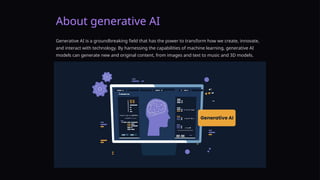
About generative AI
Generative AI is a groundbreaking field that has the power to transform how we create, innovate,
and interact with technology. By harnessing the capabilities of machine learning, generative AI
models can generate new and original content, from images and text to music and 3D models.
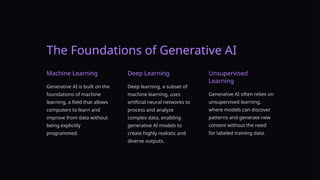
The Foundations of Generative AI
Machine Learning
Generative AI is built on the
foundations of machine
learning, a field that allows
computers to learn and
improve from data without
being explicitly
programmed.
Deep Learning
Deep learning, a subset of
machine learning, uses
artificial neural networks to
process and analyze
complex data, enabling
generative AI models to
create highly realistic and
diverse outputs.
Unsupervised
Learning
Generative AI often relies on
unsupervised learning,
where models can discover
patterns and generate new
content without the need
for labeled training data.
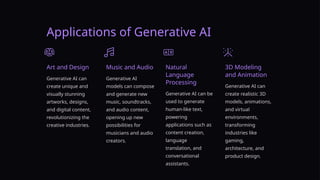
Applications of Generative AI
Art and Design
Generative AI can
create unique and
visually stunning
artworks, designs,
and digital content,
revolutionizing the
creative industries.
Music and Audio
Generative AI
models can compose
and generate new
music, soundtracks,
and audio content,
opening up new
possibilities for
musicians and audio
creators.
Natural
Language
Processing
Generative AI can be
used to generate
human-like text,
powering
applications such as
content creation,
language
translation, and
conversational
assistants.
3D Modeling
and Animation
Generative AI can
create realistic 3D
models, animations,
and virtual
environments,
transforming
industries like
gaming,
architecture, and
product design.
Key Advancements in Generative AI
1 Generative Adversarial
Networks (GANs)
GANs are a type of neural network
architecture that pits two models
against each other, allowing for the
generation of highly realistic and diverse
outputs.
2 Variational Autoencoders (VAEs)
VAEs are a probabilistic approach to
generative modeling, enabling the
creation of new data points that are
similar to the training data.
3 Transformer Models
Transformer models, such as GPT-3,
have revolutionized natural language
processing and can be used to generate
human-like text, opening up new
possibilities for content creation.
4 Diffusion Models
Diffusion models, like DALL-E 2, have
demonstrated remarkable abilities in
generating high-quality, diverse images
from textual descriptions, blurring the
line between human and machine
creativity.
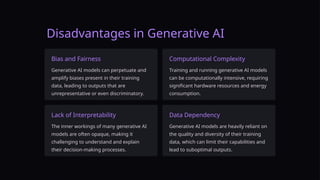
Disadvantages in Generative AI
Bias and Fairness
Generative AI models can perpetuate and
amplify biases present in their training
data, leading to outputs that are
unrepresentative or even discriminatory.
Computational Complexity
Training and running generative AI models
can be computationally intensive, requiring
significant hardware resources and energy
consumption.
Lack of Interpretability
The inner workings of many generative AI
models are often opaque, making it
challenging to understand and explain
their decision-making processes.
Data Dependency
Generative AI models are heavily reliant on
the quality and diversity of their training
data, which can limit their capabilities and
lead to suboptimal outputs.
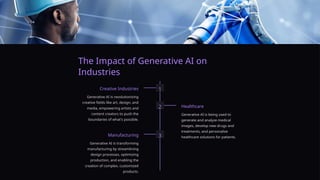
The Impact of Generative AI on
Industries
1
Creative Industries
Generative AI is revolutionizing
creative fields like art, design, and
media, empowering artists and
content creators to push the
boundaries of what's possible.
2 Healthcare
Generative AI is being used to
generate and analyze medical
images, develop new drugs and
treatments, and personalize
healthcare solutions for patients.
3
Manufacturing
Generative AI is transforming
manufacturing by streamlining
design processes, optimizing
production, and enabling the
creation of complex, customized
products.
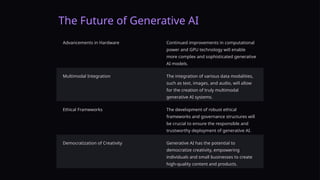
The Future of Generative AI
Advancements in Hardware Continued improvements in computational
power and GPU technology will enable
more complex and sophisticated generative
AI models.
Multimodal Integration The integration of various data modalities,
such as text, images, and audio, will allow
for the creation of truly multimodal
generative AI systems.
Ethical Frameworks The development of robust ethical
frameworks and governance structures will
be crucial to ensure the responsible and
trustworthy deployment of generative AI.
Democratization of Creativity Generative AI has the potential to
democratize creativity, empowering
individuals and small businesses to create
high-quality content and products.
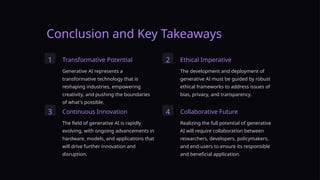
Conclusion and Key Takeaways
1 Transformative Potential
Generative AI represents a
transformative technology that is
reshaping industries, empowering
creativity, and pushing the boundaries
of what's possible.
2 Ethical Imperative
The development and deployment of
generative AI must be guided by robust
ethical frameworks to address issues of
bias, privacy, and transparency.
3 Continuous Innovation
The field of generative AI is rapidly
evolving, with ongoing advancements in
hardware, models, and applications that
will drive further innovation and
disruption.
4 Collaborative Future
Realizing the full potential of generative
AI will require collaboration between
researchers, developers, policymakers,
and end-users to ensure its responsible
and beneficial application.