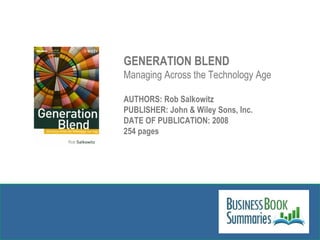

GENERATION BLEND Managing Across the Technology Age AUTHORS: Rob Salkowitz PUBLISHER: John & Wiley Sons, Inc. DATE OF PUBLICATION: 2008 254 pages
FEATURES OF THE BOOK To obtain the greatest levels of productivity and employee satisfaction, organizations must address the diverse needs of different generations in the workforce. Attitudes toward technology are an important aspect of generational differences.  Generation Blend  is intended to help company decision makers move beyond stereotypes and better understand the relationship between generations and technology.
THE BIG IDEA In  Generation Blend , Rob Salkowitz discusses the four generations in the workplace today and provides tools to address generational issues.
INTRODUCTION In the years ahead, the workplace will be characterized by high degrees of demographic diversity. Today, there are four generations represented in the workforce: the Silent Generation (born between the Great Depression and the end of World War II), Baby Boomers (born between 1946 and 1962), Generation X (born between 1963 and 1980), and the Millennials (born between 1981 and 2000). To maintain productivity, organizations must learn to blend these generations. In addition, companies should attempt to increase productivity through the implementation of new and sophisticated information technology tools. Unfortunately, generational issues related to technology often go unacknowledged.
EMPLOYERS FACE DRAMATIC DEMOGRAPHIC AND TECHNOLOGICAL CHANGES  The beginning of the 21st century is noteworthy because American employers are facing significant demographic shifts in the workforce, as well as simultaneously experiencing an explosion of information and communication technologies. As Baby Boomers approach retirement age, it will become challenging for organizations to find skilled workers. Older employees will be forced to work side by side with younger Generation X and Millennial employees.
OLDER EMPLOYEES IN TODAY’S WORKPLACE  Today,  45 percent of the American workforce is comprised of Baby Boomers.  Although many expect to retire by age 65, organizations should still be concerned about preserving these employees’ knowledge and skills. Technology can be helpful in achieving this goal. However many older employees are reluctant to use knowledge and collaboration tools. In addition, some Baby Boomers feel that collaborative content and distributed decision-making are threats to their authority. To overcome these obstacles to technology, it is essential that companies identify the root of employees’ opposition. In most cases, it is not simply that older workers fear change in the workplace. The real barriers to adoption are usually related to values, work styles, and priorities.
UNDERSTANDING TECHNOLOGY-LOVING MILLENNIALS The Millennial generation is considered to be optimistic, moral, collaborative, and global in their outlook and approach to the workplace.  In the United States alone, there are approximately 80 million Millennials. Although Boomers established a workplace that offers money in exchange for an employees’ time, this system does not appeal to Millennials. They view personal development as the best compensation for time spent at work.
GENERATION X IN THE EXECUTIVE SUITE  Generation X or Gen X is the age cohort between the Boomers and the Millennials . Experts estimate that there are approximately 51 million Generation Xers in the United States. Just as Generation X was entering the teen years, the personal computer arrived on the scene. As a result, this generation entered the workforce with a good understanding of computer applications and how computers are supposed to work.
BLENDING OLDER WORKERS INTO TODAY’S WORKPLACE  In today’s competitive employment market, older workers’ expertise and mature point of view are attractive to organizations. To adapt to the connected workplace, older employees must accept a set of values and practices associated with technology.  Training programs  are one way to effectively facilitate this transition. Training is a valuable approach because older workers are often reluctant to ask younger co-workers for help. This reluctance may be related to issues of control, authority, or social dynamics. It is important to recognize, however, that standard training programs often create barriers to full participation.
YOUNGER WORKERS AS A SOURCE OF STRATEGIC INSIGHTS  Although the Millennials may not impact companies for another 10 to 15 years, it is important for employers to recognize that this generation will absolutely change the face of the workplace. Salkowitz highlights Microsoft’s Information Worker Board of the Future. This is an initiative that was designed to identify Millennials’ capabilities, desires, and expectations when they join the workforce. The resulting vision of the future workplace has been used by Microsoft in customer discussions and as the basis for product development, employee recruitment, and human resource planning.
BRIDGING THE DIGITAL AGE GAP  Diverse generations in the workplace have different values and do things differently from one another. The  digital age gap  is defined as a conflict between people and technology. It is based on people’s expectations, experiences, priorities, and the ways they understand work and the broader world. Successfully managing across this gap requires companies to harmonize the strengths of different generations in the workforce and to use technology to unite the organization.
BRIDGING THE DIGITAL AGE GAP  As new technologies are implemented, organizations should  budget for the cost of training , as well as licensing, integration, deployment, and technical support. It is essential that training address generational factors and be delivered in formats that are compatible with different users’ learning styles. Salkowitz proposes several design principles that make the introduction of new technologies less disruptive for workers. The first is to use customization to reduce complexity.
BRIDGING THE DIGITAL AGE GAP  Company culture  is another factor that cannot be overlooked when it comes to the adoption of technology. Technological changes that conflict with the prevailing culture are much more likely to be rejected. It is important to note that organizational culture is closely linked with the generational values of the company’s leadership, as well as its workforce.
BRIDGING THE DIGITAL AGE GAP  When leadership teams respect the needs of all workers, it is possible to combine the technological knowledge of young employees with the knowledge of more mature employees.  This enables firms to be more competitive, efficient, and responsive to external changes.
Business Book Summaries is a product of EBSCO Publishing. The website is updated weekly with 4 to 5 new summaries chosen from among the top business books printed in the United States. For more information or to sign up for the weekly newsletter, please visit  http://www.bizsum.com. ABOUT BIZSUM.COM

Generation Blend

  • 1.
  • 2.
    GENERATION BLEND ManagingAcross the Technology Age AUTHORS: Rob Salkowitz PUBLISHER: John & Wiley Sons, Inc. DATE OF PUBLICATION: 2008 254 pages
  • 3.
    FEATURES OF THEBOOK To obtain the greatest levels of productivity and employee satisfaction, organizations must address the diverse needs of different generations in the workforce. Attitudes toward technology are an important aspect of generational differences. Generation Blend is intended to help company decision makers move beyond stereotypes and better understand the relationship between generations and technology.
  • 4.
    THE BIG IDEAIn Generation Blend , Rob Salkowitz discusses the four generations in the workplace today and provides tools to address generational issues.
  • 5.
    INTRODUCTION In theyears ahead, the workplace will be characterized by high degrees of demographic diversity. Today, there are four generations represented in the workforce: the Silent Generation (born between the Great Depression and the end of World War II), Baby Boomers (born between 1946 and 1962), Generation X (born between 1963 and 1980), and the Millennials (born between 1981 and 2000). To maintain productivity, organizations must learn to blend these generations. In addition, companies should attempt to increase productivity through the implementation of new and sophisticated information technology tools. Unfortunately, generational issues related to technology often go unacknowledged.
  • 6.
    EMPLOYERS FACE DRAMATICDEMOGRAPHIC AND TECHNOLOGICAL CHANGES The beginning of the 21st century is noteworthy because American employers are facing significant demographic shifts in the workforce, as well as simultaneously experiencing an explosion of information and communication technologies. As Baby Boomers approach retirement age, it will become challenging for organizations to find skilled workers. Older employees will be forced to work side by side with younger Generation X and Millennial employees.
  • 7.
    OLDER EMPLOYEES INTODAY’S WORKPLACE Today, 45 percent of the American workforce is comprised of Baby Boomers. Although many expect to retire by age 65, organizations should still be concerned about preserving these employees’ knowledge and skills. Technology can be helpful in achieving this goal. However many older employees are reluctant to use knowledge and collaboration tools. In addition, some Baby Boomers feel that collaborative content and distributed decision-making are threats to their authority. To overcome these obstacles to technology, it is essential that companies identify the root of employees’ opposition. In most cases, it is not simply that older workers fear change in the workplace. The real barriers to adoption are usually related to values, work styles, and priorities.
  • 8.
    UNDERSTANDING TECHNOLOGY-LOVING MILLENNIALSThe Millennial generation is considered to be optimistic, moral, collaborative, and global in their outlook and approach to the workplace. In the United States alone, there are approximately 80 million Millennials. Although Boomers established a workplace that offers money in exchange for an employees’ time, this system does not appeal to Millennials. They view personal development as the best compensation for time spent at work.
  • 9.
    GENERATION X INTHE EXECUTIVE SUITE Generation X or Gen X is the age cohort between the Boomers and the Millennials . Experts estimate that there are approximately 51 million Generation Xers in the United States. Just as Generation X was entering the teen years, the personal computer arrived on the scene. As a result, this generation entered the workforce with a good understanding of computer applications and how computers are supposed to work.
  • 10.
    BLENDING OLDER WORKERSINTO TODAY’S WORKPLACE In today’s competitive employment market, older workers’ expertise and mature point of view are attractive to organizations. To adapt to the connected workplace, older employees must accept a set of values and practices associated with technology. Training programs are one way to effectively facilitate this transition. Training is a valuable approach because older workers are often reluctant to ask younger co-workers for help. This reluctance may be related to issues of control, authority, or social dynamics. It is important to recognize, however, that standard training programs often create barriers to full participation.
  • 11.
    YOUNGER WORKERS ASA SOURCE OF STRATEGIC INSIGHTS Although the Millennials may not impact companies for another 10 to 15 years, it is important for employers to recognize that this generation will absolutely change the face of the workplace. Salkowitz highlights Microsoft’s Information Worker Board of the Future. This is an initiative that was designed to identify Millennials’ capabilities, desires, and expectations when they join the workforce. The resulting vision of the future workplace has been used by Microsoft in customer discussions and as the basis for product development, employee recruitment, and human resource planning.
  • 12.
    BRIDGING THE DIGITALAGE GAP Diverse generations in the workplace have different values and do things differently from one another. The digital age gap is defined as a conflict between people and technology. It is based on people’s expectations, experiences, priorities, and the ways they understand work and the broader world. Successfully managing across this gap requires companies to harmonize the strengths of different generations in the workforce and to use technology to unite the organization.
  • 13.
    BRIDGING THE DIGITALAGE GAP As new technologies are implemented, organizations should budget for the cost of training , as well as licensing, integration, deployment, and technical support. It is essential that training address generational factors and be delivered in formats that are compatible with different users’ learning styles. Salkowitz proposes several design principles that make the introduction of new technologies less disruptive for workers. The first is to use customization to reduce complexity.
  • 14.
    BRIDGING THE DIGITALAGE GAP Company culture is another factor that cannot be overlooked when it comes to the adoption of technology. Technological changes that conflict with the prevailing culture are much more likely to be rejected. It is important to note that organizational culture is closely linked with the generational values of the company’s leadership, as well as its workforce.
  • 15.
    BRIDGING THE DIGITALAGE GAP When leadership teams respect the needs of all workers, it is possible to combine the technological knowledge of young employees with the knowledge of more mature employees. This enables firms to be more competitive, efficient, and responsive to external changes.
  • 16.
    Business Book Summariesis a product of EBSCO Publishing. The website is updated weekly with 4 to 5 new summaries chosen from among the top business books printed in the United States. For more information or to sign up for the weekly newsletter, please visit http://www.bizsum.com. ABOUT BIZSUM.COM