www.civilenvironjournal.com 001
https://doi.org/10.29328/journal.acee.1001032
Short Review
Generating eco-friendly electricity
from rain water
Khalid Abdel Naser Abdel Rahim*
Freelance Researcher in Civil Engineering, Coimbra, Portugal
More Information
*Address for Correspondence:
Khalid Abdel Naser Abdel Rahim, Freelance
Researcher in Civil Engineering, Coimbra,
Portugal, Email: khalid.ar@outlook.com
Submitted: Feburary 22, 2022
Approved: March 03, 2022
Published: March 04, 2022
How to cite this article: Abdel Rahim KAN*.
Generating eco-friendly electricity from rain
water. Ann Civil Environ Eng. 2022; 6: 001-002.
DOI: 10.29328/journal.acee.1001032
Copyright License: © 2022 Abdel Rahim KAN.
This is an open access article distributed under
the Creative Commons Attribution License,
which permits unrestricted use, distribution,
and reproduction in any medium, provided the
original work is properly cited.
Keywords: Design; Eco-friendly; Electricity; Rain
water
OPEN ACCESS
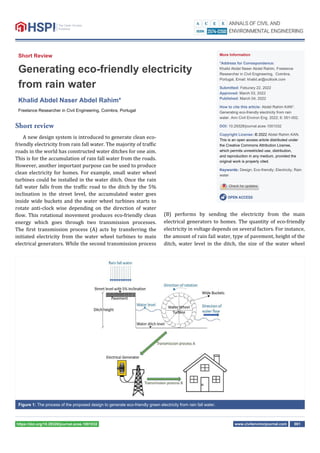
(B) performs by sending the electricity from the main
electrical generators to homes. The quantity of eco-friendly
electricity in voltage depends on several factors. For instance,
the amount of rain fail water, type of pavement, height of the
ditch, water level in the ditch, the size of the water wheel
Short review
A new design system is introduced to generate clean eco-
friendly electricity from rain fall water. The majority of traf ic
roads in the world has constructed water ditches for one aim.
This is for the accumulation of rain fall water from the roads.
However, another important purpose can be used to produce
clean electricity for homes. For example, small water wheel
turbines could be installed in the water ditch. Once the rain
fall water falls from the traf ic road to the ditch by the 5%
inclination in the street level, the accumulated water goes
inside wide buckets and the water wheel turbines starts to
rotate anti-clock wise depending on the direction of water
low. This rotational movement produces eco-friendly clean
energy which goes through two transmission processes.
The irst transmission process (A) acts by transferring the
initiated electricity from the water wheel turbines to main
electrical generators. While the second transmission process
Figure 1: The process of the proposed design to generate eco-friendly green electricity from rain fall water.
Generating eco-friendly electricity from rain water
www.civilenvironjournal.com 002
https://doi.org/10.29328/journal.acee.1001032
turbine and wide buckets. Another major aspect which should
be taken into consideration to successfully produce suf icient
amounts of electricity is the rainy region. As this system relays
completely on the amount of water fall, higher amounts of
water fail means higher amounts of generated electricity. The
water wheel turbine along with the generator including the
cables and their ixtures can be easily installed as long as the
main water wheel turbine its in the water ditch. Moreover,
the system can be easily de-installed in case it is not working
properly or in the case of few waters falls in the region of
installation. On the other hand, the system is considered very
economical suf icient and cost effective on the long-term
run. Furthermore, Figure 1 shows the whole process of the
proposed design to generate eco-friendly green electricity
from rain fall water.
In the opinion of the author of this short review, this
proposed design has many advantages to replace the current
pollutant sources of electricity such as fossil fuels. In addition,
this new technique of generating electricity can be a great
solution for poor countries with high rates of water fall.
Moreover, this system can be used on two scales. Where the
irst scale is the individual scale for personal direct use of
electricity for home. This could be conducted by individuals
whom has water ditches constructed in front of their home.
They can apply for approval license from the local municipally
to install water wheel turbines in the water ditch within their
home circumference. In this case a small electrical generator
may be itted to store additional electricity for personal home
use for later. On the contrary, the second scale is through
private companies or governmental agencies. They can install
this system on wide scales perhaps throughout the country
to generate clean electricity and distribute it to the public for
a small amount of fee. Also, this could be a great method to
save money from paying the monthly electricity bills. Below
are the main advantages of the proposed design to generate
eco-friendly green electricity from rain fall water:
• Permanent source of electricity with regular main
tenance.
• Cheaper than casual sources of electricity.
• Environmentally friendly design system for producing
green electricity.
• The system can be installed and de-installed easily.
Finally, the author of this short review paper hopes that
this new system of generating eco-friendly electricity from
rain water will be used on small and big scales in the near
future.

Generating eco-friendly electricity from rain water

  • 1.
    www.civilenvironjournal.com 001 https://doi.org/10.29328/journal.acee.1001032 Short Review Generatingeco-friendly electricity from rain water Khalid Abdel Naser Abdel Rahim* Freelance Researcher in Civil Engineering, Coimbra, Portugal More Information *Address for Correspondence: Khalid Abdel Naser Abdel Rahim, Freelance Researcher in Civil Engineering, Coimbra, Portugal, Email: khalid.ar@outlook.com Submitted: Feburary 22, 2022 Approved: March 03, 2022 Published: March 04, 2022 How to cite this article: Abdel Rahim KAN*. Generating eco-friendly electricity from rain water. Ann Civil Environ Eng. 2022; 6: 001-002. DOI: 10.29328/journal.acee.1001032 Copyright License: © 2022 Abdel Rahim KAN. This is an open access article distributed under the Creative Commons Attribution License, which permits unrestricted use, distribution, and reproduction in any medium, provided the original work is properly cited. Keywords: Design; Eco-friendly; Electricity; Rain water OPEN ACCESS (B) performs by sending the electricity from the main electrical generators to homes. The quantity of eco-friendly electricity in voltage depends on several factors. For instance, the amount of rain fail water, type of pavement, height of the ditch, water level in the ditch, the size of the water wheel Short review A new design system is introduced to generate clean eco- friendly electricity from rain fall water. The majority of traf ic roads in the world has constructed water ditches for one aim. This is for the accumulation of rain fall water from the roads. However, another important purpose can be used to produce clean electricity for homes. For example, small water wheel turbines could be installed in the water ditch. Once the rain fall water falls from the traf ic road to the ditch by the 5% inclination in the street level, the accumulated water goes inside wide buckets and the water wheel turbines starts to rotate anti-clock wise depending on the direction of water low. This rotational movement produces eco-friendly clean energy which goes through two transmission processes. The irst transmission process (A) acts by transferring the initiated electricity from the water wheel turbines to main electrical generators. While the second transmission process Figure 1: The process of the proposed design to generate eco-friendly green electricity from rain fall water.
  • 2.
    Generating eco-friendly electricityfrom rain water www.civilenvironjournal.com 002 https://doi.org/10.29328/journal.acee.1001032 turbine and wide buckets. Another major aspect which should be taken into consideration to successfully produce suf icient amounts of electricity is the rainy region. As this system relays completely on the amount of water fall, higher amounts of water fail means higher amounts of generated electricity. The water wheel turbine along with the generator including the cables and their ixtures can be easily installed as long as the main water wheel turbine its in the water ditch. Moreover, the system can be easily de-installed in case it is not working properly or in the case of few waters falls in the region of installation. On the other hand, the system is considered very economical suf icient and cost effective on the long-term run. Furthermore, Figure 1 shows the whole process of the proposed design to generate eco-friendly green electricity from rain fall water. In the opinion of the author of this short review, this proposed design has many advantages to replace the current pollutant sources of electricity such as fossil fuels. In addition, this new technique of generating electricity can be a great solution for poor countries with high rates of water fall. Moreover, this system can be used on two scales. Where the irst scale is the individual scale for personal direct use of electricity for home. This could be conducted by individuals whom has water ditches constructed in front of their home. They can apply for approval license from the local municipally to install water wheel turbines in the water ditch within their home circumference. In this case a small electrical generator may be itted to store additional electricity for personal home use for later. On the contrary, the second scale is through private companies or governmental agencies. They can install this system on wide scales perhaps throughout the country to generate clean electricity and distribute it to the public for a small amount of fee. Also, this could be a great method to save money from paying the monthly electricity bills. Below are the main advantages of the proposed design to generate eco-friendly green electricity from rain fall water: • Permanent source of electricity with regular main tenance. • Cheaper than casual sources of electricity. • Environmentally friendly design system for producing green electricity. • The system can be installed and de-installed easily. Finally, the author of this short review paper hopes that this new system of generating eco-friendly electricity from rain water will be used on small and big scales in the near future.