Financial Reporting &
Reporting Standards
Definition: it is a record which gives the
users a picture or description of how as
individual, business, or an organization is
in terms of financial health.
Financial Statement
Financial Statements provide a snapshot of
a firm’s financial performance within a
specified period of time.
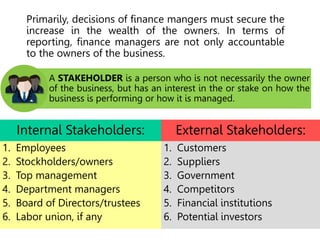
Internal Stakeholders:
1. Employees
2. Stockholders/owners
3. Top management
4. Department managers
5. Board of Directors/trustees
6. Labor union, if any
Primarily, decisions of finance mangers must secure the
increase in the wealth of the owners. In terms of
reporting, finance managers are not only accountable
to the owners of the business.
External Stakeholders:
1. Customers
2. Suppliers
3. Government
4. Competitors
5. Financial institutions
6. Potential investors
A STAKEHOLDER is a person who is not necessarily the owner
of the business, but has an interest in the or stake on how the
business is performing or how it is managed.
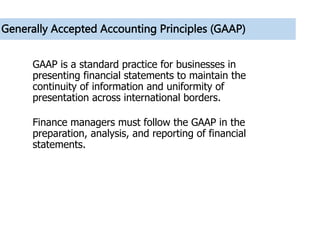
Generally Accepted Accounting Principles (GAAP)
GAAP is a standard practice for businesses in
presenting financial statements to maintain the
continuity of information and uniformity of
presentation across international borders.
Finance managers must follow the GAAP in the
preparation, analysis, and reporting of financial
statements.
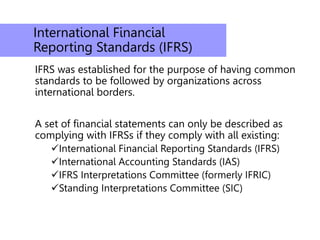
International Financial
Reporting Standards (IFRS)
IFRS was established for the purpose of having common
standards to be followed by organizations across
international borders.
A set of financial statements can only be described as
complying with IFRSs if they comply with all existing:
International Financial Reporting Standards (IFRS)
International Accounting Standards (IAS)
IFRS Interpretations Committee (formerly IFRIC)
Standing Interpretations Committee (SIC)
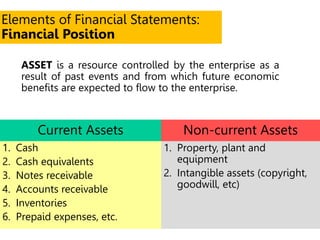
Current Assets
1. Cash
2. Cash equivalents
3. Notes receivable
4. Accounts receivable
5. Inventories
6. Prepaid expenses, etc.
ASSET is a resource controlled by the enterprise as a
result of past events and from which future economic
benefits are expected to flow to the enterprise.
Non-current Assets
1. Property, plant and
equipment
2. Intangible assets (copyright,
goodwill, etc)
Elements of Financial Statements:
Financial Position
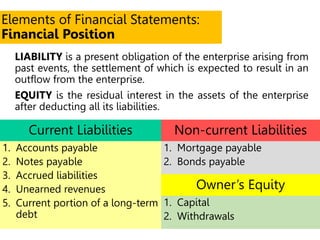
Current Liabilities
1. Accounts payable
2. Notes payable
3. Accrued liabilities
4. Unearned revenues
5. Current portion of a long-term
debt
LIABILITY is a present obligation of the enterprise arising from
past events, the settlement of which is expected to result in an
outflow from the enterprise.
EQUITY is the residual interest in the assets of the enterprise
after deducting all its liabilities.
Non-current Liabilities
1. Mortgage payable
2. Bonds payable
Elements of Financial Statements:
Financial Position
Owner’s Equity
1. Capital
2. Withdrawals
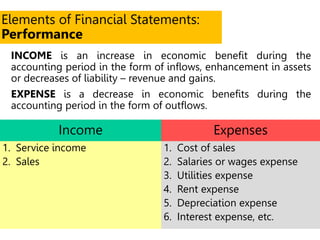
Income
1. Service income
2. Sales
Expenses
1. Cost of sales
2. Salaries or wages expense
3. Utilities expense
4. Rent expense
5. Depreciation expense
6. Interest expense, etc.
INCOME is an increase in economic benefit during the
accounting period in the form of inflows, enhancement in assets
or decreases of liability – revenue and gains.
EXPENSE is a decrease in economic benefits during the
accounting period in the form of outflows.
Elements of Financial Statements:
Performance
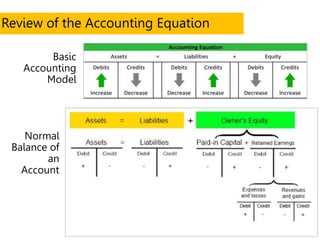
Review of the Accounting Equation
Basic
Accounting
Model
Normal
Balance of
an
Account
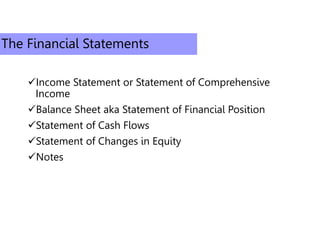
The Financial Statements
Income Statement or Statement of Comprehensive
Income
Balance Sheet aka Statement of Financial Position
Statement of Cash Flows
Statement of Changes in Equity
Notes
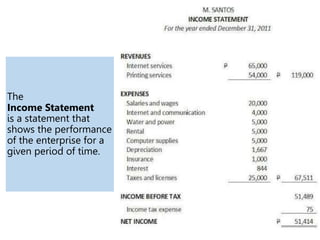
The
Income Statement
is a statement that
shows the performance
of the enterprise for a
given period of time.
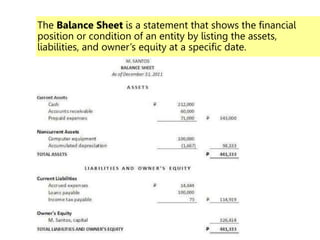
The Balance Sheet is a statement that shows the financial
position or condition of an entity by listing the assets,
liabilities, and owner’s equity at a specific date.
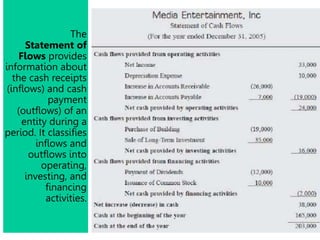
The
Statement of
Flows provides
information about
the cash receipts
(inflows) and cash
payment
(outflows) of an
entity during a
period. It classifies
inflows and
outflows into
operating,
investing, and
financing
activities.
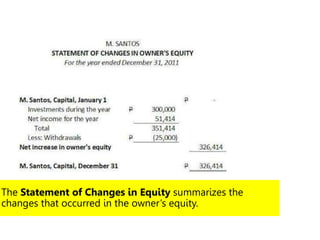
The Statement of Changes in Equity summarizes the
changes that occurred in the owner’s equity.
References:
Basic Accounting by Win Ballada.
(2014)
Principles of Managerial Finance by
Lawrence Gitman and Chad Zutter.
Thirteenth Edition. (2013)
Credits to the owners and authors of
the images used in this presentation.

1FIN_Financial-Reporting-and-Reporting-Standards.pptx

  • 1.
  • 2.
    Definition: it isa record which gives the users a picture or description of how as individual, business, or an organization is in terms of financial health. Financial Statement Financial Statements provide a snapshot of a firm’s financial performance within a specified period of time.
  • 3.
    Internal Stakeholders: 1. Employees 2.Stockholders/owners 3. Top management 4. Department managers 5. Board of Directors/trustees 6. Labor union, if any Primarily, decisions of finance mangers must secure the increase in the wealth of the owners. In terms of reporting, finance managers are not only accountable to the owners of the business. External Stakeholders: 1. Customers 2. Suppliers 3. Government 4. Competitors 5. Financial institutions 6. Potential investors A STAKEHOLDER is a person who is not necessarily the owner of the business, but has an interest in the or stake on how the business is performing or how it is managed.
  • 4.
    Generally Accepted AccountingPrinciples (GAAP) GAAP is a standard practice for businesses in presenting financial statements to maintain the continuity of information and uniformity of presentation across international borders. Finance managers must follow the GAAP in the preparation, analysis, and reporting of financial statements.
  • 5.
    International Financial Reporting Standards(IFRS) IFRS was established for the purpose of having common standards to be followed by organizations across international borders. A set of financial statements can only be described as complying with IFRSs if they comply with all existing: International Financial Reporting Standards (IFRS) International Accounting Standards (IAS) IFRS Interpretations Committee (formerly IFRIC) Standing Interpretations Committee (SIC)
  • 6.
    Current Assets 1. Cash 2.Cash equivalents 3. Notes receivable 4. Accounts receivable 5. Inventories 6. Prepaid expenses, etc. ASSET is a resource controlled by the enterprise as a result of past events and from which future economic benefits are expected to flow to the enterprise. Non-current Assets 1. Property, plant and equipment 2. Intangible assets (copyright, goodwill, etc) Elements of Financial Statements: Financial Position
  • 7.
    Current Liabilities 1. Accountspayable 2. Notes payable 3. Accrued liabilities 4. Unearned revenues 5. Current portion of a long-term debt LIABILITY is a present obligation of the enterprise arising from past events, the settlement of which is expected to result in an outflow from the enterprise. EQUITY is the residual interest in the assets of the enterprise after deducting all its liabilities. Non-current Liabilities 1. Mortgage payable 2. Bonds payable Elements of Financial Statements: Financial Position Owner’s Equity 1. Capital 2. Withdrawals
  • 8.
    Income 1. Service income 2.Sales Expenses 1. Cost of sales 2. Salaries or wages expense 3. Utilities expense 4. Rent expense 5. Depreciation expense 6. Interest expense, etc. INCOME is an increase in economic benefit during the accounting period in the form of inflows, enhancement in assets or decreases of liability – revenue and gains. EXPENSE is a decrease in economic benefits during the accounting period in the form of outflows. Elements of Financial Statements: Performance
  • 9.
    Review of theAccounting Equation Basic Accounting Model Normal Balance of an Account
  • 10.
    The Financial Statements IncomeStatement or Statement of Comprehensive Income Balance Sheet aka Statement of Financial Position Statement of Cash Flows Statement of Changes in Equity Notes
  • 11.
    The Income Statement is astatement that shows the performance of the enterprise for a given period of time.
  • 12.
    The Balance Sheetis a statement that shows the financial position or condition of an entity by listing the assets, liabilities, and owner’s equity at a specific date.
  • 13.
    The Statement of Flows provides informationabout the cash receipts (inflows) and cash payment (outflows) of an entity during a period. It classifies inflows and outflows into operating, investing, and financing activities.
  • 14.
    The Statement ofChanges in Equity summarizes the changes that occurred in the owner’s equity.
  • 15.
    References: Basic Accounting byWin Ballada. (2014) Principles of Managerial Finance by Lawrence Gitman and Chad Zutter. Thirteenth Edition. (2013) Credits to the owners and authors of the images used in this presentation.