Generalized Virtual Networking: 
an enabler for Service Centric Networking and 
Network Function Virtualization 
Stefano Salsano(1), Nicola Blefari-Melazzi(1), Francesco Lo Presti(1), 
Giuseppe Siracusano(1), Pier Luigi Ventre(2) 
(1) Univ. of Rome Tor Vergata, (2) Consortium GARR 
stefano.salsano@uniroma2.it
A position paper… 
2 
 Introduce Generic Virtual Networking (GVN) 
 GVN : a concept and a framework 
 Influence the routing of (IP) packets based on service 
level information that is carried in the packets 
Generalized Virtual Networking: 
an enabler for Service Centric Networking and Network Function Virtualization
Outline 
3 
1. Rationale and state of the art 
2. Generalized Virtual Networking (GVN) 
3. GVN details & deployment scenarios 
4. GVN as universal enabler 
5. GVN, NFV and SDN 
Generalized Virtual Networking: 
an enabler for Service Centric Networking and Network Function Virtualization
Rationale for the work (1/2) 
4 
 A more and more pervasive cloud computing 
environment, end-user mobility, service mobility… 
 Service-Centric / Service-Oriented Networking: 
 services should be accessed independently from the 
IP network address (and transport port) of the 
service nodes 
Generalized Virtual Networking: 
an enabler for Service Centric Networking and Network Function Virtualization
Rationale for the work (2/2) 
5 
 The IP layer does not offer too much room for 
innovation 
 Several “clean slate” approaches have been proposed 
to re-design the Network Level (…no success so far) 
 On the other hand, Overlay Networking (CDNs…) and 
Cross-Layer Networking (NATs, Firewall, Layer-7 
balancers) are the norm 
Generalized Virtual Networking: 
an enabler for Service Centric Networking and Network Function Virtualization
GVN basics 
6 
 GVN is based on a protocol header inserted between 
the Network and Transport layers 
 It can be defined as a “layer 3.5” solution 
 Backward compatibility: legacy nodes which do not 
know GVN simply forward using IP or layer 2 info 
Generalized Virtual Networking: 
an enabler for Service Centric Networking and Network Function Virtualization
Existing work (GVN roots…) 
7 
 Service Centric Networking (Serval) 
 Service Oriented Networking (FUSION) 
 Application Delivery Networking (OpenADN) 
 Information Centric Networking in general 
GVN: 
• a generalization of the above proposals 
• a framework that can support all of them 
Generalized Virtual Networking: 
an enabler for Service Centric Networking and Network Function Virtualization
State of the art: FUSION 
8 
 The the EU project FUSION has developed the 
concept of Service Oriented Networking 
 Networked software functions are dynamically 
deployed, replicated and invoked, as is proposed for 
static content in Information Centric Networking 
 Services are identified by a serviceID 
 An overlay routing solution is proposed 
Generalized Virtual Networking: 
an enabler for Service Centric Networking and Network Function Virtualization
State of the art: Serval 
9 
 For “… current online services, running on multiple 
servers in different locations and serving clients that 
are often mobile and multi-homed…” 
 a Service Access Layer (SAL) sits above unmodified IP 
and enables applications to communicate directly on 
service names using serviceIDs 
 The Serval protocol header is introduced between the 
IP and the transport layer headers 
 The socket abstraction between applications and 
transport/network layers is redefined by Serval 
Generalized Virtual Networking: 
an enabler for Service Centric Networking and Network Function Virtualization
State of the art: OpenADN (1/2) 
10 
 “The service-centric delivery semantics of modern 
Internet-scale applications and services does not fit 
naturally into the Internet’s host-centric design” 
 OpenADN provides a general architectural support for 
service-centric Internet, with an application-neutral, 
standardized, session-layer overlay over IP 
 Two new layers in the protocol stack: 
1. between the network and the transport layer 
2. on top of the transport layer, offering the API 
towards the applications 
Generalized Virtual Networking: 
an enabler for Service Centric Networking and Network Function Virtualization
State of the art: OpenADN (2/2) 
11 
 A layer 3.5 header in introduced between the IP 
header and the transport headers. 
 The OpenADN data plane implements an MPLS 
inspired label switching and stacking mechanism 
called APLS (APplication Label Switching) 
Generalized Virtual Networking: 
an enabler for Service Centric Networking and Network Function Virtualization
State of the art: ICN 
12 
 Information Centric Networking (ICN) concept: a 
paradigm shift from host-to-host communication 
model to a model that focuses on information objects 
 If implemented in IP, ICN info can be carried: 
 within UDP or TCP (overlay approach) 
 as a new transport protocol 
 extending the IP layer 
 A general framework could be helpful… 
Generalized Virtual Networking: 
an enabler for Service Centric Networking and Network Function Virtualization
Two successful technologies 
13 
 VLANs and MPLS ! 
 An additional header can be inserted in a pre-existing 
packet when needed and then removed 
 Commonly referred to as “tagging” and “un-tagging” 
(e.g. VLAN tagging) 
Generalized Virtual Networking: 
an enabler for Service Centric Networking and Network Function Virtualization
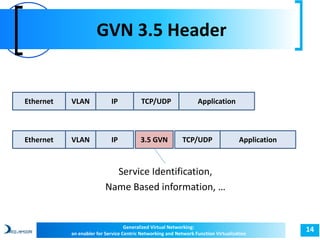
GVN 3.5 Header 
Ethernet VLAN IP TCP/UDP Application 
Ethernet VLAN IP 3.5 GVN TCP/UDP Application 
Service Identification, 
Name Based information, … 
Generalized Virtual Networking: 14 
an enabler for Service Centric Networking and Network Function Virtualization
How to make GVN generic? 
15 
 We want a common framework, and a potentially 
unlimited set of different “Processing Logic” 
(GVN-PLs) 
 Serval, OpenADN, the different ICN proposals can be 
seen as “GVN-Processing Logics” on top of the 
common GVN framework 
Generalized Virtual Networking: 
an enabler for Service Centric Networking and Network Function Virtualization
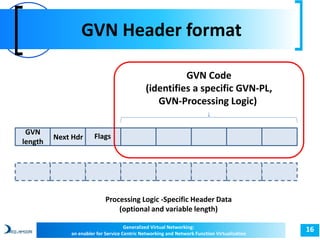
GVN Header format 
Generalized Virtual Networking: 16 
an enabler for Service Centric Networking and Network Function Virtualization 
GVN 
length 
Next Hdr 
GVN Code 
(identifies a specific GVN-PL, 
GVN-Processing Logic) 
Processing Logic -Specific Header Data 
(optional and variable length) 
Flags
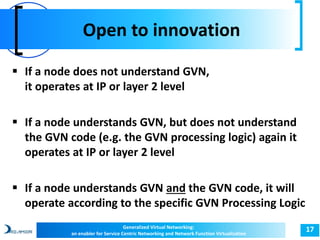
Open to innovation 
17 
 If a node does not understand GVN, 
it operates at IP or layer 2 level 
 If a node understands GVN, but does not understand 
the GVN code (e.g. the GVN processing logic) again it 
operates at IP or layer 2 level 
 If a node understands GVN and the GVN code, it will 
operate according to the specific GVN Processing Logic 
Generalized Virtual Networking: 
an enabler for Service Centric Networking and Network Function Virtualization
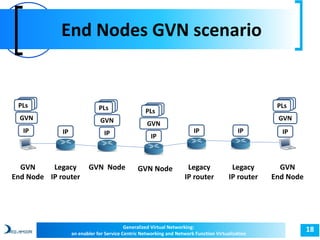
End Nodes GVN scenario 
IP IP IP 
Generalized Virtual Networking: 18 
PPLLss 
PLs 
GVN 
IP 
an enabler for Service Centric Networking and Network Function Virtualization 
GVN 
End Node 
GVN Node 
GVN 
End Node 
Legacy 
IP router 
IP 
Legacy 
IP router 
PPLLss 
GVN 
IP 
PLs 
GVN Node 
PPLLss 
GVN 
PLs 
IP 
Legacy 
IP router 
PPLLss 
GVN 
PLs
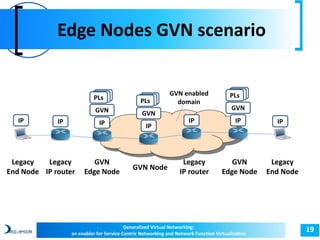
Edge Nodes GVN scenario 
IP IP IP 
Generalized Virtual Networking: 19 
PPLLss 
PLs 
GVN 
IP 
an enabler for Service Centric Networking and Network Function Virtualization 
Legacy 
End Node 
GVN 
Edge Node 
PPLLss 
GVN 
IP 
PLs 
GVN 
Edge Node 
Legacy 
End Node 
Legacy 
IP router 
IP 
Legacy 
IP router 
PPLLss 
GVN 
IP 
PLs 
GVN Node 
GVN enabled 
domain
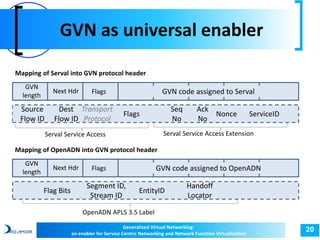
GVN as universal enabler 
Mapping of Serval into GVN protocol header 
Mapping of OpenADN into GVN protocol header 
EntityID 
Generalized Virtual Networking: 20 
an enabler for Service Centric Networking and Network Function Virtualization 
GVN 
length 
Next Hdr Flags GVN code assigned to Serval 
Source 
Flow ID 
Dest 
Flow ID 
Transport 
Protocol 
Flags 
Seq 
No 
Ack 
No 
Nonce ServiceID 
Serval Service Access Serval Service Access Extension 
GVN 
length 
Next Hdr Flags GVN code assigned to OpenADN 
Flag Bits 
Segment ID, 
Stream ID 
Handoff 
Locator 
OpenADN APLS 3.5 Label
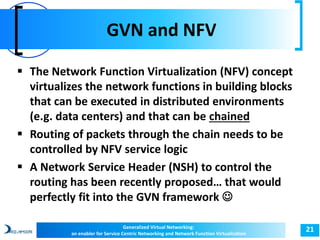
GVN and NFV 
21 
 The Network Function Virtualization (NFV) concept 
virtualizes the network functions in building blocks 
that can be executed in distributed environments 
(e.g. data centers) and that can be chained 
 Routing of packets through the chain needs to be 
controlled by NFV service logic 
 A Network Service Header (NSH) to control the 
routing has been recently proposed… that would 
perfectly fit into the GVN framework  
Generalized Virtual Networking: 
an enabler for Service Centric Networking and Network Function Virtualization
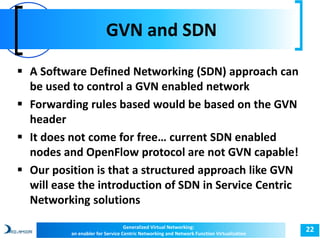
GVN and SDN 
22 
 A Software Defined Networking (SDN) approach can 
be used to control a GVN enabled network 
 Forwarding rules based would be based on the GVN 
header 
 It does not come for free… current SDN enabled 
nodes and OpenFlow protocol are not GVN capable! 
 Our position is that a structured approach like GVN 
will ease the introduction of SDN in Service Centric 
Networking solutions 
Generalized Virtual Networking: 
an enabler for Service Centric Networking and Network Function Virtualization
Next steps 
18 
 Implementation… 
 Standardization… 
… quite a long way to go, 
but we look for travel buddies  
Generalized Virtual Networking: 
an enabler for Service Centric Networking and Network Function Virtualization
Thank you! (questions) 
19 Generalized Virtual Networking: 
an enabler for Service Centric Networking and Network Function Virtualization
DREAMER Project 
http://netgroup.uniroma2.it/DREAMER 
25 
Distributed REsilient sdn Architecture 
MEeting carrier grade Requirements 
 Partners: 
The DREAMER Project is one of the beneficiary projects of the GÉANT Open 
Call research initiative running from October 2013 to March 2015, see 
www.geant.net 
Generalized Virtual Networking: 
an enabler for Service Centric Networking and Network Function Virtualization
19 
UNIVERSITY OF ROME TOR VERGATA 
Department of Electronics Engineering 
Via del Politecnico, 1 - 00133 Rome - Italy 
Stefano Salsano, Ph. D. 
Assistant professor 
e-mail: stefano.salsano@uniroma2.it 
http://netgroup.uniroma2.it/Stefano_Salsano 
Phone: +39 06 7259 7770 
Fax: +39 06 7259 7435 
Generalized Virtual Networking: 
an enabler for Service Centric Networking and Network Function Virtualization

Generalized Virtual Networking, an enabler for Service Centric Networking and NFV @Networks2014

  • 1.
    Generalized Virtual Networking: an enabler for Service Centric Networking and Network Function Virtualization Stefano Salsano(1), Nicola Blefari-Melazzi(1), Francesco Lo Presti(1), Giuseppe Siracusano(1), Pier Luigi Ventre(2) (1) Univ. of Rome Tor Vergata, (2) Consortium GARR stefano.salsano@uniroma2.it
  • 2.
    A position paper… 2  Introduce Generic Virtual Networking (GVN)  GVN : a concept and a framework  Influence the routing of (IP) packets based on service level information that is carried in the packets Generalized Virtual Networking: an enabler for Service Centric Networking and Network Function Virtualization
  • 3.
    Outline 3 1.Rationale and state of the art 2. Generalized Virtual Networking (GVN) 3. GVN details & deployment scenarios 4. GVN as universal enabler 5. GVN, NFV and SDN Generalized Virtual Networking: an enabler for Service Centric Networking and Network Function Virtualization
  • 4.
    Rationale for thework (1/2) 4  A more and more pervasive cloud computing environment, end-user mobility, service mobility…  Service-Centric / Service-Oriented Networking:  services should be accessed independently from the IP network address (and transport port) of the service nodes Generalized Virtual Networking: an enabler for Service Centric Networking and Network Function Virtualization
  • 5.
    Rationale for thework (2/2) 5  The IP layer does not offer too much room for innovation  Several “clean slate” approaches have been proposed to re-design the Network Level (…no success so far)  On the other hand, Overlay Networking (CDNs…) and Cross-Layer Networking (NATs, Firewall, Layer-7 balancers) are the norm Generalized Virtual Networking: an enabler for Service Centric Networking and Network Function Virtualization
  • 6.
    GVN basics 6  GVN is based on a protocol header inserted between the Network and Transport layers  It can be defined as a “layer 3.5” solution  Backward compatibility: legacy nodes which do not know GVN simply forward using IP or layer 2 info Generalized Virtual Networking: an enabler for Service Centric Networking and Network Function Virtualization
  • 7.
    Existing work (GVNroots…) 7  Service Centric Networking (Serval)  Service Oriented Networking (FUSION)  Application Delivery Networking (OpenADN)  Information Centric Networking in general GVN: • a generalization of the above proposals • a framework that can support all of them Generalized Virtual Networking: an enabler for Service Centric Networking and Network Function Virtualization
  • 8.
    State of theart: FUSION 8  The the EU project FUSION has developed the concept of Service Oriented Networking  Networked software functions are dynamically deployed, replicated and invoked, as is proposed for static content in Information Centric Networking  Services are identified by a serviceID  An overlay routing solution is proposed Generalized Virtual Networking: an enabler for Service Centric Networking and Network Function Virtualization
  • 9.
    State of theart: Serval 9  For “… current online services, running on multiple servers in different locations and serving clients that are often mobile and multi-homed…”  a Service Access Layer (SAL) sits above unmodified IP and enables applications to communicate directly on service names using serviceIDs  The Serval protocol header is introduced between the IP and the transport layer headers  The socket abstraction between applications and transport/network layers is redefined by Serval Generalized Virtual Networking: an enabler for Service Centric Networking and Network Function Virtualization
  • 10.
    State of theart: OpenADN (1/2) 10  “The service-centric delivery semantics of modern Internet-scale applications and services does not fit naturally into the Internet’s host-centric design”  OpenADN provides a general architectural support for service-centric Internet, with an application-neutral, standardized, session-layer overlay over IP  Two new layers in the protocol stack: 1. between the network and the transport layer 2. on top of the transport layer, offering the API towards the applications Generalized Virtual Networking: an enabler for Service Centric Networking and Network Function Virtualization
  • 11.
    State of theart: OpenADN (2/2) 11  A layer 3.5 header in introduced between the IP header and the transport headers.  The OpenADN data plane implements an MPLS inspired label switching and stacking mechanism called APLS (APplication Label Switching) Generalized Virtual Networking: an enabler for Service Centric Networking and Network Function Virtualization
  • 12.
    State of theart: ICN 12  Information Centric Networking (ICN) concept: a paradigm shift from host-to-host communication model to a model that focuses on information objects  If implemented in IP, ICN info can be carried:  within UDP or TCP (overlay approach)  as a new transport protocol  extending the IP layer  A general framework could be helpful… Generalized Virtual Networking: an enabler for Service Centric Networking and Network Function Virtualization
  • 13.
    Two successful technologies 13  VLANs and MPLS !  An additional header can be inserted in a pre-existing packet when needed and then removed  Commonly referred to as “tagging” and “un-tagging” (e.g. VLAN tagging) Generalized Virtual Networking: an enabler for Service Centric Networking and Network Function Virtualization
  • 14.
    GVN 3.5 Header Ethernet VLAN IP TCP/UDP Application Ethernet VLAN IP 3.5 GVN TCP/UDP Application Service Identification, Name Based information, … Generalized Virtual Networking: 14 an enabler for Service Centric Networking and Network Function Virtualization
  • 15.
    How to makeGVN generic? 15  We want a common framework, and a potentially unlimited set of different “Processing Logic” (GVN-PLs)  Serval, OpenADN, the different ICN proposals can be seen as “GVN-Processing Logics” on top of the common GVN framework Generalized Virtual Networking: an enabler for Service Centric Networking and Network Function Virtualization
  • 16.
    GVN Header format Generalized Virtual Networking: 16 an enabler for Service Centric Networking and Network Function Virtualization GVN length Next Hdr GVN Code (identifies a specific GVN-PL, GVN-Processing Logic) Processing Logic -Specific Header Data (optional and variable length) Flags
  • 17.
    Open to innovation 17  If a node does not understand GVN, it operates at IP or layer 2 level  If a node understands GVN, but does not understand the GVN code (e.g. the GVN processing logic) again it operates at IP or layer 2 level  If a node understands GVN and the GVN code, it will operate according to the specific GVN Processing Logic Generalized Virtual Networking: an enabler for Service Centric Networking and Network Function Virtualization
  • 18.
    End Nodes GVNscenario IP IP IP Generalized Virtual Networking: 18 PPLLss PLs GVN IP an enabler for Service Centric Networking and Network Function Virtualization GVN End Node GVN Node GVN End Node Legacy IP router IP Legacy IP router PPLLss GVN IP PLs GVN Node PPLLss GVN PLs IP Legacy IP router PPLLss GVN PLs
  • 19.
    Edge Nodes GVNscenario IP IP IP Generalized Virtual Networking: 19 PPLLss PLs GVN IP an enabler for Service Centric Networking and Network Function Virtualization Legacy End Node GVN Edge Node PPLLss GVN IP PLs GVN Edge Node Legacy End Node Legacy IP router IP Legacy IP router PPLLss GVN IP PLs GVN Node GVN enabled domain
  • 20.
    GVN as universalenabler Mapping of Serval into GVN protocol header Mapping of OpenADN into GVN protocol header EntityID Generalized Virtual Networking: 20 an enabler for Service Centric Networking and Network Function Virtualization GVN length Next Hdr Flags GVN code assigned to Serval Source Flow ID Dest Flow ID Transport Protocol Flags Seq No Ack No Nonce ServiceID Serval Service Access Serval Service Access Extension GVN length Next Hdr Flags GVN code assigned to OpenADN Flag Bits Segment ID, Stream ID Handoff Locator OpenADN APLS 3.5 Label
  • 21.
    GVN and NFV 21  The Network Function Virtualization (NFV) concept virtualizes the network functions in building blocks that can be executed in distributed environments (e.g. data centers) and that can be chained  Routing of packets through the chain needs to be controlled by NFV service logic  A Network Service Header (NSH) to control the routing has been recently proposed… that would perfectly fit into the GVN framework  Generalized Virtual Networking: an enabler for Service Centric Networking and Network Function Virtualization
  • 22.
    GVN and SDN 22  A Software Defined Networking (SDN) approach can be used to control a GVN enabled network  Forwarding rules based would be based on the GVN header  It does not come for free… current SDN enabled nodes and OpenFlow protocol are not GVN capable!  Our position is that a structured approach like GVN will ease the introduction of SDN in Service Centric Networking solutions Generalized Virtual Networking: an enabler for Service Centric Networking and Network Function Virtualization
  • 23.
    Next steps 18  Implementation…  Standardization… … quite a long way to go, but we look for travel buddies  Generalized Virtual Networking: an enabler for Service Centric Networking and Network Function Virtualization
  • 24.
    Thank you! (questions) 19 Generalized Virtual Networking: an enabler for Service Centric Networking and Network Function Virtualization
  • 25.
    DREAMER Project http://netgroup.uniroma2.it/DREAMER 25 Distributed REsilient sdn Architecture MEeting carrier grade Requirements  Partners: The DREAMER Project is one of the beneficiary projects of the GÉANT Open Call research initiative running from October 2013 to March 2015, see www.geant.net Generalized Virtual Networking: an enabler for Service Centric Networking and Network Function Virtualization
  • 26.
    19 UNIVERSITY OFROME TOR VERGATA Department of Electronics Engineering Via del Politecnico, 1 - 00133 Rome - Italy Stefano Salsano, Ph. D. Assistant professor e-mail: stefano.salsano@uniroma2.it http://netgroup.uniroma2.it/Stefano_Salsano Phone: +39 06 7259 7770 Fax: +39 06 7259 7435 Generalized Virtual Networking: an enabler for Service Centric Networking and Network Function Virtualization