General Mathematics: Essential
Concepts and Applications
Understanding, Modeling, and
Solving Real-Life Problems
Presented by: [Your Name]
Date: [Today's Date]
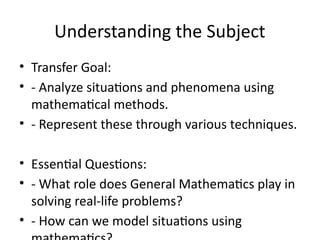
Understanding the Subject
• Transfer Goal:
• - Analyze situations and phenomena using
mathematical methods.
• - Represent these through various techniques.
• Essential Questions:
• - What role does General Mathematics play in
solving real-life problems?
• - How can we model situations using
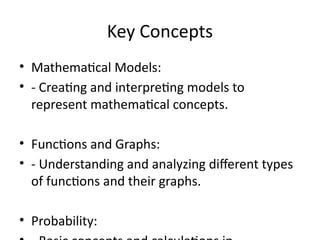
Key Concepts
• Mathematical Models:
• - Creating and interpreting models to
represent mathematical concepts.
• Functions and Graphs:
• - Understanding and analyzing different types
of functions and their graphs.
• Probability:
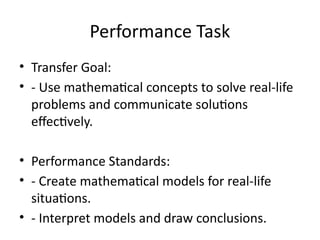
Performance Task
• Transfer Goal:
• - Use mathematical concepts to solve real-life
problems and communicate solutions
effectively.
• Performance Standards:
• - Create mathematical models for real-life
situations.
• - Interpret models and draw conclusions.
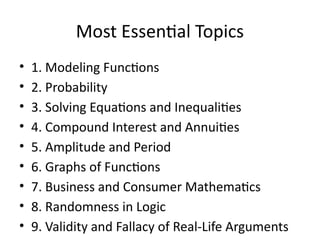
Most Essential Topics
• 1. Modeling Functions
• 2. Probability
• 3. Solving Equations and Inequalities
• 4. Compound Interest and Annuities
• 5. Amplitude and Period
• 6. Graphs of Functions
• 7. Business and Consumer Mathematics
• 8. Randomness in Logic
• 9. Validity and Fallacy of Real-Life Arguments
Goals in Teaching the Subject
• - Develop critical thinking through problem-
solving and reasoning activities.
• - Highlight the relevance of General
Mathematics in everyday life and various
fields of study.
Conclusion
• Summary:
• - General Mathematics helps in
understanding, modeling, and solving real-life
problems.
• - Key concepts include functions, probability,
and mathematical models.
• - Essential topics range from modeling
functions to understanding consumer
mathematics.

General_Mathematics_Presentation grade11.pptx

  • 1.
    General Mathematics: Essential Conceptsand Applications Understanding, Modeling, and Solving Real-Life Problems Presented by: [Your Name] Date: [Today's Date]
  • 2.
    Understanding the Subject •Transfer Goal: • - Analyze situations and phenomena using mathematical methods. • - Represent these through various techniques. • Essential Questions: • - What role does General Mathematics play in solving real-life problems? • - How can we model situations using
  • 3.
    Key Concepts • MathematicalModels: • - Creating and interpreting models to represent mathematical concepts. • Functions and Graphs: • - Understanding and analyzing different types of functions and their graphs. • Probability:
  • 4.
    Performance Task • TransferGoal: • - Use mathematical concepts to solve real-life problems and communicate solutions effectively. • Performance Standards: • - Create mathematical models for real-life situations. • - Interpret models and draw conclusions.
  • 5.
    Most Essential Topics •1. Modeling Functions • 2. Probability • 3. Solving Equations and Inequalities • 4. Compound Interest and Annuities • 5. Amplitude and Period • 6. Graphs of Functions • 7. Business and Consumer Mathematics • 8. Randomness in Logic • 9. Validity and Fallacy of Real-Life Arguments
  • 6.
    Goals in Teachingthe Subject • - Develop critical thinking through problem- solving and reasoning activities. • - Highlight the relevance of General Mathematics in everyday life and various fields of study.
  • 7.
    Conclusion • Summary: • -General Mathematics helps in understanding, modeling, and solving real-life problems. • - Key concepts include functions, probability, and mathematical models. • - Essential topics range from modeling functions to understanding consumer mathematics.