R.Kavitha
4th yr
GENERAL
EXAMINATION
The general examination comprises of the general
assessment of the patient. An observant clinician
usually begins his general examination as soon as
the patient enters the clinic.
2
1.Height and weight
• The height and weight of the patient are recorded as they provide a clue to the
physical growth and maturation of the patient which may have dento- facial
correlation.
3 Orthodontics 2023
2023
ORTHODONTICS
4
Gait
It is the way a person walks.
Abnormalities of gait are usually associated with
neuromuscular disorders which may have a dental co-
relation.
2023
ORTHODONTICS
5
Types of gait
6 ORTHODONTICS 2023
Posture
Posture refers to the way a person stands.
Abnormal postures can predispose to malocclusion due to
alteration in maxillo- mandibular relationship.
2023
ORTHODONTICS
7
Types of posture
8 ORTHODONTICS 2023
Body build (physique)
It is possible to classify the physique into one of the
following three types:
2023
ORTHODONTICS
9
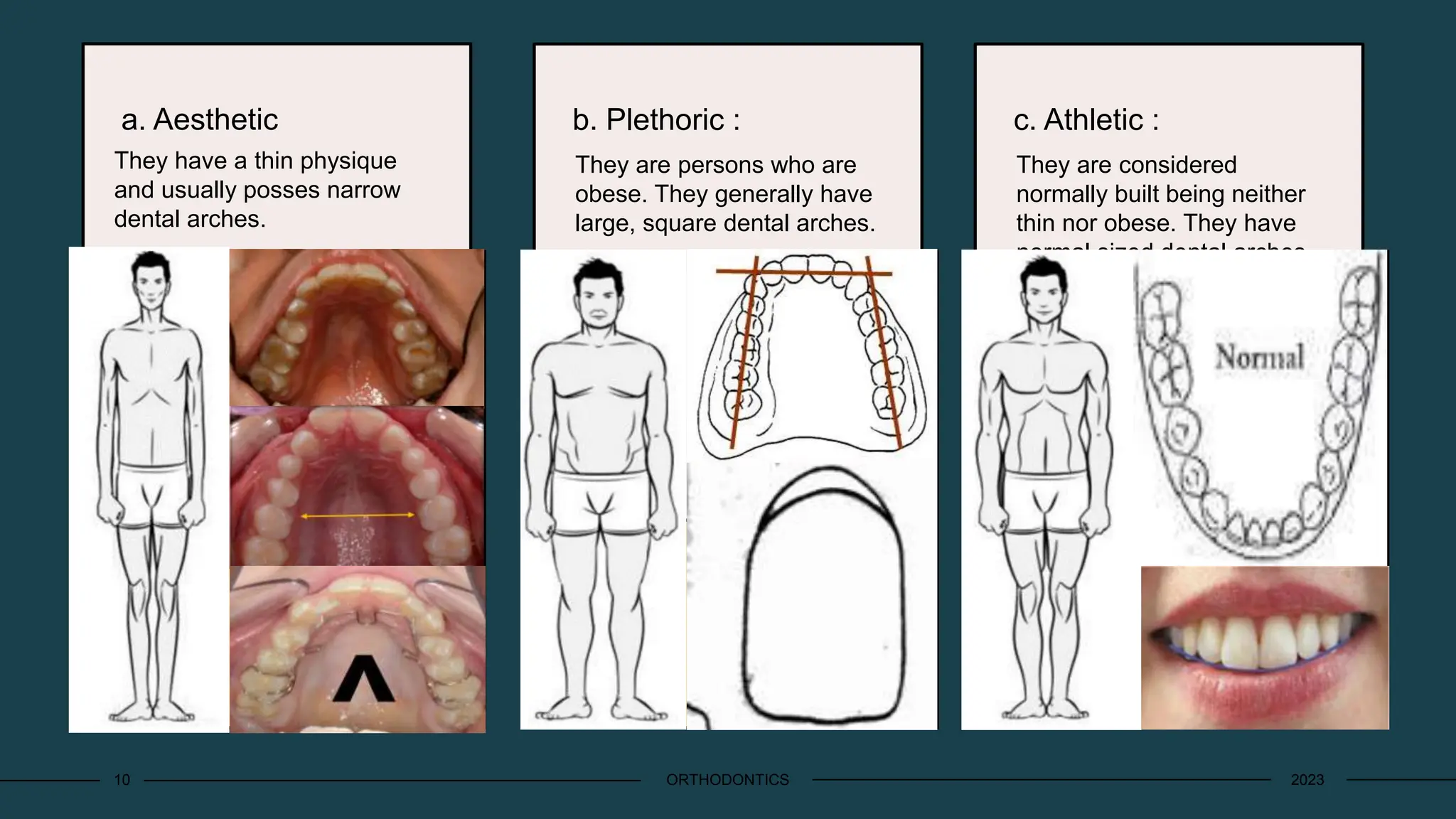
a. Aesthetic
They have a thin physique
and usually posses narrow
dental arches.
b. Plethoric :
They are persons who are
obese. They generally have
large, square dental arches.
c. Athletic :
They are considered
normally built being neither
thin nor obese. They have
normal sized dental arches.
10 ORTHODONTICS 2023
General body build
2023
ORTHODONTICS
11
Sheldon has classified the general body
build into three types :
a. Ectomorphic :
Tall and thin physique
b. Mesomorphic :
Average physique
c. Endomorphic :
Short and obese physique
12 ORTHODONTICS 2023
EXTRA - ORAL
EXAMINATION
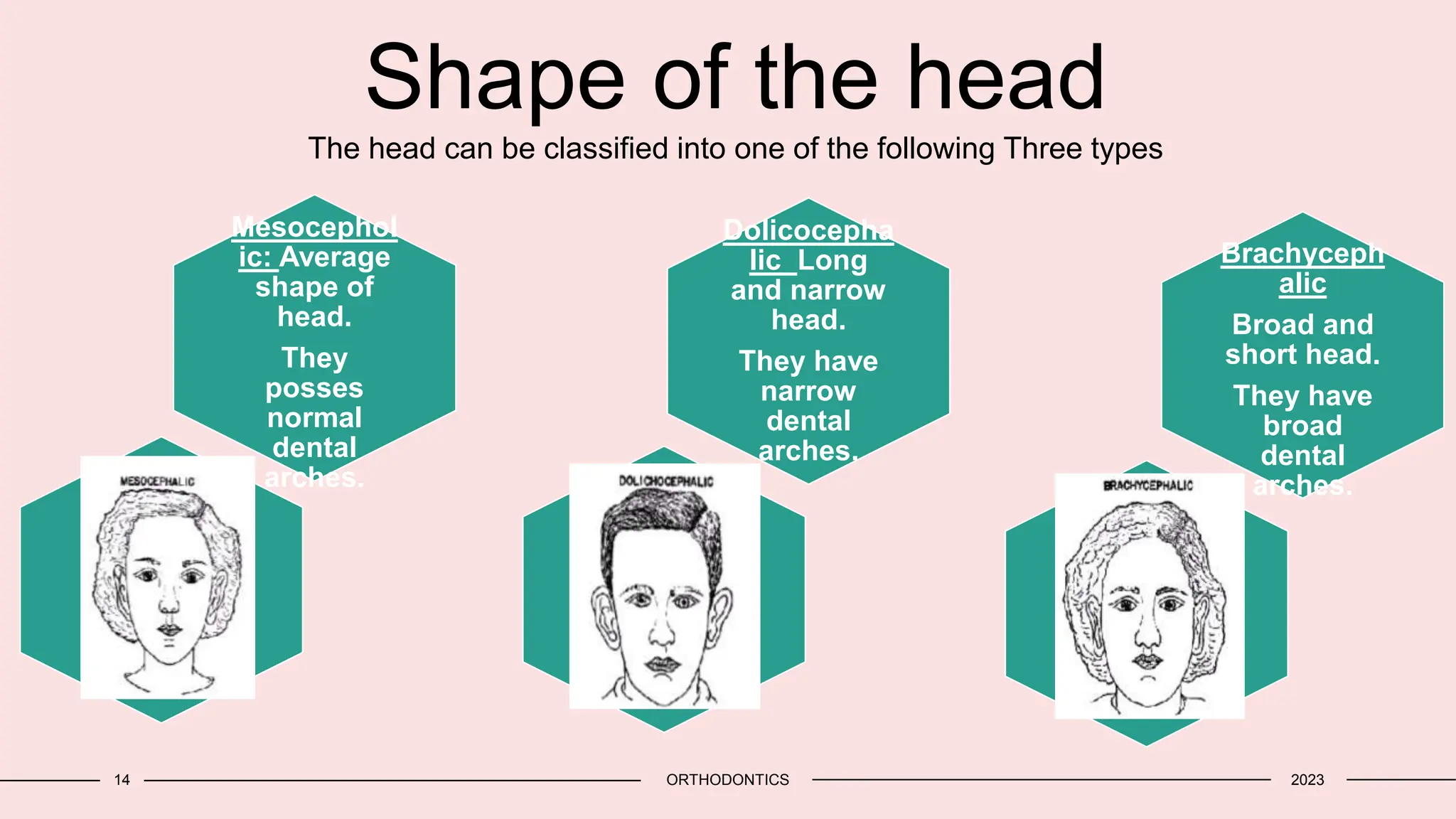
Shape of the head
The head can be classified into one of the following Three types
Mesocephol
ic: Average
shape of
head.
They
posses
normal
dental
arches.
Dolicocepha
lic Long
and narrow
head.
They have
narrow
dental
arches.
Brachyceph
alic
Broad and
short head.
They have
broad
dental
arches.
14 ORTHODONTICS 2023
Facial form
A simple way of describing the face is to classify it as either round, oval or square.
A more scientific classification is to classify face into the following three types:
a. Mesoprosopic :
It is an average or
normal face form.
b. Euryprosopic:
This type of face is
broad and short.
c. Leptoprosopic: It
is a long and
narrow face form.
15 ORTHODONTICS 2023
Assessment of
facial symmetry
The patient's facial symmetry is examined to
determine disproportions of the face in
transverse and vertical planes.
In most people the right and left sides are
not identical .
Thus some degree of asymmetry is
considered normal.
Asymmetries that are gross and are
detected easily should be recorded
17 ORTHODONTICS 2023
Gross facial
asymmetries
can occur as
a result of:
a.
Congenital
defects
b. Hemi-
facial
atrophy /
hypertrophy
c. Unilateral
condylar
ankylosis
and
hyperplasia
Facial profile
The facial profile is examined by
viewing the patient from the side. The
facial profile helps in diagnosing gross
deviations in the maxillo- mandibular
relationship.
The profile is assessed by joining the
following two reference lines :
• 1. A line joining the forehead and the soft tissue point A (deepest point in curvature of upper lip).
• 2. A line joining point A and the soft tissue pogonion (most anterior point of the chin).
19 ORTHODONTICS 2023
Based on the relationship between these two lines, three types of profiles
exist.
Straight profile : The two lines form a
nearly straight line
Convex profile : The two lines form an
angle with the concavity facing the
tissue. This kind of profile occurs as a
result of a prognathic maxilla or a
retrognathic mandible as seen in a
Class II, Division 1 malocclusion
Concave profile : The two reference
lines form an angle with the convexity
towards the tissue This type of profile
is associated with a prognathic
mandible or a retrognathic maxilla as
in a Class III malocclusion
20 ORTHODONTICS 2023
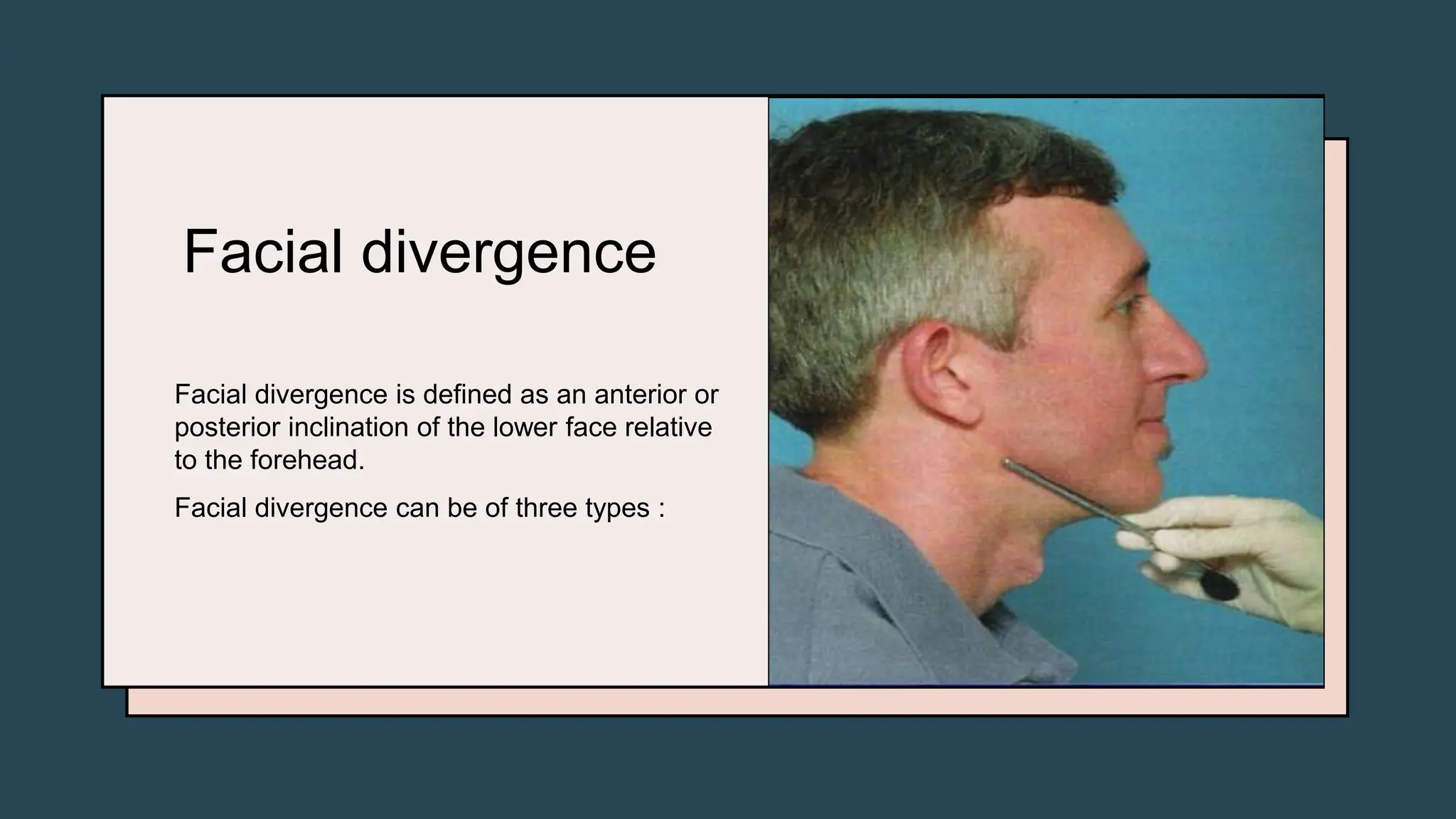
Facial divergence
Facial divergence is defined as an anterior or
posterior inclination of the lower face relative
to the forehead.
Facial divergence can be of three types :
Anterior divergent ; A line drawn
between the forehead and chin is
inclined anteriorly towards the chin
Posterior divergent : A line drawn
between the forehead and chin slants
posteriorly towards chin
Straignt or orthognathic ; The line
between the forehead and chin is
straight or perpendicular to the floor
22 ORTHODONTICS 2023
Assessment of Antero -
posterior Jaw relationship
The antero-posterior relationship
between the upper and lower jaw
can be assessed to a certain extent
clinically.
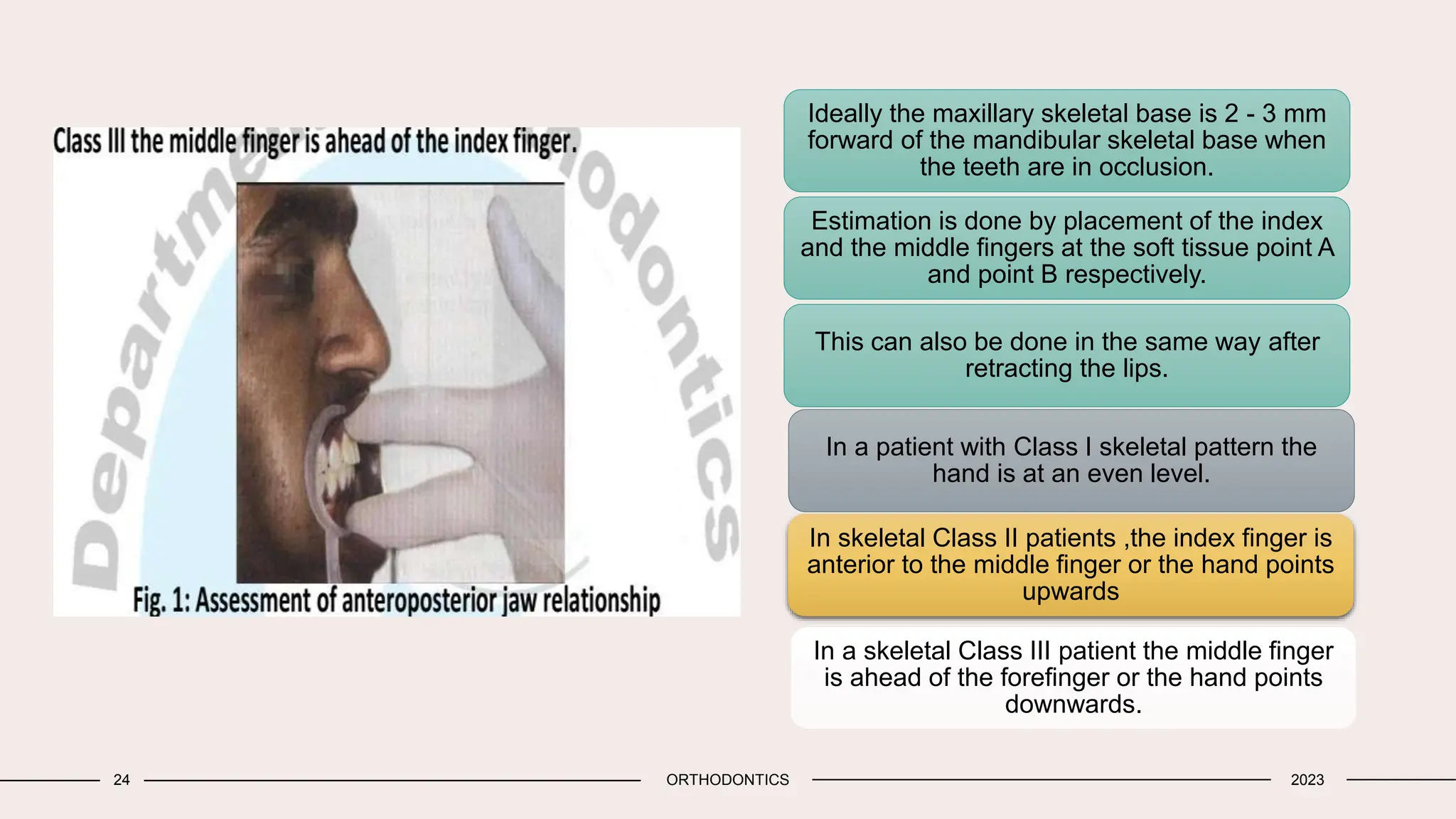
Ideally the maxillary skeletal base is 2 - 3 mm
forward of the mandibular skeletal base when
the teeth are in occlusion.
Estimation is done by placement of the index
and the middle fingers at the soft tissue point A
and point B respectively.
This can also be done in the same way after
retracting the lips.
In skeletal Class II patients ,the index finger is
anterior to the middle finger or the hand points
upwards
In a skeletal Class III patient the middle finger
is ahead of the forefinger or the hand points
downwards.
In a patient with Class I skeletal pattern the
hand is at an even level.
24 ORTHODONTICS 2023
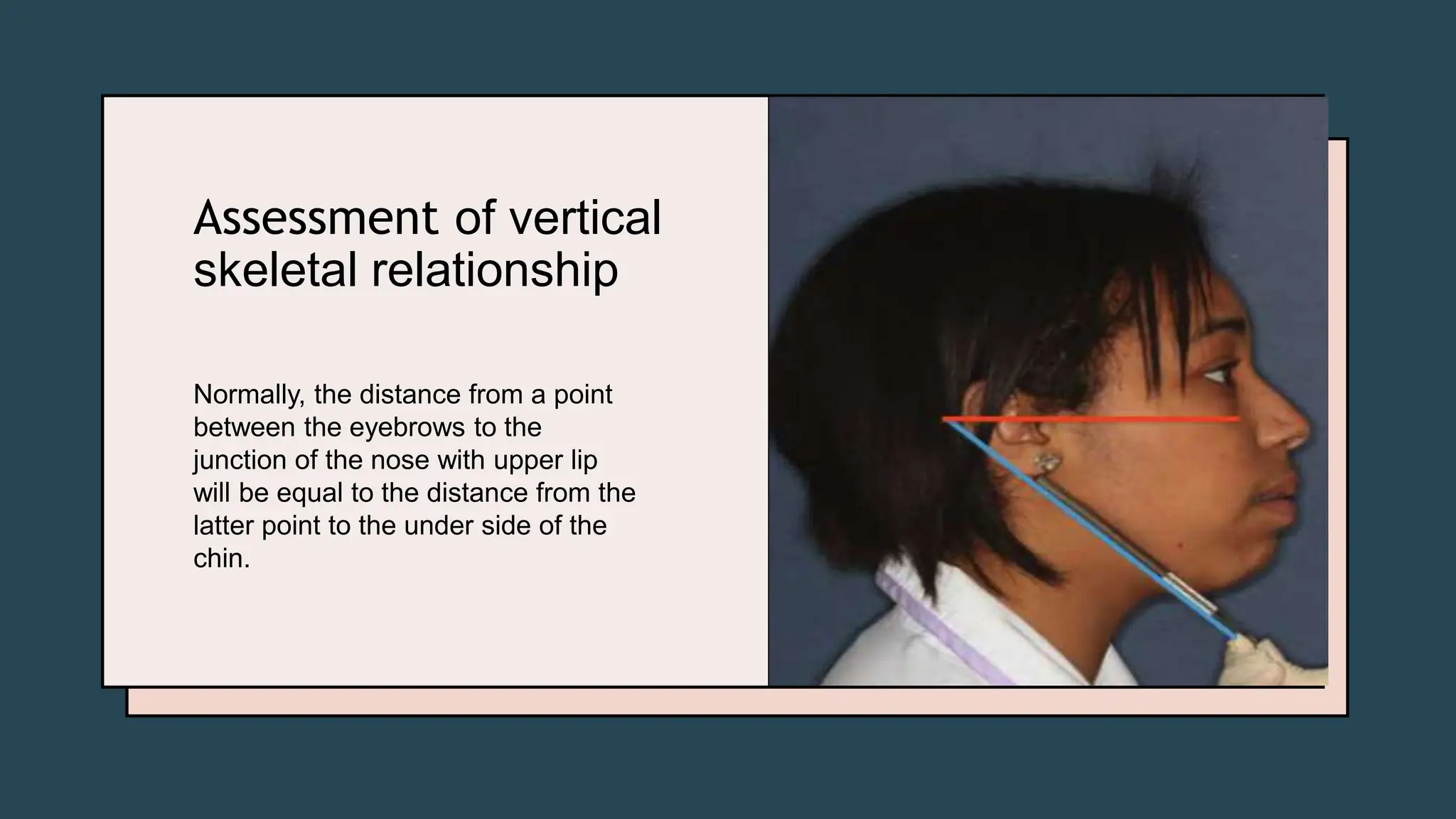
Assessment of vertical
skeletal relationship
Normally, the distance from a point
between the eyebrows to the
junction of the nose with upper lip
will be equal to the distance from the
latter point to the under side of the
chin.
• A markedly reduced lower facial height is associated with deep bites while increased lower facial height is
associated with anterior open bites.
• The vertical skeletal relationship can also be assessed by studying the angle formed between the lower border
of the mandible and the Frankfort horizontal plane (a line between the most superior point of external auditory
meatus and inferior border of orbit)
• Normally the two planes intersect at the occipital region.
• In case the two planes meet beyond the occipital region, it indicates a low angle case or a horizontal growing
face.
• If the two planes meet anterior to the occipital region it indicates a high angle case or a vertical growing face
26 ORTHODONTICS 2023
Evaluation of
facial proportions
A well proportioned face can be divided into three
equal vertical thirds using four horizontal planes
at the level of the hair line, the supraorbital
region, the base of the nose and the inferior
border of chin.
28 ORTHODONTICS 2023
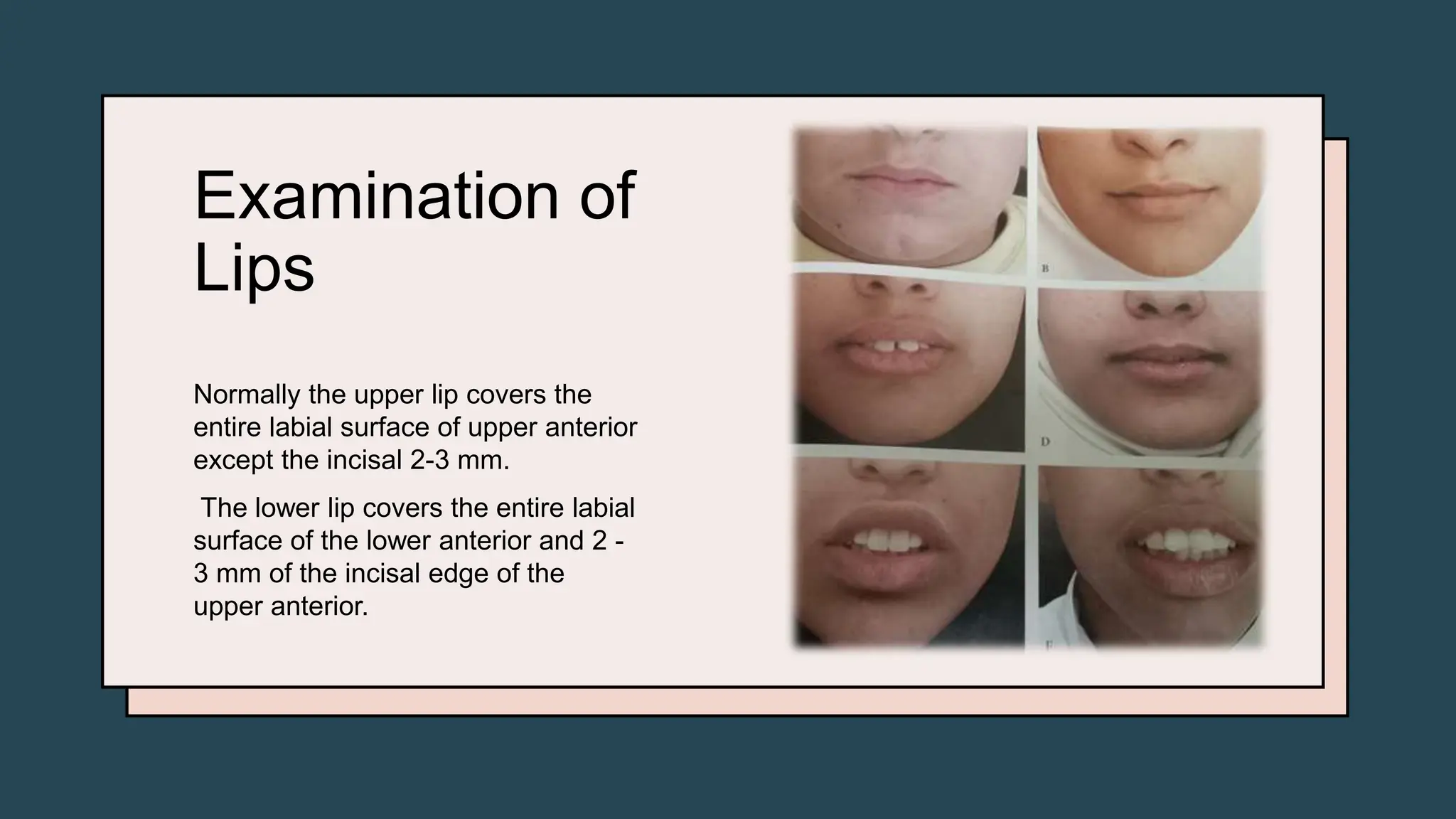
Examination of
Lips
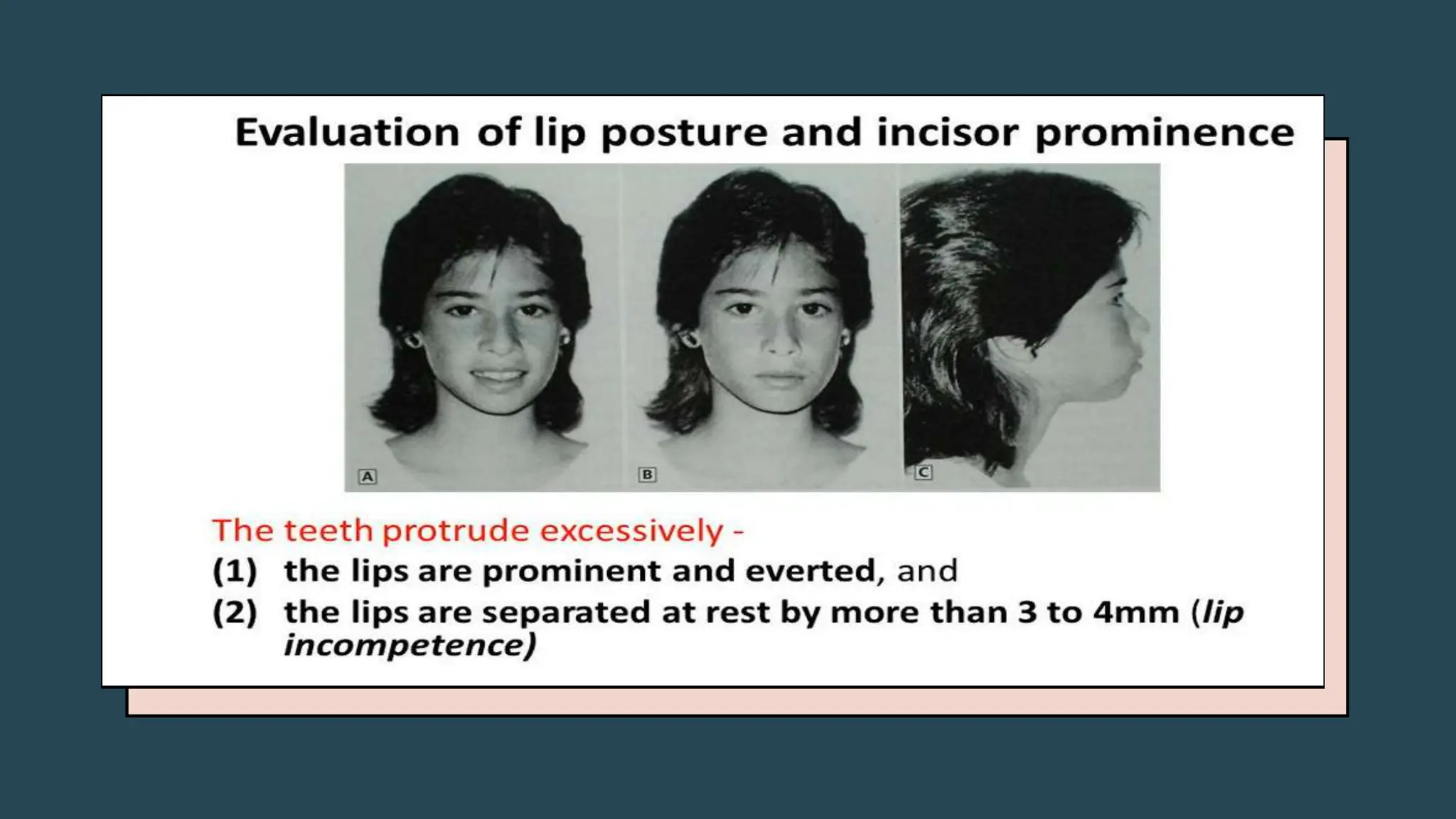
Normally the upper lip covers the
entire labial surface of upper anterior
except the incisal 2-3 mm.
The lower lip covers the entire labial
surface of the lower anterior and 2 -
3 mm of the incisal edge of the
upper anterior.
Lips can be classified into the following four
types :
Competent Zips ;
The lips are in slight
contact when the
musculature is
relaxed
Incompetent lips :
They are
morphologically short
lips which do not form
a lip seal in a relaxed
state. The lip seal con
only be achieved by
active contraction of
the perioral and
mentalis muscles(fig
8.b).
Potentially
incompetent lips :
They are normal lips
that fail lo form a lip
seal due to proclined
upper incisors.
Everted lips :
They are
hypertrophied lips
with weak muscular
tonicity
31 ORTHODONTICS 2023
Examination of the
nose
Extent contributes to the esthetic appearance of a face.
Size : Normally the nose
is one third of the total
facial height (from hair
line to lower border of
chin).
Contour : The shape of
the nose can be straight,
convex or crooked as a
result of nasal injuries.
Nostrils : They are oval
and should be bilaterally
symmetrical. Stenosis of
the nostrils may indicate
impaired nasal breathing.
33 ORTHODONTICS 2023
Examination
of chin
Mento labial sulcus : The
mento-labial sulcus is a
concavity seen below the
lower lip .Deep mento-labial
sulcus is seen in Class II,
Division 1 malocclusion while it
is shallow in bimaxillary
protrusion.
Mentalis activity : Normally
the mental is muscle does
not show any contraction at
rest. Hyperactive mentalis
activity is seen in some
malocclusions such as
Class II, division 1 cases. It
causes puckering of the
chin.
Chin position and
prominence:
Prominent chin is
usually associated
with Closs III
35 ORTHODONTICS 2023
Thank you

General and extra oral examination orthodontics

  • 1.
  • 2.
    GENERAL EXAMINATION The general examinationcomprises of the general assessment of the patient. An observant clinician usually begins his general examination as soon as the patient enters the clinic. 2
  • 3.
    1.Height and weight •The height and weight of the patient are recorded as they provide a clue to the physical growth and maturation of the patient which may have dento- facial correlation. 3 Orthodontics 2023
  • 4.
  • 5.
    Gait It is theway a person walks. Abnormalities of gait are usually associated with neuromuscular disorders which may have a dental co- relation. 2023 ORTHODONTICS 5
  • 6.
    Types of gait 6ORTHODONTICS 2023
  • 7.
    Posture Posture refers tothe way a person stands. Abnormal postures can predispose to malocclusion due to alteration in maxillo- mandibular relationship. 2023 ORTHODONTICS 7
  • 8.
    Types of posture 8ORTHODONTICS 2023
  • 9.
    Body build (physique) Itis possible to classify the physique into one of the following three types: 2023 ORTHODONTICS 9
  • 10.
    a. Aesthetic They havea thin physique and usually posses narrow dental arches. b. Plethoric : They are persons who are obese. They generally have large, square dental arches. c. Athletic : They are considered normally built being neither thin nor obese. They have normal sized dental arches. 10 ORTHODONTICS 2023
  • 11.
  • 12.
    Sheldon has classifiedthe general body build into three types : a. Ectomorphic : Tall and thin physique b. Mesomorphic : Average physique c. Endomorphic : Short and obese physique 12 ORTHODONTICS 2023
  • 13.
  • 14.
    Shape of thehead The head can be classified into one of the following Three types Mesocephol ic: Average shape of head. They posses normal dental arches. Dolicocepha lic Long and narrow head. They have narrow dental arches. Brachyceph alic Broad and short head. They have broad dental arches. 14 ORTHODONTICS 2023
  • 15.
    Facial form A simpleway of describing the face is to classify it as either round, oval or square. A more scientific classification is to classify face into the following three types: a. Mesoprosopic : It is an average or normal face form. b. Euryprosopic: This type of face is broad and short. c. Leptoprosopic: It is a long and narrow face form. 15 ORTHODONTICS 2023
  • 16.
    Assessment of facial symmetry Thepatient's facial symmetry is examined to determine disproportions of the face in transverse and vertical planes. In most people the right and left sides are not identical . Thus some degree of asymmetry is considered normal. Asymmetries that are gross and are detected easily should be recorded
  • 17.
    17 ORTHODONTICS 2023 Grossfacial asymmetries can occur as a result of: a. Congenital defects b. Hemi- facial atrophy / hypertrophy c. Unilateral condylar ankylosis and hyperplasia
  • 18.
    Facial profile The facialprofile is examined by viewing the patient from the side. The facial profile helps in diagnosing gross deviations in the maxillo- mandibular relationship. The profile is assessed by joining the following two reference lines :
  • 19.
    • 1. Aline joining the forehead and the soft tissue point A (deepest point in curvature of upper lip). • 2. A line joining point A and the soft tissue pogonion (most anterior point of the chin). 19 ORTHODONTICS 2023
  • 20.
    Based on therelationship between these two lines, three types of profiles exist. Straight profile : The two lines form a nearly straight line Convex profile : The two lines form an angle with the concavity facing the tissue. This kind of profile occurs as a result of a prognathic maxilla or a retrognathic mandible as seen in a Class II, Division 1 malocclusion Concave profile : The two reference lines form an angle with the convexity towards the tissue This type of profile is associated with a prognathic mandible or a retrognathic maxilla as in a Class III malocclusion 20 ORTHODONTICS 2023
  • 21.
    Facial divergence Facial divergenceis defined as an anterior or posterior inclination of the lower face relative to the forehead. Facial divergence can be of three types :
  • 22.
    Anterior divergent ;A line drawn between the forehead and chin is inclined anteriorly towards the chin Posterior divergent : A line drawn between the forehead and chin slants posteriorly towards chin Straignt or orthognathic ; The line between the forehead and chin is straight or perpendicular to the floor 22 ORTHODONTICS 2023
  • 23.
    Assessment of Antero- posterior Jaw relationship The antero-posterior relationship between the upper and lower jaw can be assessed to a certain extent clinically.
  • 24.
    Ideally the maxillaryskeletal base is 2 - 3 mm forward of the mandibular skeletal base when the teeth are in occlusion. Estimation is done by placement of the index and the middle fingers at the soft tissue point A and point B respectively. This can also be done in the same way after retracting the lips. In skeletal Class II patients ,the index finger is anterior to the middle finger or the hand points upwards In a skeletal Class III patient the middle finger is ahead of the forefinger or the hand points downwards. In a patient with Class I skeletal pattern the hand is at an even level. 24 ORTHODONTICS 2023
  • 25.
    Assessment of vertical skeletalrelationship Normally, the distance from a point between the eyebrows to the junction of the nose with upper lip will be equal to the distance from the latter point to the under side of the chin.
  • 26.
    • A markedlyreduced lower facial height is associated with deep bites while increased lower facial height is associated with anterior open bites. • The vertical skeletal relationship can also be assessed by studying the angle formed between the lower border of the mandible and the Frankfort horizontal plane (a line between the most superior point of external auditory meatus and inferior border of orbit) • Normally the two planes intersect at the occipital region. • In case the two planes meet beyond the occipital region, it indicates a low angle case or a horizontal growing face. • If the two planes meet anterior to the occipital region it indicates a high angle case or a vertical growing face 26 ORTHODONTICS 2023
  • 27.
    Evaluation of facial proportions Awell proportioned face can be divided into three equal vertical thirds using four horizontal planes at the level of the hair line, the supraorbital region, the base of the nose and the inferior border of chin.
  • 28.
  • 29.
    Examination of Lips Normally theupper lip covers the entire labial surface of upper anterior except the incisal 2-3 mm. The lower lip covers the entire labial surface of the lower anterior and 2 - 3 mm of the incisal edge of the upper anterior.
  • 31.
    Lips can beclassified into the following four types : Competent Zips ; The lips are in slight contact when the musculature is relaxed Incompetent lips : They are morphologically short lips which do not form a lip seal in a relaxed state. The lip seal con only be achieved by active contraction of the perioral and mentalis muscles(fig 8.b). Potentially incompetent lips : They are normal lips that fail lo form a lip seal due to proclined upper incisors. Everted lips : They are hypertrophied lips with weak muscular tonicity 31 ORTHODONTICS 2023
  • 32.
  • 33.
    Extent contributes tothe esthetic appearance of a face. Size : Normally the nose is one third of the total facial height (from hair line to lower border of chin). Contour : The shape of the nose can be straight, convex or crooked as a result of nasal injuries. Nostrils : They are oval and should be bilaterally symmetrical. Stenosis of the nostrils may indicate impaired nasal breathing. 33 ORTHODONTICS 2023
  • 34.
  • 35.
    Mento labial sulcus: The mento-labial sulcus is a concavity seen below the lower lip .Deep mento-labial sulcus is seen in Class II, Division 1 malocclusion while it is shallow in bimaxillary protrusion. Mentalis activity : Normally the mental is muscle does not show any contraction at rest. Hyperactive mentalis activity is seen in some malocclusions such as Class II, division 1 cases. It causes puckering of the chin. Chin position and prominence: Prominent chin is usually associated with Closs III 35 ORTHODONTICS 2023
  • 36.