
Gender transformative approaches
in agriculture
A literature review conducted for the European Commission by the
CGIAR Collaborative Platform for Gender Research
gender.cgiar.org
Background and rationale for gender
transformative approaches
 Dissatisfaction / critique of mainstream gender integration:
 Too technical (focus on gaps),
 Superficial,
 Based on ‘fixed’ categories of men and women
 Reproducing gender inequity though implicit bias
 GTAs as alternative to “business as usual”
gender.cgiar.org
Understanding gender transformative
approaches
Common threads in the conceptualization of GTA:
 GTA center around transformation:
 Focus on underlying causes, power dynamics and
structures
 Creating an enabling environment
 Examine, question and change rigid gender norms
 GTAs operate at three interrelated dimensions of change:
 Individual capacities and agency
 Social relations and norms
 Social structures and institutions
 Partnerships: engaging with different actors across scales
gender.cgiar.org
The goals of gender transformative
approaches
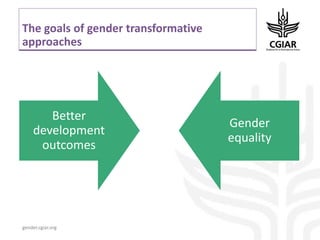
Better
development
outcomes
Gender
equality
gender.cgiar.org
Women’s empowerment and gender
transformative change
Commonalities:
 concerned with individual and collective agency
 conceptualization of power:
 power to,
 power with
 power from within
 critical reflection, engagement with social structures and
institutions
gender.cgiar.org
Women’s empowerment and gender
transformative change
Some (potential) differences:
 (targeting power relations)
 Emphasis on women’s agency vs. relational aspects of
gender inequity
 Who benefits: women or society as a whole?
 Explicit focus on men and questioning the effects of harmful
masculinities
 Focus on organizational change and learning
gender.cgiar.org
Methodologies for gender transformative
change
Participatory Action Research for knowledge generation as
well as a process for transformation
 encourage critical self-reflection and explores bias
 acknowledge and value different ways of knowing and
forms of knowledge
 emphasis on the role and positionality of the facilitator
gender.cgiar.org
Methodologies for gender transformative
change
Capacity strengthening and organizational learning:
“talk the talk and walk the walk”
 Holistic focus on participants of GTA: community members,
researchers and development actors
 Capacity strengthening at inter-related levels of the
individual staff/researcher and the organization
 “Learning by doing” to complement traditional training
 Strengthening reflective and critical capacities,
 Encounter inequality and adversity, which is needed to
understand alternative ways of believing and behaving
gender.cgiar.org
Lessons learned on GTA from Aquatic
Agricultural Systems (AAS)
 Translate big ideas into principles and concrete strategies
for action (with room for maneuver)
 Intersectionality: reframing gender in complex systems
 Start at the beginning with contextual analysis and capacity
development around GTAs across the research team
 Individual and institutional commitment
 Critical reflection
 GTAs are long-term and diverse
gender.cgiar.org
Thank you!

Gender transformative approaches in agriculture

  • 1.
    Gender transformative approaches inagriculture A literature review conducted for the European Commission by the CGIAR Collaborative Platform for Gender Research
  • 2.
    gender.cgiar.org Background and rationalefor gender transformative approaches  Dissatisfaction / critique of mainstream gender integration:  Too technical (focus on gaps),  Superficial,  Based on ‘fixed’ categories of men and women  Reproducing gender inequity though implicit bias  GTAs as alternative to “business as usual”
  • 3.
    gender.cgiar.org Understanding gender transformative approaches Commonthreads in the conceptualization of GTA:  GTA center around transformation:  Focus on underlying causes, power dynamics and structures  Creating an enabling environment  Examine, question and change rigid gender norms  GTAs operate at three interrelated dimensions of change:  Individual capacities and agency  Social relations and norms  Social structures and institutions  Partnerships: engaging with different actors across scales
  • 4.
    gender.cgiar.org The goals ofgender transformative approaches Better development outcomes Gender equality
  • 5.
    gender.cgiar.org Women’s empowerment andgender transformative change Commonalities:  concerned with individual and collective agency  conceptualization of power:  power to,  power with  power from within  critical reflection, engagement with social structures and institutions
  • 6.
    gender.cgiar.org Women’s empowerment andgender transformative change Some (potential) differences:  (targeting power relations)  Emphasis on women’s agency vs. relational aspects of gender inequity  Who benefits: women or society as a whole?  Explicit focus on men and questioning the effects of harmful masculinities  Focus on organizational change and learning
  • 7.
    gender.cgiar.org Methodologies for gendertransformative change Participatory Action Research for knowledge generation as well as a process for transformation  encourage critical self-reflection and explores bias  acknowledge and value different ways of knowing and forms of knowledge  emphasis on the role and positionality of the facilitator
  • 8.
    gender.cgiar.org Methodologies for gendertransformative change Capacity strengthening and organizational learning: “talk the talk and walk the walk”  Holistic focus on participants of GTA: community members, researchers and development actors  Capacity strengthening at inter-related levels of the individual staff/researcher and the organization  “Learning by doing” to complement traditional training  Strengthening reflective and critical capacities,  Encounter inequality and adversity, which is needed to understand alternative ways of believing and behaving
  • 9.
    gender.cgiar.org Lessons learned onGTA from Aquatic Agricultural Systems (AAS)  Translate big ideas into principles and concrete strategies for action (with room for maneuver)  Intersectionality: reframing gender in complex systems  Start at the beginning with contextual analysis and capacity development around GTAs across the research team  Individual and institutional commitment  Critical reflection  GTAs are long-term and diverse
  • 10.

Editor's Notes

  • #2  Presentation is based on a literature review commissioned by the EU as part of their initiative to embed GTAs in policy dialogue, programmes of the United Nations Rome-Based Agencies (e.g. FAO, IFAD, etc) Provides background on the discourse and practice of GTAs in agriculture and NRM domains Based on a search of literature within the CGIAR and beyond that conceptualized gender transformative change and approaches.
  • #3 The rising interest and popularity of GT work springs from a dissatisfaction with current / technical approaches to gender integration: Focus on gaps (only visible manifestations of gender inequality) Simplify complex problems Fixes men and women into categories that are opposing and ignoring other intersecting social relations and changing relations Reproduces gender inequity through implicit bias The idea behind GTAs is not new – but rooted in radical ideas of gender justice and feminist analysis. Could be seen as an effort to put the political back into gender and development theory and practice and address the “second generation challenges” of gender integration.
  • #4 No single accepted definition, but a diversity of understandings that emphasize different aspects. Some central lines of GTA found in literature: Social relations and norms that are dynamic and specific to time and place
  • #5 The goals of GTA can be situated across a spectrum with one the one hand gender transformative change as a means to an end: Development outcomes that are more impactful and lasting Increased incomes, productivity, food security, market access And on the other hand gender transformative change as a process and an outcome in itself Gender equality as an end goal Expand range of aspirations, opportunities, increased agency of individuals, households and communities Most literature is somewhere in the middle, leaning the one way or the other way.
  • #6 Women’s empowerment and gender transformative approaches overlap and differ in various ways depending on how the concepts are used and understood. These are some general trends.
  • #7 Potential: depending how empowerment is conceptualized or employed Women’s empowerment critical to GTAs as GTAs cannot start with the assumption of a level playing field.
  • #8 This method aligns with those who understand GTAs as both a process and an outcome It is about questioning of the assumptions and practices underlying gender inequality, as part of a process of challenging gender-based power imbalances and developing people’s aspirations for self-determination beyond existing gender roles Examples are: Transformative Household Methodology, Rapid Care Analysis, Gender Action Learning System and Asset-Based Community Development. -- emphasis on the role and positionality of the researcher brings us to the next critical part of GTAs ---
  • #9 Organisations as manifestations of wider social institutions, reflecting and reproducing “rules of the game”. This idea is not new, but present in gender and organizational development literature where “getting institutions right for women”. GTAs reintroduce this thinking as a central component of its approach Capacity strengthening is premised on a learning-by-doing approach, in complement to more traditional training. strengthening reflective and critical capacities, encounter inequality and adversity, which is needed to understand alternative ways of believing and behaving
  • #10 Critical reflection – at the root of achieving gender transformative change - It is not enough to get women and men in the same room, GTAs are about initiating critical reflection on norms, attitudes, practices, processes and policies and identifying options for change. The researchers’ role is to facilitate these discussions.
  • #11 Next steps lit review: Peer review and interviews with CGIAR gender researchers involved in GTA work, Presentation at Inception Workshop in Rome Develop a recommendation paper for next steps for RBAs to implement GTAs See GTAs being thoughtfully implemented by the RBAs