SEX CHARACTERISTICS…
• Womenmenstruated while men do not
• Women have developed breasts that
are usually capable of lactating while
men have not
• Women can give birth.
• Men can supply sperm.
• Men have testicles while women do not
CANNOT
BE
CHANGED
4.
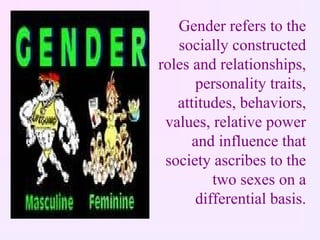
Gender refers tothe
socially constructed
roles and relationships,
personality traits,
attitudes, behaviors,
values, relative power
and influence that
society ascribes to the
two sexes on a
differential basis.
5.
BIOLOGICAL DIFFERENCES....
FEMALE MALE
GENITALIAvagina,
clitoris
penis,
scrotum
INTERNAL
REPRODUCTIVE
ORGANS
uterus,
ovaries,
fallopian
tube, ovum
teste
s
CHROMOSOMES XX XY
HORMONES Estrogen
Progesteron
Testosterone
FAMILY
FAMILY
Composition of theFamily
Role of each member is often
defined by gender
Father – responsible for the material
well being of the wife, children, and
elderly dependents
Mother – responsible for the emotional
and spiritual welfare of the family unit
In nursery andkindergarten classes,
boys and girls are taught what toys
and games are “appropriate” for
their gender
– Heavy block, trucks, airplanes and
carpentry for boys
– Dolls and home making equipment for
girls
SCHOOL
SCHOOL
19.
Classroom dynamics
• Teacherscall on boys more often and
spend more time with them
• Ask boys more challenging questions
• Wait longer for boys to answer
• Urge boys to try harder, constantly
telling the boys that they can do it
SCHOOL
SCHOOL
Masculinity and SportsMedia
• Sports is dominated by men
• Transmit powerful ideas about
manliness and masculinity
• Refer to men athletes as “big,”
“strong,” “gutsy,” “brilliant”
• Call men by their last names
25.
Women and Sports
•Women occupy usually only 2%
of air time
• Sports commentators describe
women athletes as “panicked,”
“fatigued,” “weary,” “vulnerable,”
• Usually use the first names of
women
• Photos are sexualized,
emphasizes the beauty rather
than the game
26.
Masculinity and advertising
•Powerful bodies
dominate space in
ads
• Men are presented
as “virile,” “slim,”
“muscular,”
“powerful”
Because of unevenand unjust
GENDER POWER RELATIONS
women and men are boxed
boxed into
situations – which constrain
constrain their
Capacity to do and to be
30.
Gender issues/concerns
are issues,concerns or
problems arising from societal
expectations and perceptions
on the roles of women and
men that impede one’s
opportunities to participate
in the development process
and enjoy its benefits.
Manifestation of GenderBias
NEGATIVE EFFECTS ON PERSONHOOD
• no self-determination & self-actualization
• low self-esteem / lack of self-confidence
• inability to set higher goals
• etc.
35.
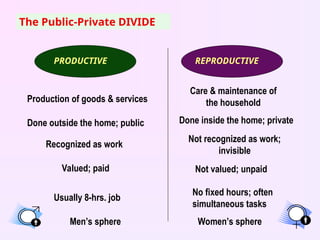
The Public-Private DIVIDE
PRODUCTIVEREPRODUCTIVE
Production of goods & services
Care & maintenance of
the household
Done outside the home; public Done inside the home; private
Recognized as work
Not recognized as work;
invisible
Valued; paid Not valued; unpaid
Usually 8-hrs. job
No fixed hours; often
simultaneous tasks
Men’s sphere Women’s sphere
36.
GAD is aboutbeing faithful to
the principle that
Justice and equity demands that
everyone in society, whether male or
female, has the right to the same
opportunities to achieve a full,
satisfying and peaceful life.
37.
Key Principles
Development thatis gender-responsive should:
EXPAND/ENLARGE women’s range of
CHOICES and OPPORTUNITIES
Deliberately ADDRESS OBSTACLES to
women’s effective participation in
and their enjoyment of the benefits
of development
STRENGTHEN their capabilities to
attain a full, satisfying & peaceful life
#33 Marginalization (economic sphere)
Not equal pay for work of equal value
Women last hired, first fired
No/little opportunities for career advancement (training available or accessible to men only)
Work at home not given any economic value, not considered as work
Work outside the home that are considered extension of their home roles are valued less
Subordination (political sphere)
Few women in decision-making (incl. At home)
Glass ceiling for women – promotions slow, some leadership positions not for women - 10% women in most legislatures
Politics too dirty for women – di masikmura ng women
Gender Stereotyping
“kinakahon” – men’s place, role, work, dress, color, etc. not women’s place, role, dress, color, etc.
From womb to tomb – malikot sa tiyan/baby boy, maganda ang nanay/baby girl – boy’s games & toys/girl’s games & toys
Prevents women from full enjoyment of rights and expression of her talents
Like the air we breath – oftentimes subtle so we are socialized into it without realizing it – defined by our songs, textbooks, church sermons, advertisements
Multiple burden
8 hr. work outside the home – 8 hrs. housework required by defined gender roles – little time for rest & recreation
Men not expected to do housework (some do housework, but only when they want to.e.g. pasikat sa friends na marunong magluto ng pasta)
Violence against women
Whole range of violent acts – green jokes, sexual innuendos, sexual harassment, acts of lasciviousness, rape
Women treated as sex objects
Men socialized into thinking than women are virgins (they expect of their girlfriend, wives, daughters) or vamps (the women who provide them sexual favors)
Some places (parks, bars,etc. or work (night work, work that requires travel) not for women - No woman is safe until all women are safe.
Negative effect on personhood
Women develop low self-esteem, no self-confidence
No control over their bodies
Women set low expectations of themselves, will not want to achieve more, will not want to outshine her man
Will feel that without a man, she is nothing (pressures for women to get married, when married – must keep her man at all costs)







![Gender Senstivity.ppt [Compatibility Mode].pdf](https://cdn.slidesharecdn.com/ss_thumbnails/gendersenstivity-230129191314-6de722a2-thumbnail.jpg?width=640&height=640&fit=bounds)


