TOPIC
GENDER RESPONSIVE
SETTING WITH SPECIAL
REFERENCE TO SCHOOL AND
ITS CURRICULUM
PRESENTED BY:
DR. NIMISHA SRIVASTAVA
ASSISTANT PROFESSOR,
ST.XAVIER’S COLLEGE OF EDUCATION,PATNA
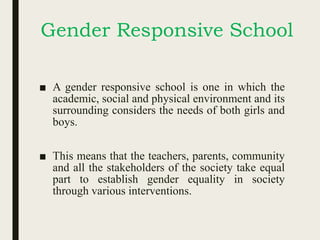
Gender Responsive School
■ A gender responsive school is one in which the
academic, social and physical environment and its
surrounding considers the needs of both girls and
boys.
■ This means that the teachers, parents, community
and all the stakeholders of the society take equal
part to establish gender equality in society
through various interventions.
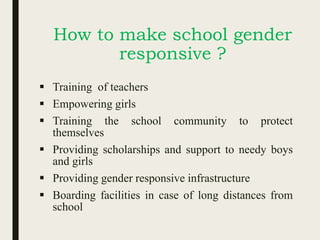
How to make school gender
responsive ?
 Training of teachers
 Empowering girls
 Training the school community to protect
themselves
 Providing scholarships and support to needy boys
and girls
 Providing gender responsive infrastructure
 Boarding facilities in case of long distances from
school
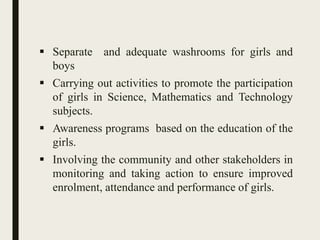
 Separate and adequate washrooms for girls and
boys
 Carrying out activities to promote the participation
of girls in Science, Mathematics and Technology
subjects.
 Awareness programs based on the education of the
girls.
 Involving the community and other stakeholders in
monitoring and taking action to ensure improved
enrolment, attendance and performance of girls.
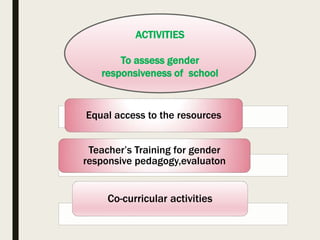
ACTIVITIES
To assess gender
responsiveness of school
Equal access to the resources
Teacher’s Training for gender
responsive pedagogy,evaluaton
Co-curricular activities
Gender Responsive Lesson
Planning
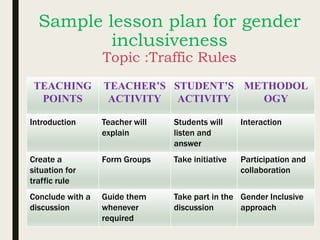
Sample lesson plan for gender
inclusiveness
Topic :Traffic Rules
TEACHING
POINTS
TEACHER’S
ACTIVITY
STUDENT’S
ACTIVITY
METHODOL
OGY
Introduction Teacher will
explain
Students will
listen and
answer
Interaction
Create a
situation for
traffic rule
Form Groups Take initiative Participation and
collaboration
Conclude with a
discussion
Guide them
whenever
required
Take part in the
discussion
Gender Inclusive
approach
GENDER INCLUSIVE LESSION
PLAN INCLUDES:
■ Content
■ Pedagogical Approach
■ Teaching Learning Materials
■ Interaction among students and teachers
■ Assessment
GENDER RESPONSIVE
PEDAGOGY
Gender Responsive Pedagogy
■ Observations of classroom practices show that
teaching and learning is largely gender biased.
■ Many teachers while applying teaching
methodologies, do not give equal opportunities to
boys and girls.
■ There is urgent need to introduce gender responsive
pedagogy.
■ Within the context of classroom settings , pedagogy
is a term that includes what is taught, how teaching
takes place and how what is taught is learnt.
■ Many innovative pedagogical approaches are
available in use , including role play, group
discussions,
■ Case studies, skits, demonstrations and study
tours.
■ A different arrangement such as breaking the
class into mixed smaller groups .
GENDER RESPONSIVE
LANGUAGE
■ In many instances , the teachers themselves are
not aware of the language they are using in the
classroom .
■ They may use terms and expressions that give
the impression that girls are not as intelligent as
boys or that girls do not need to perform well
because they will just get married.
GENDER RESPONSIVE
TEACHING AND
LEARNING MATERIALS
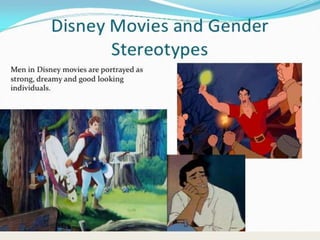
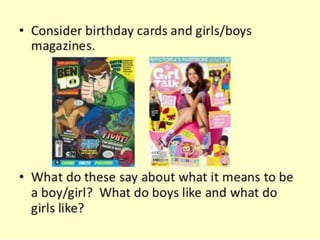
■ Many books and teaching aids reinforce
attitudes and beliefs that men are superior to
women by portraying men in lead roles and
women as helpers.
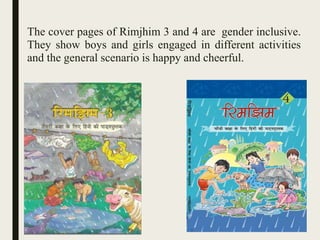
The cover pages of Rimjhim 3 and 4 are gender inclusive.
They show boys and girls engaged in different activities
and the general scenario is happy and cheerful.
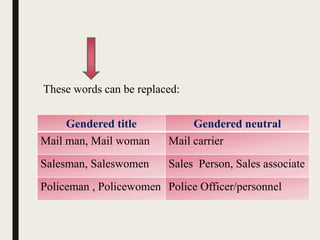
These words can be replaced:
Gendered title Gendered neutral
Mail man, Mail woman Mail carrier
Salesman, Saleswomen Sales Person, Sales associate
Policeman , Policewomen Police Officer/personnel
CLASSROOM SETUP
A gender-responsive classroom setup may involve:
■ A mixed seating arrangement to enhance the
equal participation of boys and girls, and
particularly to encourage women to speak out and
overcome shyness.
GENDER EQUALITY
■ Gender equality refers to equal chances or
opportunities for groups of women and men to
access and control, social, economic and political
resources.
Ways to Establish Gender
Equality in the Class
• Teachers create the gender bias through unintentional,
nonverbal actions. The first step to correcting this
problem is to organize your classroom in a way that
makes all students feel equal and compatible.
• If you find that certain students, regardless of their
gender, are not participating in class, try to change the
seating plan and introduce different activities.
• Teachers tend to interact the most with students sitting
closest to them. Therefore, keep rotating the seating
order (if possible) to give all students a chance to sit
near the teacher.
 Teachers should try to avoid making things easier
for either male or female students by giving them
easier questions in class, or trying to solve things
for the students.
 Doing this can create the perception that certain
students are not as smart as others. Teachers should
hold the same expectations from all the students.
USE GROUP WORK
■ Some students are not comfortable in bigger
groups.
■ Teachers can divide them in smaller groups
to promote better participation.
ADDRESSING
STUDENTS EQUALLY
■ While asking questions teachers generally give
more chance to brighter students. Teachers
should address both the boys and girls in a
balanced way.
■ Research shows that both male and female
teachers often call on male students to speak in
class more often than female students.
PROVIDE ENOUGH TIME
TO ANSWER QUESTIONS
■ Teachers should give time to the students
regardless of their gender to think and answer the
questions so that participation can be enhanced.
■ Research shows that giving students more time to
answer increases the number of participants.
USE GENDER NEUTRAL
LANGUAGE
■ Sometimes teachers use male pronouns when
referring to a group. But, this can make female
students feel left out. Teachers should use
gender neutral pronouns whenever possible.
■ Instead of saying he or she use “everybody” or
“everyone.”
BODY LANGUAGE
■ Body language refers to gesture, facial expression
and posture.
■ Teachers may not realize that their body language is
also a part of their communication. They must be
aware of their posture which does not embarrass
anyone.
■ Teachers should pay attention to the listener , do not
unnecessarily interrupt .Teacher should not keep
sitting on the chair or standing near the board, they
should keep moving in the class to draw the attention
of the students.
DISCIPLINE
■ Be aware when male students insult female
students, or female students insult male students.
■ If the insults appear to be gender-based, students
may be discouraged immediately.
■ Be quick to intervene and discipline the students
who insult others. This shows students of either
gender that they have enough support.
■ However it is important that both male and
female students are given the same discipline for
the same actions.
■ These strategies will help teachers create a more
equal classroom environment for their students.
They will also help teachers effectively manage
their classrooms.
■ Remember:
The best form of teaching is the FAIREST
form of teaching!
Gender responsive setting

Gender responsive setting

  • 1.
    TOPIC GENDER RESPONSIVE SETTING WITHSPECIAL REFERENCE TO SCHOOL AND ITS CURRICULUM PRESENTED BY: DR. NIMISHA SRIVASTAVA ASSISTANT PROFESSOR, ST.XAVIER’S COLLEGE OF EDUCATION,PATNA
  • 2.
    Gender Responsive School ■A gender responsive school is one in which the academic, social and physical environment and its surrounding considers the needs of both girls and boys. ■ This means that the teachers, parents, community and all the stakeholders of the society take equal part to establish gender equality in society through various interventions.
  • 3.
    How to makeschool gender responsive ?  Training of teachers  Empowering girls  Training the school community to protect themselves  Providing scholarships and support to needy boys and girls  Providing gender responsive infrastructure  Boarding facilities in case of long distances from school
  • 4.
     Separate andadequate washrooms for girls and boys  Carrying out activities to promote the participation of girls in Science, Mathematics and Technology subjects.  Awareness programs based on the education of the girls.  Involving the community and other stakeholders in monitoring and taking action to ensure improved enrolment, attendance and performance of girls.
  • 5.
    ACTIVITIES To assess gender responsivenessof school Equal access to the resources Teacher’s Training for gender responsive pedagogy,evaluaton Co-curricular activities
  • 6.
  • 7.
    Sample lesson planfor gender inclusiveness Topic :Traffic Rules TEACHING POINTS TEACHER’S ACTIVITY STUDENT’S ACTIVITY METHODOL OGY Introduction Teacher will explain Students will listen and answer Interaction Create a situation for traffic rule Form Groups Take initiative Participation and collaboration Conclude with a discussion Guide them whenever required Take part in the discussion Gender Inclusive approach
  • 8.
    GENDER INCLUSIVE LESSION PLANINCLUDES: ■ Content ■ Pedagogical Approach ■ Teaching Learning Materials ■ Interaction among students and teachers ■ Assessment
  • 9.
  • 10.
    Gender Responsive Pedagogy ■Observations of classroom practices show that teaching and learning is largely gender biased. ■ Many teachers while applying teaching methodologies, do not give equal opportunities to boys and girls. ■ There is urgent need to introduce gender responsive pedagogy. ■ Within the context of classroom settings , pedagogy is a term that includes what is taught, how teaching takes place and how what is taught is learnt.
  • 11.
    ■ Many innovativepedagogical approaches are available in use , including role play, group discussions, ■ Case studies, skits, demonstrations and study tours. ■ A different arrangement such as breaking the class into mixed smaller groups .
  • 12.
  • 13.
    ■ In manyinstances , the teachers themselves are not aware of the language they are using in the classroom . ■ They may use terms and expressions that give the impression that girls are not as intelligent as boys or that girls do not need to perform well because they will just get married.
  • 14.
  • 15.
    ■ Many booksand teaching aids reinforce attitudes and beliefs that men are superior to women by portraying men in lead roles and women as helpers.
  • 22.
    The cover pagesof Rimjhim 3 and 4 are gender inclusive. They show boys and girls engaged in different activities and the general scenario is happy and cheerful.
  • 23.
    These words canbe replaced: Gendered title Gendered neutral Mail man, Mail woman Mail carrier Salesman, Saleswomen Sales Person, Sales associate Policeman , Policewomen Police Officer/personnel
  • 24.
    CLASSROOM SETUP A gender-responsiveclassroom setup may involve: ■ A mixed seating arrangement to enhance the equal participation of boys and girls, and particularly to encourage women to speak out and overcome shyness.
  • 25.
    GENDER EQUALITY ■ Genderequality refers to equal chances or opportunities for groups of women and men to access and control, social, economic and political resources.
  • 26.
    Ways to EstablishGender Equality in the Class • Teachers create the gender bias through unintentional, nonverbal actions. The first step to correcting this problem is to organize your classroom in a way that makes all students feel equal and compatible. • If you find that certain students, regardless of their gender, are not participating in class, try to change the seating plan and introduce different activities. • Teachers tend to interact the most with students sitting closest to them. Therefore, keep rotating the seating order (if possible) to give all students a chance to sit near the teacher.
  • 27.
     Teachers shouldtry to avoid making things easier for either male or female students by giving them easier questions in class, or trying to solve things for the students.  Doing this can create the perception that certain students are not as smart as others. Teachers should hold the same expectations from all the students.
  • 28.
    USE GROUP WORK ■Some students are not comfortable in bigger groups. ■ Teachers can divide them in smaller groups to promote better participation.
  • 29.
    ADDRESSING STUDENTS EQUALLY ■ Whileasking questions teachers generally give more chance to brighter students. Teachers should address both the boys and girls in a balanced way. ■ Research shows that both male and female teachers often call on male students to speak in class more often than female students.
  • 30.
    PROVIDE ENOUGH TIME TOANSWER QUESTIONS ■ Teachers should give time to the students regardless of their gender to think and answer the questions so that participation can be enhanced. ■ Research shows that giving students more time to answer increases the number of participants.
  • 31.
    USE GENDER NEUTRAL LANGUAGE ■Sometimes teachers use male pronouns when referring to a group. But, this can make female students feel left out. Teachers should use gender neutral pronouns whenever possible. ■ Instead of saying he or she use “everybody” or “everyone.”
  • 32.
    BODY LANGUAGE ■ Bodylanguage refers to gesture, facial expression and posture. ■ Teachers may not realize that their body language is also a part of their communication. They must be aware of their posture which does not embarrass anyone. ■ Teachers should pay attention to the listener , do not unnecessarily interrupt .Teacher should not keep sitting on the chair or standing near the board, they should keep moving in the class to draw the attention of the students.
  • 33.
    DISCIPLINE ■ Be awarewhen male students insult female students, or female students insult male students. ■ If the insults appear to be gender-based, students may be discouraged immediately. ■ Be quick to intervene and discipline the students who insult others. This shows students of either gender that they have enough support. ■ However it is important that both male and female students are given the same discipline for the same actions.
  • 34.
    ■ These strategieswill help teachers create a more equal classroom environment for their students. They will also help teachers effectively manage their classrooms. ■ Remember: The best form of teaching is the FAIREST form of teaching!