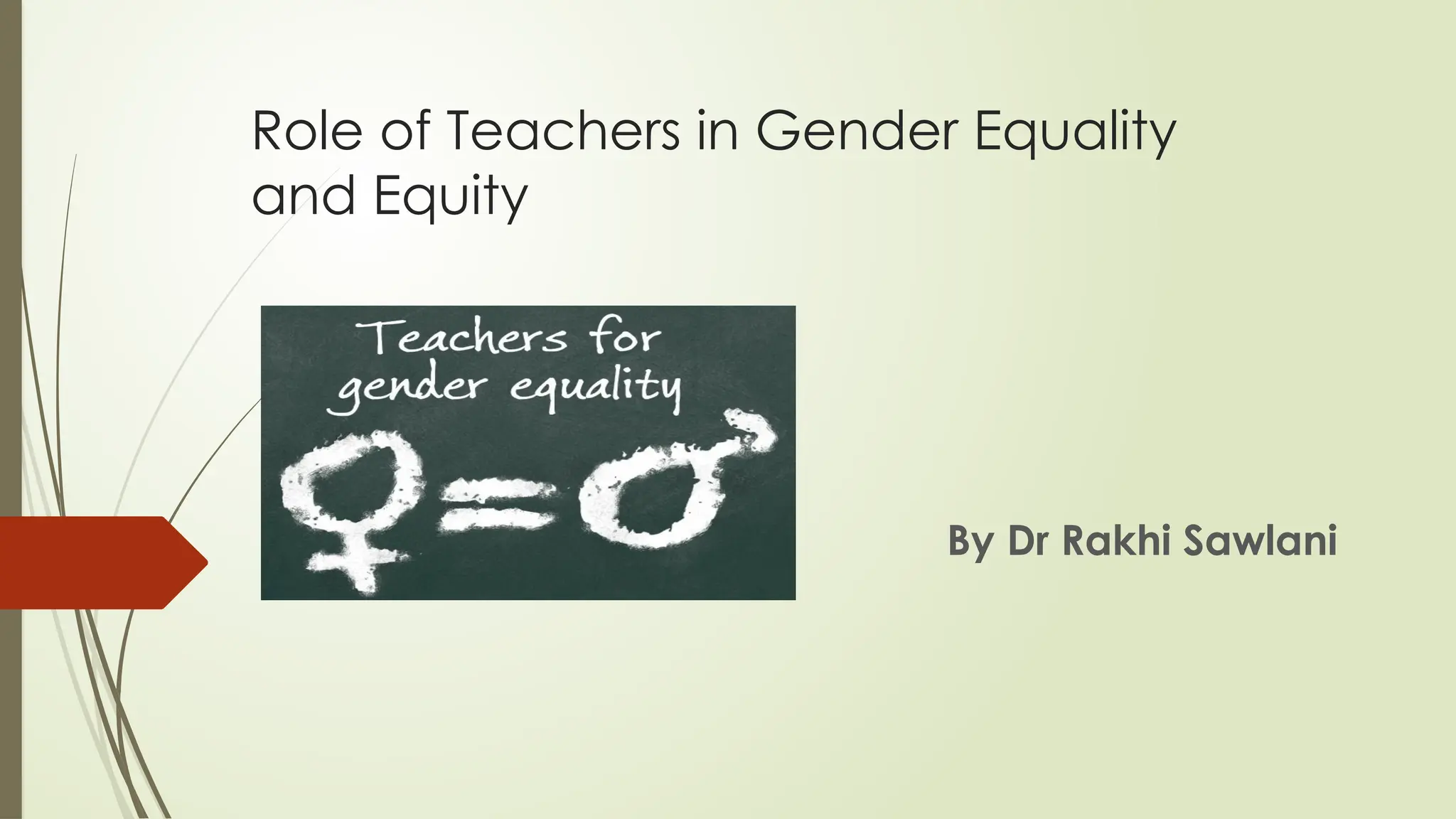
Role of Teachersin Gender Equality
and Equity
By Dr Rakhi Sawlani
2.
Teachers play acrucial role in every classroom. They are
the actors who shape the success or failure of their
students. Their interpretation of the curriculum, interaction
with
learners, and way they assign duties and homework, are
important factors in a child’s schooling.
Teachers play an important role in promoting gender equality
and gender equity because:
Teacher is held in high esteem by students.
Every word and action of the teacher moulds the thoughts
and views of the child.
Teacher educators themselves be gender sensitive through
gender awareness and sensitization programmes.
Therefore, the teacher needs to exercise great care
regarding his/her interaction with the students.
3.
Teachers can promotegender equality in a number of ways.
They are as follows:
Critically analyse the teaching content and identify
gender bias, if any. While teaching break gender
stereotypes by providing examples of both sexes.
For example, while discussing about the contribution of
scientists, include examples of men as well as women.
While teaching about the freedom struggle of India,
include examples of the contribution of women.
Children often bring stereotyped notions due to what they
see and hear at home or in the society around them. Help
students to analyse these notions and discern for
themselves what is right and wrong.
4.
Ensure equal participationof both boys and girls in all teaching-
learning activities such as discussions, brainstorming or answering
of questions. Hesitant students should be encouraged. It is quite
likely what when the class has a majority of girls, the boys tend to
be reticent. In a class with more boys, girls may not be
forthcoming. Teachers need to be mindful of the demographics
of the class and encourage participation of those in minority.
Have a common set of rules for both boys and girls while
disciplining in case of misbehaviour. Often, boys get harsher
penalty as compared to girls for the same mistakes. this should not
be done.
Teachers and teacher educators should examine their syllabuses
with the view of incorporating a gender dimension by: including
the introductory themes on gender; and by exploring gender
issues within some of the topics of existing syllabus; employ
engendered patterns of classroom organisation and interaction,
and teaching approaches.
5.
Be mindful ofsexist bullying and labelling.
For example, a girl who climbs tress may be labelled as
‘tomboy’ by her classmates. A boy who cannot ride a
bicycle may be called a ‘sissy’ by his classmates. Such
teasing can have a deep impact on the child.
The teacher needs to realise that stereotypes operate
on the surface, while attitudes towards genders are far
more entrenched, address the attitudes that students
harbour and help them develop a healthy respect
towards their own sex and opposite sex.
This can be done through workshops on life skills and
gender sensitisation activities.
6.
Encourage students toparticipate in activities
according to their interests and aptitude.
For example: coaching in sports like football or hockey is
arranged exclusively for boys and not for girls. This is to
be avoided.
The manner in which the media depicts men and
women colours the views of the students. Unconsciously,
their own perceptions get moulded based on what is
portrayed. Teachers could organise regular discussions
about the films and serials that students watch and
dispel wrong notions about gender.
For example: television serials eulogise silent, suffering
and weeping women and applaud macho men.
Capacity building centres should be established in all
educational regions intended to train teachers and
teacher educators in gender-laden education.
7.
Teachers and teachereducators should :
a)conduct workshops,
b)introduce engendered classroom
organisation and interaction;
c)introductory lessons on gender;
d)focus on gender issues within the existing
syllabus topics;
e)Introducing gender issues career guidance;
f) analysing gender issues in instructional
materials
g) conducting research projects on gender
issues.
8.
Children often sharetheir dreams with their teachers.
Teachers can be catalysts who proved the impetus to let
students achieve their dreams.
For example, when Seeta said she wants to be an IAS
officer, some of her friends said, 'OH, but that would mean
a transferable job and that won’t be suitable once you
marry’.
Her teacher’s response in this case was,’It is perfectly fine
for seta to pursue her dream. We do have some women
IAS officers doing great work in our country. They do
justice to their job as well as to their family’.
Both boys and girls must be assisted to break the gender
based stereotypes that exist regarding our choice of
professions.