International Journal of Evaluation and Research in Education (IJERE)
Vol. 14, No. 4, August 2025, pp. 2832~2845
ISSN: 2252-8822, DOI: 10.11591/ijere.v14i4.31105  2832
Journal homepage: http://ijere.iaescore.com
Gender differences in motivation and problem-solving in a
physics course online problem-based learning
Elnetthra Folly Eldy1
, Fauziah Sulaiman2
, Mohd Zaki Ishak3
, Lorna Uden4
, Jo-Ann Netto-Shek5
1
Preparatory Centre for Science and Technology, Universiti Malaysia Sabah, Kota Kinabalu, Malaysia
2
Faculty of Science and Technology, Universiti Malaysia Sabah, Kota Kinabalu, Malaysia
3
Independent Researcher, Malaysia
4
Faculty of Computing and Digital Technologies, Staffordshire University, Stoke-on-Trent, United Kingdom
5
English Language and Literature, National Institute of Education, Nanyang Technology University, Singapore, Singapore
Article Info ABSTRACT
Article history:
Received May 7, 2024
Revised Dec 17, 2024
Accepted Mar 2, 2025
Online learning has been crucial since COVID-19, yet its effectiveness,
particularly in physics education, remains debated. Understanding students’
motivation and problem-solving abilities in online environments is critical.
This paper examined and presented the gender difference in motivation and
problem-solving skills using an integrated online problem-based learning
(iON-PBL) in a physics course. Developed using analysis, design,
development, implementation, and evaluation (ADDIE) mode, iON-PBL
module of physics guided students through problem-solving activities over 13
weeks. A post-test–delayed post-test design was used to assess retention of
motivation and problem-solving skills. The study involved 116 pre-university
students from Universiti Malaysia Sabah (88 females, 28 males). Motivation
was measured using the motivated strategies for learning questionnaire
(MSLQ) (four components), and problem-solving skills were assessed with
the problem-solving inventory (PSI) (three components). Data analysis was
conducted using SPSS version 28. Findings showed a significant gender
difference in the ‘cognitive strategy’ component of motivation at the post-test,
favoring female students. However, this difference was not sustained in the
delayed post-test. In contrast, no gender difference was found in problem-
solving at the post-test, but females scored significantly higher in ‘personal
control’ in the delayed post-test. These findings suggest that female students
are more likely to maintain cognitive strategies and personal control in online
learning. Educators should consider targeted strategies to support male
students’ motivation and problem-solving development in virtual
environments to foster gender equity. Educators should consider targeted
strategies to support male students’ motivation and problem-solving
development in virtual environments to foster gender equity.
Keywords:
Gender perspectives
iON-PBL
Motivation
Physics
Pre-university
Problem-solving skills
This is an open access article under the CC BY-SA license.
Corresponding Author:
Fauziah Sulaiman
Faculty of Science and Technology, Universiti Malaysia Sabah
UMS Street, 88400 Kota Kinabalu, Sabah, Malaysia
Email: fauziahs@ums.edu.my
1. INTRODUCTION
The declining interest in science, technology, engineering, and mathematics (STEM) subjects in
school is become a hot issue that is constantly debated these recent years. It has created a potential crisis for
the future workforce and innovation. According to junior achievement, there has been a 12% decrease in
interest among teenage boys and a steady 11% interest level among teenage girls from 2017 to 2018.
Int J Eval & Res Educ ISSN: 2252-8822 
Gender differences in motivation and problem-solving in a physics course online … (Elnetthra Folly Eldy)
2833
In Malaysia, recent statistics indicate that only 45.73% of school students choose science-related subjects,
which includes technical and vocational programs [1]. This number falls short of the 60:40 ratio of science to
arts students, raising concerns about a future shortage of qualified STEM professionals [2]. Several
challenges contribute to this issue, such as the need for localized STEM learning materials and a shortage of
skilled STEM teachers, which hinder effective teaching and learning in these subjects [3]. Another
contributing factor is the student’s perception that these subjects are too difficult [4]. For instance, physics is
often perceived as challenging due to its abstract nature, and generally less appealing amongst student when
compared to other science subjects [5], resulting in decreased number of students enrolling [6]. However,
early-year STEM education offers hope, with experts advocating for this approach to cultivate interest and
address the shortage of engineers and other STEM professionals in Malaysia [7].
The gender gap in STEM fields is another persistent global issue. Women are significantly
underrepresented in STEM education and careers worldwide. Globally, women make up only 35% of STEM
students in higher education [8]. In the United Kingdom, only 11% of positions in STEM fields are held by
women. In the United States, women with a bachelor’s degree or higher make up 44.2% of the STEM
workforce, while women without a bachelor’s degree make up 25.8%. In China, women account for only
26.27% of research and development personnel and 5.79% of the total academicians of the Chinese Academy
of Sciences and Engineering [9]. In Saudi, women comprise only 16% of its workforce, the lowest rate
among the 20 countries in the global gender gap report [10], followed by the UAE at 20% and India at 22%
[11]. However, there are encouraging strides being made in Malaysia in terms of gender equality in STEM
education. Despite the global gender disparity favoring male students, Malaysia reported in 2021 that 53.2%
of STEM graduates were female. This indicates a strong female presence in STEM education at the tertiary
level, where women outnumber men in graduation rates from STEM programs [12]. Challenges remain in
physics, where gender disparity is pronounced, with women underrepresented in traditionally male-
dominated fields. This reflects broader societal norms and stereotypes that can discourage women from
pursuing careers in these areas. Addressing these disparities requires a multifaceted approach that includes
cultural change, better educational practices, and supportive policies to create an equitable environment for
women in STEM [13].
From another perspective, one constructive approach to attracting students to enroll in physics
courses and STEM fields is incorporating real-life examples relevant to their daily activities. Real-life
examples and practical applications of physics can significantly enhance student engagement and
understanding of the subject. Educators can make the subject more relatable and exciting by demonstrating
how physics principles are integrated into everyday life. For instance, the impact of physics on modern
technology is profound. The global positioning system (GPS) is one of the many everyday technologies that
are built on physics principles, specifically relativity. To deliver precise location data, satellites must take
account of time dilation due to their speed and earth's gravitational [14]. This connection can help students
appreciate the relevance and importance of physics in modern technology, making the subject more engaging
and exciting [15]. There are many approaches that may prompt student learning, such as project-based
learning (PjBL) [16] and problem-based learning (PBL) [17]. PBL and PjBL approaches in physics education
offer numerous benefits and outcomes that enhance student engagement, understanding, and skill
development especially in physical classroom [15], [18], [19]. For instance, PBL fosters a more engaging
learning environment by allowing students to work on meaningful projects that relate to real-world problems.
This relevance boosts motivation and interest in physics [15]. Research indicates that students often report
improved attitudes towards learning physics [16], reduced anxiety, and increased enjoyment when involved
in PBL activities. This practice is widely recognized as an effective way to make the study of physics more
engaging and accessible [20].
Although some studies revealed no significant difference in impacts on male and female students
[21], still numerous studies have demonstrated that these strategies can increase the motivation of male and
female students [22] and problem-solving skills in learning physics [23]. PBL implementation varies by field
and often includes different approaches, strategies, and tools. It commonly occurs in face-to-face settings,
with independent learning, continuous reading, group discussions, and presentations in a classroom. For a
variety of reasons, including student adaptability [24] and technical pedagogical preparedness [25], PBL
integration is rarely implemented online. Consequently, only some studies examined the impact of PBL on
males and females, where implementing PBL online presents several challenges; one is scaling PBL to work
effectively online. Faithfully replicating the classroom setting of the PBL online requires careful planning
and adaptation [26], [27]. Strategies like asynchronous discussions, virtual group meetings, and online
resources can help scale PBL online, but they may require more structure than in-person PBL [28], [29].
Therefore, the theoretical framework for this research is based on constructivist theory, e.g.
Piaget [30] and Vygotsky [31] and connectivism theory, proposed by Siemens [32] and Downes [33], [34],
both of which provide valuable insights into the learning process, especially in the context of online
education. The main objective of this research is to compare how the iON-PBL module of physics enhances
 ISSN: 2252-8822
Int J Eval & Res Educ, Vol. 14, No. 4, August 2025: 2832-2845
2834
and retains students’ motivation and problem-solving skills based on gender, followed by these research
question (RQ):
i) Is there any significant difference between male and female students in their motivation to learn physics
from the iON-PBL module of physics for post-test? (RQ1)
ii) Is there any significant difference between male and female students in their motivation to learn physics
from iON-PBL module of physics for delayed post-test? (RQ2)
iii) Is there any significant difference between male and female students in their problem-solving skills to
learn physics from the iON-PBL module of physics for post-test? (RQ3)
iv) Is there any significant difference between male and female students in their problem-solving skills to
learn physics from iON-PBL module of physics for delayed post-test? (RQ4)
2. LITERATURE REVIEW
Motivation plays a crucial role in the academic success of students pursuing physics. It is important
to note that a combination of intrinsic and extrinsic motivation is necessary to keep students engaged and
driven. While extrinsic motivation is driven by external rewards, such as grades or recognition, intrinsic
motivation comes from within [34]. Intrinsic motivation provides a sense of fulfilment and accomplishment,
making learning more enjoyable and satisfying [35], [36]. However, external incentives might affect students
differently during the learning process. Nevertheless, teachers cannot always rely on it because not all the
work students must complete is engaging and pleasurable [36]. Extrinsic drive can also boost intrinsic desire,
even though it has a limited effect and discourages pupils from wanting to do comparable activities in the
future [35]. Saleh [37] study uncovered a significant disparity in the motivation to learn physics between
urban and rural students, where there were no notable differences between male and female students. The
study also pointed out that various intrinsic factors such as relationships, stress, and effort strongly influence
a student's motivation to learn physics. Petri [38] indicates that intrinsically motivated students retain
information and concepts longer than extrinsically motivated students. This intrinsic motivation correlates
with higher engagement, enjoyment, and persistence in learning physics and leads to enhanced performance
and creativity in problem-solving tasks, underscoring its potential impact. To date, how motivations play an
important role in gender [39] is also being debated by many researchers in terms of student achievement [40],
attitude and anxiety [41], in educational technology [42], and students’ autonomy [43].
The literature shows different views on teaching strategies for different genders, influenced by
gender-role stereotypes. Male students may have more drive in activities aligned with their interests [36], for
example, in a study by Lee and Yuan [36], male students have higher positive evaluations of virtual
manipulatives when participating in computer-based mathematics activities. Meanwhile, female students
need more interesting teaching activities related to virtual manipulatives to boost their motivation and
enjoyment of mathematics. They could be more likely to work on projects that let them use their talents or
pursue their passions. Similarly, female students may be intrinsically motivated when they have a strong
emotional connection to the material, opportunities for creativity and self-expression, and are encouraged to
cooperate and make significant contributions [44]. Male students also may be more influenced in academic
environments by prizes or recognition from outside sources [45], as they could aim for better grades,
instructor praise, or competition with other students to demonstrate their mastery or domination. Conversely,
external influences may also impact female students, but they may be more prone to working together and
attaining goals to preserve social ties [36]. Therefore, examining gender differences in motivation is crucial
for promoting equality in learning environments. Exploring diverse motivational profiles, considering the
impact of learning environments [45], academic achievement and performance [46], and addressing
emotional factors [47] are all critical areas of study that can help address gender inequality in education.
Therefore, there are numerous approaches to enhance students' physics learning motivation, such as
utilizing technology to engage students [25]. However, the success of these tools and methods largely
depends on the educators. By implementing various teaching and learning strategies, such as PBL [25], PjBL
[48], inquiry-based learning (IBL) [49], and game-based learning (GBL) [50], educators can enhance
students' willingness to learn physics and make the subject more engaging. In order to improve learning
results, instructors must make use of these resources and techniques to help students find physics more
engaging and relevant [48]. Few studies have demonstrated how well PBL fosters creativity and critical
thinking in online contexts [51], [52], as well as students’ academic achievement, problem-solving skills,
communication skills [53], [54], and boost their active learning [54]. Different research has also indicated
that integrating Web 2.0 tools into PBL enhances student engagement and learning outcomes. For instance,
students used collaborative platforms to research, share information, and present their findings on scientific
topics, which has made learning more interactive and helped them develop digital literacy skills crucial in
modern science education [55].
Int J Eval & Res Educ ISSN: 2252-8822 
Gender differences in motivation and problem-solving in a physics course online … (Elnetthra Folly Eldy)
2835
From another perspective, solving problems efficiently is a crucial 21st century skill that can benefit
students' academic pursuits and daily lives [56], [57]. However, students often need help developing effective
problem-solving techniques when studying physics, and if not, they can lose interest and motivation [58]. To
overcome this, students must understand the problems' fundamental concepts and avoid relying solely on
memorization. Istiyono et al. [56] emphasize that the key to mastering problem-solving skills in physics is
the ability to analyze and evaluate given problems. By doing so, students can develop practical problem-
solving skills that will benefit them in the long run. Problem-solving skills also influence students' motivation
to learn physics; findings such as those by Argaw et al. [57] show no dormant students' motivation when
studying integrated PBL in physics. However, studies such as by Hasrawati et al. [59] also shows the direct
positive impacts of PBL on students' problem-solving skills and learning motivation when the PBL model is
applied to learning mathematics. Another study indicated that students who engaged in problem-solving
strategies while learning physics demonstrated higher-order thinking skills (HOTS) than those who relied on
rote memorization [60]. Not only that, Aldemir et al. [15] found that students studying physics topics could
enhance their real-world applications by applying physics concepts to real-life situations. Students become
more engaged and motivated to solve problems when they can see real-world applications, such as
calculating the trajectory of a projectile or understanding the principles of electricity. This connection to the
real-world enhances their ability to think critically and creatively about solutions [15], [52]. Physics also
often involves collaborative problem-solving, where students work together to tackle complex problems
making the learning process more engaging and enjoyable. For example, a study by Adolphus et al. [61]
revealed that students are motivated when they cooperatively solve problems in physics; there was a
significant difference in problem-solving abilities among students taught using collaborative learning strategy
and those taught with the conventional method.
Literature on PBL practices in science education indicates mixed results towards students'
motivation and problem-solving skills. Positively, PBL in online environment found to have significant
positive impact on students’ problem-solving skills [62]. Additionally, Pozuelo-Muñoz et al. [63] highlighted
that PBL encourages students to engage actively in learning, fostering a deeper understanding of scientific
concepts through hands-on experiences. A study done by Wijnia et al. [64] showed that PBL had a small to
moderate, heterogeneous positive effect on students' motivation. Despite the generally positive findings, the
same meta-analysis revealed that the effects of PBL on motivation are not uniform across all contexts. While
PBL can increase motivation, the effect is more pronounced in STEM and healthcare domains compared to
other fields [65]. Additionally, the study found that the impact on intrinsic motivation was trivial, challenging
the assumption that PBL universally enhances intrinsic motivation [66]. Not all students respond positively to
PBL, factors such as prior knowledge, learning styles, and individual motivation levels can affect
engagement. Some students may prefer more structured learning environments and find the open-ended
nature of PBL challenging, which can lead to disengagement and frustration [67].
Traits of PBL can also equally beneficial for both male and female students’ problem-solving skills
and motivation. Findings from several researches [66], [68] reassures us that both genders can excel in
problem-solving and related cognitive abilities. While there are mixed findings regarding gender differences
in motivation and problem-solving abilities, it is crucial to consider these differences. Several studies suggest
shows on no significant differences overall, underscoring the importance of this topic in the field of
education and psychology. For example, in a study by Zambo and Follman [69], of 6th and 8th graders
solving 2-step math word problems found no significant differences between genders at the individual
problem-solving steps, and they concluded that the step-by-step problem-solving plan might be gender-
biased. Another study by Hyde et al. [70] suggested that gender differences in mathematics performance are
relatively small, favoring males in problem-solving tasks at higher educational levels. To a different study,
there was more to the average gap in female and male students' problem-solving skills than just learning
methods. Problem-solving abilities for both genders have been successfully enhanced by strategies like
guided discovery learning, while in terms of motivation, male students were better at planning and problem-
solving, whereas female students tended to be more driven to learn and to seek credit for their achievements
[71]. Acknowledging these accomplishments is essential since it greatly increases students' enthusiasm and
involvement. The potential of tailoring PBL online to diverse learning styles is significant, as it could
effectively address the different learning styles and preferences of both males and females.
3. METHOD
This research focuses on the integrated online problem-based learning (iON-PBL) module of
physics approach, a method that leverages online tools and resources to facilitate PBL. This module aims to
enhance and retains per-university students’ motivation and problem-solving skills emphasizes characteristics
such as active learning environment as students engage with real-world problems, leading to deeper
understanding. By integrating network information, communication technology, and electronic devices, the
 ISSN: 2252-8822
Int J Eval & Res Educ, Vol. 14, No. 4, August 2025: 2832-2845
2836
entire PBL process, from problem introduction to reflection, is conducted virtually. The methodology
employed in this study closely aligns with the McMaster health science curricula. Students engage in
scenario review, information sharing, problem exploration, information gathering, application of new
knowledge, and reflection. Additionally, this module fosters the development of cognitive strategies by
encouraging students to break down problems into smaller, more manageable parts. Finally, the module
utilizes real-life problems that are more relatable and interesting, which enhances students' motivation. The
module was developed using analysis, design, development, implementation, and evaluation (ADDIE)
instructional design. ADDIE is an acronym and consists of five essential steps, i.e., analysis, design,
development, implementation, and evaluation [72], as what listed:
− Analysis: four important instructions to facilitate the designer in developing an effective module were
highlighted: needs assessment (i.e., analysis of the learner, analysis of the instructional goals), problem
identification, task analysis, and developing learning objectives [73].
− Design: three aspects of this step were highlighted: designing assessments, choosing the course format,
and developing the instructional technique [73].
− Development: this stage depends on the first two phases, creating factual sample for instruction design,
developing the materials of this course, and run through the conduction of the design [73].
− Implementation: this stage is where the plan is transformed into action. Components such as instructor
training, students' preparation, and learning environment were key at this stage [73].
− Evaluation: the last step is to evaluate the module's suitability. Aldoobie [73] highlighted one-to-one
formative evaluation, small evaluation group, formative evaluation, and summative evaluation in this
final stage of the ADDIE model.
Figure 1 presents a summary of the entire procedure to provide a comprehensive overview of the
research. The procedure was divided into two phases, with phase 1 devoted to module development and
phase 2 centered on measuring module effectiveness. It is noteworthy, however, that this paper exclusively
reports on the analysis data found within the red dotted line. Our research solely centered on the experimental
group (EG) comprising male and female students. The aim was to examine the influence of the iON-PBL
physics module on the gender perspective.
Figure 1. Summary of the research procedure
This study used the explanatory sequential mixed-methods research designs where a two-group
(i.e., experimental and control group) pretest-posttest-delayed posttest was employed. Explanatory sequential
designs combine the strengths of each quantitative and qualitative methods in a particular sequence to
Phase 1: Module development
Phase 2: Module effectiveness
Briefing and online training session
Pre-test
Experimental group Control group
Module intervention (13 weeks)
Post-test
Delayed post-test
Focus group interview
Quantitative and data analysis
Traditional instructions (13 weeks)
Int J Eval & Res Educ ISSN: 2252-8822 
Gender differences in motivation and problem-solving in a physics course online … (Elnetthra Folly Eldy)
2837
provide more comprehensive understanding of a research problem or question [74]. The researcher was also
able to make more precise conclusions on the causal relationship between the independent and dependent
variables because to the research design. The inclusion of the control group in this study was justified by the
need to ascertain whether the intervention of the iON-PBL module of physics caused any changes in the
experimental group's posttest and delayed posttest from the pretest. Table 1 shows the full framework of the
two-group pretest-posttest-delayed posttest of this research design suggested by Creswell [75].
Table 1. Two-group pretest-posttest-delayed posttest design
Group Implementation
Experimental O1a X O2a O3a
Control O1b O2b O3b
*O1a and O1b=pretest; X=intervention; O2a and O2b=posttest; O3a and O3b=delayed posttest
The study methodology involved a pre-test and post-test comparison between an EG and a control
group. Both groups initially used the same instrument to measure the dependent variable (O1) in the pre-test.
Subsequently, the EG underwent a 13-week intervention (X), while the control group did not receive any
intervention. After the intervention, the dependent variable (O2) was measured in a post-test using the same
instrument, and this process was repeated in a delayed post-test four weeks later (O3). The learning activities
for both groups were conducted entirely online, ensuring a consistent environment for the study. The
researcher conducted pre-test and post-test analysis mainly to identify whether the dependent variable had
improved. The researchers determined whether there was a statistically significant difference in the mean
values of O2a and O1a for male and female students in the EG. Similarly, the researchers analyzed the
considerable difference in the mean values between O3a and O2a for male and female students in the EG to
determine the retention of the dependent variable–as shows in red dotted line in Figure 1 and Table 1. This
paper only presented and addressed quantitative data and focused solely on the findings of the mean
comparison between male and female students in the EG exposed to PBL in online environment for the entire
implementation. The students also participated in the PBL online activity, which included various active
learning activities, such as group formation, issue identification, independent learning, discussion, reflection,
and presentation. The teaching and learning platform used for this activity was SmartV3, powered by
Moodle.
The 30 items of Pintrich et al. [76] motivated strategies for learning questionnaire (MSLQ) were
used in this study and were grouped into four themes: self-efficacy (SE), intrinsic value (IV), cognitive
strategy use (CSU), and self-regulation (SR). Concurrently, the problem-solving inventory (PSI) developed
by Heppner and Petersen [77] was implemented. It has thirty-two (32) PSI items grouped into three themes:
personal control (PC), approach avoidance style (AAS), and problem-solving confidence (PSC). Prior to,
throughout, and four weeks following the intervention, measurements of both dependent variables will be
taken. Before the implementation, a pilot test was performed to assess the instruments' dependability. As a
result, Cronbach's alpha of the analysis from statistical package for social science (SPSS) version 28 is 0.905
and 0.756 for MSLQ and PSI, respectively. Based on the ranges of values summarized by Taber [78], this
value is sufficient, satisfactory, and acceptable. Subsequently, this instrument was sent to expertise for
content validity. The participants of this research, the pre-university students at the Preparatory Centre for
Science and Technology, Universiti Malaysia Sabah session 2021/2022, played a crucial role. They enrolled
on a one-year foundation in science program, which is compulsory to sit for science subjects, i.e., physics,
biology, chemistry, and mathematics. Table 2 shows the distribution of students based on gender for the
experimental group. The number of samples (N) is a total of N=116, consisting of females (N=88, 75.9%)
and males (N=28, 24.1%).
Table 2. Distribution of students based on gender
Group Frequency (N) Percentage (%)
EG Female 88 75.9
Male 28 24.1
Total 116 100
Due to the COVID-19 situation, data gathering for this research was conducted using Google Forms.
This application was chosen for its user-friendly interface, free availability, and quick completion time,
making it an ideal choice for participants to respond to Raju and Harinarayana [79]. Additionally, as the
study's participants are based at home with varying internet capabilities, Google Forms was deemed a
 ISSN: 2252-8822
Int J Eval & Res Educ, Vol. 14, No. 4, August 2025: 2832-2845
2838
suitable medium due to its mobile-friendly nature. The RQ were answered using post-test results, delayed
post-test results, and a five-point Likert scale questionnaire. The delayed post-test is important because it can
assess the retention of students' motivation and problem-solving skills in physics after the iON-PBL module
of physics intervention.
4. RESULTS
4.1. iON-PBL module of physics on students’ motivation learning physics
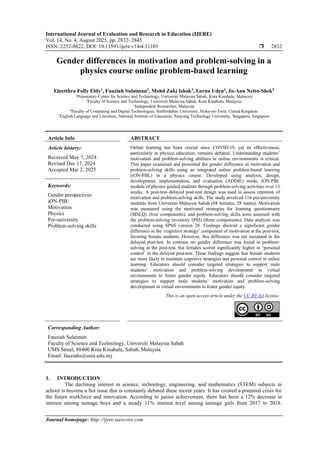
An independent sample t-test was conducted to compare the mean scores of male and female
students for motivation towards learning physics in the experimental group. Table 3 shows the mean scores
for each component of motivation in MSLQ (i.e., SE, IV, CSU, and SR) between males and females, for both
post-test and delayed post-test.
Table 3. The motivation’s mean score between male and female student
Components
Gender
Total
Independent sample t-test
Male (N=28) Female (N=88) t MD Sig (2-tailed)
Post-test
SE Mean 3.30 3.45 3.41 -0.88 -0.15 0.38
SD 0.68 0.80 0.77
IV Mean 3.93 3.97 3.97 -0.29 -0.04 0.77
SD 0.53 0.59 0.59
CSU Mean 3.73 4.19 4.08 -4.44 -0.46 *0.00
SD 0.58 0.44 0.51
SR Mean 3.37 3.51 3.48 -1.28 -0.14 0.20
SD 0.56 0.48 0.51
Delayed post-test
SE Mean 3.24 3.31 3.29 -0.41 -0.07 0.67
SD 0.59 0.83 0.78
IV Mean 3.64 3.79 3.76 -1.24 -0.15 0.22
SD 0.49 0.59 0.58
CSU Mean 3.64 3.81 3.77 -1.30 -0.17 0.19
SD 0.58 0.59 0.59
SR Mean 3.36 3.44 3.42 -0.77 -0.08 0.45
SD 0.45 0.51 0.49
*Sig. (2-tailed), p≤0.05, SD=standard deviation, MD=mean difference
For post-test, opposite results were shows for SE and IV, as mean score for female students was
higher than male students for both components. For SE, mean score for female students (M=3.45) was higher
by 0.15 than male students (M=3.30), and for IV, mean score for female students (M=3.97) was slightly
higher by 0.04 than male students (M=3.93). Consistently, for CSU and SR, mean score for female students
was higher than male students. For CSU, mean score for female students (M=4.19) higher by 0.46 to male
students (M=3.73), and for SR, mean score for female students (M=3.51) higher by 0.14 to male students
(M=3.37). In addition, results show significant difference with favor to female students on CSU with score of
MD=-0.46; t-test value, t=-2.76, and p≤0.05:<0.00*.
Lastly, for delayed post-test which was collected four weeks after the implementation, similar
pattern of results was shows as mean score for female students was higher than male students for all
components. For SE, mean score for female students (M=3.31) higher by compared to male students
(M=3.24), and for IV, mean score for female students (M=3.79) higher than male students (M=3.64).
Likewise, for CSU, mean score for female (M=3.81) higher than male students (M=3.64), and for SR mean
score for female students (M=3.44) higher than male students (M=3.36). Comparatively, there is no
significance difference on male and female students’ motivation on all components for delayed post-test.
4.2. iON-PBL module of physics on students’ problem-solving skills
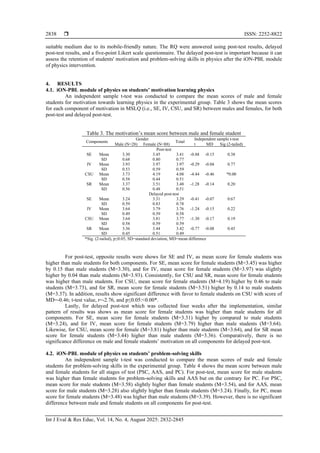
An independent sample t-test was conducted to compare the mean scores of male and female
students for problem-solving skills in the experimental group. Table 4 shows the mean score between male
and female students for all stages of test (PSC, AAS, and PC). For post-test, mean score for male students
was higher than female students for problem-solving skills and AAS but on the contrary for PC. For PSC,
mean score for male students (M=3.58) slightly higher than female students (M=3.54), and for AAS, mean
score for male students (M=3.28) also slightly higher than female students (M=3.24). Finally, for PC, mean
score for female students (M=3.48) was higher than male students (M=3.39). However, there is no significant
difference between male and female students on all components for post-test.
Int J Eval & Res Educ ISSN: 2252-8822 
Gender differences in motivation and problem-solving in a physics course online … (Elnetthra Folly Eldy)
2839
Equivalently to post-test, for delayed post-test, mean score for male students was higher than female
students for PSC and AAS, but opposite with the PC. For PSC, mean score for male students (M=3.66) was
higher than female students (M=3.56), and for AAS, mean score for male students (M=3.31) was higher than
female students (M=3.26), however these results show insignificant difference. Finally, for PC, mean score
for female students (M=3.31) was higher significantly than male students (M=3.01) with score of MD=-0.29;
t-test value, t=-2.04, and p≤0.05:*0.04.
Table 4. The problem-solving skills’ mean score between male and female students
Components
Gender
Total
Independent sample t-test
Male (N=28) Female (N=88) t MD Sig (2-tailed)
Post-test
PSC Mean 3.58 3.54 3.55 0.46 0.04 0.64
SD 0.37 0.43 0.42
AAS Mean 3.28 3.24 3.25 0.51 0.04 0.62
SD 0.42 0.39 0.39
PC Mean 3.39 3.48 3.46 -0.36 -0.08 0.72
SD 1.68 0.79 1.07
Delayed post-test
PSC Mean 3.66 3.56 3.58 0.97 0.09 0.33
SD 0.47 0.47 0.47
AAS Mean 3.31 3.26 3.27 0.57 0.05 0.57
SD 0.46 0.36 0.38
PC Mean 3.01 3.31 3.23 -2.04 -0.29 *0.04
SD 0.68 0.66 0.68
*Sig. (2-tailed), p≤0.05, SD=standard deviation, MD=mean difference
5. DISCUSSION
The results show that only the CSU component for the post-test showed a significant difference in
favoring female students compared to male students after implementing the iON-PBL module. However, the
rest of them, although female students, scored higher on mean marks than male students (i.e., post-test
and delayed post-test) on all components; this is insignificant. This is consistent with findings by several
studies [57], [80], which show that female students improve their motivation to learn physics after being
introduced to PBL, but it is insignificant. This probably due to reasons such as female students tended to have
higher learning motivation and seek recognition for success [71]. Additionally, their higher motivation in
learning environments positively impacts their engagement and performance in problem-solving tasks, which
is often linked to a desire for self-recognition and achievement [81]. On the post-test, the CSU component
shows a significant difference in favoring female students. It indicates that female students increase their
learning strategies, such as reciting or naming items from the list after being introduced to the module,
similarly with finding by Golightly and Muniz [82].
Meanwhile, the problem-solving skills show that only the PC component for the delayed post-test
showed a significant difference in favoring female students compared to male students after implementing
the iON-PBL module. However, no insignificant results were recorded (i.e., post-test and delayed post-test)
on all components for the rest of them. Significant in PC indicates female students' ability to control their
attitudes towards learning growth. It also reflects that female student recognized their ability to control their
learning after the iON-PBL physics module. Previous studies [21], [83] highlighted this recognition in their
findings as well, as female students exhibited higher mean marks, improved motivation, increased CSU, and
enhanced problem-solving skills after being introduced to PBL compared to male students. Equivalently,
study by Wahyuni [84] also revealed that the problem-solving ability of students who are taught PBL in
female students is better than that of male students.
The study revealed several critical implications. Firstly, it highlighted the practical necessity of
carefully developing a well-structured curriculum for integrating an online PBL module into a complex
subject like physics. Traditional face-to-face classes already have challenges, especially in physics [54], [55].
However, studies have proven that integrating online and technology positively impacts student motivation
and problem-solving skills [85], [86]. For instance, Wu et al. [87] study revealed that gamification courses
significantly influenced pre-service teachers' motivation to explore more emerging technologies for teaching
after controlling for gender. Secondly, online learning has significant potential implications for boosting and
optimizing, especially in physics courses, and addressing gender issues. Studies suggest increasing
engagement and motivation for female students, where female students exhibit higher levels of engagement
and motivation in online PBL settings than their male counterparts. The collaborative and interactive nature
of PBL aligns well with the learning preferences often observed in female students, leading to greater
participation and enthusiasm. That is why educators and teachers need to set a learning environment for
 ISSN: 2252-8822
Int J Eval & Res Educ, Vol. 14, No. 4, August 2025: 2832-2845
2840
mixed genders so that the potential of each student can be uplifted by support from each other. It is important
to remember that online PBL presents an opportunity to ensure that our education system can continue
without interruption. Review by Castro and Tumibay [88] suggested that online learning can be powerful if
the instructional design effectively aligns with the subject matter. This opens up significant opportunities for
educators to effectively deliver their course content online and expand their reach globally. The promise of
online learning inspires confidence and positivity among stakeholders regarding the direction of education in
the future.
As for the students' implications, it is well known that most students struggle with abstract subjects
such as physics, which are traditionally more prevalent online. In the current post-COVID-19 scenario,
students must adapt to digital teaching and learning methods to effectively keep up with their studies. The
fast-paced evolution of online learning provides everything students need to achieve their learning objectives
quickly using the learning technology device. The research indicates that female students show higher
motivation levels than their male counterparts, especially when using cognitive online learning strategies.
Educators and policymakers must acknowledge the significance of bridging the gender gap in digital
education to attain their educational objectives successfully. This is also aligned with few Malaysia’s policies
and aim in the context of post-COVID-19 recovery and digital learning [89].
The third implication revolves around the COVID-19 pandemic, which caused a significant shift for
physics educators and lecturers. While it poses new challenges, it also presents an opportunity for them to
explore innovative teaching methods. Traditional face-to-face learning approaches may not suffice in the
current digital era, and educators must adapt to the changing times. Teachers should proactively find effective
ways to deliver their teaching to students online. Although many instructional design models are available,
the best fit for physics and fully online learning still needs to be debated. Therefore, embracing change and
aligning with technological advancements is crucial for educators to provide their students with a more
engaging and practical learning experience. That is why educators and lecturers must adopt proactive
strategies to effectively deliver online instruction, ensuring that they engage students and create a conducive
learning environment. Educators should realize that understanding the tools and platforms including learning
management systems, video conferencing tools, and online collaboration platforms used for online teaching
is crucial. This preparation allows for smoother class operations, helps troubleshoot issues as they arise and
helps maintain a positive learning atmosphere [90]. Apart from that, educators should also utilize diverse
teaching methods. Incorporating various teaching methods such as synchronous lectures, presentations,
online discussions, and interactive quizzes which cater to different learning styles and keep students engaged.
This diversity helps maintain interest and supports various educational needs [89]. Educators can regularly
solicit student feedback about their learning experiences by encouraging reflection and feedback, allowing
teachers to adjust their methods and address concerns. This practice improves the course and empowers
students by valuing their input [89]. By using these components, educators can improve their capacity to
strategize, convey their learning content, and attain their educational goals, ultimately benefiting both male
and female students.
Integrated PBL in online environments can effectively address gender issues in education by
fostering a more inclusive and engaging learning experience. Although the research revealed a gender
imbalance, it also highlighted our progress in promoting higher institutional education for women [91]. The
research outcomes have significantly contributed to understanding how an iON-PBL approach can promote
physics education. Furthermore, the research has identified areas where improvements can be made to
improve physics education, mainly through online learning. Specific matters like enhancing motivation and
engagement levels in online PBL settings for female students [92], more flexibility and accessibility will
benefit women who constantly juggle multiple responsibilities, allowing them to engage with course
materials at their own pace [89], reduction of stereotypes, where online PBL environments can help mitigate
the impact of gender stereotypes that may arise in face-to-face interactions. With less emphasis on physical
presence, students can focus on their contributions and ideas rather than being influenced by gender biases.
This can lead to a more equitable gender participation rate [92] and tailoring feedback and scaffolding where
teachers can utilize online tools to provide personalized feedback and scaffolding based on individual student
needs. This approach can help address specific challenges that female students may face in physics or other
traditionally male-dominated fields, ensuring that all students receive the support they need to succeed, and
definitely will bridge the gap.
6. CONCLUSION
This study provides clear answers to all RQ, particularly from the gender perspective. Findings show
that for motivation, only the CSU component significantly differs in favor of female students at the post-test.
However, there is no significant difference in their delayed post-test. Meanwhile, no significant difference
Int J Eval & Res Educ ISSN: 2252-8822 
Gender differences in motivation and problem-solving in a physics course online … (Elnetthra Folly Eldy)
2841
was recorded between the two genders in the post-test for the problem-solving skills findings. Still, at their
delayed post-test, the PC component recorded significantly higher mean scores favoring female students.
Therefore, female students have more potential to hold their motivation in strategizing their cognitive
thinking and are more aware of their PC in solving problems through online learning. As one of the crucial
STEM courses, physics is the essence of science for a middle-income developing country like Malaysia.
Therefore, more students must embrace fundamental science subjects, like physics, to prepare for the
competent workforce desired in the 4.0 industrial revolution. While this study provides valuable insights,
some areas require further exploration. To ensure a comprehensive understanding, future research should aim
for a more balanced gender sample. Additionally, more extensive research investigating the relationship or
influence of students' learning motivation and problem-solving skills on gender is necessary. A more
extended implementation period is also recommended to observe the long-term impact of the iON-PBL
modules of physics. Finally, by integrating various physics topics and incorporating essential 21st-century
skills like scientific-skills, critical thinking, and creativity, it can strive towards achieving a holistic and
successful iON-PBL module of physics, particularly in gender equality.
FUNDING INFORMATION
This manuscript is part of the first author’s Ph.D. study with a scholarship from Universiti Malaysia
Sabah. The study was also supported by a grant from Universiti Malaysia Sabah, coded SGA0027-2020.
AUTHOR CONTRIBUTIONS STATEMENT
This journal uses the Contributor Roles Taxonomy (CRediT) to recognize individual author
contributions, reduce authorship disputes, and facilitate collaboration.
Name of Author C M So Va Fo I R D O E Vi Su P Fu
Elnetthra Folly Eldy ✓ ✓ ✓ ✓ ✓ ✓ ✓ ✓ ✓ ✓
Fauziah Sulaiman ✓ ✓ ✓ ✓ ✓ ✓ ✓ ✓ ✓ ✓
Mohd Zaki Ishak ✓ ✓ ✓ ✓ ✓ ✓
Lorna Uden ✓ ✓ ✓ ✓ ✓
Jo-Ann Netto-Shek ✓ ✓ ✓ ✓
C : Conceptualization
M : Methodology
So : Software
Va : Validation
Fo : Formal analysis
I : Investigation
R : Resources
D : Data Curation
O : Writing - Original Draft
E : Writing - Review & Editing
Vi : Visualization
Su : Supervision
P : Project administration
Fu : Funding acquisition
CONFLICT OF INTEREST STATEMENT
The authors declare that there are no conflicts of interest regarding the publication of this paper.
INFORMED CONSENT
Informed consent was obtained from all individuals who participated in this study.
ETHICAL APPROVAL
This research involving human participants complies with all relevant national regulations and
institutional policies, adheres to the principles outlined in the Declaration of Helsinki, and has been approved
by the authors’ ethics committee.
DATA AVAILABILITY
The data supporting the findings of this study are part of an ongoing Ph.D. research project and are
therefore not publicly available at this time. However, the data may be made available from the first or
corresponding author [FS], upon reasonable request, once the research has been completed and finalized.
 ISSN: 2252-8822
Int J Eval & Res Educ, Vol. 14, No. 4, August 2025: 2832-2845
2842
REFERENCES
[1] R. Idris, P. Govindasamy, S. Nachiappan, and J. Bacotang, “Beyond Grades: Investigating the Influence of Personality on STEM
Pathways in Malaysia,” International Journal of Academic Research in Business and Social Sciences, vol. 13, no. 5,
pp. 2749–2761, May 2023, doi: 10.6007/IJARBSS/v13-i5/17136.
[2] S. H. Aspin, A. Marlina, and M. A. H. Bunyamin, “STEM education in Malaysia: a review,” Learning Science and Mathematics,
no. 15, pp. 125–139, 2021.
[3] Ministry of Education Malaysia (MoE), Malaysia education blueprint (2013-2025): preschool to post-secondary education.
Putrajaya: Ministry of Education Malaysia, 2013.
[4] S. N. D. Mahmud, N. M. Nasri, M. A. Samsudin, and L. Halim, “Science teacher education in Malaysia: challenges and way
forward,” Asia-Pacific Science Education, vol. 4, no. 1, p. 8, Dec. 2018, doi: 10.1186/s41029-018-0026-3.
[5] N. Ibrahim, M. A. A. Zakiang, and S. M. Damio, “Attitude in learning physics among form four students,” Social and
Management Research Journal (SMRJ), vol. 16, no. 2, pp. 21–42, Oct. 2019, doi: 10.24191/smrj.v16i2.7060.
[6] P. Oon and R. Subramaniam, “On the declining interest in physics among students—from the perspective of teachers,”
International Journal of Science Education, vol. 33, no. 5, pp. 727–746, Mar. 2011, doi: 10.1080/09500693.2010.500338.
[7] Y. F. Liew and H. K. Teoh, “STEM Education in Malaysia: An Organisational Development Approach?” International Journal of
Advanced Research in Future Ready Learning and Education, vol. 29, no. 1, pp. 1–19, Jan. 2023, doi: 10.37934/frle.29.1.119.
[8] T. E. S. Charlesworth and M. R. Banaji, “Gender in science, technology, engineering, and mathematics: issues, causes, solutions,”
The Journal of Neuroscience, vol. 39, no. 37, pp. 7228–7243, Sep. 2019, doi: 10.1523/JNEUROSCI.0475-18.2019.
[9] X. Wang, D. Sun, G. Cheng, and H. Luo, “Key factors predicting problem-based learning in online environments: evidence from
multimodal learning analytics,” Frontiers in Psychology, vol. 14, p. 1080294, Feb. 2023, doi: 10.3389/fpsyg.2023.1080294.
[10] World Economic Forum “Global gender gap report 2020,” Geneva, Switzerland, 2019. [Online]. Available:
https://www3.weforum.org/docs/WEF_GGGR_2020.pdf
[11] J. Alghneimin, A. Varga, and M. Kovacs, “Gender disparities and potentials in STEM approach in Jordan and Saudi Arabia–an
analytical literature review,” Hungarian Educational Research Journal, vol. 14, no. 2, 2024, doi: 10.1556/063.2023.00236.
[12] R. Gong, Malaysia’s gender gap in STEM education and employment. Kuala Lumpur: Khazanah Research Institute, 2023.
[Online]. Available: https://www.krinstitute.org/Views-@-Malaysia’s_gender_gap_in_STEM_education_and_employment.aspx
[13] R. Idris, M. Faisal-E-Alam, R. A. Castanho, and L. Loures, “Bridging the Gender Gap in STEM Fields: Empowering Women for
Economic and Social Development in Malaysia,” WSEAS Transactions on Business and Economics, vol. 21, pp. 617–629, Jan.
2024, doi: 10.37394/23207.2024.21.51.
[14] N. Ashby, “Relativity in the global positioning system,” Living Reviews in Relativity, vol. 6, no. 1, p. 1, 2003, doi: 10.12942/lrr-
2003-1.
[15] T. Aldemir et al., “Investigating Students’ Learning Experiences in a Neural Engineering Integrated STEM High School
Curriculum,” Education Sciences, vol. 12, no. 10, p. 705, Oct. 2022, doi: 10.3390/educsci12100705.
[16] Roslina, W. Liliawatiand, and L. Hasanah, “Integration of Project Based Learning with STEM Approach to Alternative Energy
Material as Effective Learning to Improve Problem Solving Skills,” JoTaLP: Journal of Teaching and Learning Physics, vol. 9,
no. 2, pp. 93–100, 2024, doi: 10.15575/jotalp.v9i2.26650.
[17] S. Ge, C. H. Leng, and M. S. N. Shaharom, “The effect of students’ readiness and achievement in online learning integrates
problem-based learning pedagogy during the COVID-19 pandemic,” International Journal of Chinese Education, vol. 11, no. 3,
pp. 1–12, Sep. 2022, doi: 10.1177/2212585X221144901.
[18] B. Devanda, Lufri, and Elizar, “The Effectiveness of the STEM Project Based Learning Approach in Physics Learning to Improve
Scientific Work Skills of High School Students,” International Journal of Humanities Education and Social Sciences (IJHESS),
vol. 2, no. 4, pp. 1219–1226, Feb. 2023, doi: 10.55227/ijhess.v2i4.358.
[19] O. Goldstein, “A project-based learning approach to teaching physics for pre-service elementary school teacher education
students,” Cogent Education, vol. 3, no. 1, p. 1200833, Dec. 2016, doi: 10.1080/2331186X.2016.1200833.
[20] R. Holubova, “How to motivate our students to study physics?” Universal Journal of Educational Research, vol. 3, no. 10,
pp. 727–734, Oct. 2015, doi: 10.13189/ujer.2015.031011.
[21] T. I. Eze, I. M. Onwusuru, and O. O. Ginigeme, “Gender-relative effect of project-based learning method on academic
achievement and retention of technical college students in basic electricty,” Journal of Vocational Education Studies, vol. 4, no. 1,
pp. 85–93, May 2021, doi: 10.12928/joves.v4i1.3379.
[22] M. Vooren, C. Haelermans, W. Groot, and H. M. van den Brink, “Comparing success of female students to their male
counterparts in the STEM fields: an empirical analysis from enrollment until graduation using longitudinal register data,”
International Journal of STEM Education, vol. 9, no. 1, p. 1, Dec. 2022, doi: 10.1186/s40594-021-00318-8.
[23] T. T. Kiong, N. S. M. Rusly, R. I. A. Hamid, C. K. S. Singh, and Z. Hanapi, “Inventive problem-solving in project-based learning
on design and technology: a needs analysis for module development,” Asian Journal of University Education, vol. 18, no. 1,
pp. 271–278, Feb. 2022, doi: 10.24191/ajue.v18i1.17196.
[24] R. K. Valaitis, W. A. Sword, B. Jones, and A. Hodges, “Problem-based learning online: perceptions of health science students,”
Advances in Health Sciences Education, vol. 10, no. 3, pp. 231–252, Aug. 2005, doi: 10.1007/s10459-005-6705-3.
[25] Munawaroh, N. S. Setyani, L. Susilowati, and Rukminingsih, “The Effect of E-Problem Based Learning on Students’ Interest,
Motivation and Achievement,” International Journal of Instruction, vol. 15, no. 3, p. 503, 2022, doi: 10.29333/iji.2022.15328a.
[26] L. Soubra, M. A. Al-Ghouti, M. Abu-Dieyeh, S. Crovella, and H. Abou-Saleh, “Impacts on student learning and skills and
implementation challenges of two student-centered learning methods applied in online education,” Sustainability, vol. 14, no. 15,
p. 9625, Aug. 2022, doi: 10.3390/su14159625.
[27] E. T. Nelson, “Effects of online problem-based learning on teachers’ technology perceptions and planning,” Ph.D. dissertation,
Capella University, Minneapolis, USA, 2007.
[28] A. Riaz, R. A. Khan, M. Arooj, and M. Z. Iqbal, “Exploring the viability of online problem-based learning through the lens of
students and teachers,” Education in Medicine Journal, vol. 13, no. 4, pp. 19–31, Dec. 2021, doi: 10.21315/eimj2021.13.4.2.
[29] A. N. Mansor et al., “Managing problem-based learning: challenges and solutions for educational practice,” Asian Social Science,
vol. 11, no. 4, pp. 259–268, Jan. 2015, doi: 10.5539/ass.v11n4p259.
[30] J. Soffer, “Jean Piaget and George Kelly: toward a stronger constructivism,” International Journal of Personal Construct
Psychology, vol. 6, no. 1, pp. 59–77, 1993, doi: 10.1080/08936039308404332.
[31] K. S. Devi, “Constructivist approach to learning based on the concepts of Jean Piaget and Lev Vygotsky,” Journal of Indian
Education, vol. 44, no. 4, pp. 5–19, 2019.
Int J Eval & Res Educ ISSN: 2252-8822 
Gender differences in motivation and problem-solving in a physics course online … (Elnetthra Folly Eldy)
2843
[32] D. C. Kropf, “Connectivism: 21st century’s new learning theory,” European Journal of Open, Distance and E-Learning, vol. 16,
no. 2, pp. 13–24, 2013.
[33] D. Betsy, H. Ginger, and J. Mark, “Connectivism as a digital age learning theory,” The International HETL Review, vol. Special
Issue, pp. 4–13, 2013.
[34] R. Romaniuc and C. Bazart, “Intrinsic and extrinsic motivation,” in Encyclopedia of Law and Economics, 2015, pp. 1–4,
doi: 10.1007/978-1-4614-7883-6_270-1.
[35] R. M. Ryan and E. L. Deci, “Intrinsic and extrinsic motivations: classic definitions and new directions,” Contemporary
Educational Psychology, vol. 25, no. 1, pp. 54–67, Jan. 2000, doi: 10.1006/ceps.1999.1020.
[36] C. Y. Lee and Y. Yuan, “Gender differences in the relationship between Taiwanese adolescents’ mathematics attitudes and their
perceptions toward virtual manipulatives,” International Journal of Science and Mathematics Education, vol. 8, no. 5,
pp. 937–950, Oct. 2010, doi: 10.1007/s10763-010-9193-8.
[37] S. Saleh, “Malaysian students’ motivation towards physics learning,” European Journal of Science and Mathematics Education,
vol. 2, no. 4, pp. 223–232, 2014.
[38] H. L. Petri, Motivation: theory and research, 2nd ed. Belmont, CA: Wadsworth Publishing Company, 1986.
[39] H. M. G. Watt, “Gender and motivation,” in Handbook of Motivation at School, 2nd ed., K. R. Wentzel and D. B. Miele, Eds.,
New York: Routledge, 2016, pp. 320–339, doi: 10.4324/9781315773384-23.
[40] M. Akib, H. Haryanto, I. Iskandar, and A. A. Patak, “Investigating the motivation, participation, and achievement of students,”
International Journal of Humanities and Innovation (IJHI), vol. 1, no. 2, pp. 17–27, Jun. 2018, doi: 10.33750/ijhi.v1i2.10.
[41] S. Noreen, M. Ahmed, and A. Esmail, “Role of students’ motivation, attitude and anxiety in learning English at intermediate level
in Pakistan: a gender based study,” Educational Research International, vol. 4, no. 2, pp. 96–108, 2015.
[42] S. Virtanen, E. Räikkönen, and P. Ikonen, “Gender-based motivational differences in technology education,” International
Journal of Technology and Design Education, vol. 25, no. 2, pp. 197–211, 2015, doi: 10.1007/s10798-014-9278-8.
[43] N. Großmann, N. Hofferber, M. Wilde, and M. Basten, “Students’ motivation in biology lessons—can student autonomy reduce
the gender gap?” European Journal of Psychology of Education, vol. 38, no. 1, pp. 409–434, 2023, doi: 10.1007/s10212-022-
00604-1.
[44] S. Luttenberger, M. Paechter, and B. Ertl, “Self-concept and support experienced in school as key variables for the motivation of
women enrolled in stem subjects with a low and moderate proportion of females,” Frontiers in Psychology, vol. 10, p. 1242, Jun.
2019, doi: 10.3389/fpsyg.2019.01242.
[45] J. D. Stolk, M. D. Gross, and Y. V. Zastavker, “Motivation, pedagogy, and gender: examining the multifaceted and dynamic
situational responses of women and men in college STEM courses,” International Journal of STEM Education, vol. 8, no. 1,
p. 35, Dec. 2021, doi: 10.1186/s40594-021-00283-2.
[46] C. Kuśnierz, A. M. Rogowska, and I. Pavlova, “Examining Gender Differences, Personality Traits, Academic Performance, and
Motivation in Ukrainian and Polish Students of Physical Education: A Cross-Cultural Study,” International Journal of
Environmental Research and Public Health, vol. 17, no. 16, p. 5729, Aug. 2020, doi: 10.3390/ijerph17165729.
[47] K. Csizér and Á. Albert, “Gender-related differences in the effects of motivation, self-efficacy, and emotions on autonomous use
of technology in second language learning,” The Asia-Pacific Education Researcher, vol. 33, no. 4, pp. 819–828, Aug. 2024,
doi: 10.1007/s40299-023-00808-z.
[48] S. Laitinen, A. Kaukiainen, and T. Tuominen, “Motivational Orientation Profiles and Study Well-Being among Higher Education
Students,” Education Sciences, vol. 14, no. 6, p. 585, May 2024, doi: 10.3390/educsci14060585.
[49] B. Self, J. Widmann, and G. Adam, “Increasing conceptual understanding and student motivation in undergraduate dynamics
using inquiry-based learning activities,” in 2016 ASEE Annual Conference and Exposition Proceedings, 2016, pp. 1–14,
doi: 10.18260/p.25668.
[50] V. Tinedi, Y. Yohandri, and D. Djamas, “How games are designed to increase students’ motivation in learning physics? a
literature review,” in IOP Conference Series: Materials Science and Engineering, vol. 335, p. 012065, Apr. 2018,
doi: 10.1088/1757-899X/335/1/012065.
[51] Y. Gui, Z. Cai, Y. Yang, L. Kong, X. Fan, and R. H. Tai, “Effectiveness of digital educational game and game design in STEM
learning: a meta-analytic review,” International Journal of STEM Education, vol. 10, no. 1, p. 36, 2023, doi: 10.1186/s40594-
023-00424-9.
[52] Y. Mulyati, D. ‘Ainunnizar, S. Hasan, A. Wicaksono, and M. Ichsan, “Enhancing Students’ Critical and Creative Thinking Skills
Through Problem-Based Learning,” Indonesian Journal of Biology Education, vol. 7, no. 2, pp. 20–27, Nov. 2024,
doi: 10.31002/ijobe.v7i2.2069.
[53] R. Phungsuk, C. Viriyavejakul, and T. Ratanaolarn, “Development of a problem-based learning model via a virtual learning
environment,” Kasetsart Journal of Social Sciences, vol. 38, no. 3, pp. 297–306, 2017, doi: 10.1016/j.kjss.2017.01.001.
[54] E. Karan and L. Brown, “Enhancing Students’ Problem-solving Skills through Project-based Learning,” Journal of Problem
Based Learning in Higher Education, vol. 10, no. 1, pp. 74–87, Jun. 2022, doi: 10.54337/ojs.jpblhe.v10i1.6887.
[55] U. Uluçinar, “The effect of problem-based learning in science education on academic achievement: a meta-analytical study,”
Science Education International, vol. 34, no. 2, pp. 72–85, 2023, doi: 10.33828/sei.v34.i2.1.
[56] E. Istiyono, S. S. Mustakim, Widihastuti, Suranto, and T. S. Mukti, “Measurement of physics problem-solving skills in female and
male students by phystepross,” Jurnal Pendidikan IPA Indonesia, vol. 8, no. 2, pp. 170–176, 2019, doi: 10.15294/jpii.v8i2.17640.
[57] A. S. Argaw, B. B. Haile, B. T. Ayalew, and S. G. Kuma, “The effect of problem based learning (PBL) instruction on students’
motivation and problem solving skills of physics,” Eurasia Journal of Mathematics, Science and Technology Education, vol. 13,
no. 3, pp. 857–871, Dec. 2017, doi: 10.12973/eurasia.2017.00647a.
[58] M. H. Amiruddin, S. Sumarwati, and K. Amat, “The Impact of Problem-Based Learning (PBL) on Student Achievement in
Engineering Subject Material at Vocational College Kuantan, Pahang,” Online Journal for TVET Practitioners, vol. 6, no. 1, pp.
1–6, Mar. 2021, doi: 10.30880/ojtp.2021.06.01.001.
[59] Hasrawati, M. Ikhsan, and Hajidin, “Improving students’ problem-solving ability and learning motivation through problem based
learning model in senior high school,” Journal of Physics: Conference Series, vol. 1460, no. 1, p. 012027, Feb. 2020,
doi: 10.1088/1742-6596/1460/1/012027.
[60] H. T. M. Silitonga, M. Panjaitan, and Y. Supriyati, “Problem solving based physics learning strategy to enhance students’ higher
order thinking skills,” Journal of Physics: Conference Series, vol. 1567, no. 4, p. 042104, Jun. 2020, doi: 10.1088/1742-
6596/1567/4/042104.
[61] T. Adolphus, J. Alamina, T. Aderonmu, T. Education, and R. State, “The effects of collaborative learning on problem solving
abilities among senior secondary school physics students in simple harmonic motion,” Journal of Education and Practice, vol. 4,
no. 25, pp. 95–101, 2013.
 ISSN: 2252-8822
Int J Eval & Res Educ, Vol. 14, No. 4, August 2025: 2832-2845
2844
[62] I. A. Alshaye, Z. Tasir, and N. F. Jumaat, “The effectiveness of online problem-based learning tasks on Riyadh’s secondary
school students’ problem-solving ability and programming skills,” Open Education Studies, vol. 5, no. 1, pp. 1–17, Dec. 2023,
doi: 10.1515/edu-2022-0208.
[63] J. Pozuelo-Muñoz, E. Calvo-Zueco, E. Sánchez-Sánchez, and E. Cascarosa-Salillas, “Science skills development through
problem-based learning in secondary education,” Education Sciences, vol. 13, no. 11, Oct. 2023, doi: 10.3390/educsci13111096.
[64] L. Wijnia, G. Noordzij, L. R. Arends, R. M. J. P. Rikers, and S. M. M. Loyens, “The effects of problem-based, project-based, and
case-based learning on students’ motivation: a meta-analysis,” Educational Psychology Review, vol. 36, no. 1, p. 29, Mar. 2024,
doi: 10.1007/s10648-024-09864-3.
[65] E. C. Miller, S. Severance, and J. Krajcik, “Motivating teaching, sustaining change in practice: design principles for teacher
learning in project-based learning contexts,” Journal of Science Teacher Education, vol. 32, no. 7, pp. 757–779, Oct. 2021,
doi: 10.1080/1046560X.2020.1864099.
[66] Z. Zhu, “Gender differences in mathematical problem solving patterns: a review of literature,” International education Journal,
vol. 8, no. 2, pp. 187–203, 2007.
[67] E. Pyle and W. Hung, “The role of subject presence type on student motivation in a PBL learning environment,” Advances in
Health Sciences Education, vol. 24, no. 4, pp. 643–663, 2019, doi: 10.1007/s10459-019-09889-2.
[68] R. Marimuthu, L. S. Chone, L. T. Heng, E. A. Nah, and O. S. Fen, “Comparing the online learning strategies of male and female
diploma students of an English language course,” Procedia - Social and Behavioral Sciences, vol. 90, pp. 626–633, 2013,
doi: 10.1016/j.sbspro.2013.07.134.
[69] R. Zambo and J. Follman, “Gender-related differences in problem solving at the 6th and the 8th grade levels,” Focus on Learning
Problems in Mathematics, vol. 16, no. 2, pp. 20–38, 1993.
[70] J. S. Hyde, E. Fennema, and S. J. Lamon, “Gender differences in mathematics performance: a meta-analysis,” Psychological
Bulletin, vol. 107, no. 2, pp. 139–155, 1990, doi: 10.1037/0033-2909.107.2.139.
[71] Y. Hidayati, I. Rosidi, and W. P. Hadi, “The identification problem-solving abilities based on gender: implementation teaching
science trough guided discovery model’s in Bangkalan District,” Journal of Physics: Conference Series, vol. 1227, no. 1,
p. 012039, 2019, doi: 10.1088/1742-6596/1227/1/012039.
[72] L. Lu and M. Sides, “Instructional design for effective teaching: the application of ADDIE model in a college reading lesson,”
NOSS Practitioner to Practitioner, vol. 11, no. 1, pp. 4–12, 2022.
[73] N. Aldoobie, “ADDIE model,” American International Journal of Contemporary Research, vol. 5, no. 6, pp. 68–72, 2015.
[74] D. L. Morgan, “Mixed methods research,” in The Cambridge Handbook of Sociology, K. O. Korgen, Ed., Cambridge, UK:
Cambridge University Press, 2017, pp. 143–152, doi: 10.1017/9781316418376.015.
[75] J. W. Creswell, Research design: qualitative, quantitative, and mixed methods approaches, 3rd ed. Thousand Oaks, CA: SAGE
Publications, Inc, 2009.
[76] P. R. Pintrich, D. Smith, and T. García, “Motivated strategies for learning questionnaire (MSLQ),” Mediterranean Journal of
Social Sciences, vol. 6, no. 1, pp. 156–164, 1991.
[77] P. P. Heppner and C. H. Petersen, “The development and implications of a personal problem-solving inventory.,” Journal of
Counseling Psychology, vol. 29, no. 1, pp. 66–75, 1982, doi: 10.1037//0022-0167.29.1.66.
[78] K. S. Taber, “The use of Cronbach’s alpha when developing and reporting research instruments in science education,” Research
in Science Education, vol. 48, pp. 1273–1296, 2017, doi: 10.1007/s11165-016-9602-2.
[79] V. Raju and N. S. Harinarayana, “Online survey tools: a case study of google forms,” in National Conference on Scientific,
Computational and Information Research Trends in Engineering, GSSS-IETW, 2016, pp. 1–12.
[80] Z. Yu and X. Deng, “A meta-analysis of gender differences in e-learners’ self-efficacy, satisfaction, motivation, attitude, and
performance across the world,” Frontiers in Psychology, vol. 13, p. 897327, 2022, doi: 10.3389/fpsyg.2022.897327.
[81] G. Ezeddine et al., “The problem-solving method: efficacy for learning and motivation in the field of physical education,”
Frontiers in Psychology, vol. 13, p. 1041252, 2023, doi: 10.3389/fpsyg.2022.1041252.
[82] A. Golightly and O. A. Muniz, “Are South African geography education students ready for problem-based learning?” Journal of
Geography in Higher Education, vol. 37, no. 3, pp. 432–455, Aug. 2013, doi: 10.1080/03098265.2013.794332.
[83] R. Karimi, “Interface between problem-based learning and a learner-centered paradigm,” Advances in Medical Education and
Practice, vol. 2, pp. 117–125, May 2011, doi: 10.2147/AMEP.S12794.
[84] S. E. Wahyuni, “Analysis of the effect of problem based learning on mathematical problem solving abilities based gender at SMP
Negeri 1 Rantau Selatan,” Jurnal Fibonaci: Jurnal Pendidikan Matematika, vol. 2, no. 2, 2021, doi: 10.24114/jfi.v2i2.31168.
[85] R. De Souza et al., “Language teachers’ pedagogical orientations in integrating technology in the online classroom: its effect on
students motivation and engagement,” Turkish Journal of Computer and Mathematics Education (TURCOMAT), vol. 12, no. 10,
pp. 5001–5014, Apr. 2021, doi: 10.17762/turcomat.v12i10.5268.
[86] Y. Ahmed, I. Ismail, A. A. Mokh, and M. Hamarsha, “Exploring the effectiveness of technology integration on students’
motivation and engagement during COVID-19 from teachers’ perspectives: a case study,” İlköğretim Online, vol. 19, no. 4,
pp. 720–729, 2020, doi: 10.17051/ilkonline.2020.04.176.
[87] M. L. Wu, Y. Zhou, and L. Li, “The effects of a gamified online course on pre-service teachers’ confidence, intention, and
motivation in integrating technology into teaching,” Education and Information Technologies, vol. 28, no. 10, pp. 12903–12918,
2023, doi: 10.1007/s10639-023-11727-3.
[88] M. D. B. Castro and G. M. Tumibay, “A literature review: efficacy of online learning courses for higher education institution
using meta-analysis,” Education and Information Technologies, vol. 26, no. 2, pp. 1367–1385, 2021, doi: 10.1007/s10639-019-
10027-z.
[89] M. F. M. Yaakob, H. Awang, and N. S. Mansor, “Digital inclusion in Malaysia: realigning research and education policy,” in
From Digital Divide to Digital Inclusion: Challenges, Perspectives and Trends in the Development of Digital Competences,
L. Tomczyk, F. D. Guillén-Gámez, J. Ruiz-Palmero, and A. Habibi, Eds., Singapore: Springer Nature Singapore, 2023,
pp. 329–346, doi: 10.1007/978-981-99-7645-4_15.
[90] H. Shi, J. Hur, Y. M. Tang, and V. P. Dennen, “Instructional Strategies for Engaging Online Learners,” Online Learning, vol. 27,
no. 4, pp. 271–294, Dec. 2023, doi: 10.24059/olj.v27i4.4038.
[91] J. Y. Tienxhi, “The Gender Gap in Malaysian Public Universities: Examining The ’Lost Boys’,” Journal of International and
Comparative Education, vol. 6, no. 1, pp. 1–16, 2017, doi: 10.14425/jice.2017.6.1.0116.
[92] H. S. Atwa et al., “Online or face-to-face problem-based learning tutorials? Comparing perceptions and preferences of students
and tutors,” Frontiers in Education, vol. 9, p. 1354494, Apr. 2024, doi: 10.3389/feduc.2024.1354494.
Int J Eval & Res Educ ISSN: 2252-8822 
Gender differences in motivation and problem-solving in a physics course online … (Elnetthra Folly Eldy)
2845
BIOGRAPHIES OF AUTHORS
Elnetthra Folly Eldy is a physics lecturer at the Preparatory Center for Science
and Technology at Universiti Malaysia Sabah. Her research interests lie in Educational
Technology, specifically in physics education. She has authored over 30 papers and has
published in various local and international journals and books. She is pursuing her Ph.D. and
has studied extensively in domains such as problem-based learning, student-centered learning,
online learning, and instructional design in Physics at the tertiary level. She can be contacted at
email: elnetthra@ums.edu.my.
Fauziah Sulaiman (Ph.D.) is a senior lecturer in physics with education at the
Faculty of Science and Technology at Universiti Malaysia Sabah. She has written more than
70 papers in various journals, local, and international. Her areas of specialization are physics
with education/science education and educational technology, especially those involving
institutions and trends in educational technology in higher learning. Problem-based learning,
student-centered learning, science education, and instructional design in physics at the tertiary
level are domains that she studied a lot. At this, she is pursuing research in developing a
master map of technology pedagogy content knowledge (TPACK) that benefits higher learning
institutions and how it has been integrated from neuroscience perspectives. She can be
contacted at email: fauziahs@ums.edu.my.
Mohd Zaki Ishak is a retired professor of Physics Education at the Universiti
Malaysia Sabah (UMS). He has been actively involved in various research areas, such as the
impact of integrated online problem-based learning on students’ motivation, energy concept
development, and the transformation of education in rural areas. He has also contributed to
studies on environmental education, health education for sustainable development, and teacher
beliefs in online learning. He can be contacted at email: mjetrog@gmail.com.
Lorna Uden a trailblazer in academia, holds the prestigious title of emeritus
professor of IT Systems in the School of Computing at Staffordshire University. With a doctor
of philosophy degree, she is at the forefront of research and teaching innovation. Her
publications and expertise in intelligent systems are noteworthy and pioneering, making her an
intriguing figure in the academic community. She can be contacted at email:
l.uden@staffs.ac.uk.
Jo-Ann Netto-Shek is a prominent figure in education, particularly in the English
language and literature. She is a lecturer at the National Institute of Education (NIE) in
Singapore, where she has been actively involved in teaching English at the primary level and
contributing to curriculum development. With extensive experience in classroom teaching and
curriculum design, she is recognized as a teacher educator with a strong background in English
language education. She can be contacted at email: joann.shek@nie.edu.sg.

Gender differences in motivation and problem-solving in a physics course online problem-based learning

  • 1.
    International Journal ofEvaluation and Research in Education (IJERE) Vol. 14, No. 4, August 2025, pp. 2832~2845 ISSN: 2252-8822, DOI: 10.11591/ijere.v14i4.31105  2832 Journal homepage: http://ijere.iaescore.com Gender differences in motivation and problem-solving in a physics course online problem-based learning Elnetthra Folly Eldy1 , Fauziah Sulaiman2 , Mohd Zaki Ishak3 , Lorna Uden4 , Jo-Ann Netto-Shek5 1 Preparatory Centre for Science and Technology, Universiti Malaysia Sabah, Kota Kinabalu, Malaysia 2 Faculty of Science and Technology, Universiti Malaysia Sabah, Kota Kinabalu, Malaysia 3 Independent Researcher, Malaysia 4 Faculty of Computing and Digital Technologies, Staffordshire University, Stoke-on-Trent, United Kingdom 5 English Language and Literature, National Institute of Education, Nanyang Technology University, Singapore, Singapore Article Info ABSTRACT Article history: Received May 7, 2024 Revised Dec 17, 2024 Accepted Mar 2, 2025 Online learning has been crucial since COVID-19, yet its effectiveness, particularly in physics education, remains debated. Understanding students’ motivation and problem-solving abilities in online environments is critical. This paper examined and presented the gender difference in motivation and problem-solving skills using an integrated online problem-based learning (iON-PBL) in a physics course. Developed using analysis, design, development, implementation, and evaluation (ADDIE) mode, iON-PBL module of physics guided students through problem-solving activities over 13 weeks. A post-test–delayed post-test design was used to assess retention of motivation and problem-solving skills. The study involved 116 pre-university students from Universiti Malaysia Sabah (88 females, 28 males). Motivation was measured using the motivated strategies for learning questionnaire (MSLQ) (four components), and problem-solving skills were assessed with the problem-solving inventory (PSI) (three components). Data analysis was conducted using SPSS version 28. Findings showed a significant gender difference in the ‘cognitive strategy’ component of motivation at the post-test, favoring female students. However, this difference was not sustained in the delayed post-test. In contrast, no gender difference was found in problem- solving at the post-test, but females scored significantly higher in ‘personal control’ in the delayed post-test. These findings suggest that female students are more likely to maintain cognitive strategies and personal control in online learning. Educators should consider targeted strategies to support male students’ motivation and problem-solving development in virtual environments to foster gender equity. Educators should consider targeted strategies to support male students’ motivation and problem-solving development in virtual environments to foster gender equity. Keywords: Gender perspectives iON-PBL Motivation Physics Pre-university Problem-solving skills This is an open access article under the CC BY-SA license. Corresponding Author: Fauziah Sulaiman Faculty of Science and Technology, Universiti Malaysia Sabah UMS Street, 88400 Kota Kinabalu, Sabah, Malaysia Email: fauziahs@ums.edu.my 1. INTRODUCTION The declining interest in science, technology, engineering, and mathematics (STEM) subjects in school is become a hot issue that is constantly debated these recent years. It has created a potential crisis for the future workforce and innovation. According to junior achievement, there has been a 12% decrease in interest among teenage boys and a steady 11% interest level among teenage girls from 2017 to 2018.
  • 2.
    Int J Eval& Res Educ ISSN: 2252-8822  Gender differences in motivation and problem-solving in a physics course online … (Elnetthra Folly Eldy) 2833 In Malaysia, recent statistics indicate that only 45.73% of school students choose science-related subjects, which includes technical and vocational programs [1]. This number falls short of the 60:40 ratio of science to arts students, raising concerns about a future shortage of qualified STEM professionals [2]. Several challenges contribute to this issue, such as the need for localized STEM learning materials and a shortage of skilled STEM teachers, which hinder effective teaching and learning in these subjects [3]. Another contributing factor is the student’s perception that these subjects are too difficult [4]. For instance, physics is often perceived as challenging due to its abstract nature, and generally less appealing amongst student when compared to other science subjects [5], resulting in decreased number of students enrolling [6]. However, early-year STEM education offers hope, with experts advocating for this approach to cultivate interest and address the shortage of engineers and other STEM professionals in Malaysia [7]. The gender gap in STEM fields is another persistent global issue. Women are significantly underrepresented in STEM education and careers worldwide. Globally, women make up only 35% of STEM students in higher education [8]. In the United Kingdom, only 11% of positions in STEM fields are held by women. In the United States, women with a bachelor’s degree or higher make up 44.2% of the STEM workforce, while women without a bachelor’s degree make up 25.8%. In China, women account for only 26.27% of research and development personnel and 5.79% of the total academicians of the Chinese Academy of Sciences and Engineering [9]. In Saudi, women comprise only 16% of its workforce, the lowest rate among the 20 countries in the global gender gap report [10], followed by the UAE at 20% and India at 22% [11]. However, there are encouraging strides being made in Malaysia in terms of gender equality in STEM education. Despite the global gender disparity favoring male students, Malaysia reported in 2021 that 53.2% of STEM graduates were female. This indicates a strong female presence in STEM education at the tertiary level, where women outnumber men in graduation rates from STEM programs [12]. Challenges remain in physics, where gender disparity is pronounced, with women underrepresented in traditionally male- dominated fields. This reflects broader societal norms and stereotypes that can discourage women from pursuing careers in these areas. Addressing these disparities requires a multifaceted approach that includes cultural change, better educational practices, and supportive policies to create an equitable environment for women in STEM [13]. From another perspective, one constructive approach to attracting students to enroll in physics courses and STEM fields is incorporating real-life examples relevant to their daily activities. Real-life examples and practical applications of physics can significantly enhance student engagement and understanding of the subject. Educators can make the subject more relatable and exciting by demonstrating how physics principles are integrated into everyday life. For instance, the impact of physics on modern technology is profound. The global positioning system (GPS) is one of the many everyday technologies that are built on physics principles, specifically relativity. To deliver precise location data, satellites must take account of time dilation due to their speed and earth's gravitational [14]. This connection can help students appreciate the relevance and importance of physics in modern technology, making the subject more engaging and exciting [15]. There are many approaches that may prompt student learning, such as project-based learning (PjBL) [16] and problem-based learning (PBL) [17]. PBL and PjBL approaches in physics education offer numerous benefits and outcomes that enhance student engagement, understanding, and skill development especially in physical classroom [15], [18], [19]. For instance, PBL fosters a more engaging learning environment by allowing students to work on meaningful projects that relate to real-world problems. This relevance boosts motivation and interest in physics [15]. Research indicates that students often report improved attitudes towards learning physics [16], reduced anxiety, and increased enjoyment when involved in PBL activities. This practice is widely recognized as an effective way to make the study of physics more engaging and accessible [20]. Although some studies revealed no significant difference in impacts on male and female students [21], still numerous studies have demonstrated that these strategies can increase the motivation of male and female students [22] and problem-solving skills in learning physics [23]. PBL implementation varies by field and often includes different approaches, strategies, and tools. It commonly occurs in face-to-face settings, with independent learning, continuous reading, group discussions, and presentations in a classroom. For a variety of reasons, including student adaptability [24] and technical pedagogical preparedness [25], PBL integration is rarely implemented online. Consequently, only some studies examined the impact of PBL on males and females, where implementing PBL online presents several challenges; one is scaling PBL to work effectively online. Faithfully replicating the classroom setting of the PBL online requires careful planning and adaptation [26], [27]. Strategies like asynchronous discussions, virtual group meetings, and online resources can help scale PBL online, but they may require more structure than in-person PBL [28], [29]. Therefore, the theoretical framework for this research is based on constructivist theory, e.g. Piaget [30] and Vygotsky [31] and connectivism theory, proposed by Siemens [32] and Downes [33], [34], both of which provide valuable insights into the learning process, especially in the context of online education. The main objective of this research is to compare how the iON-PBL module of physics enhances
  • 3.
     ISSN: 2252-8822 IntJ Eval & Res Educ, Vol. 14, No. 4, August 2025: 2832-2845 2834 and retains students’ motivation and problem-solving skills based on gender, followed by these research question (RQ): i) Is there any significant difference between male and female students in their motivation to learn physics from the iON-PBL module of physics for post-test? (RQ1) ii) Is there any significant difference between male and female students in their motivation to learn physics from iON-PBL module of physics for delayed post-test? (RQ2) iii) Is there any significant difference between male and female students in their problem-solving skills to learn physics from the iON-PBL module of physics for post-test? (RQ3) iv) Is there any significant difference between male and female students in their problem-solving skills to learn physics from iON-PBL module of physics for delayed post-test? (RQ4) 2. LITERATURE REVIEW Motivation plays a crucial role in the academic success of students pursuing physics. It is important to note that a combination of intrinsic and extrinsic motivation is necessary to keep students engaged and driven. While extrinsic motivation is driven by external rewards, such as grades or recognition, intrinsic motivation comes from within [34]. Intrinsic motivation provides a sense of fulfilment and accomplishment, making learning more enjoyable and satisfying [35], [36]. However, external incentives might affect students differently during the learning process. Nevertheless, teachers cannot always rely on it because not all the work students must complete is engaging and pleasurable [36]. Extrinsic drive can also boost intrinsic desire, even though it has a limited effect and discourages pupils from wanting to do comparable activities in the future [35]. Saleh [37] study uncovered a significant disparity in the motivation to learn physics between urban and rural students, where there were no notable differences between male and female students. The study also pointed out that various intrinsic factors such as relationships, stress, and effort strongly influence a student's motivation to learn physics. Petri [38] indicates that intrinsically motivated students retain information and concepts longer than extrinsically motivated students. This intrinsic motivation correlates with higher engagement, enjoyment, and persistence in learning physics and leads to enhanced performance and creativity in problem-solving tasks, underscoring its potential impact. To date, how motivations play an important role in gender [39] is also being debated by many researchers in terms of student achievement [40], attitude and anxiety [41], in educational technology [42], and students’ autonomy [43]. The literature shows different views on teaching strategies for different genders, influenced by gender-role stereotypes. Male students may have more drive in activities aligned with their interests [36], for example, in a study by Lee and Yuan [36], male students have higher positive evaluations of virtual manipulatives when participating in computer-based mathematics activities. Meanwhile, female students need more interesting teaching activities related to virtual manipulatives to boost their motivation and enjoyment of mathematics. They could be more likely to work on projects that let them use their talents or pursue their passions. Similarly, female students may be intrinsically motivated when they have a strong emotional connection to the material, opportunities for creativity and self-expression, and are encouraged to cooperate and make significant contributions [44]. Male students also may be more influenced in academic environments by prizes or recognition from outside sources [45], as they could aim for better grades, instructor praise, or competition with other students to demonstrate their mastery or domination. Conversely, external influences may also impact female students, but they may be more prone to working together and attaining goals to preserve social ties [36]. Therefore, examining gender differences in motivation is crucial for promoting equality in learning environments. Exploring diverse motivational profiles, considering the impact of learning environments [45], academic achievement and performance [46], and addressing emotional factors [47] are all critical areas of study that can help address gender inequality in education. Therefore, there are numerous approaches to enhance students' physics learning motivation, such as utilizing technology to engage students [25]. However, the success of these tools and methods largely depends on the educators. By implementing various teaching and learning strategies, such as PBL [25], PjBL [48], inquiry-based learning (IBL) [49], and game-based learning (GBL) [50], educators can enhance students' willingness to learn physics and make the subject more engaging. In order to improve learning results, instructors must make use of these resources and techniques to help students find physics more engaging and relevant [48]. Few studies have demonstrated how well PBL fosters creativity and critical thinking in online contexts [51], [52], as well as students’ academic achievement, problem-solving skills, communication skills [53], [54], and boost their active learning [54]. Different research has also indicated that integrating Web 2.0 tools into PBL enhances student engagement and learning outcomes. For instance, students used collaborative platforms to research, share information, and present their findings on scientific topics, which has made learning more interactive and helped them develop digital literacy skills crucial in modern science education [55].
  • 4.
    Int J Eval& Res Educ ISSN: 2252-8822  Gender differences in motivation and problem-solving in a physics course online … (Elnetthra Folly Eldy) 2835 From another perspective, solving problems efficiently is a crucial 21st century skill that can benefit students' academic pursuits and daily lives [56], [57]. However, students often need help developing effective problem-solving techniques when studying physics, and if not, they can lose interest and motivation [58]. To overcome this, students must understand the problems' fundamental concepts and avoid relying solely on memorization. Istiyono et al. [56] emphasize that the key to mastering problem-solving skills in physics is the ability to analyze and evaluate given problems. By doing so, students can develop practical problem- solving skills that will benefit them in the long run. Problem-solving skills also influence students' motivation to learn physics; findings such as those by Argaw et al. [57] show no dormant students' motivation when studying integrated PBL in physics. However, studies such as by Hasrawati et al. [59] also shows the direct positive impacts of PBL on students' problem-solving skills and learning motivation when the PBL model is applied to learning mathematics. Another study indicated that students who engaged in problem-solving strategies while learning physics demonstrated higher-order thinking skills (HOTS) than those who relied on rote memorization [60]. Not only that, Aldemir et al. [15] found that students studying physics topics could enhance their real-world applications by applying physics concepts to real-life situations. Students become more engaged and motivated to solve problems when they can see real-world applications, such as calculating the trajectory of a projectile or understanding the principles of electricity. This connection to the real-world enhances their ability to think critically and creatively about solutions [15], [52]. Physics also often involves collaborative problem-solving, where students work together to tackle complex problems making the learning process more engaging and enjoyable. For example, a study by Adolphus et al. [61] revealed that students are motivated when they cooperatively solve problems in physics; there was a significant difference in problem-solving abilities among students taught using collaborative learning strategy and those taught with the conventional method. Literature on PBL practices in science education indicates mixed results towards students' motivation and problem-solving skills. Positively, PBL in online environment found to have significant positive impact on students’ problem-solving skills [62]. Additionally, Pozuelo-Muñoz et al. [63] highlighted that PBL encourages students to engage actively in learning, fostering a deeper understanding of scientific concepts through hands-on experiences. A study done by Wijnia et al. [64] showed that PBL had a small to moderate, heterogeneous positive effect on students' motivation. Despite the generally positive findings, the same meta-analysis revealed that the effects of PBL on motivation are not uniform across all contexts. While PBL can increase motivation, the effect is more pronounced in STEM and healthcare domains compared to other fields [65]. Additionally, the study found that the impact on intrinsic motivation was trivial, challenging the assumption that PBL universally enhances intrinsic motivation [66]. Not all students respond positively to PBL, factors such as prior knowledge, learning styles, and individual motivation levels can affect engagement. Some students may prefer more structured learning environments and find the open-ended nature of PBL challenging, which can lead to disengagement and frustration [67]. Traits of PBL can also equally beneficial for both male and female students’ problem-solving skills and motivation. Findings from several researches [66], [68] reassures us that both genders can excel in problem-solving and related cognitive abilities. While there are mixed findings regarding gender differences in motivation and problem-solving abilities, it is crucial to consider these differences. Several studies suggest shows on no significant differences overall, underscoring the importance of this topic in the field of education and psychology. For example, in a study by Zambo and Follman [69], of 6th and 8th graders solving 2-step math word problems found no significant differences between genders at the individual problem-solving steps, and they concluded that the step-by-step problem-solving plan might be gender- biased. Another study by Hyde et al. [70] suggested that gender differences in mathematics performance are relatively small, favoring males in problem-solving tasks at higher educational levels. To a different study, there was more to the average gap in female and male students' problem-solving skills than just learning methods. Problem-solving abilities for both genders have been successfully enhanced by strategies like guided discovery learning, while in terms of motivation, male students were better at planning and problem- solving, whereas female students tended to be more driven to learn and to seek credit for their achievements [71]. Acknowledging these accomplishments is essential since it greatly increases students' enthusiasm and involvement. The potential of tailoring PBL online to diverse learning styles is significant, as it could effectively address the different learning styles and preferences of both males and females. 3. METHOD This research focuses on the integrated online problem-based learning (iON-PBL) module of physics approach, a method that leverages online tools and resources to facilitate PBL. This module aims to enhance and retains per-university students’ motivation and problem-solving skills emphasizes characteristics such as active learning environment as students engage with real-world problems, leading to deeper understanding. By integrating network information, communication technology, and electronic devices, the
  • 5.
     ISSN: 2252-8822 IntJ Eval & Res Educ, Vol. 14, No. 4, August 2025: 2832-2845 2836 entire PBL process, from problem introduction to reflection, is conducted virtually. The methodology employed in this study closely aligns with the McMaster health science curricula. Students engage in scenario review, information sharing, problem exploration, information gathering, application of new knowledge, and reflection. Additionally, this module fosters the development of cognitive strategies by encouraging students to break down problems into smaller, more manageable parts. Finally, the module utilizes real-life problems that are more relatable and interesting, which enhances students' motivation. The module was developed using analysis, design, development, implementation, and evaluation (ADDIE) instructional design. ADDIE is an acronym and consists of five essential steps, i.e., analysis, design, development, implementation, and evaluation [72], as what listed: − Analysis: four important instructions to facilitate the designer in developing an effective module were highlighted: needs assessment (i.e., analysis of the learner, analysis of the instructional goals), problem identification, task analysis, and developing learning objectives [73]. − Design: three aspects of this step were highlighted: designing assessments, choosing the course format, and developing the instructional technique [73]. − Development: this stage depends on the first two phases, creating factual sample for instruction design, developing the materials of this course, and run through the conduction of the design [73]. − Implementation: this stage is where the plan is transformed into action. Components such as instructor training, students' preparation, and learning environment were key at this stage [73]. − Evaluation: the last step is to evaluate the module's suitability. Aldoobie [73] highlighted one-to-one formative evaluation, small evaluation group, formative evaluation, and summative evaluation in this final stage of the ADDIE model. Figure 1 presents a summary of the entire procedure to provide a comprehensive overview of the research. The procedure was divided into two phases, with phase 1 devoted to module development and phase 2 centered on measuring module effectiveness. It is noteworthy, however, that this paper exclusively reports on the analysis data found within the red dotted line. Our research solely centered on the experimental group (EG) comprising male and female students. The aim was to examine the influence of the iON-PBL physics module on the gender perspective. Figure 1. Summary of the research procedure This study used the explanatory sequential mixed-methods research designs where a two-group (i.e., experimental and control group) pretest-posttest-delayed posttest was employed. Explanatory sequential designs combine the strengths of each quantitative and qualitative methods in a particular sequence to Phase 1: Module development Phase 2: Module effectiveness Briefing and online training session Pre-test Experimental group Control group Module intervention (13 weeks) Post-test Delayed post-test Focus group interview Quantitative and data analysis Traditional instructions (13 weeks)
  • 6.
    Int J Eval& Res Educ ISSN: 2252-8822  Gender differences in motivation and problem-solving in a physics course online … (Elnetthra Folly Eldy) 2837 provide more comprehensive understanding of a research problem or question [74]. The researcher was also able to make more precise conclusions on the causal relationship between the independent and dependent variables because to the research design. The inclusion of the control group in this study was justified by the need to ascertain whether the intervention of the iON-PBL module of physics caused any changes in the experimental group's posttest and delayed posttest from the pretest. Table 1 shows the full framework of the two-group pretest-posttest-delayed posttest of this research design suggested by Creswell [75]. Table 1. Two-group pretest-posttest-delayed posttest design Group Implementation Experimental O1a X O2a O3a Control O1b O2b O3b *O1a and O1b=pretest; X=intervention; O2a and O2b=posttest; O3a and O3b=delayed posttest The study methodology involved a pre-test and post-test comparison between an EG and a control group. Both groups initially used the same instrument to measure the dependent variable (O1) in the pre-test. Subsequently, the EG underwent a 13-week intervention (X), while the control group did not receive any intervention. After the intervention, the dependent variable (O2) was measured in a post-test using the same instrument, and this process was repeated in a delayed post-test four weeks later (O3). The learning activities for both groups were conducted entirely online, ensuring a consistent environment for the study. The researcher conducted pre-test and post-test analysis mainly to identify whether the dependent variable had improved. The researchers determined whether there was a statistically significant difference in the mean values of O2a and O1a for male and female students in the EG. Similarly, the researchers analyzed the considerable difference in the mean values between O3a and O2a for male and female students in the EG to determine the retention of the dependent variable–as shows in red dotted line in Figure 1 and Table 1. This paper only presented and addressed quantitative data and focused solely on the findings of the mean comparison between male and female students in the EG exposed to PBL in online environment for the entire implementation. The students also participated in the PBL online activity, which included various active learning activities, such as group formation, issue identification, independent learning, discussion, reflection, and presentation. The teaching and learning platform used for this activity was SmartV3, powered by Moodle. The 30 items of Pintrich et al. [76] motivated strategies for learning questionnaire (MSLQ) were used in this study and were grouped into four themes: self-efficacy (SE), intrinsic value (IV), cognitive strategy use (CSU), and self-regulation (SR). Concurrently, the problem-solving inventory (PSI) developed by Heppner and Petersen [77] was implemented. It has thirty-two (32) PSI items grouped into three themes: personal control (PC), approach avoidance style (AAS), and problem-solving confidence (PSC). Prior to, throughout, and four weeks following the intervention, measurements of both dependent variables will be taken. Before the implementation, a pilot test was performed to assess the instruments' dependability. As a result, Cronbach's alpha of the analysis from statistical package for social science (SPSS) version 28 is 0.905 and 0.756 for MSLQ and PSI, respectively. Based on the ranges of values summarized by Taber [78], this value is sufficient, satisfactory, and acceptable. Subsequently, this instrument was sent to expertise for content validity. The participants of this research, the pre-university students at the Preparatory Centre for Science and Technology, Universiti Malaysia Sabah session 2021/2022, played a crucial role. They enrolled on a one-year foundation in science program, which is compulsory to sit for science subjects, i.e., physics, biology, chemistry, and mathematics. Table 2 shows the distribution of students based on gender for the experimental group. The number of samples (N) is a total of N=116, consisting of females (N=88, 75.9%) and males (N=28, 24.1%). Table 2. Distribution of students based on gender Group Frequency (N) Percentage (%) EG Female 88 75.9 Male 28 24.1 Total 116 100 Due to the COVID-19 situation, data gathering for this research was conducted using Google Forms. This application was chosen for its user-friendly interface, free availability, and quick completion time, making it an ideal choice for participants to respond to Raju and Harinarayana [79]. Additionally, as the study's participants are based at home with varying internet capabilities, Google Forms was deemed a
  • 7.
     ISSN: 2252-8822 IntJ Eval & Res Educ, Vol. 14, No. 4, August 2025: 2832-2845 2838 suitable medium due to its mobile-friendly nature. The RQ were answered using post-test results, delayed post-test results, and a five-point Likert scale questionnaire. The delayed post-test is important because it can assess the retention of students' motivation and problem-solving skills in physics after the iON-PBL module of physics intervention. 4. RESULTS 4.1. iON-PBL module of physics on students’ motivation learning physics An independent sample t-test was conducted to compare the mean scores of male and female students for motivation towards learning physics in the experimental group. Table 3 shows the mean scores for each component of motivation in MSLQ (i.e., SE, IV, CSU, and SR) between males and females, for both post-test and delayed post-test. Table 3. The motivation’s mean score between male and female student Components Gender Total Independent sample t-test Male (N=28) Female (N=88) t MD Sig (2-tailed) Post-test SE Mean 3.30 3.45 3.41 -0.88 -0.15 0.38 SD 0.68 0.80 0.77 IV Mean 3.93 3.97 3.97 -0.29 -0.04 0.77 SD 0.53 0.59 0.59 CSU Mean 3.73 4.19 4.08 -4.44 -0.46 *0.00 SD 0.58 0.44 0.51 SR Mean 3.37 3.51 3.48 -1.28 -0.14 0.20 SD 0.56 0.48 0.51 Delayed post-test SE Mean 3.24 3.31 3.29 -0.41 -0.07 0.67 SD 0.59 0.83 0.78 IV Mean 3.64 3.79 3.76 -1.24 -0.15 0.22 SD 0.49 0.59 0.58 CSU Mean 3.64 3.81 3.77 -1.30 -0.17 0.19 SD 0.58 0.59 0.59 SR Mean 3.36 3.44 3.42 -0.77 -0.08 0.45 SD 0.45 0.51 0.49 *Sig. (2-tailed), p≤0.05, SD=standard deviation, MD=mean difference For post-test, opposite results were shows for SE and IV, as mean score for female students was higher than male students for both components. For SE, mean score for female students (M=3.45) was higher by 0.15 than male students (M=3.30), and for IV, mean score for female students (M=3.97) was slightly higher by 0.04 than male students (M=3.93). Consistently, for CSU and SR, mean score for female students was higher than male students. For CSU, mean score for female students (M=4.19) higher by 0.46 to male students (M=3.73), and for SR, mean score for female students (M=3.51) higher by 0.14 to male students (M=3.37). In addition, results show significant difference with favor to female students on CSU with score of MD=-0.46; t-test value, t=-2.76, and p≤0.05:<0.00*. Lastly, for delayed post-test which was collected four weeks after the implementation, similar pattern of results was shows as mean score for female students was higher than male students for all components. For SE, mean score for female students (M=3.31) higher by compared to male students (M=3.24), and for IV, mean score for female students (M=3.79) higher than male students (M=3.64). Likewise, for CSU, mean score for female (M=3.81) higher than male students (M=3.64), and for SR mean score for female students (M=3.44) higher than male students (M=3.36). Comparatively, there is no significance difference on male and female students’ motivation on all components for delayed post-test. 4.2. iON-PBL module of physics on students’ problem-solving skills An independent sample t-test was conducted to compare the mean scores of male and female students for problem-solving skills in the experimental group. Table 4 shows the mean score between male and female students for all stages of test (PSC, AAS, and PC). For post-test, mean score for male students was higher than female students for problem-solving skills and AAS but on the contrary for PC. For PSC, mean score for male students (M=3.58) slightly higher than female students (M=3.54), and for AAS, mean score for male students (M=3.28) also slightly higher than female students (M=3.24). Finally, for PC, mean score for female students (M=3.48) was higher than male students (M=3.39). However, there is no significant difference between male and female students on all components for post-test.
  • 8.
    Int J Eval& Res Educ ISSN: 2252-8822  Gender differences in motivation and problem-solving in a physics course online … (Elnetthra Folly Eldy) 2839 Equivalently to post-test, for delayed post-test, mean score for male students was higher than female students for PSC and AAS, but opposite with the PC. For PSC, mean score for male students (M=3.66) was higher than female students (M=3.56), and for AAS, mean score for male students (M=3.31) was higher than female students (M=3.26), however these results show insignificant difference. Finally, for PC, mean score for female students (M=3.31) was higher significantly than male students (M=3.01) with score of MD=-0.29; t-test value, t=-2.04, and p≤0.05:*0.04. Table 4. The problem-solving skills’ mean score between male and female students Components Gender Total Independent sample t-test Male (N=28) Female (N=88) t MD Sig (2-tailed) Post-test PSC Mean 3.58 3.54 3.55 0.46 0.04 0.64 SD 0.37 0.43 0.42 AAS Mean 3.28 3.24 3.25 0.51 0.04 0.62 SD 0.42 0.39 0.39 PC Mean 3.39 3.48 3.46 -0.36 -0.08 0.72 SD 1.68 0.79 1.07 Delayed post-test PSC Mean 3.66 3.56 3.58 0.97 0.09 0.33 SD 0.47 0.47 0.47 AAS Mean 3.31 3.26 3.27 0.57 0.05 0.57 SD 0.46 0.36 0.38 PC Mean 3.01 3.31 3.23 -2.04 -0.29 *0.04 SD 0.68 0.66 0.68 *Sig. (2-tailed), p≤0.05, SD=standard deviation, MD=mean difference 5. DISCUSSION The results show that only the CSU component for the post-test showed a significant difference in favoring female students compared to male students after implementing the iON-PBL module. However, the rest of them, although female students, scored higher on mean marks than male students (i.e., post-test and delayed post-test) on all components; this is insignificant. This is consistent with findings by several studies [57], [80], which show that female students improve their motivation to learn physics after being introduced to PBL, but it is insignificant. This probably due to reasons such as female students tended to have higher learning motivation and seek recognition for success [71]. Additionally, their higher motivation in learning environments positively impacts their engagement and performance in problem-solving tasks, which is often linked to a desire for self-recognition and achievement [81]. On the post-test, the CSU component shows a significant difference in favoring female students. It indicates that female students increase their learning strategies, such as reciting or naming items from the list after being introduced to the module, similarly with finding by Golightly and Muniz [82]. Meanwhile, the problem-solving skills show that only the PC component for the delayed post-test showed a significant difference in favoring female students compared to male students after implementing the iON-PBL module. However, no insignificant results were recorded (i.e., post-test and delayed post-test) on all components for the rest of them. Significant in PC indicates female students' ability to control their attitudes towards learning growth. It also reflects that female student recognized their ability to control their learning after the iON-PBL physics module. Previous studies [21], [83] highlighted this recognition in their findings as well, as female students exhibited higher mean marks, improved motivation, increased CSU, and enhanced problem-solving skills after being introduced to PBL compared to male students. Equivalently, study by Wahyuni [84] also revealed that the problem-solving ability of students who are taught PBL in female students is better than that of male students. The study revealed several critical implications. Firstly, it highlighted the practical necessity of carefully developing a well-structured curriculum for integrating an online PBL module into a complex subject like physics. Traditional face-to-face classes already have challenges, especially in physics [54], [55]. However, studies have proven that integrating online and technology positively impacts student motivation and problem-solving skills [85], [86]. For instance, Wu et al. [87] study revealed that gamification courses significantly influenced pre-service teachers' motivation to explore more emerging technologies for teaching after controlling for gender. Secondly, online learning has significant potential implications for boosting and optimizing, especially in physics courses, and addressing gender issues. Studies suggest increasing engagement and motivation for female students, where female students exhibit higher levels of engagement and motivation in online PBL settings than their male counterparts. The collaborative and interactive nature of PBL aligns well with the learning preferences often observed in female students, leading to greater participation and enthusiasm. That is why educators and teachers need to set a learning environment for
  • 9.
     ISSN: 2252-8822 IntJ Eval & Res Educ, Vol. 14, No. 4, August 2025: 2832-2845 2840 mixed genders so that the potential of each student can be uplifted by support from each other. It is important to remember that online PBL presents an opportunity to ensure that our education system can continue without interruption. Review by Castro and Tumibay [88] suggested that online learning can be powerful if the instructional design effectively aligns with the subject matter. This opens up significant opportunities for educators to effectively deliver their course content online and expand their reach globally. The promise of online learning inspires confidence and positivity among stakeholders regarding the direction of education in the future. As for the students' implications, it is well known that most students struggle with abstract subjects such as physics, which are traditionally more prevalent online. In the current post-COVID-19 scenario, students must adapt to digital teaching and learning methods to effectively keep up with their studies. The fast-paced evolution of online learning provides everything students need to achieve their learning objectives quickly using the learning technology device. The research indicates that female students show higher motivation levels than their male counterparts, especially when using cognitive online learning strategies. Educators and policymakers must acknowledge the significance of bridging the gender gap in digital education to attain their educational objectives successfully. This is also aligned with few Malaysia’s policies and aim in the context of post-COVID-19 recovery and digital learning [89]. The third implication revolves around the COVID-19 pandemic, which caused a significant shift for physics educators and lecturers. While it poses new challenges, it also presents an opportunity for them to explore innovative teaching methods. Traditional face-to-face learning approaches may not suffice in the current digital era, and educators must adapt to the changing times. Teachers should proactively find effective ways to deliver their teaching to students online. Although many instructional design models are available, the best fit for physics and fully online learning still needs to be debated. Therefore, embracing change and aligning with technological advancements is crucial for educators to provide their students with a more engaging and practical learning experience. That is why educators and lecturers must adopt proactive strategies to effectively deliver online instruction, ensuring that they engage students and create a conducive learning environment. Educators should realize that understanding the tools and platforms including learning management systems, video conferencing tools, and online collaboration platforms used for online teaching is crucial. This preparation allows for smoother class operations, helps troubleshoot issues as they arise and helps maintain a positive learning atmosphere [90]. Apart from that, educators should also utilize diverse teaching methods. Incorporating various teaching methods such as synchronous lectures, presentations, online discussions, and interactive quizzes which cater to different learning styles and keep students engaged. This diversity helps maintain interest and supports various educational needs [89]. Educators can regularly solicit student feedback about their learning experiences by encouraging reflection and feedback, allowing teachers to adjust their methods and address concerns. This practice improves the course and empowers students by valuing their input [89]. By using these components, educators can improve their capacity to strategize, convey their learning content, and attain their educational goals, ultimately benefiting both male and female students. Integrated PBL in online environments can effectively address gender issues in education by fostering a more inclusive and engaging learning experience. Although the research revealed a gender imbalance, it also highlighted our progress in promoting higher institutional education for women [91]. The research outcomes have significantly contributed to understanding how an iON-PBL approach can promote physics education. Furthermore, the research has identified areas where improvements can be made to improve physics education, mainly through online learning. Specific matters like enhancing motivation and engagement levels in online PBL settings for female students [92], more flexibility and accessibility will benefit women who constantly juggle multiple responsibilities, allowing them to engage with course materials at their own pace [89], reduction of stereotypes, where online PBL environments can help mitigate the impact of gender stereotypes that may arise in face-to-face interactions. With less emphasis on physical presence, students can focus on their contributions and ideas rather than being influenced by gender biases. This can lead to a more equitable gender participation rate [92] and tailoring feedback and scaffolding where teachers can utilize online tools to provide personalized feedback and scaffolding based on individual student needs. This approach can help address specific challenges that female students may face in physics or other traditionally male-dominated fields, ensuring that all students receive the support they need to succeed, and definitely will bridge the gap. 6. CONCLUSION This study provides clear answers to all RQ, particularly from the gender perspective. Findings show that for motivation, only the CSU component significantly differs in favor of female students at the post-test. However, there is no significant difference in their delayed post-test. Meanwhile, no significant difference
  • 10.
    Int J Eval& Res Educ ISSN: 2252-8822  Gender differences in motivation and problem-solving in a physics course online … (Elnetthra Folly Eldy) 2841 was recorded between the two genders in the post-test for the problem-solving skills findings. Still, at their delayed post-test, the PC component recorded significantly higher mean scores favoring female students. Therefore, female students have more potential to hold their motivation in strategizing their cognitive thinking and are more aware of their PC in solving problems through online learning. As one of the crucial STEM courses, physics is the essence of science for a middle-income developing country like Malaysia. Therefore, more students must embrace fundamental science subjects, like physics, to prepare for the competent workforce desired in the 4.0 industrial revolution. While this study provides valuable insights, some areas require further exploration. To ensure a comprehensive understanding, future research should aim for a more balanced gender sample. Additionally, more extensive research investigating the relationship or influence of students' learning motivation and problem-solving skills on gender is necessary. A more extended implementation period is also recommended to observe the long-term impact of the iON-PBL modules of physics. Finally, by integrating various physics topics and incorporating essential 21st-century skills like scientific-skills, critical thinking, and creativity, it can strive towards achieving a holistic and successful iON-PBL module of physics, particularly in gender equality. FUNDING INFORMATION This manuscript is part of the first author’s Ph.D. study with a scholarship from Universiti Malaysia Sabah. The study was also supported by a grant from Universiti Malaysia Sabah, coded SGA0027-2020. AUTHOR CONTRIBUTIONS STATEMENT This journal uses the Contributor Roles Taxonomy (CRediT) to recognize individual author contributions, reduce authorship disputes, and facilitate collaboration. Name of Author C M So Va Fo I R D O E Vi Su P Fu Elnetthra Folly Eldy ✓ ✓ ✓ ✓ ✓ ✓ ✓ ✓ ✓ ✓ Fauziah Sulaiman ✓ ✓ ✓ ✓ ✓ ✓ ✓ ✓ ✓ ✓ Mohd Zaki Ishak ✓ ✓ ✓ ✓ ✓ ✓ Lorna Uden ✓ ✓ ✓ ✓ ✓ Jo-Ann Netto-Shek ✓ ✓ ✓ ✓ C : Conceptualization M : Methodology So : Software Va : Validation Fo : Formal analysis I : Investigation R : Resources D : Data Curation O : Writing - Original Draft E : Writing - Review & Editing Vi : Visualization Su : Supervision P : Project administration Fu : Funding acquisition CONFLICT OF INTEREST STATEMENT The authors declare that there are no conflicts of interest regarding the publication of this paper. INFORMED CONSENT Informed consent was obtained from all individuals who participated in this study. ETHICAL APPROVAL This research involving human participants complies with all relevant national regulations and institutional policies, adheres to the principles outlined in the Declaration of Helsinki, and has been approved by the authors’ ethics committee. DATA AVAILABILITY The data supporting the findings of this study are part of an ongoing Ph.D. research project and are therefore not publicly available at this time. However, the data may be made available from the first or corresponding author [FS], upon reasonable request, once the research has been completed and finalized.
  • 11.
     ISSN: 2252-8822 IntJ Eval & Res Educ, Vol. 14, No. 4, August 2025: 2832-2845 2842 REFERENCES [1] R. Idris, P. Govindasamy, S. Nachiappan, and J. Bacotang, “Beyond Grades: Investigating the Influence of Personality on STEM Pathways in Malaysia,” International Journal of Academic Research in Business and Social Sciences, vol. 13, no. 5, pp. 2749–2761, May 2023, doi: 10.6007/IJARBSS/v13-i5/17136. [2] S. H. Aspin, A. Marlina, and M. A. H. Bunyamin, “STEM education in Malaysia: a review,” Learning Science and Mathematics, no. 15, pp. 125–139, 2021. [3] Ministry of Education Malaysia (MoE), Malaysia education blueprint (2013-2025): preschool to post-secondary education. Putrajaya: Ministry of Education Malaysia, 2013. [4] S. N. D. Mahmud, N. M. Nasri, M. A. Samsudin, and L. Halim, “Science teacher education in Malaysia: challenges and way forward,” Asia-Pacific Science Education, vol. 4, no. 1, p. 8, Dec. 2018, doi: 10.1186/s41029-018-0026-3. [5] N. Ibrahim, M. A. A. Zakiang, and S. M. Damio, “Attitude in learning physics among form four students,” Social and Management Research Journal (SMRJ), vol. 16, no. 2, pp. 21–42, Oct. 2019, doi: 10.24191/smrj.v16i2.7060. [6] P. Oon and R. Subramaniam, “On the declining interest in physics among students—from the perspective of teachers,” International Journal of Science Education, vol. 33, no. 5, pp. 727–746, Mar. 2011, doi: 10.1080/09500693.2010.500338. [7] Y. F. Liew and H. K. Teoh, “STEM Education in Malaysia: An Organisational Development Approach?” International Journal of Advanced Research in Future Ready Learning and Education, vol. 29, no. 1, pp. 1–19, Jan. 2023, doi: 10.37934/frle.29.1.119. [8] T. E. S. Charlesworth and M. R. Banaji, “Gender in science, technology, engineering, and mathematics: issues, causes, solutions,” The Journal of Neuroscience, vol. 39, no. 37, pp. 7228–7243, Sep. 2019, doi: 10.1523/JNEUROSCI.0475-18.2019. [9] X. Wang, D. Sun, G. Cheng, and H. Luo, “Key factors predicting problem-based learning in online environments: evidence from multimodal learning analytics,” Frontiers in Psychology, vol. 14, p. 1080294, Feb. 2023, doi: 10.3389/fpsyg.2023.1080294. [10] World Economic Forum “Global gender gap report 2020,” Geneva, Switzerland, 2019. [Online]. Available: https://www3.weforum.org/docs/WEF_GGGR_2020.pdf [11] J. Alghneimin, A. Varga, and M. Kovacs, “Gender disparities and potentials in STEM approach in Jordan and Saudi Arabia–an analytical literature review,” Hungarian Educational Research Journal, vol. 14, no. 2, 2024, doi: 10.1556/063.2023.00236. [12] R. Gong, Malaysia’s gender gap in STEM education and employment. Kuala Lumpur: Khazanah Research Institute, 2023. [Online]. Available: https://www.krinstitute.org/Views-@-Malaysia’s_gender_gap_in_STEM_education_and_employment.aspx [13] R. Idris, M. Faisal-E-Alam, R. A. Castanho, and L. Loures, “Bridging the Gender Gap in STEM Fields: Empowering Women for Economic and Social Development in Malaysia,” WSEAS Transactions on Business and Economics, vol. 21, pp. 617–629, Jan. 2024, doi: 10.37394/23207.2024.21.51. [14] N. Ashby, “Relativity in the global positioning system,” Living Reviews in Relativity, vol. 6, no. 1, p. 1, 2003, doi: 10.12942/lrr- 2003-1. [15] T. Aldemir et al., “Investigating Students’ Learning Experiences in a Neural Engineering Integrated STEM High School Curriculum,” Education Sciences, vol. 12, no. 10, p. 705, Oct. 2022, doi: 10.3390/educsci12100705. [16] Roslina, W. Liliawatiand, and L. Hasanah, “Integration of Project Based Learning with STEM Approach to Alternative Energy Material as Effective Learning to Improve Problem Solving Skills,” JoTaLP: Journal of Teaching and Learning Physics, vol. 9, no. 2, pp. 93–100, 2024, doi: 10.15575/jotalp.v9i2.26650. [17] S. Ge, C. H. Leng, and M. S. N. Shaharom, “The effect of students’ readiness and achievement in online learning integrates problem-based learning pedagogy during the COVID-19 pandemic,” International Journal of Chinese Education, vol. 11, no. 3, pp. 1–12, Sep. 2022, doi: 10.1177/2212585X221144901. [18] B. Devanda, Lufri, and Elizar, “The Effectiveness of the STEM Project Based Learning Approach in Physics Learning to Improve Scientific Work Skills of High School Students,” International Journal of Humanities Education and Social Sciences (IJHESS), vol. 2, no. 4, pp. 1219–1226, Feb. 2023, doi: 10.55227/ijhess.v2i4.358. [19] O. Goldstein, “A project-based learning approach to teaching physics for pre-service elementary school teacher education students,” Cogent Education, vol. 3, no. 1, p. 1200833, Dec. 2016, doi: 10.1080/2331186X.2016.1200833. [20] R. Holubova, “How to motivate our students to study physics?” Universal Journal of Educational Research, vol. 3, no. 10, pp. 727–734, Oct. 2015, doi: 10.13189/ujer.2015.031011. [21] T. I. Eze, I. M. Onwusuru, and O. O. Ginigeme, “Gender-relative effect of project-based learning method on academic achievement and retention of technical college students in basic electricty,” Journal of Vocational Education Studies, vol. 4, no. 1, pp. 85–93, May 2021, doi: 10.12928/joves.v4i1.3379. [22] M. Vooren, C. Haelermans, W. Groot, and H. M. van den Brink, “Comparing success of female students to their male counterparts in the STEM fields: an empirical analysis from enrollment until graduation using longitudinal register data,” International Journal of STEM Education, vol. 9, no. 1, p. 1, Dec. 2022, doi: 10.1186/s40594-021-00318-8. [23] T. T. Kiong, N. S. M. Rusly, R. I. A. Hamid, C. K. S. Singh, and Z. Hanapi, “Inventive problem-solving in project-based learning on design and technology: a needs analysis for module development,” Asian Journal of University Education, vol. 18, no. 1, pp. 271–278, Feb. 2022, doi: 10.24191/ajue.v18i1.17196. [24] R. K. Valaitis, W. A. Sword, B. Jones, and A. Hodges, “Problem-based learning online: perceptions of health science students,” Advances in Health Sciences Education, vol. 10, no. 3, pp. 231–252, Aug. 2005, doi: 10.1007/s10459-005-6705-3. [25] Munawaroh, N. S. Setyani, L. Susilowati, and Rukminingsih, “The Effect of E-Problem Based Learning on Students’ Interest, Motivation and Achievement,” International Journal of Instruction, vol. 15, no. 3, p. 503, 2022, doi: 10.29333/iji.2022.15328a. [26] L. Soubra, M. A. Al-Ghouti, M. Abu-Dieyeh, S. Crovella, and H. Abou-Saleh, “Impacts on student learning and skills and implementation challenges of two student-centered learning methods applied in online education,” Sustainability, vol. 14, no. 15, p. 9625, Aug. 2022, doi: 10.3390/su14159625. [27] E. T. Nelson, “Effects of online problem-based learning on teachers’ technology perceptions and planning,” Ph.D. dissertation, Capella University, Minneapolis, USA, 2007. [28] A. Riaz, R. A. Khan, M. Arooj, and M. Z. Iqbal, “Exploring the viability of online problem-based learning through the lens of students and teachers,” Education in Medicine Journal, vol. 13, no. 4, pp. 19–31, Dec. 2021, doi: 10.21315/eimj2021.13.4.2. [29] A. N. Mansor et al., “Managing problem-based learning: challenges and solutions for educational practice,” Asian Social Science, vol. 11, no. 4, pp. 259–268, Jan. 2015, doi: 10.5539/ass.v11n4p259. [30] J. Soffer, “Jean Piaget and George Kelly: toward a stronger constructivism,” International Journal of Personal Construct Psychology, vol. 6, no. 1, pp. 59–77, 1993, doi: 10.1080/08936039308404332. [31] K. S. Devi, “Constructivist approach to learning based on the concepts of Jean Piaget and Lev Vygotsky,” Journal of Indian Education, vol. 44, no. 4, pp. 5–19, 2019.
  • 12.
    Int J Eval& Res Educ ISSN: 2252-8822  Gender differences in motivation and problem-solving in a physics course online … (Elnetthra Folly Eldy) 2843 [32] D. C. Kropf, “Connectivism: 21st century’s new learning theory,” European Journal of Open, Distance and E-Learning, vol. 16, no. 2, pp. 13–24, 2013. [33] D. Betsy, H. Ginger, and J. Mark, “Connectivism as a digital age learning theory,” The International HETL Review, vol. Special Issue, pp. 4–13, 2013. [34] R. Romaniuc and C. Bazart, “Intrinsic and extrinsic motivation,” in Encyclopedia of Law and Economics, 2015, pp. 1–4, doi: 10.1007/978-1-4614-7883-6_270-1. [35] R. M. Ryan and E. L. Deci, “Intrinsic and extrinsic motivations: classic definitions and new directions,” Contemporary Educational Psychology, vol. 25, no. 1, pp. 54–67, Jan. 2000, doi: 10.1006/ceps.1999.1020. [36] C. Y. Lee and Y. Yuan, “Gender differences in the relationship between Taiwanese adolescents’ mathematics attitudes and their perceptions toward virtual manipulatives,” International Journal of Science and Mathematics Education, vol. 8, no. 5, pp. 937–950, Oct. 2010, doi: 10.1007/s10763-010-9193-8. [37] S. Saleh, “Malaysian students’ motivation towards physics learning,” European Journal of Science and Mathematics Education, vol. 2, no. 4, pp. 223–232, 2014. [38] H. L. Petri, Motivation: theory and research, 2nd ed. Belmont, CA: Wadsworth Publishing Company, 1986. [39] H. M. G. Watt, “Gender and motivation,” in Handbook of Motivation at School, 2nd ed., K. R. Wentzel and D. B. Miele, Eds., New York: Routledge, 2016, pp. 320–339, doi: 10.4324/9781315773384-23. [40] M. Akib, H. Haryanto, I. Iskandar, and A. A. Patak, “Investigating the motivation, participation, and achievement of students,” International Journal of Humanities and Innovation (IJHI), vol. 1, no. 2, pp. 17–27, Jun. 2018, doi: 10.33750/ijhi.v1i2.10. [41] S. Noreen, M. Ahmed, and A. Esmail, “Role of students’ motivation, attitude and anxiety in learning English at intermediate level in Pakistan: a gender based study,” Educational Research International, vol. 4, no. 2, pp. 96–108, 2015. [42] S. Virtanen, E. Räikkönen, and P. Ikonen, “Gender-based motivational differences in technology education,” International Journal of Technology and Design Education, vol. 25, no. 2, pp. 197–211, 2015, doi: 10.1007/s10798-014-9278-8. [43] N. Großmann, N. Hofferber, M. Wilde, and M. Basten, “Students’ motivation in biology lessons—can student autonomy reduce the gender gap?” European Journal of Psychology of Education, vol. 38, no. 1, pp. 409–434, 2023, doi: 10.1007/s10212-022- 00604-1. [44] S. Luttenberger, M. Paechter, and B. Ertl, “Self-concept and support experienced in school as key variables for the motivation of women enrolled in stem subjects with a low and moderate proportion of females,” Frontiers in Psychology, vol. 10, p. 1242, Jun. 2019, doi: 10.3389/fpsyg.2019.01242. [45] J. D. Stolk, M. D. Gross, and Y. V. Zastavker, “Motivation, pedagogy, and gender: examining the multifaceted and dynamic situational responses of women and men in college STEM courses,” International Journal of STEM Education, vol. 8, no. 1, p. 35, Dec. 2021, doi: 10.1186/s40594-021-00283-2. [46] C. Kuśnierz, A. M. Rogowska, and I. Pavlova, “Examining Gender Differences, Personality Traits, Academic Performance, and Motivation in Ukrainian and Polish Students of Physical Education: A Cross-Cultural Study,” International Journal of Environmental Research and Public Health, vol. 17, no. 16, p. 5729, Aug. 2020, doi: 10.3390/ijerph17165729. [47] K. Csizér and Á. Albert, “Gender-related differences in the effects of motivation, self-efficacy, and emotions on autonomous use of technology in second language learning,” The Asia-Pacific Education Researcher, vol. 33, no. 4, pp. 819–828, Aug. 2024, doi: 10.1007/s40299-023-00808-z. [48] S. Laitinen, A. Kaukiainen, and T. Tuominen, “Motivational Orientation Profiles and Study Well-Being among Higher Education Students,” Education Sciences, vol. 14, no. 6, p. 585, May 2024, doi: 10.3390/educsci14060585. [49] B. Self, J. Widmann, and G. Adam, “Increasing conceptual understanding and student motivation in undergraduate dynamics using inquiry-based learning activities,” in 2016 ASEE Annual Conference and Exposition Proceedings, 2016, pp. 1–14, doi: 10.18260/p.25668. [50] V. Tinedi, Y. Yohandri, and D. Djamas, “How games are designed to increase students’ motivation in learning physics? a literature review,” in IOP Conference Series: Materials Science and Engineering, vol. 335, p. 012065, Apr. 2018, doi: 10.1088/1757-899X/335/1/012065. [51] Y. Gui, Z. Cai, Y. Yang, L. Kong, X. Fan, and R. H. Tai, “Effectiveness of digital educational game and game design in STEM learning: a meta-analytic review,” International Journal of STEM Education, vol. 10, no. 1, p. 36, 2023, doi: 10.1186/s40594- 023-00424-9. [52] Y. Mulyati, D. ‘Ainunnizar, S. Hasan, A. Wicaksono, and M. Ichsan, “Enhancing Students’ Critical and Creative Thinking Skills Through Problem-Based Learning,” Indonesian Journal of Biology Education, vol. 7, no. 2, pp. 20–27, Nov. 2024, doi: 10.31002/ijobe.v7i2.2069. [53] R. Phungsuk, C. Viriyavejakul, and T. Ratanaolarn, “Development of a problem-based learning model via a virtual learning environment,” Kasetsart Journal of Social Sciences, vol. 38, no. 3, pp. 297–306, 2017, doi: 10.1016/j.kjss.2017.01.001. [54] E. Karan and L. Brown, “Enhancing Students’ Problem-solving Skills through Project-based Learning,” Journal of Problem Based Learning in Higher Education, vol. 10, no. 1, pp. 74–87, Jun. 2022, doi: 10.54337/ojs.jpblhe.v10i1.6887. [55] U. Uluçinar, “The effect of problem-based learning in science education on academic achievement: a meta-analytical study,” Science Education International, vol. 34, no. 2, pp. 72–85, 2023, doi: 10.33828/sei.v34.i2.1. [56] E. Istiyono, S. S. Mustakim, Widihastuti, Suranto, and T. S. Mukti, “Measurement of physics problem-solving skills in female and male students by phystepross,” Jurnal Pendidikan IPA Indonesia, vol. 8, no. 2, pp. 170–176, 2019, doi: 10.15294/jpii.v8i2.17640. [57] A. S. Argaw, B. B. Haile, B. T. Ayalew, and S. G. Kuma, “The effect of problem based learning (PBL) instruction on students’ motivation and problem solving skills of physics,” Eurasia Journal of Mathematics, Science and Technology Education, vol. 13, no. 3, pp. 857–871, Dec. 2017, doi: 10.12973/eurasia.2017.00647a. [58] M. H. Amiruddin, S. Sumarwati, and K. Amat, “The Impact of Problem-Based Learning (PBL) on Student Achievement in Engineering Subject Material at Vocational College Kuantan, Pahang,” Online Journal for TVET Practitioners, vol. 6, no. 1, pp. 1–6, Mar. 2021, doi: 10.30880/ojtp.2021.06.01.001. [59] Hasrawati, M. Ikhsan, and Hajidin, “Improving students’ problem-solving ability and learning motivation through problem based learning model in senior high school,” Journal of Physics: Conference Series, vol. 1460, no. 1, p. 012027, Feb. 2020, doi: 10.1088/1742-6596/1460/1/012027. [60] H. T. M. Silitonga, M. Panjaitan, and Y. Supriyati, “Problem solving based physics learning strategy to enhance students’ higher order thinking skills,” Journal of Physics: Conference Series, vol. 1567, no. 4, p. 042104, Jun. 2020, doi: 10.1088/1742- 6596/1567/4/042104. [61] T. Adolphus, J. Alamina, T. Aderonmu, T. Education, and R. State, “The effects of collaborative learning on problem solving abilities among senior secondary school physics students in simple harmonic motion,” Journal of Education and Practice, vol. 4, no. 25, pp. 95–101, 2013.
  • 13.
     ISSN: 2252-8822 IntJ Eval & Res Educ, Vol. 14, No. 4, August 2025: 2832-2845 2844 [62] I. A. Alshaye, Z. Tasir, and N. F. Jumaat, “The effectiveness of online problem-based learning tasks on Riyadh’s secondary school students’ problem-solving ability and programming skills,” Open Education Studies, vol. 5, no. 1, pp. 1–17, Dec. 2023, doi: 10.1515/edu-2022-0208. [63] J. Pozuelo-Muñoz, E. Calvo-Zueco, E. Sánchez-Sánchez, and E. Cascarosa-Salillas, “Science skills development through problem-based learning in secondary education,” Education Sciences, vol. 13, no. 11, Oct. 2023, doi: 10.3390/educsci13111096. [64] L. Wijnia, G. Noordzij, L. R. Arends, R. M. J. P. Rikers, and S. M. M. Loyens, “The effects of problem-based, project-based, and case-based learning on students’ motivation: a meta-analysis,” Educational Psychology Review, vol. 36, no. 1, p. 29, Mar. 2024, doi: 10.1007/s10648-024-09864-3. [65] E. C. Miller, S. Severance, and J. Krajcik, “Motivating teaching, sustaining change in practice: design principles for teacher learning in project-based learning contexts,” Journal of Science Teacher Education, vol. 32, no. 7, pp. 757–779, Oct. 2021, doi: 10.1080/1046560X.2020.1864099. [66] Z. Zhu, “Gender differences in mathematical problem solving patterns: a review of literature,” International education Journal, vol. 8, no. 2, pp. 187–203, 2007. [67] E. Pyle and W. Hung, “The role of subject presence type on student motivation in a PBL learning environment,” Advances in Health Sciences Education, vol. 24, no. 4, pp. 643–663, 2019, doi: 10.1007/s10459-019-09889-2. [68] R. Marimuthu, L. S. Chone, L. T. Heng, E. A. Nah, and O. S. Fen, “Comparing the online learning strategies of male and female diploma students of an English language course,” Procedia - Social and Behavioral Sciences, vol. 90, pp. 626–633, 2013, doi: 10.1016/j.sbspro.2013.07.134. [69] R. Zambo and J. Follman, “Gender-related differences in problem solving at the 6th and the 8th grade levels,” Focus on Learning Problems in Mathematics, vol. 16, no. 2, pp. 20–38, 1993. [70] J. S. Hyde, E. Fennema, and S. J. Lamon, “Gender differences in mathematics performance: a meta-analysis,” Psychological Bulletin, vol. 107, no. 2, pp. 139–155, 1990, doi: 10.1037/0033-2909.107.2.139. [71] Y. Hidayati, I. Rosidi, and W. P. Hadi, “The identification problem-solving abilities based on gender: implementation teaching science trough guided discovery model’s in Bangkalan District,” Journal of Physics: Conference Series, vol. 1227, no. 1, p. 012039, 2019, doi: 10.1088/1742-6596/1227/1/012039. [72] L. Lu and M. Sides, “Instructional design for effective teaching: the application of ADDIE model in a college reading lesson,” NOSS Practitioner to Practitioner, vol. 11, no. 1, pp. 4–12, 2022. [73] N. Aldoobie, “ADDIE model,” American International Journal of Contemporary Research, vol. 5, no. 6, pp. 68–72, 2015. [74] D. L. Morgan, “Mixed methods research,” in The Cambridge Handbook of Sociology, K. O. Korgen, Ed., Cambridge, UK: Cambridge University Press, 2017, pp. 143–152, doi: 10.1017/9781316418376.015. [75] J. W. Creswell, Research design: qualitative, quantitative, and mixed methods approaches, 3rd ed. Thousand Oaks, CA: SAGE Publications, Inc, 2009. [76] P. R. Pintrich, D. Smith, and T. García, “Motivated strategies for learning questionnaire (MSLQ),” Mediterranean Journal of Social Sciences, vol. 6, no. 1, pp. 156–164, 1991. [77] P. P. Heppner and C. H. Petersen, “The development and implications of a personal problem-solving inventory.,” Journal of Counseling Psychology, vol. 29, no. 1, pp. 66–75, 1982, doi: 10.1037//0022-0167.29.1.66. [78] K. S. Taber, “The use of Cronbach’s alpha when developing and reporting research instruments in science education,” Research in Science Education, vol. 48, pp. 1273–1296, 2017, doi: 10.1007/s11165-016-9602-2. [79] V. Raju and N. S. Harinarayana, “Online survey tools: a case study of google forms,” in National Conference on Scientific, Computational and Information Research Trends in Engineering, GSSS-IETW, 2016, pp. 1–12. [80] Z. Yu and X. Deng, “A meta-analysis of gender differences in e-learners’ self-efficacy, satisfaction, motivation, attitude, and performance across the world,” Frontiers in Psychology, vol. 13, p. 897327, 2022, doi: 10.3389/fpsyg.2022.897327. [81] G. Ezeddine et al., “The problem-solving method: efficacy for learning and motivation in the field of physical education,” Frontiers in Psychology, vol. 13, p. 1041252, 2023, doi: 10.3389/fpsyg.2022.1041252. [82] A. Golightly and O. A. Muniz, “Are South African geography education students ready for problem-based learning?” Journal of Geography in Higher Education, vol. 37, no. 3, pp. 432–455, Aug. 2013, doi: 10.1080/03098265.2013.794332. [83] R. Karimi, “Interface between problem-based learning and a learner-centered paradigm,” Advances in Medical Education and Practice, vol. 2, pp. 117–125, May 2011, doi: 10.2147/AMEP.S12794. [84] S. E. Wahyuni, “Analysis of the effect of problem based learning on mathematical problem solving abilities based gender at SMP Negeri 1 Rantau Selatan,” Jurnal Fibonaci: Jurnal Pendidikan Matematika, vol. 2, no. 2, 2021, doi: 10.24114/jfi.v2i2.31168. [85] R. De Souza et al., “Language teachers’ pedagogical orientations in integrating technology in the online classroom: its effect on students motivation and engagement,” Turkish Journal of Computer and Mathematics Education (TURCOMAT), vol. 12, no. 10, pp. 5001–5014, Apr. 2021, doi: 10.17762/turcomat.v12i10.5268. [86] Y. Ahmed, I. Ismail, A. A. Mokh, and M. Hamarsha, “Exploring the effectiveness of technology integration on students’ motivation and engagement during COVID-19 from teachers’ perspectives: a case study,” İlköğretim Online, vol. 19, no. 4, pp. 720–729, 2020, doi: 10.17051/ilkonline.2020.04.176. [87] M. L. Wu, Y. Zhou, and L. Li, “The effects of a gamified online course on pre-service teachers’ confidence, intention, and motivation in integrating technology into teaching,” Education and Information Technologies, vol. 28, no. 10, pp. 12903–12918, 2023, doi: 10.1007/s10639-023-11727-3. [88] M. D. B. Castro and G. M. Tumibay, “A literature review: efficacy of online learning courses for higher education institution using meta-analysis,” Education and Information Technologies, vol. 26, no. 2, pp. 1367–1385, 2021, doi: 10.1007/s10639-019- 10027-z. [89] M. F. M. Yaakob, H. Awang, and N. S. Mansor, “Digital inclusion in Malaysia: realigning research and education policy,” in From Digital Divide to Digital Inclusion: Challenges, Perspectives and Trends in the Development of Digital Competences, L. Tomczyk, F. D. Guillén-Gámez, J. Ruiz-Palmero, and A. Habibi, Eds., Singapore: Springer Nature Singapore, 2023, pp. 329–346, doi: 10.1007/978-981-99-7645-4_15. [90] H. Shi, J. Hur, Y. M. Tang, and V. P. Dennen, “Instructional Strategies for Engaging Online Learners,” Online Learning, vol. 27, no. 4, pp. 271–294, Dec. 2023, doi: 10.24059/olj.v27i4.4038. [91] J. Y. Tienxhi, “The Gender Gap in Malaysian Public Universities: Examining The ’Lost Boys’,” Journal of International and Comparative Education, vol. 6, no. 1, pp. 1–16, 2017, doi: 10.14425/jice.2017.6.1.0116. [92] H. S. Atwa et al., “Online or face-to-face problem-based learning tutorials? Comparing perceptions and preferences of students and tutors,” Frontiers in Education, vol. 9, p. 1354494, Apr. 2024, doi: 10.3389/feduc.2024.1354494.
  • 14.
    Int J Eval& Res Educ ISSN: 2252-8822  Gender differences in motivation and problem-solving in a physics course online … (Elnetthra Folly Eldy) 2845 BIOGRAPHIES OF AUTHORS Elnetthra Folly Eldy is a physics lecturer at the Preparatory Center for Science and Technology at Universiti Malaysia Sabah. Her research interests lie in Educational Technology, specifically in physics education. She has authored over 30 papers and has published in various local and international journals and books. She is pursuing her Ph.D. and has studied extensively in domains such as problem-based learning, student-centered learning, online learning, and instructional design in Physics at the tertiary level. She can be contacted at email: elnetthra@ums.edu.my. Fauziah Sulaiman (Ph.D.) is a senior lecturer in physics with education at the Faculty of Science and Technology at Universiti Malaysia Sabah. She has written more than 70 papers in various journals, local, and international. Her areas of specialization are physics with education/science education and educational technology, especially those involving institutions and trends in educational technology in higher learning. Problem-based learning, student-centered learning, science education, and instructional design in physics at the tertiary level are domains that she studied a lot. At this, she is pursuing research in developing a master map of technology pedagogy content knowledge (TPACK) that benefits higher learning institutions and how it has been integrated from neuroscience perspectives. She can be contacted at email: fauziahs@ums.edu.my. Mohd Zaki Ishak is a retired professor of Physics Education at the Universiti Malaysia Sabah (UMS). He has been actively involved in various research areas, such as the impact of integrated online problem-based learning on students’ motivation, energy concept development, and the transformation of education in rural areas. He has also contributed to studies on environmental education, health education for sustainable development, and teacher beliefs in online learning. He can be contacted at email: mjetrog@gmail.com. Lorna Uden a trailblazer in academia, holds the prestigious title of emeritus professor of IT Systems in the School of Computing at Staffordshire University. With a doctor of philosophy degree, she is at the forefront of research and teaching innovation. Her publications and expertise in intelligent systems are noteworthy and pioneering, making her an intriguing figure in the academic community. She can be contacted at email: l.uden@staffs.ac.uk. Jo-Ann Netto-Shek is a prominent figure in education, particularly in the English language and literature. She is a lecturer at the National Institute of Education (NIE) in Singapore, where she has been actively involved in teaching English at the primary level and contributing to curriculum development. With extensive experience in classroom teaching and curriculum design, she is recognized as a teacher educator with a strong background in English language education. She can be contacted at email: joann.shek@nie.edu.sg.