TD 601
Gender and Development
Sowmya M. R. - 160260028
Ananya Sarangi - 183350016
Satish Dulla - 183350017
Akanksha Chavan - 183350018
Prathamesh Antarkar – 183350019
Under the guidance of :
Prof. N. C. Narayanan
2
Contents:
• Introduction
• Demographic Indicators
• Sex ratio
• Gender and Literacy rates
• Labor force participation
• Infant mortality rate
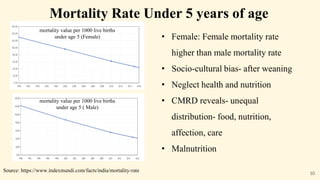
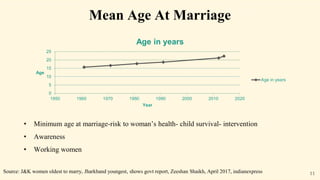
• Mortality under 5 years of age
• Mean marriage age
• Limits of feminist theories of development
• Major assumptions of the developmental paradigm
• Challenges for thinking in feminist development studies
• Scope
• References
INTRODUCTION
● National planning commission in 1938 - SCW- dealt with planning
for women’s role in economy.
● Committee comprised of highly educated women , lacked expertise
on everyday life of rural women.
● Women identified as individuals , emphasis on education , health ,
work participation except agriculture and cottage industries.
3
● 1970s- committee realised invisibility of women’s role in many sectors of
society
● Movements organised but limited only to educated middle class feminist
activists .
● Issues in health , employment questioned gender based policies
Source-Maitrayee Chaudhuri,1995, Citizens, workers and emblems of culture, Contributions to Indian Sociology
4
• Sex ratio
• Literacy rates
• Labor force participation
• Mortality rates
• Mean age at marriage
Demographic Indicators
5
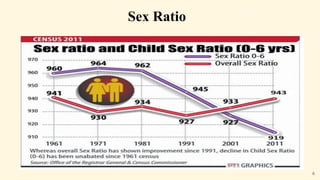
Sex Ratio
6
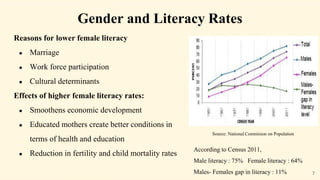
According to Census 2011,
Male literacy : 75% Female literacy : 64%
Males- Females gap in literacy : 11%
Gender and Literacy Rates
Reasons for lower female literacy
● Marriage
● Work force participation
● Cultural determinants
Effects of higher female literacy rates:
● Smoothens economic development
● Educated mothers create better conditions in
terms of health and education
● Reduction in fertility and child mortality rates
Source: National Commision on Population
7
Labor force participation
• Labor force participation by women and literacy rates
• Female house head
• Demand for skilled and semi skilled workers
• Formal sector and informal sector
• Informal sector and labor intensive technologies
• Female labor force participation and girl child labor
8
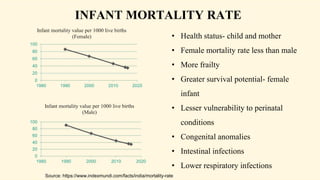
INFANT MORTALITY RATE
• Health status- child and mother
• Female mortality rate less than male
• More frailty
• Greater survival potential- female
infant
• Lesser vulnerability to perinatal
conditions
• Congenital anomalies
• Intestinal infections
• Lower respiratory infections
Source: https://www.indexmundi.com/facts/india/mortality-rate
0
20
40
60
80
100
1980 1990 2000 2010 2020
Infant mortality value per 1000 live births
(Female)
0
20
40
60
80
100
1980 1990 2000 2010 2020
Infant mortality value per 1000 live births
(Male)
Source: https://www.indexmundi.com/facts/india/mortality-rate
Mortality Rate Under 5 years of age
• Female: Female mortality rate
higher than male mortality rate
• Socio-cultural bias- after weaning
• Neglect health and nutrition
• CMRD reveals- unequal
distribution- food, nutrition,
affection, care
• Malnutrition
10
mortality value per 1000 live births
under age 5 (Female)
mortality value per 1000 live births
under age 5 ( Male)
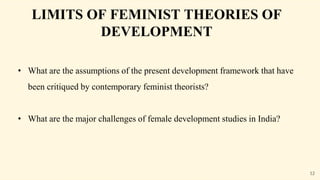
Mean Age At Marriage
0
5
10
15
20
25
1950 1960 1970 1980 1990 2000 2010 2020
Age
Year
Age in years
Age in years
Source: J&K women oldest to marry, Jharkhand youngest, shows govt report, Zeeshan Shaikh, April 2017, indianexpress 11
• Minimum age at marriage-risk to woman’s health- child survival- intervention
• Awareness
• Working women
LIMITS OF FEMINIST THEORIES OF
DEVELOPMENT
• What are the assumptions of the present development framework that have
been critiqued by contemporary feminist theorists?
• What are the major challenges of female development studies in India?
12
Major assumptions of the developmental
paradigm
• Public - private dichotomy
• Evolution and growth as a movement towards development of
productive forces - theory of exploitation
• Western culture as a universal definition of modernity
• Existing methodologies of social science research
13
• The legacy of colonialism
• Measuring women’s work
• Dilemma of economic growth
• Expanding citizenship and public participation
• Cultural plurality and lack of consensus in ethical issues
Challenges for thinking in feminist development
studies
14
15
Scope
• Analyze the different perspectives taken by the feminist engagement with
mainstream development discourse has taken.
• Read further about the specific policy implementations in the Constitution
regarding gender roles and the roles they have played in the post-
independent development of India.
• Discuss solutions and possible alternative approaches that development
framework could incorporate to reduce the gender disparities further.
• Finally discuss existing gender-related problems in society, possible
solutions and how they will go on to aid development.
16
References:
• Rustagi, P., 2000. Gender development indicators: issues, debates and ranking of districts. Occasional Paper No. 33, Centre for
Women’s Development Studies, New Delhi
• S. Agnihotri. “Juvenile Sex Ratios in India: A Disaggregated Analysis.” Economic and Political Weekly, vol. 31, no. 52, 1996, pp.
3369–3382. JSTOR, JSTOR, www.jstor.org/stable/4404938.
• Verma, Vidhu. “Engendering Development: Limits of Feminist Theories and Justice.” Economic and Political Weekly, vol. 39, no. 49,
2004, pp. 5246–5252. JSTOR, JSTOR, www.jstor.org/stable/4415871.
• Professor Dominique Anxo, Professor Thomas Lindh “Women’s impact on development in India” Thesis in Economics, NA3083,
Winter 2009, LINNAEUS UNIVERSITY
• Sundaram, A. & Vanneman, R. (2007). “Gender Differentials in Literacy in India: The Intriguing Relationship with Women’s Labor
Force Participation”. World Development, Vol. 36, No. 1, pp. 128–143
• John, Mary E. “Gender and Development in India, 1970s-1990s: Some Reflections on the Constitutive Role of Contexts.” Economic
and Political Weekly, vol. 31, no. 47, 1996, pp. 3071–3077. JSTOR, JSTOR, www.jstor.org/stable/4404800.
• Prerona Bura Gohain. "Gender Inequality and Development in Indian Scenario: Consequences, Causes, Challenges and Cures". IOSR
Journal Of Humanities And Social Science (IOSR-JHSS) Volume 21, Issue 6, Ver. 5 (June. 2016) PP 01-10 e-ISSN: 2279-0837, p-
ISSN: 2279-0845
17
THANK YOU

Gender and development

  • 1.
    TD 601 Gender andDevelopment Sowmya M. R. - 160260028 Ananya Sarangi - 183350016 Satish Dulla - 183350017 Akanksha Chavan - 183350018 Prathamesh Antarkar – 183350019 Under the guidance of : Prof. N. C. Narayanan
  • 2.
    2 Contents: • Introduction • DemographicIndicators • Sex ratio • Gender and Literacy rates • Labor force participation • Infant mortality rate • Mortality under 5 years of age • Mean marriage age • Limits of feminist theories of development • Major assumptions of the developmental paradigm • Challenges for thinking in feminist development studies • Scope • References
  • 3.
    INTRODUCTION ● National planningcommission in 1938 - SCW- dealt with planning for women’s role in economy. ● Committee comprised of highly educated women , lacked expertise on everyday life of rural women. ● Women identified as individuals , emphasis on education , health , work participation except agriculture and cottage industries. 3
  • 4.
    ● 1970s- committeerealised invisibility of women’s role in many sectors of society ● Movements organised but limited only to educated middle class feminist activists . ● Issues in health , employment questioned gender based policies Source-Maitrayee Chaudhuri,1995, Citizens, workers and emblems of culture, Contributions to Indian Sociology 4
  • 5.
    • Sex ratio •Literacy rates • Labor force participation • Mortality rates • Mean age at marriage Demographic Indicators 5
  • 6.
  • 7.
    According to Census2011, Male literacy : 75% Female literacy : 64% Males- Females gap in literacy : 11% Gender and Literacy Rates Reasons for lower female literacy ● Marriage ● Work force participation ● Cultural determinants Effects of higher female literacy rates: ● Smoothens economic development ● Educated mothers create better conditions in terms of health and education ● Reduction in fertility and child mortality rates Source: National Commision on Population 7
  • 8.
    Labor force participation •Labor force participation by women and literacy rates • Female house head • Demand for skilled and semi skilled workers • Formal sector and informal sector • Informal sector and labor intensive technologies • Female labor force participation and girl child labor 8
  • 9.
    INFANT MORTALITY RATE •Health status- child and mother • Female mortality rate less than male • More frailty • Greater survival potential- female infant • Lesser vulnerability to perinatal conditions • Congenital anomalies • Intestinal infections • Lower respiratory infections Source: https://www.indexmundi.com/facts/india/mortality-rate 0 20 40 60 80 100 1980 1990 2000 2010 2020 Infant mortality value per 1000 live births (Female) 0 20 40 60 80 100 1980 1990 2000 2010 2020 Infant mortality value per 1000 live births (Male)
  • 10.
    Source: https://www.indexmundi.com/facts/india/mortality-rate Mortality RateUnder 5 years of age • Female: Female mortality rate higher than male mortality rate • Socio-cultural bias- after weaning • Neglect health and nutrition • CMRD reveals- unequal distribution- food, nutrition, affection, care • Malnutrition 10 mortality value per 1000 live births under age 5 (Female) mortality value per 1000 live births under age 5 ( Male)
  • 11.
    Mean Age AtMarriage 0 5 10 15 20 25 1950 1960 1970 1980 1990 2000 2010 2020 Age Year Age in years Age in years Source: J&K women oldest to marry, Jharkhand youngest, shows govt report, Zeeshan Shaikh, April 2017, indianexpress 11 • Minimum age at marriage-risk to woman’s health- child survival- intervention • Awareness • Working women
  • 12.
    LIMITS OF FEMINISTTHEORIES OF DEVELOPMENT • What are the assumptions of the present development framework that have been critiqued by contemporary feminist theorists? • What are the major challenges of female development studies in India? 12
  • 13.
    Major assumptions ofthe developmental paradigm • Public - private dichotomy • Evolution and growth as a movement towards development of productive forces - theory of exploitation • Western culture as a universal definition of modernity • Existing methodologies of social science research 13
  • 14.
    • The legacyof colonialism • Measuring women’s work • Dilemma of economic growth • Expanding citizenship and public participation • Cultural plurality and lack of consensus in ethical issues Challenges for thinking in feminist development studies 14
  • 15.
    15 Scope • Analyze thedifferent perspectives taken by the feminist engagement with mainstream development discourse has taken. • Read further about the specific policy implementations in the Constitution regarding gender roles and the roles they have played in the post- independent development of India. • Discuss solutions and possible alternative approaches that development framework could incorporate to reduce the gender disparities further. • Finally discuss existing gender-related problems in society, possible solutions and how they will go on to aid development.
  • 16.
    16 References: • Rustagi, P.,2000. Gender development indicators: issues, debates and ranking of districts. Occasional Paper No. 33, Centre for Women’s Development Studies, New Delhi • S. Agnihotri. “Juvenile Sex Ratios in India: A Disaggregated Analysis.” Economic and Political Weekly, vol. 31, no. 52, 1996, pp. 3369–3382. JSTOR, JSTOR, www.jstor.org/stable/4404938. • Verma, Vidhu. “Engendering Development: Limits of Feminist Theories and Justice.” Economic and Political Weekly, vol. 39, no. 49, 2004, pp. 5246–5252. JSTOR, JSTOR, www.jstor.org/stable/4415871. • Professor Dominique Anxo, Professor Thomas Lindh “Women’s impact on development in India” Thesis in Economics, NA3083, Winter 2009, LINNAEUS UNIVERSITY • Sundaram, A. & Vanneman, R. (2007). “Gender Differentials in Literacy in India: The Intriguing Relationship with Women’s Labor Force Participation”. World Development, Vol. 36, No. 1, pp. 128–143 • John, Mary E. “Gender and Development in India, 1970s-1990s: Some Reflections on the Constitutive Role of Contexts.” Economic and Political Weekly, vol. 31, no. 47, 1996, pp. 3071–3077. JSTOR, JSTOR, www.jstor.org/stable/4404800. • Prerona Bura Gohain. "Gender Inequality and Development in Indian Scenario: Consequences, Causes, Challenges and Cures". IOSR Journal Of Humanities And Social Science (IOSR-JHSS) Volume 21, Issue 6, Ver. 5 (June. 2016) PP 01-10 e-ISSN: 2279-0837, p- ISSN: 2279-0845
  • 17.