
Characteristics
 Most diverse and familiar of the gymnosperms

 Consist of about 50 genera of trees with approximately 550 species
worldwide

Include the world’s tallest and largest plants; from moderate to gigantic
size

Note that conifers are never vines, herbs, or annuals, and they never
have
 bulbs or rhizomes

The leaves of conifers are always simple, being either needles or
scales,
  and are perennial

Conifers are dominant species at high elevations
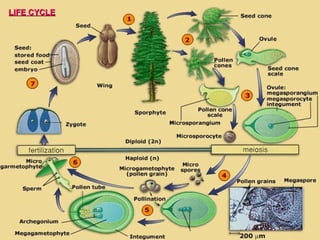
LIFE CYCLE
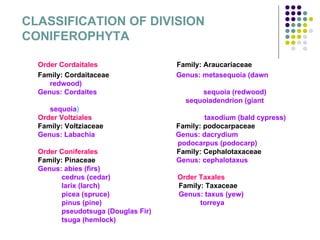
CLASSIFICATION OF DIVISION
CONIFEROPHYTA

  Order Cordaitales                  Family: Araucariaceae
  Family: Cordaitaceae               Genus: metasequoia (dawn
     redwood)
  Genus: Cordaites                         sequoia (redwood)
                                       sequoiadendrion (giant
     sequoia)
  Order Voltziales                           taxodium (bald cypress)
  Family: Voltziaceae                Family: podocarpaceae
  Genus: Labachia                    Genus: dacrydium
                                     podocarpus (podocarp)
  Order Coniferales                  Family: Cephalotaxaceae
  Family: Pinaceae                   Genus: cephalotaxus
  Genus: abies (firs)
         cedrus (cedar)              Order Taxales
         larix (larch)               Family: Taxaceae
         picea (spruce)              Genus: taxus (yew)
         pinus (pine)                      torreya
         pseudotsuga (Douglas Fir)
         tsuga (hemlock)
ECONOMIC IMPORTANCE OF CONIFERS


   They occur in extensive forest that supply us
    with wood used for lumber and paper
   Chemicals are also obtained from conifers,
    example of which is cellulose ; after being
    purified, it can be converted into rayon,
    cellophane and other household products
   Venetian Turpene, extracted from larch, is an
    important material for artists.