Visible Learning:
 A System-Wide Approach to
    Collaborative Inquiry
          GECDSB
                 May 11th, 2012


System-Wide Approach to Collaborative Inquiry
This too shall pass?
But before I join the chorus of “this too shall
pass”, I must turn the lens inward and ask the
question every true professional must ask: “Is
my present practice as effective as I think it is?”
As teachers, we must be willing to confront this
question every day of our professional lives if
teacher leadership is to become a reality rather
than a slogan”
                                   ~ Reeves, 2008.


   System-Wide Approach to Collaborative Inquiry
History
• Year 1: “Schools in the Middle”
             16 of 60 Elementary Schools
             Grade 3 and 6 Teachers, plus Principal and coach
             Three Full Day Sessions
             Content Focus – Components of Balanced Literacy
             Led by Student Achievement Officers

             Reflections
             Sessions had positive impact on instruction
             Correlation with participation and EQAO increases
             Model should be expanded beyond Grade 3 and 6
             Ownership needed to be with board to allow flexibility
             and responsiveness to current needs


  System-Wide Approach to Collaborative Inquiry
History
• Year 2: “Visible Learning”
             All 60 Elementary Schools included
             Three Full Day Sessions
             Principal selects team from each school
             Family of School Organization with S.O. participation
             Content-based using LNS Resources and Assessment
             Framework)

             Reflections
             Sessions had positive impact on instruction
             Work in session starting to link to SIPSA and work of
             coaches
             How do we give schools ownership of their own
             learning to met individual needs?

  System-Wide Approach to Collaborative Inquiry
Systemic Response – System Learning
                     External                                Internal
                     Prescribed                              Autonomous
                     Mandated                                Choice
                     Independent                             Collaborative


System Supports:

OFIP 1,      ‘Canned PD Days’,        SIM,   Visible Learning,    Collaborative Inquiry


‘Some have to’,          ‘all have to’,      ‘some can choose’,        ‘all can choose’


           System-Wide Approach to Collaborative Inquiry
The Importance of a Learning
          Stance


System-Wide Approach to Collaborative Inquiry
How the World’s Most Improved School
     Systems Keep Getting Better
                McKinsey and Company, 2010


“ …when teachers achieve a higher level of
  skill, as is the case in „good to great‟ and
  „great to excellent‟ improvement journey
  stages, such tight central control becomes
  counterproductive to system improvement.
  Rather, school-level flexibility and
  teacher collaboration become the drivers
  of improvement because they lead to
  innovations in teaching and learning.”

 System-Wide Approach to Collaborative Inquiry
Our
“Sandbox”                          BIPSA

                   SIPSA
                                                   SEF


          Empowering
            Schools
          - McKinsey
                                                    K to 12
                                                  Instruction
                        Special      Growing
                       Education     Success
                         Plan

                                   Learning For
                                        All


   System-Wide Approach to Collaborative Inquiry
Our
“Sandbox”
                                 BIPSA

                 SIPSA
                                                 SEF

                           Collaborative
        Empowering            Inquiry
          Schools
        - McKinsey           K to 12
                                                  K to 12
                                                Instruction

                   Special         Growing
                Education Plan     Success
                                 Learning For
                                      All


   System-Wide Approach to Collaborative Inquiry
Visible Learning 2011-2012
• Year 3 – “Collaborative Inquiry”
             60 elementary and 15 secondary schools
             Principal selected school teams
             “Family of Schools” organization with the S.O. involved
             in every session
             Four full-day sessions
             Process-based sessions, guiding schools through
             model of Collaborative Inquiry
             Focus on schools owning learning based on current
             student learning needs
             Intentional alignment of SIPSA to Collaborative Inquiry
             Focus


  System-Wide Approach to Collaborative Inquiry
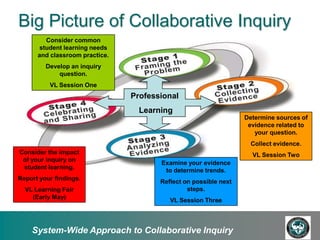
Big Picture of Collaborative Inquiry
        Consider common
      student learning needs
      and classroom practice.
         Develop an inquiry
             question.
          VL Session One
                                Professional
                                  Learning
                                                                  Determine sources of
                                                                   evidence related to
                                                                     your question.
                                                                    Collect evidence.
Consider the impact                                                 VL Session Two
 of your inquiry on
                                       Examine your evidence
 student learning.
                                        to determine trends.
Report your findings.
                                       Reflect on possible next
  VL Learning Fair                              steps.
    (Early May)
                                          VL Session Three


    System-Wide Approach to Collaborative Inquiry
SyIT Collaborative Inquiry
• Engage school teams in collaborative
  inquiry linked to student needs identified in
  School Improvement Plans
• Implement selected improvement
  strategies with greater depth and precision
• Build a culture of collaborative inquiry
• Improve student learning


  System-Wide Approach to Collaborative Inquiry
Our Evidence Collection
• Exit tickets after each session
• Anecdotal feedback throughout sessions
  from multiple sources
• Principals surveyed on implementation
• School team reflections


 System-Wide Approach to Collaborative Inquiry
Emerging Themes
1. The process resulted in an alignment
between the work/learning that is happening
in the schools and the system improvement
efforts


 System-Wide Approach to Collaborative Inquiry
Emerging Themes
“we are starting to hear that senior administration
honours our professionalism and trusts our
knowledge and that they let us make decisions
that suit our own needs and our students needs”
 – Elementary School Principal

91% of the teacher actions articulated in the
inquiry questions reflect a strategy in the BIPSA.


    System-Wide Approach to Collaborative Inquiry
Emerging Themes
2. De-privatization of practice is occurring
and teams are collaborating with colleagues
within and across content-areas, grades,
and divisions.


  System-Wide Approach to Collaborative Inquiry
Emerging Themes
“there have been more teacher-to-teacher
conversations. We are trying to focus on cross-
division. This is new collaboration – something
we haven‟t done before”
-Elementary School Teacher
“I am beginning the open-door policy – posting an
email to invite teachers to come to my class…to
get feedback”
-Elementary School Teacher
    System-Wide Approach to Collaborative Inquiry
Emerging Themes
3. Teams valued the process of
collaborative inquiry, focused on student
learning needs, the curriculum, engaged in
the use of data, and reflected upon their
practice as a result.


 System-Wide Approach to Collaborative Inquiry
Emerging Themes
“This has been the most inspiring, valuable workshops –
before it was “here, try something new – do it” and now
we are owning it! It is what we are saying with kids –
give them ownership and they will soar”
-Elementary School Teacher
“I can‟t believe how my teaching has changed. I used to
just go through the curriculum but now I seem to be
really looking at whether the kids actually got it before I
move on…I‟m really thinking about the kids‟ learning”
-Elementary School Teacher

     System-Wide Approach to Collaborative Inquiry
Supporting our Learning
• Please complete a feedback card
  including any thoughts, insights or
  reflections you have on our work to
  continue our learning.


  System-Wide Approach to Collaborative Inquiry
Principal Reflections
Jan Fairall – Hetherington Public School

Dustin O’Neil – Prince Andrew Public School


  System-Wide Approach to Collaborative Inquiry
Reflections and Plans for Next Year
• All elementary and secondary included
• Four full-day sessions
• Principal selected school teams
• Schools organized by identified student need with continued
  S.O. involvement
• Sessions support collaborative inquiry process and content
  based on specific student learning need and the related
  professional learning need
• Continue to use model to inform SIPSA and system supports
  eg. coaches, PD sessions, PLC’s, hubs and networks


     System-Wide Approach to Collaborative Inquiry
Question and Answer


System-Wide Approach to Collaborative Inquiry

GECDSB LSA Presentation May 11th 2012

  • 1.
    Visible Learning: ASystem-Wide Approach to Collaborative Inquiry GECDSB May 11th, 2012 System-Wide Approach to Collaborative Inquiry
  • 2.
    This too shallpass? But before I join the chorus of “this too shall pass”, I must turn the lens inward and ask the question every true professional must ask: “Is my present practice as effective as I think it is?” As teachers, we must be willing to confront this question every day of our professional lives if teacher leadership is to become a reality rather than a slogan” ~ Reeves, 2008. System-Wide Approach to Collaborative Inquiry
  • 3.
    History • Year 1:“Schools in the Middle” 16 of 60 Elementary Schools Grade 3 and 6 Teachers, plus Principal and coach Three Full Day Sessions Content Focus – Components of Balanced Literacy Led by Student Achievement Officers Reflections Sessions had positive impact on instruction Correlation with participation and EQAO increases Model should be expanded beyond Grade 3 and 6 Ownership needed to be with board to allow flexibility and responsiveness to current needs System-Wide Approach to Collaborative Inquiry
  • 4.
    History • Year 2:“Visible Learning” All 60 Elementary Schools included Three Full Day Sessions Principal selects team from each school Family of School Organization with S.O. participation Content-based using LNS Resources and Assessment Framework) Reflections Sessions had positive impact on instruction Work in session starting to link to SIPSA and work of coaches How do we give schools ownership of their own learning to met individual needs? System-Wide Approach to Collaborative Inquiry
  • 5.
    Systemic Response –System Learning External Internal Prescribed Autonomous Mandated Choice Independent Collaborative System Supports: OFIP 1, ‘Canned PD Days’, SIM, Visible Learning, Collaborative Inquiry ‘Some have to’, ‘all have to’, ‘some can choose’, ‘all can choose’ System-Wide Approach to Collaborative Inquiry
  • 6.
    The Importance ofa Learning Stance System-Wide Approach to Collaborative Inquiry
  • 7.
    System-Wide Approach toCollaborative Inquiry
  • 8.
    How the World’sMost Improved School Systems Keep Getting Better McKinsey and Company, 2010 “ …when teachers achieve a higher level of skill, as is the case in „good to great‟ and „great to excellent‟ improvement journey stages, such tight central control becomes counterproductive to system improvement. Rather, school-level flexibility and teacher collaboration become the drivers of improvement because they lead to innovations in teaching and learning.” System-Wide Approach to Collaborative Inquiry
  • 9.
    Our “Sandbox” BIPSA SIPSA SEF Empowering Schools - McKinsey K to 12 Instruction Special Growing Education Success Plan Learning For All System-Wide Approach to Collaborative Inquiry
  • 10.
    Our “Sandbox” BIPSA SIPSA SEF Collaborative Empowering Inquiry Schools - McKinsey K to 12 K to 12 Instruction Special Growing Education Plan Success Learning For All System-Wide Approach to Collaborative Inquiry
  • 11.
    Visible Learning 2011-2012 •Year 3 – “Collaborative Inquiry” 60 elementary and 15 secondary schools Principal selected school teams “Family of Schools” organization with the S.O. involved in every session Four full-day sessions Process-based sessions, guiding schools through model of Collaborative Inquiry Focus on schools owning learning based on current student learning needs Intentional alignment of SIPSA to Collaborative Inquiry Focus System-Wide Approach to Collaborative Inquiry
  • 12.
    Big Picture ofCollaborative Inquiry Consider common student learning needs and classroom practice. Develop an inquiry question. VL Session One Professional Learning Determine sources of evidence related to your question. Collect evidence. Consider the impact VL Session Two of your inquiry on Examine your evidence student learning. to determine trends. Report your findings. Reflect on possible next VL Learning Fair steps. (Early May) VL Session Three System-Wide Approach to Collaborative Inquiry
  • 13.
    SyIT Collaborative Inquiry •Engage school teams in collaborative inquiry linked to student needs identified in School Improvement Plans • Implement selected improvement strategies with greater depth and precision • Build a culture of collaborative inquiry • Improve student learning System-Wide Approach to Collaborative Inquiry
  • 14.
    Our Evidence Collection •Exit tickets after each session • Anecdotal feedback throughout sessions from multiple sources • Principals surveyed on implementation • School team reflections System-Wide Approach to Collaborative Inquiry
  • 15.
    Emerging Themes 1. Theprocess resulted in an alignment between the work/learning that is happening in the schools and the system improvement efforts System-Wide Approach to Collaborative Inquiry
  • 16.
    Emerging Themes “we arestarting to hear that senior administration honours our professionalism and trusts our knowledge and that they let us make decisions that suit our own needs and our students needs” – Elementary School Principal 91% of the teacher actions articulated in the inquiry questions reflect a strategy in the BIPSA. System-Wide Approach to Collaborative Inquiry
  • 17.
    Emerging Themes 2. De-privatizationof practice is occurring and teams are collaborating with colleagues within and across content-areas, grades, and divisions. System-Wide Approach to Collaborative Inquiry
  • 18.
    Emerging Themes “there havebeen more teacher-to-teacher conversations. We are trying to focus on cross- division. This is new collaboration – something we haven‟t done before” -Elementary School Teacher “I am beginning the open-door policy – posting an email to invite teachers to come to my class…to get feedback” -Elementary School Teacher System-Wide Approach to Collaborative Inquiry
  • 19.
    Emerging Themes 3. Teamsvalued the process of collaborative inquiry, focused on student learning needs, the curriculum, engaged in the use of data, and reflected upon their practice as a result. System-Wide Approach to Collaborative Inquiry
  • 20.
    Emerging Themes “This hasbeen the most inspiring, valuable workshops – before it was “here, try something new – do it” and now we are owning it! It is what we are saying with kids – give them ownership and they will soar” -Elementary School Teacher “I can‟t believe how my teaching has changed. I used to just go through the curriculum but now I seem to be really looking at whether the kids actually got it before I move on…I‟m really thinking about the kids‟ learning” -Elementary School Teacher System-Wide Approach to Collaborative Inquiry
  • 21.
    Supporting our Learning •Please complete a feedback card including any thoughts, insights or reflections you have on our work to continue our learning. System-Wide Approach to Collaborative Inquiry
  • 22.
    Principal Reflections Jan Fairall– Hetherington Public School Dustin O’Neil – Prince Andrew Public School System-Wide Approach to Collaborative Inquiry
  • 23.
    Reflections and Plansfor Next Year • All elementary and secondary included • Four full-day sessions • Principal selected school teams • Schools organized by identified student need with continued S.O. involvement • Sessions support collaborative inquiry process and content based on specific student learning need and the related professional learning need • Continue to use model to inform SIPSA and system supports eg. coaches, PD sessions, PLC’s, hubs and networks System-Wide Approach to Collaborative Inquiry
  • 24.
    Question and Answer System-WideApproach to Collaborative Inquiry

Editor's Notes

  • #6 ChrisOur system response to system learning model showing our journey to CI and schools owning their learning1 min
  • #10 Sue 30 secsSandbox – Katz. There were several system-wide drivers to inform our work and school improvement. We needed a model that aligned our work.
  • #11 Sue 30 secs:We believe that Collaborative Inquiry addresses our goal of alignment.
  • #13 Sue:An overview of the CI process and the focus of our 4 sessions2 mins