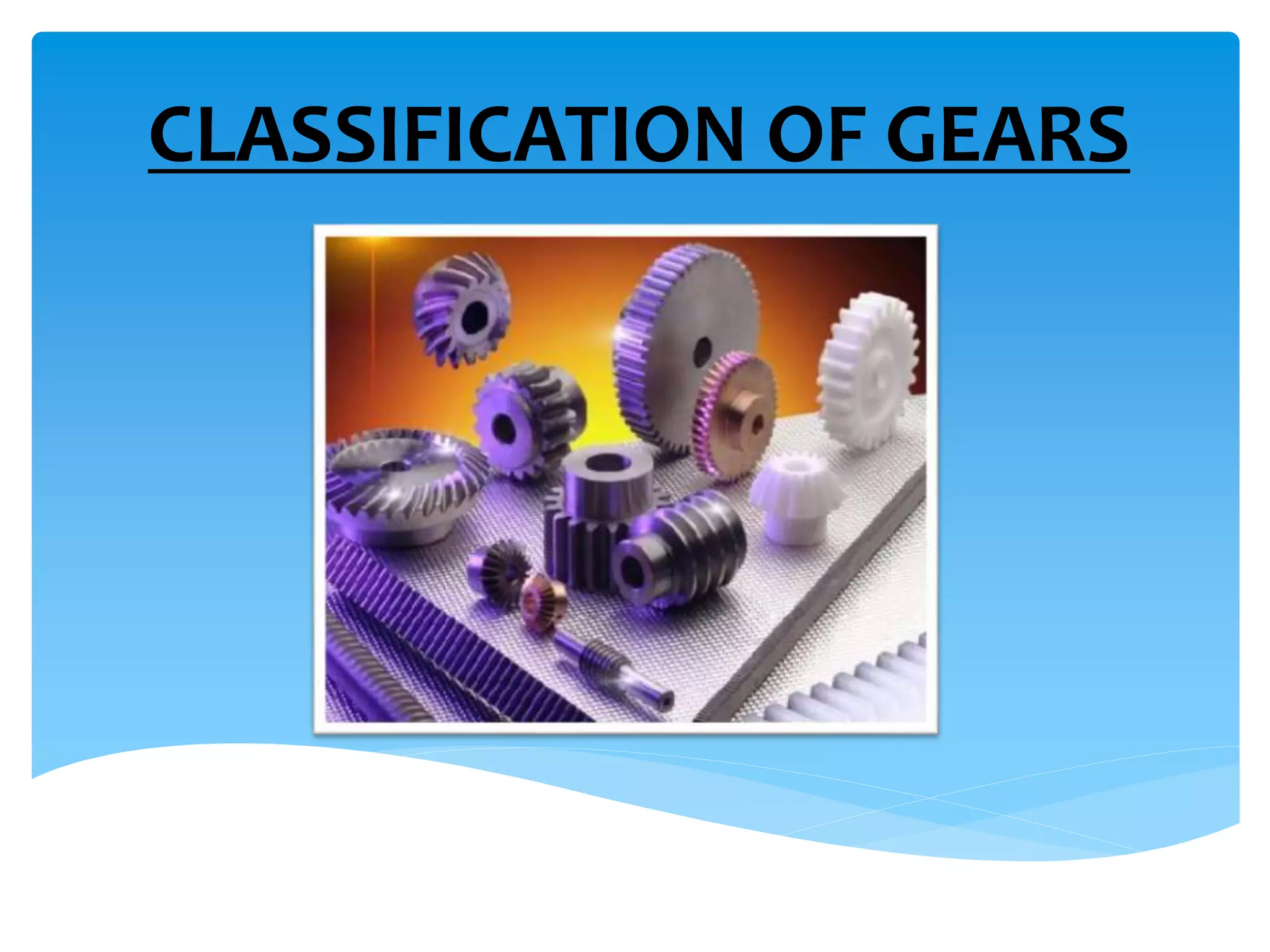
CLASSIFICATION OF GEARS
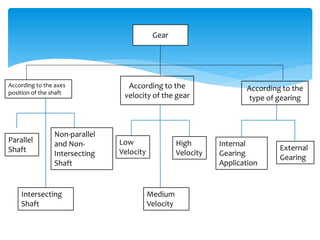
Gear
According to the axes
position of the shaft
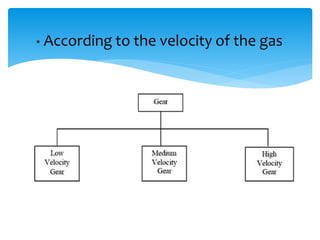
According to the
velocity of the gear
According to the
type of gearing
Parallel
Shaft
Intersecting
Shaft
Non-parallel
and Non-
Intersecting
Shaft
Low
Velocity
Medium
Velocity
High
Velocity
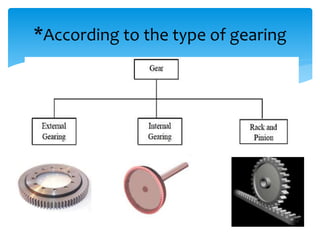
Internal
Gearing
Application
External
Gearing
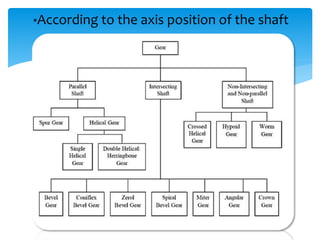
*According to the axis position of the shaft
Parallel shaft
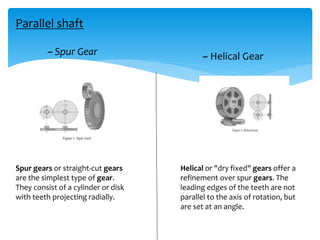
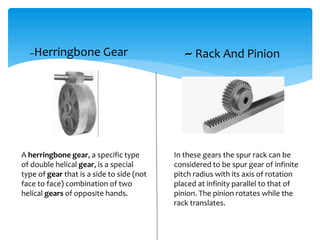
~ Spur Gear ~ Helical Gear
Spur gears or straight-cut gears
are the simplest type of gear.
They consist of a cylinder or disk
with teeth projecting radially.
Helical or "dry fixed" gears offer a
refinement over spur gears. The
leading edges of the teeth are not
parallel to the axis of rotation, but
are set at an angle.
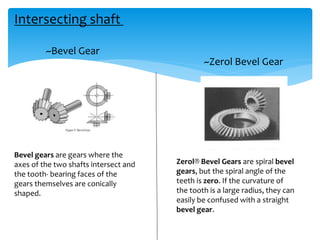
~Herringbone Gear
A herringbone gear, a specific type
of double helical gear, is a special
type of gear that is a side to side (not
face to face) combination of two
helical gears of opposite hands.
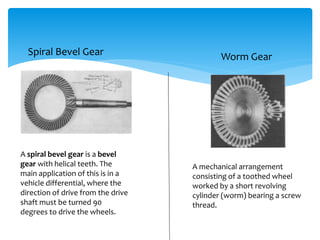
~ Rack And Pinion
In these gears the spur rack can be
considered to be spur gear of infinite
pitch radius with its axis of rotation
placed at infinity parallel to that of
pinion. The pinion rotates while the
rack translates.
Intersecting shaft
~Bevel Gear
Bevel gears are gears where the
axes of the two shafts intersect and
the tooth- bearing faces of the
gears themselves are conically
shaped.
~Zerol Bevel Gear
Zerol® Bevel Gears are spiral bevel
gears, but the spiral angle of the
teeth is zero. If the curvature of
the tooth is a large radius, they can
easily be confused with a straight
bevel gear.
Spiral Bevel Gear Worm Gear
A spiral bevel gear is a bevel
gear with helical teeth. The
main application of this is in a
vehicle differential, where the
direction of drive from the drive
shaft must be turned 90
degrees to drive the wheels.
A mechanical arrangement
consisting of a toothed wheel
worked by a short revolving
cylinder (worm) bearing a screw
thread.
~ Crown Gear
A crown gear (or a contrate gear) is a
gear which has teeth that project at right
angles to the face of the wheel. In
particular, a crown gear is a type of bevel
gear where the pitch cone angle is 90
degrees. A pitch cone of any other angle
is simply called a bevel gear.
* According to the velocity of the gas
1. Low velocity type, if their peripheral velocity lies in
the range of 1 to 3 m/sec.
2. Medium velocity type, if their peripheral velocity lies
in the range of 3 to 15 m/sec.
3. High velocity type, if their peripheral velocity exceeds
15 m/sec.
*According to the type of gearing
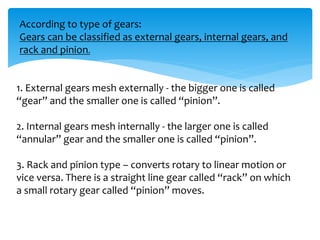
1. External gears mesh externally - the bigger one is called
“gear” and the smaller one is called “pinion”.
2. Internal gears mesh internally - the larger one is called
“annular” gear and the smaller one is called “pinion”.
3. Rack and pinion type – converts rotary to linear motion or
vice versa. There is a straight line gear called “rack” on which
a small rotary gear called “pinion” moves.
According to type of gears:
Gears can be classified as external gears, internal gears, and
rack and pinion.
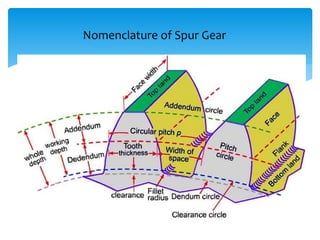
Nomenclature of Spur Gear
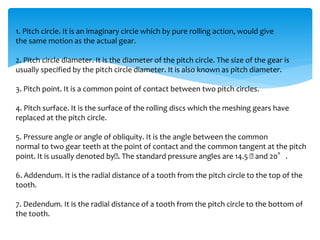
1. Pitch circle. It is an imaginary circle which by pure rolling action, would give
the same motion as the actual gear.
2. Pitch circle diameter. It is the diameter of the pitch circle. The size of the gear is
usually specified by the pitch circle diameter. It is also known as pitch diameter.
3. Pitch point. It is a common point of contact between two pitch circles.
4. Pitch surface. It is the surface of the rolling discs which the meshing gears have
replaced at the pitch circle.
5. Pressure angle or angle of obliquity. It is the angle between the common
normal to two gear teeth at the point of contact and the common tangent at the pitch
point. It is usually denoted by . The standard pressure angles are 14.5 and 20°.
6. Addendum. It is the radial distance of a tooth from the pitch circle to the top of the
tooth.
7. Dedendum. It is the radial distance of a tooth from the pitch circle to the bottom of
the tooth.
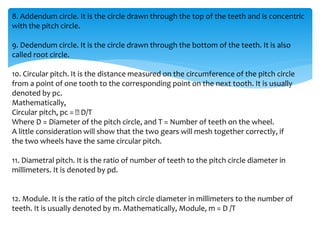
8. Addendum circle. It is the circle drawn through the top of the teeth and is concentric
with the pitch circle.
9. Dedendum circle. It is the circle drawn through the bottom of the teeth. It is also
called root circle.
10. Circular pitch. It is the distance measured on the circumference of the pitch circle
from a point of one tooth to the corresponding point on the next tooth. It is usually
denoted by pc.
Mathematically,
Circular pitch, pc = D/T
Where D = Diameter of the pitch circle, and T = Number of teeth on the wheel.
A little consideration will show that the two gears will mesh together correctly, if
the two wheels have the same circular pitch.
11. Diametral pitch. It is the ratio of number of teeth to the pitch circle diameter in
millimeters. It is denoted by pd.
12. Module. It is the ratio of the pitch circle diameter in millimeters to the number of
teeth. It is usually denoted by m. Mathematically, Module, m = D /T
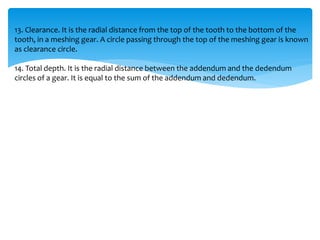
13. Clearance. It is the radial distance from the top of the tooth to the bottom of the
tooth, in a meshing gear. A circle passing through the top of the meshing gear is known
as clearance circle.
14. Total depth. It is the radial distance between the addendum and the dedendum
circles of a gear. It is equal to the sum of the addendum and dedendum.
Gear Materials
Aluminum Gears
Brass Gears
Magnesium Gears
Steel Gears
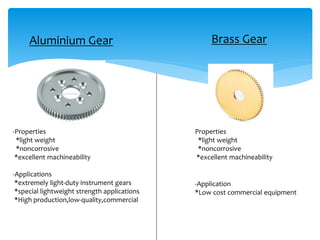
Aluminium Gear Brass Gear
-Properties
*light weight
*noncorrosive
*excellent machineability
-Applications
*extremely light-duty instrument gears
*special lightweight strength applications
*High production,low-quality,commercial
Properties
*light weight
*noncorrosive
*excellent machineability
-Application
*Low cost commercial equipment
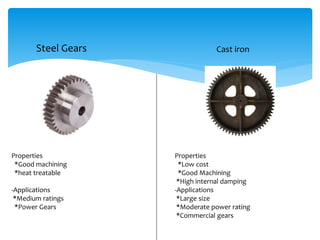
Steel Gears Cast iron
Properties
*Good machining
*heat treatable
-Applications
*Medium ratings
*Power Gears
Properties
*Low cost
*Good Machining
*High internal damping
-Applications
*Large size
*Moderate power rating
*Commercial gears

Gear_slides.ppt

  • 1.
  • 2.
    Gear According to theaxes position of the shaft According to the velocity of the gear According to the type of gearing Parallel Shaft Intersecting Shaft Non-parallel and Non- Intersecting Shaft Low Velocity Medium Velocity High Velocity Internal Gearing Application External Gearing
  • 3.
    *According to theaxis position of the shaft
  • 4.
    Parallel shaft ~ SpurGear ~ Helical Gear Spur gears or straight-cut gears are the simplest type of gear. They consist of a cylinder or disk with teeth projecting radially. Helical or "dry fixed" gears offer a refinement over spur gears. The leading edges of the teeth are not parallel to the axis of rotation, but are set at an angle.
  • 5.
    ~Herringbone Gear A herringbonegear, a specific type of double helical gear, is a special type of gear that is a side to side (not face to face) combination of two helical gears of opposite hands. ~ Rack And Pinion In these gears the spur rack can be considered to be spur gear of infinite pitch radius with its axis of rotation placed at infinity parallel to that of pinion. The pinion rotates while the rack translates.
  • 6.
    Intersecting shaft ~Bevel Gear Bevelgears are gears where the axes of the two shafts intersect and the tooth- bearing faces of the gears themselves are conically shaped. ~Zerol Bevel Gear Zerol® Bevel Gears are spiral bevel gears, but the spiral angle of the teeth is zero. If the curvature of the tooth is a large radius, they can easily be confused with a straight bevel gear.
  • 7.
    Spiral Bevel GearWorm Gear A spiral bevel gear is a bevel gear with helical teeth. The main application of this is in a vehicle differential, where the direction of drive from the drive shaft must be turned 90 degrees to drive the wheels. A mechanical arrangement consisting of a toothed wheel worked by a short revolving cylinder (worm) bearing a screw thread.
  • 8.
    ~ Crown Gear Acrown gear (or a contrate gear) is a gear which has teeth that project at right angles to the face of the wheel. In particular, a crown gear is a type of bevel gear where the pitch cone angle is 90 degrees. A pitch cone of any other angle is simply called a bevel gear.
  • 9.
    * According tothe velocity of the gas
  • 10.
    1. Low velocitytype, if their peripheral velocity lies in the range of 1 to 3 m/sec. 2. Medium velocity type, if their peripheral velocity lies in the range of 3 to 15 m/sec. 3. High velocity type, if their peripheral velocity exceeds 15 m/sec.
  • 11.
    *According to thetype of gearing
  • 12.
    1. External gearsmesh externally - the bigger one is called “gear” and the smaller one is called “pinion”. 2. Internal gears mesh internally - the larger one is called “annular” gear and the smaller one is called “pinion”. 3. Rack and pinion type – converts rotary to linear motion or vice versa. There is a straight line gear called “rack” on which a small rotary gear called “pinion” moves. According to type of gears: Gears can be classified as external gears, internal gears, and rack and pinion.
  • 13.
  • 14.
    1. Pitch circle.It is an imaginary circle which by pure rolling action, would give the same motion as the actual gear. 2. Pitch circle diameter. It is the diameter of the pitch circle. The size of the gear is usually specified by the pitch circle diameter. It is also known as pitch diameter. 3. Pitch point. It is a common point of contact between two pitch circles. 4. Pitch surface. It is the surface of the rolling discs which the meshing gears have replaced at the pitch circle. 5. Pressure angle or angle of obliquity. It is the angle between the common normal to two gear teeth at the point of contact and the common tangent at the pitch point. It is usually denoted by . The standard pressure angles are 14.5 and 20°. 6. Addendum. It is the radial distance of a tooth from the pitch circle to the top of the tooth. 7. Dedendum. It is the radial distance of a tooth from the pitch circle to the bottom of the tooth.
  • 15.
    8. Addendum circle.It is the circle drawn through the top of the teeth and is concentric with the pitch circle. 9. Dedendum circle. It is the circle drawn through the bottom of the teeth. It is also called root circle. 10. Circular pitch. It is the distance measured on the circumference of the pitch circle from a point of one tooth to the corresponding point on the next tooth. It is usually denoted by pc. Mathematically, Circular pitch, pc = D/T Where D = Diameter of the pitch circle, and T = Number of teeth on the wheel. A little consideration will show that the two gears will mesh together correctly, if the two wheels have the same circular pitch. 11. Diametral pitch. It is the ratio of number of teeth to the pitch circle diameter in millimeters. It is denoted by pd. 12. Module. It is the ratio of the pitch circle diameter in millimeters to the number of teeth. It is usually denoted by m. Mathematically, Module, m = D /T
  • 16.
    13. Clearance. Itis the radial distance from the top of the tooth to the bottom of the tooth, in a meshing gear. A circle passing through the top of the meshing gear is known as clearance circle. 14. Total depth. It is the radial distance between the addendum and the dedendum circles of a gear. It is equal to the sum of the addendum and dedendum.
  • 17.
    Gear Materials Aluminum Gears BrassGears Magnesium Gears Steel Gears
  • 18.
    Aluminium Gear BrassGear -Properties *light weight *noncorrosive *excellent machineability -Applications *extremely light-duty instrument gears *special lightweight strength applications *High production,low-quality,commercial Properties *light weight *noncorrosive *excellent machineability -Application *Low cost commercial equipment
  • 19.
    Steel Gears Castiron Properties *Good machining *heat treatable -Applications *Medium ratings *Power Gears Properties *Low cost *Good Machining *High internal damping -Applications *Large size *Moderate power rating *Commercial gears