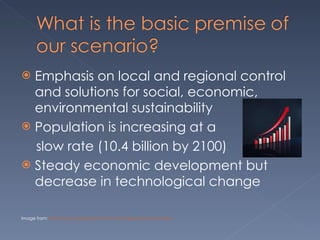
Emphasis on local and regional control and solutions for social, economic, environmental sustainability Population is increasing at a slow rate (10.4 billion by 2100) Steady economic development but decrease in technological change Image from:  http://www.teresaherrin.com/vi-eco-growth-productivity/
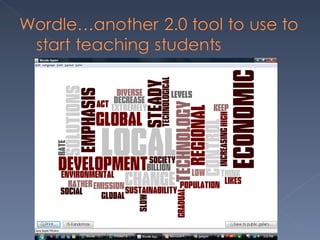
Gradual technology change (instead of rapid); more diverse technology than A1 and B1 Emphasis on local rather than global solutions Global emission levels are not extremely high or low
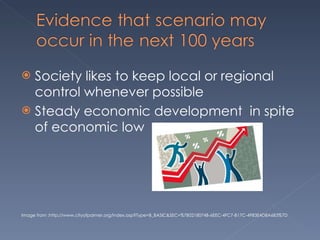
Society likes to keep local or regional control whenever possible Steady economic development  in spite of economic low Image from :http://www.cityofpalmer.org/index.asp?Type=B_BASIC&SEC=%7B0218074B-6EEC-4FC7-B17C-49B3E4D8A6B3%7D
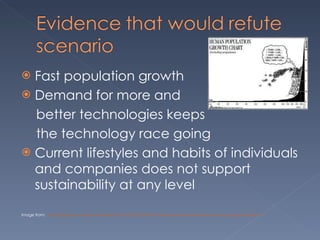
Fast population growth Demand for more and  better technologies keeps  the technology race going Current lifestyles and habits of individuals and companies does not support sustainability at any level Image from:  http://geiasousuperman.wordpress.com/2011/05/09/population-growth-people-how-are-we-going-to-make-it/
Cause -Human population continues to gradually increase at a steady rate over time Effect - A continual yet gradual increase in atmospheric gas emissions from human travel and increase in industry Effect - Due to the greenhouse effect, a continual, gradual increase in the temperature on the planet, leading to global climate warming
Effect -Higher temperatures overall, causes an increase in melting ice caps This generates a positive feedback of:   less solar light being reflected   atmosphere and oceans holding in more heat    generating warmer climate changes overall.
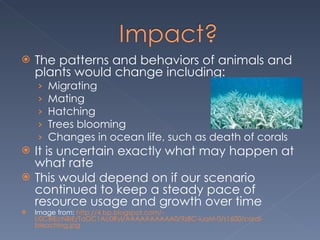
The patterns and behaviors of animals and plants would change including: Migrating Mating  Hatching  Trees blooming  Changes in ocean life, such as death of corals It is uncertain exactly what may happen at what rate  This would depend on if our scenario continued to keep a steady pace of resource usage and growth over time Image from:  http://4.bp.blogspot.com/-U0CBlEcNBlE/TaOC1Ac0RyI/AAAAAAAAAA0/9z8C-iuqM-0/s1600/coral-bleaching.jpg
CHANGE:  Have to be a switch to  local and regional control of  sustainability projects.  ISSUE:  A lack of funding causes  the society to look to global control of sustainability issues.  ISSUE:  Where would the funding come from to reach this goal? ISSUE:  Not all cities are created equal.  Example:  low economic vs. high economic levels
CHANGE:  The rate of technology advancements would need to slow down ISSUE:  Currently, constant new advances in all areas of technology make it difficult to keep with in most parts of our country  ISSUE:  Flipside to this coin, some cities have yet to catch up to the current technology level.  Thought to ponder:  When is the goal considered to be reached if different parts of the world may be reaching their “goals” at different times?
The Engineering Design Process may be utilized in the teaching experience. Students can design a model to test the effects of population growth on temperature or animal behavior Having students work in teams and analyzing different aspects of the scenario will foster critical thinking and integrate: science (the problem) math (the rise in temperature caused by population technology (blog or collaborate online to communicate results) engineering (model design for population growth effect)
We can take the idea of human population growth and give students the cause  They would be responsible for brainstorming, researching and designing a test to determine the possible effects for overpopulation  Collaboration and communication would be essential Students would be a committee panel that would determine effects and solutions
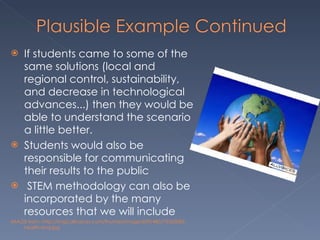
If students came to some of the same solutions (local and regional control, sustainability, and decrease in technological advances...) then they would be able to understand the scenario a little better. Students would also be responsible for communicating their results to the public   STEM methodology can also be incorporated by the many resources that we will include IMAGE from: http://img2.allvoices.com/thumbs/image/609/480/73355083-health-and.jpg
Prezi: a communication tool that is an interactive presentation tool Students can add pictures, videos and music in a fun, non-linear way Glogster: poster interactive presentation tool that can be manipulated Blogging: an open ended means of communicating and building concepts and ideas Teacher may begin the blog  Students respond and add their thoughts
 
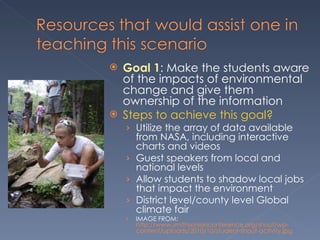
Goal 1 : Make the students aware of the impacts of environmental change and give them ownership of the information  Steps to achieve this goal? Utilize the array of data available from NASA, including interactive charts and videos Guest speakers from local and national levels Allow students to shadow local jobs that impact the environment District level/county level Global climate fair IMAGE FROM:  http://www.smithsonianconference.org/shout/wp-content/uploads/2010/10/student-shout-activity.jpg
Goal 2 : Make the community aware of the impacts of environmental change and how they can also take ownership and make a difference   Steps to achieve this goal? Get the community involved by hosting an awareness  event  that could also include: Guest speakers  Video clips  Booths on different issues  Flyers on simple ways, even in low social economic and technological areas, that can help Students could put together a play or a set up a mock debate.
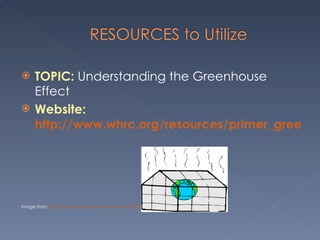
TOPIC:  Understanding the Greenhouse Effect  Website:  http://www.whrc.org/resources/primer_greenhouse.html Image from:  http://mail.colonial.net/~hkaiter/weatherclimate.html
TOPIC:  Causes Behind Global Changes  Includes various  aerosols, importance of carbon and the role it plays, interactive learning, maps and calculating your carbon footprint activity.  Most of these links have other links that are incredibly useful as well  WEBSITES:  http://earthobservatory.nasa.gov/Features/Aerosols/  http://www.npr.org/news/specials/climate/video/     http://www.pbs.org/teachers/stem/professionaldevelopment/030/explore/   http://climate.nasa.gov/causes/
TOPIC:  Evidence of global climate change    Includes all key indicators, new reports on sea level rise, permafrost evidence, ice sheet simulation  WEBSITES:  http://climate.nasa.gov/keyIndicators/   http://www.nature.com/climate/2010/1004/full/climate.2010.29.html   http://www.nasa.gov/topics/earth/features/interview-hinzman.html   http://www.teachersdomain.org/resource/ipy07.sci.ess.watcyc.icesimulate/      
"EnviroTacklebox" includes You & Me & UV, Enviro Rules, Carbon: The Element of Surprise http://www.lpb.org/education/classroom/itv/envirotacklebox/index.cfm    NASA’s Earth observatory websites offer an array of sites such as "Climate Change Uncertainties" and interactive modules like "Earth's Albedo and Global Warming" and the "Climate Time Machine"    http://climate. nasa .gov/uncertainties/   PBS offers wonderful videos and clips as well    www. pbs .org/ teacherline     
Can we save our planet by making good choices? http://www.youtube.com/watch?v=pECODIOopaI
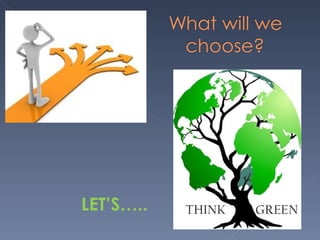
LET’S…..

Gcc presentation(1)

  • 1.
  • 2.
    Emphasis on localand regional control and solutions for social, economic, environmental sustainability Population is increasing at a slow rate (10.4 billion by 2100) Steady economic development but decrease in technological change Image from: http://www.teresaherrin.com/vi-eco-growth-productivity/
  • 3.
    Gradual technology change(instead of rapid); more diverse technology than A1 and B1 Emphasis on local rather than global solutions Global emission levels are not extremely high or low
  • 4.
    Society likes tokeep local or regional control whenever possible Steady economic development in spite of economic low Image from :http://www.cityofpalmer.org/index.asp?Type=B_BASIC&SEC=%7B0218074B-6EEC-4FC7-B17C-49B3E4D8A6B3%7D
  • 5.
    Fast population growthDemand for more and better technologies keeps the technology race going Current lifestyles and habits of individuals and companies does not support sustainability at any level Image from: http://geiasousuperman.wordpress.com/2011/05/09/population-growth-people-how-are-we-going-to-make-it/
  • 6.
    Cause -Human populationcontinues to gradually increase at a steady rate over time Effect - A continual yet gradual increase in atmospheric gas emissions from human travel and increase in industry Effect - Due to the greenhouse effect, a continual, gradual increase in the temperature on the planet, leading to global climate warming
  • 7.
    Effect -Higher temperaturesoverall, causes an increase in melting ice caps This generates a positive feedback of:   less solar light being reflected   atmosphere and oceans holding in more heat   generating warmer climate changes overall.
  • 8.
    The patterns andbehaviors of animals and plants would change including: Migrating Mating Hatching Trees blooming Changes in ocean life, such as death of corals It is uncertain exactly what may happen at what rate This would depend on if our scenario continued to keep a steady pace of resource usage and growth over time Image from: http://4.bp.blogspot.com/-U0CBlEcNBlE/TaOC1Ac0RyI/AAAAAAAAAA0/9z8C-iuqM-0/s1600/coral-bleaching.jpg
  • 9.
    CHANGE: Haveto be a switch to local and regional control of sustainability projects. ISSUE: A lack of funding causes the society to look to global control of sustainability issues. ISSUE: Where would the funding come from to reach this goal? ISSUE: Not all cities are created equal. Example: low economic vs. high economic levels
  • 10.
    CHANGE: Therate of technology advancements would need to slow down ISSUE: Currently, constant new advances in all areas of technology make it difficult to keep with in most parts of our country ISSUE: Flipside to this coin, some cities have yet to catch up to the current technology level. Thought to ponder: When is the goal considered to be reached if different parts of the world may be reaching their “goals” at different times?
  • 11.
    The Engineering DesignProcess may be utilized in the teaching experience. Students can design a model to test the effects of population growth on temperature or animal behavior Having students work in teams and analyzing different aspects of the scenario will foster critical thinking and integrate: science (the problem) math (the rise in temperature caused by population technology (blog or collaborate online to communicate results) engineering (model design for population growth effect)
  • 12.
    We can takethe idea of human population growth and give students the cause They would be responsible for brainstorming, researching and designing a test to determine the possible effects for overpopulation Collaboration and communication would be essential Students would be a committee panel that would determine effects and solutions
  • 13.
    If students cameto some of the same solutions (local and regional control, sustainability, and decrease in technological advances...) then they would be able to understand the scenario a little better. Students would also be responsible for communicating their results to the public   STEM methodology can also be incorporated by the many resources that we will include IMAGE from: http://img2.allvoices.com/thumbs/image/609/480/73355083-health-and.jpg
  • 14.
    Prezi: a communicationtool that is an interactive presentation tool Students can add pictures, videos and music in a fun, non-linear way Glogster: poster interactive presentation tool that can be manipulated Blogging: an open ended means of communicating and building concepts and ideas Teacher may begin the blog Students respond and add their thoughts
  • 15.
  • 16.
    Goal 1 :Make the students aware of the impacts of environmental change and give them ownership of the information Steps to achieve this goal? Utilize the array of data available from NASA, including interactive charts and videos Guest speakers from local and national levels Allow students to shadow local jobs that impact the environment District level/county level Global climate fair IMAGE FROM: http://www.smithsonianconference.org/shout/wp-content/uploads/2010/10/student-shout-activity.jpg
  • 17.
    Goal 2 :Make the community aware of the impacts of environmental change and how they can also take ownership and make a difference   Steps to achieve this goal? Get the community involved by hosting an awareness event that could also include: Guest speakers Video clips Booths on different issues Flyers on simple ways, even in low social economic and technological areas, that can help Students could put together a play or a set up a mock debate.
  • 18.
    TOPIC: Understandingthe Greenhouse Effect Website: http://www.whrc.org/resources/primer_greenhouse.html Image from: http://mail.colonial.net/~hkaiter/weatherclimate.html
  • 19.
    TOPIC: CausesBehind Global Changes Includes various  aerosols, importance of carbon and the role it plays, interactive learning, maps and calculating your carbon footprint activity. Most of these links have other links that are incredibly useful as well WEBSITES: http://earthobservatory.nasa.gov/Features/Aerosols/ http://www.npr.org/news/specials/climate/video/   http://www.pbs.org/teachers/stem/professionaldevelopment/030/explore/ http://climate.nasa.gov/causes/
  • 20.
    TOPIC: Evidenceof global climate change   Includes all key indicators, new reports on sea level rise, permafrost evidence, ice sheet simulation WEBSITES: http://climate.nasa.gov/keyIndicators/ http://www.nature.com/climate/2010/1004/full/climate.2010.29.html http://www.nasa.gov/topics/earth/features/interview-hinzman.html http://www.teachersdomain.org/resource/ipy07.sci.ess.watcyc.icesimulate/    
  • 21.
    "EnviroTacklebox" includes You& Me & UV, Enviro Rules, Carbon: The Element of Surprise http://www.lpb.org/education/classroom/itv/envirotacklebox/index.cfm   NASA’s Earth observatory websites offer an array of sites such as "Climate Change Uncertainties" and interactive modules like "Earth's Albedo and Global Warming" and the "Climate Time Machine"   http://climate. nasa .gov/uncertainties/ PBS offers wonderful videos and clips as well   www. pbs .org/ teacherline    
  • 22.
    Can we saveour planet by making good choices? http://www.youtube.com/watch?v=pECODIOopaI
  • 23.