Multilateral Trade
Negotiations -
THE GATT ROUND
Presented By -
Nishita
MA Eco Final
26
1. GATT- creation, principles
2. Multilateral Rounds of Trade
Negotiations
3. Most Significant GATT Rounds
& their effects on trade
• The Kennedy Round
• The Tokyo Round
• The Uruguay Round
4. Birth to WTO
5. The Failed Doha Round
6. The Outstanding Trade
Problems
Outline
• Dominick Salvatore, International Economics
• M.L. Jhingan, International Economics
• WTO Website ( www.wto.org )
References on GATT Round
GATT?
General Agreement of Tariffs and Trade
GATT rested on three basic principles:
1. Nondiscrimination. This principle refers to the
unconditional acceptance of the most- favored- nation
principle discussed earlier. The only exceptions to this
principle are made in cases of economic integration, such
as customs unions and in the trade between a nation and
its former colonies and dominions.
2. Elimination of non-tariff trade barriers (such as
quotas), except for agricultural products and for nations
in balance-of-payments difficulties.
3. Consultation among nations in solving trade disputes
within the GATT framework.
GATT was an international organization, created in 1947
and headquartered in Geneva (Switzerland), devoted to
the promotion of freer trade through multilateral trade
negotiations. Originally, it was thought that GATT would
become part of the International Trade Organization (ITO),
whose charter was negotiated in Havana in 1948 to
regulate international trade.
By 1993, a total of 123 nations (including the United
States and all major countries, with the exception of the
countries of the former Soviet Union and China) were
signatories of the GATT, and 24 other nations had applied
for admission. The agreement covered over 90 % of world
trade.
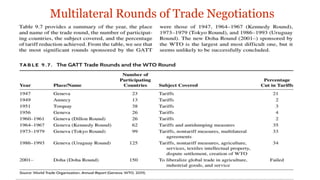
Multilateral Rounds of Trade Negotiations
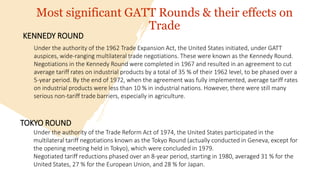
Most significant GATT Rounds & their effects on
Trade
KENNEDY ROUND
Under the authority of the 1962 Trade Expansion Act, the United States initiated, under GATT
auspices, wide-ranging multilateral trade negotiations. These were known as the Kennedy Round.
Negotiations in the Kennedy Round were completed in 1967 and resulted in an agreement to cut
average tariff rates on industrial products by a total of 35 % of their 1962 level, to be phased over a
5-year period. By the end of 1972, when the agreement was fully implemented, average tariff rates
on industrial products were less than 10 % in industrial nations. However, there were still many
serious non-tariff trade barriers, especially in agriculture.
TOKYO ROUND
Under the authority of the Trade Reform Act of 1974, the United States participated in the
multilateral tariff negotiations known as the Tokyo Round (actually conducted in Geneva, except for
the opening meeting held in Tokyo), which were concluded in 1979.
Negotiated tariff reductions phased over an 8-year period, starting in 1980, averaged 31 % for the
United States, 27 % for the European Union, and 28 % for Japan.
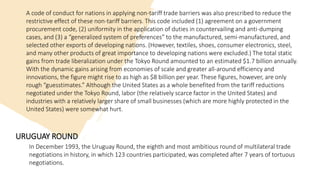
A code of conduct for nations in applying non-tariff trade barriers was also prescribed to reduce the
restrictive effect of these non-tariff barriers. This code included (1) agreement on a government
procurement code, (2) uniformity in the application of duties in countervailing and anti-dumping
cases, and (3) a “generalized system of preferences” to the manufactured, semi-manufactured, and
selected other exports of developing nations. (However, textiles, shoes, consumer electronics, steel,
and many other products of great importance to developing nations were excluded.) The total static
gains from trade liberalization under the Tokyo Round amounted to an estimated $1.7 billion annually.
With the dynamic gains arising from economies of scale and greater all-around efficiency and
innovations, the figure might rise to as high as $8 billion per year. These figures, however, are only
rough “guesstimates.” Although the United States as a whole benefited from the tariff reductions
negotiated under the Tokyo Round, labor (the relatively scarce factor in the United States) and
industries with a relatively larger share of small businesses (which are more highly protected in the
United States) were somewhat hurt.
URUGUAY ROUND
In December 1993, the Uruguay Round, the eighth and most ambitious round of multilateral trade
negotiations in history, in which 123 countries participated, was completed after 7 years of tortuous
negotiations.
The Round had started in Punta del Este in Uruguay in September 1986 and had been scheduled to
be completed by December 1990, but disagreements between the United States and the European
Union (EU), especially France, on reducing agricultural subsidies delayed its conclusion for 3 years.
The aim of the Uruguay Round was to establish rules for checking the proliferation of the new
protectionism and reverse its trend; bring services, agriculture, and foreign investments into the
negotiations;
negotiate international rules for the protection of intellectual property rights; and improve the
dispute settlement mechanism by ensuring more timely decisions and compliance with GATT
rulings. The agreement was signed by the United States and most other countries on April 15, 1994,
and took effect on July 1, 1995.
The major provisions of the accord were the following:
1. Tariffs. Tariffs on industrial products were to be reduced from an average of 4.7 to 3 %, and the
share of goods with zero tariffs was to increase from 20–22 % to 40–45 %; tariffs were removed
altogether on pharmaceuticals, construction equipment, medical equipment, paper products, and
steel.
2. Quotas. Nations were to replace quotas on agricultural imports and imports of textiles and
apparel (under the Multi-fiber Agreement) with less restrictive tariffs by the end of 1999 for
agricultural products and by the end of 2004 for textiles and apparel; tariffs on agricultural products
were to be reduced by 24 % in developing nations and by 36 % in industrial nations, and tariffs on
textiles were to be cut by 25 %.
3. Anti-dumping. The agreement provided for tougher and quicker action to resolve disputes resulting
from the use of anti-dumping laws, but it did not ban their use.
4. Subsidies. The volume of subsidized agricultural exports was to be reduced by 21% over a 6-year period;
government subsidies for industrial research were limited to 50% of applied research costs.
5. Safeguards. Nations could temporarily raise tariffs or other restrictions against an import surge that
severely harmed domestic industry, but it barred countries from administering health and safety
standards unless based on scientific evidence and not simply to restrict trade. For example, a nation could
only keep out beef imports from cattle raised with growth hormones by showing that the beef so
produced was unsafe for human consumption.
6. Intellectual property. The agreement provided for 20-year protection of patents, trademarks, and
copyrights, but it allowed a 10-year phase-in period for patent protection in pharmaceuticals for
developing countries.
7. Services. The United States failed to secure access to the markets of Japan, Korea, and many developing
nations for its banks and security firms, and did not succeed in having France and the European Union lift
restrictions on the showing of American films and TV programs in Europe.
8. Trade-related investment measures (TRIMs). The agreement phased out the requirement that foreign
investors (such as automakers) buy supplies locally or export as much as they import.
Birth to WTO
The agreement also called for the replacement of the General Agreement on Tariffs and Trade (GATT)
secretariat with World Trade Organization (WTO) in Geneva with authority not only in trade in industrial
products but also in agricultural products and services. Trade disputes were also to be settled by a vote of
two-thirds or three-quarters of the nations rather than unanimously as under GATT (which meant that the
guilty nation could block any action against it).
Although the completion of the Uruguay Round was in and of itself a great achievement, only some of its
aims were met, and many trade problems remain. It was estimated that the implementation of the
Uruguay Round by 2005 increased world welfare by $73 billion, of which $58.3 billion of the gains went to
developed countries and $19.2 billion to developing countries.
The collapse of the Uruguay Round, however, would have been disastrous psychologically and could have
led to the unrestrained proliferation of trade restrictions and destructive trade wars.
During 1996 and 1997, multilateral agreements to open up trade in telecommunications, financial services,
and information technology (that were not reached at the Uruguay Round) were concluded. Over time,
these agreements could provide larger gains in trade volumes than the entire Uruguay Round treaty. In
1999, the European Union reached a free trade agreement (FTA) with Mexico (which became effective in
July 2000) to end all tariffs on their bilateral trade. China became the 144th member of the WTO in 2001,
and Russia became the 156th member in 2012. As of the beginning of 2019, the WTO had 164 members.
Failed DOHA Round
In December 1999, an attempt was made to launch a “Millennium Round” of trade negotiations
at the WTO Trade Conference held in Seattle in December 1999. The attempt failed because (1)
developing countries were adamantly opposed to putting labor and environmental standards on the
agenda for the new round; (2) the European Union and Japan objected to the U.S. desire to put on
the agenda the complete liberalization of trade in agricultural products; and (3) the United States
objected to discussing competition and investment policies that the European Union wanted. All
this came up in the face of large demonstrations organized by a strong anti-globalization
movement, which blamed globalization for many human and environmental problems worldwide
and for sacrificing human and environmental well-being to the corporate profits of multinationals.
Then, in November 2001, the Doha Round was launched in Doha, the capital of the Gulf State of
Qatar. The agenda included (1) the further liberalization of production and trade in agriculture,
industrial products, and services and (2) the further tightening of rules for anti-dumping measures
and safeguards, as well as investment and competition policies. The new Round proposed a
reduction in agricultural tariffs of between 45 and 75 % in developed countries, between 35 and 60
% in developing countries, and no reduction for the least-developed countries. For non-agricultural
tariffs, it proposed a reduction in tariffs of 50 % in developed countries and 35 % in developing
countries (and, again, no reductions in the least-developed countries). The new Round projected
benefits of $96 billion by 2015 (or about one-third of the estimated value of full liberalization), of
which $80 billion would go to developed countries and $16 billion would go to developing
countries.
From the very beginning, developing nations were reluctant to make concessions because they felt
that the Uruguay Round had failed to deliver a great deal of what it promised them and insisted on
making the Doha Round a true “development round.” The Doha Round was supposed to be
concluded by the end of 2004, but after 5 years of negotiations, the Round all but collapsed in July
2008 over disagreements over agricultural subsidies, between developed and developing countries,
and among developed countries themselves.
All attempts to revive the Doha Round failed and the Round is now considered dead.
OUTSTANDING TRADE PROBLEMS
Despite the great benefits resulting from the successful completion of the Uruguay Round, many serious
trade problems remain.
1. Continued widespread trade protectionism. Advanced nations often seek to protect domestic production
and jobs from foreign competition and use strategic trade and industrial policies to encourage new high-
tech industries, and so do emerging market economies. Europe has increased protection on a number of
industries out of fear of turning into an industrial wasteland. Russia raised tariffs on used car imports,
India banned Chinese toys, and Argentina has tightened licensing requirements on auto parts imports,
textiles, and leather goods. The United States, the European Union, and Japan are subsidizing their
agriculture and helping their banks, while China is pursuing an aggressive industrial policy to boost its
national champions and trying to achieve technological superiority
2. Subsidies and tariffs on agricultural products remain very high; anti-dumping measures and safeguards are
still possible and frequently abused, and so the potential for serious trade disputes remains.
3. Tendency for the world to break up into three major trading blocs: the European Union (EU), the North
America Free Trade Area (NAFTA), and the newly formed Pacific Bloc. Although these trading blocs could
be regarded as building blocks of a freer trading system, they can also become stumbling blocks and lead
to more bilateral deals, protection-ism, and inter-bloc trade conflicts.
4. The call by some developed countries, such as the United States and France, for the establishment of
labor and environmental standards. These are sup-posed to ensure a “leveling of working conditions”
between developed and developing countries and avoid “social dumping” by the latter (i.e., developing
countries competing unfairly by denying their workers basic rights, and decent wages and working
conditions).The danger is that the movement to establish labor and environmental standards can easily be
captured by protectionism forces. The same is true for environmental standards. Trade-related
competition policies (such as subsidies and regulations) as well as trade-related investment measures
(TRIMs) also need to be dealt with more adequately than they have been in the Uruguay Round.
5. Trade War, the fifth and most dangerous trade problem facing the world in 2018 was the U.S.
protectionism (defensive) trade policies under Trump, which undermined the WTO and risked a trade war.
THANK YOU

GATT Roundsmmmmmmmmmmmmmmmmmmmmmmmmm.pptx

  • 1.
    Multilateral Trade Negotiations - THEGATT ROUND Presented By - Nishita MA Eco Final 26
  • 2.
    1. GATT- creation,principles 2. Multilateral Rounds of Trade Negotiations 3. Most Significant GATT Rounds & their effects on trade • The Kennedy Round • The Tokyo Round • The Uruguay Round 4. Birth to WTO 5. The Failed Doha Round 6. The Outstanding Trade Problems Outline
  • 3.
    • Dominick Salvatore,International Economics • M.L. Jhingan, International Economics • WTO Website ( www.wto.org ) References on GATT Round
  • 4.
    GATT? General Agreement ofTariffs and Trade GATT rested on three basic principles: 1. Nondiscrimination. This principle refers to the unconditional acceptance of the most- favored- nation principle discussed earlier. The only exceptions to this principle are made in cases of economic integration, such as customs unions and in the trade between a nation and its former colonies and dominions. 2. Elimination of non-tariff trade barriers (such as quotas), except for agricultural products and for nations in balance-of-payments difficulties. 3. Consultation among nations in solving trade disputes within the GATT framework. GATT was an international organization, created in 1947 and headquartered in Geneva (Switzerland), devoted to the promotion of freer trade through multilateral trade negotiations. Originally, it was thought that GATT would become part of the International Trade Organization (ITO), whose charter was negotiated in Havana in 1948 to regulate international trade. By 1993, a total of 123 nations (including the United States and all major countries, with the exception of the countries of the former Soviet Union and China) were signatories of the GATT, and 24 other nations had applied for admission. The agreement covered over 90 % of world trade.
  • 5.
    Multilateral Rounds ofTrade Negotiations
  • 6.
    Most significant GATTRounds & their effects on Trade KENNEDY ROUND Under the authority of the 1962 Trade Expansion Act, the United States initiated, under GATT auspices, wide-ranging multilateral trade negotiations. These were known as the Kennedy Round. Negotiations in the Kennedy Round were completed in 1967 and resulted in an agreement to cut average tariff rates on industrial products by a total of 35 % of their 1962 level, to be phased over a 5-year period. By the end of 1972, when the agreement was fully implemented, average tariff rates on industrial products were less than 10 % in industrial nations. However, there were still many serious non-tariff trade barriers, especially in agriculture. TOKYO ROUND Under the authority of the Trade Reform Act of 1974, the United States participated in the multilateral tariff negotiations known as the Tokyo Round (actually conducted in Geneva, except for the opening meeting held in Tokyo), which were concluded in 1979. Negotiated tariff reductions phased over an 8-year period, starting in 1980, averaged 31 % for the United States, 27 % for the European Union, and 28 % for Japan.
  • 7.
    A code ofconduct for nations in applying non-tariff trade barriers was also prescribed to reduce the restrictive effect of these non-tariff barriers. This code included (1) agreement on a government procurement code, (2) uniformity in the application of duties in countervailing and anti-dumping cases, and (3) a “generalized system of preferences” to the manufactured, semi-manufactured, and selected other exports of developing nations. (However, textiles, shoes, consumer electronics, steel, and many other products of great importance to developing nations were excluded.) The total static gains from trade liberalization under the Tokyo Round amounted to an estimated $1.7 billion annually. With the dynamic gains arising from economies of scale and greater all-around efficiency and innovations, the figure might rise to as high as $8 billion per year. These figures, however, are only rough “guesstimates.” Although the United States as a whole benefited from the tariff reductions negotiated under the Tokyo Round, labor (the relatively scarce factor in the United States) and industries with a relatively larger share of small businesses (which are more highly protected in the United States) were somewhat hurt. URUGUAY ROUND In December 1993, the Uruguay Round, the eighth and most ambitious round of multilateral trade negotiations in history, in which 123 countries participated, was completed after 7 years of tortuous negotiations.
  • 8.
    The Round hadstarted in Punta del Este in Uruguay in September 1986 and had been scheduled to be completed by December 1990, but disagreements between the United States and the European Union (EU), especially France, on reducing agricultural subsidies delayed its conclusion for 3 years. The aim of the Uruguay Round was to establish rules for checking the proliferation of the new protectionism and reverse its trend; bring services, agriculture, and foreign investments into the negotiations; negotiate international rules for the protection of intellectual property rights; and improve the dispute settlement mechanism by ensuring more timely decisions and compliance with GATT rulings. The agreement was signed by the United States and most other countries on April 15, 1994, and took effect on July 1, 1995. The major provisions of the accord were the following: 1. Tariffs. Tariffs on industrial products were to be reduced from an average of 4.7 to 3 %, and the share of goods with zero tariffs was to increase from 20–22 % to 40–45 %; tariffs were removed altogether on pharmaceuticals, construction equipment, medical equipment, paper products, and steel. 2. Quotas. Nations were to replace quotas on agricultural imports and imports of textiles and apparel (under the Multi-fiber Agreement) with less restrictive tariffs by the end of 1999 for agricultural products and by the end of 2004 for textiles and apparel; tariffs on agricultural products were to be reduced by 24 % in developing nations and by 36 % in industrial nations, and tariffs on textiles were to be cut by 25 %.
  • 9.
    3. Anti-dumping. Theagreement provided for tougher and quicker action to resolve disputes resulting from the use of anti-dumping laws, but it did not ban their use. 4. Subsidies. The volume of subsidized agricultural exports was to be reduced by 21% over a 6-year period; government subsidies for industrial research were limited to 50% of applied research costs. 5. Safeguards. Nations could temporarily raise tariffs or other restrictions against an import surge that severely harmed domestic industry, but it barred countries from administering health and safety standards unless based on scientific evidence and not simply to restrict trade. For example, a nation could only keep out beef imports from cattle raised with growth hormones by showing that the beef so produced was unsafe for human consumption. 6. Intellectual property. The agreement provided for 20-year protection of patents, trademarks, and copyrights, but it allowed a 10-year phase-in period for patent protection in pharmaceuticals for developing countries. 7. Services. The United States failed to secure access to the markets of Japan, Korea, and many developing nations for its banks and security firms, and did not succeed in having France and the European Union lift restrictions on the showing of American films and TV programs in Europe. 8. Trade-related investment measures (TRIMs). The agreement phased out the requirement that foreign investors (such as automakers) buy supplies locally or export as much as they import.
  • 10.
    Birth to WTO Theagreement also called for the replacement of the General Agreement on Tariffs and Trade (GATT) secretariat with World Trade Organization (WTO) in Geneva with authority not only in trade in industrial products but also in agricultural products and services. Trade disputes were also to be settled by a vote of two-thirds or three-quarters of the nations rather than unanimously as under GATT (which meant that the guilty nation could block any action against it). Although the completion of the Uruguay Round was in and of itself a great achievement, only some of its aims were met, and many trade problems remain. It was estimated that the implementation of the Uruguay Round by 2005 increased world welfare by $73 billion, of which $58.3 billion of the gains went to developed countries and $19.2 billion to developing countries. The collapse of the Uruguay Round, however, would have been disastrous psychologically and could have led to the unrestrained proliferation of trade restrictions and destructive trade wars. During 1996 and 1997, multilateral agreements to open up trade in telecommunications, financial services, and information technology (that were not reached at the Uruguay Round) were concluded. Over time, these agreements could provide larger gains in trade volumes than the entire Uruguay Round treaty. In 1999, the European Union reached a free trade agreement (FTA) with Mexico (which became effective in July 2000) to end all tariffs on their bilateral trade. China became the 144th member of the WTO in 2001, and Russia became the 156th member in 2012. As of the beginning of 2019, the WTO had 164 members.
  • 11.
    Failed DOHA Round InDecember 1999, an attempt was made to launch a “Millennium Round” of trade negotiations at the WTO Trade Conference held in Seattle in December 1999. The attempt failed because (1) developing countries were adamantly opposed to putting labor and environmental standards on the agenda for the new round; (2) the European Union and Japan objected to the U.S. desire to put on the agenda the complete liberalization of trade in agricultural products; and (3) the United States objected to discussing competition and investment policies that the European Union wanted. All this came up in the face of large demonstrations organized by a strong anti-globalization movement, which blamed globalization for many human and environmental problems worldwide and for sacrificing human and environmental well-being to the corporate profits of multinationals. Then, in November 2001, the Doha Round was launched in Doha, the capital of the Gulf State of Qatar. The agenda included (1) the further liberalization of production and trade in agriculture, industrial products, and services and (2) the further tightening of rules for anti-dumping measures and safeguards, as well as investment and competition policies. The new Round proposed a reduction in agricultural tariffs of between 45 and 75 % in developed countries, between 35 and 60 % in developing countries, and no reduction for the least-developed countries. For non-agricultural tariffs, it proposed a reduction in tariffs of 50 % in developed countries and 35 % in developing countries (and, again, no reductions in the least-developed countries). The new Round projected benefits of $96 billion by 2015 (or about one-third of the estimated value of full liberalization), of which $80 billion would go to developed countries and $16 billion would go to developing countries.
  • 12.
    From the verybeginning, developing nations were reluctant to make concessions because they felt that the Uruguay Round had failed to deliver a great deal of what it promised them and insisted on making the Doha Round a true “development round.” The Doha Round was supposed to be concluded by the end of 2004, but after 5 years of negotiations, the Round all but collapsed in July 2008 over disagreements over agricultural subsidies, between developed and developing countries, and among developed countries themselves. All attempts to revive the Doha Round failed and the Round is now considered dead. OUTSTANDING TRADE PROBLEMS Despite the great benefits resulting from the successful completion of the Uruguay Round, many serious trade problems remain. 1. Continued widespread trade protectionism. Advanced nations often seek to protect domestic production and jobs from foreign competition and use strategic trade and industrial policies to encourage new high- tech industries, and so do emerging market economies. Europe has increased protection on a number of industries out of fear of turning into an industrial wasteland. Russia raised tariffs on used car imports, India banned Chinese toys, and Argentina has tightened licensing requirements on auto parts imports, textiles, and leather goods. The United States, the European Union, and Japan are subsidizing their agriculture and helping their banks, while China is pursuing an aggressive industrial policy to boost its national champions and trying to achieve technological superiority
  • 13.
    2. Subsidies andtariffs on agricultural products remain very high; anti-dumping measures and safeguards are still possible and frequently abused, and so the potential for serious trade disputes remains. 3. Tendency for the world to break up into three major trading blocs: the European Union (EU), the North America Free Trade Area (NAFTA), and the newly formed Pacific Bloc. Although these trading blocs could be regarded as building blocks of a freer trading system, they can also become stumbling blocks and lead to more bilateral deals, protection-ism, and inter-bloc trade conflicts. 4. The call by some developed countries, such as the United States and France, for the establishment of labor and environmental standards. These are sup-posed to ensure a “leveling of working conditions” between developed and developing countries and avoid “social dumping” by the latter (i.e., developing countries competing unfairly by denying their workers basic rights, and decent wages and working conditions).The danger is that the movement to establish labor and environmental standards can easily be captured by protectionism forces. The same is true for environmental standards. Trade-related competition policies (such as subsidies and regulations) as well as trade-related investment measures (TRIMs) also need to be dealt with more adequately than they have been in the Uruguay Round. 5. Trade War, the fifth and most dangerous trade problem facing the world in 2018 was the U.S. protectionism (defensive) trade policies under Trump, which undermined the WTO and risked a trade war.
  • 14.