Seminar Work


 Valter Telo
  Erasmus Student
INDEX


1.     Abstract ............................................................................................................... 3

2.     World Trade Organization ................................................................................. 4

     2.1.     Description .................................................................................................. 4

     2.2.     Story ............................................................................................................. 5

     2.3.     Principles ..................................................................................................... 6

        - Non-Discrimination ......................................................................................... 6

        - Reciprocity ...................................................................................................... 6

        - Binding and enforceable commitments ....................................................... 6

        - Transparency................................................................................................... 6

        - Safety valves ................................................................................................... 7

     2.4.     Evolution...................................................................................................... 7

     2.5.     Rounds.......................................................................................................... 8

3.     Conclusion ........................................................................................................... 9

4.     References......................................................................................................... 10


                                                       Valter Telo                                                               2
1. Abstract


   I opted to choose this large subject which is "WTO - World Trade

Organization" because it’s a field that is present all over the world and has

tremendous influence both the government and society. WTO is designed to

promote the economic, financial and trade among member states, as an

essential condition to increase economic development. In this article I intend

to inform a little of this big organization and we are able to understand the

importance that the WTO has to trade market. The WTO is important because

since the decade of 1990 the trade increased at an average rate of 7%.

The WTO advantages are:

    The system promotes good governance;

    Trade increases the access;

    A freer trade means lower cost of living;

    The system helps promote peace.

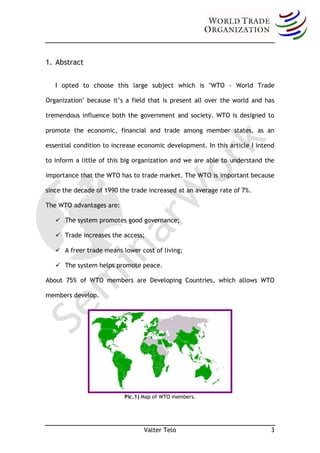
About 75% of WTO members are Developing Countries, which allows WTO

members develop.


                          Pic.1) Map of WTO members.


                          Pic.1) Map of WTO members.


                                 Valter Telo                                3
2. World Trade Organization

 2.1. Description


                  The organization was founded January 1, 1995 with the purpose of

                  enforcing the rules established by the GATT, in particular as

                  respect the increase in living standards and real income, the

                  achievement of full employment, the optimization of global

resources and the preservation of environment. The WTO includes 127 countries, 153

members (more than 97% of total world trade and 30 observers) and operates through

a permanent International Conference and Ministerial Conference, its highest body,

where each country is represented by a minister. The most important decisions are

taken unanimously; the details of implementation of the measures are approved by

majority vote. The WTO headquarters is at Geneva, Switzerland.

Their objectives are:

   1. To raise the levels of life;

   2. To improve full employment;

   3. To attain the objectives with sustainable development and environmental

       protection;

   4. To ensure the rich and poor countries benefit from fair deals for both.


                               Pic.2) WTO headquarters.


                                     Valter Telo                                4
2.2. Story


                                   At the end of World War II has been an

                                   important step for global trade. WTO

                                   arises    from     the     junction   of   the

                                   International Trade Organization and the

                                   Havana’s letter, but was not accepted by

the North Congress of USA. The principles (of ITO - Havana’s letter) were

introduced into the GATT (1947, temporarily) aimed at removing trade

barriers so as to facilitate the exchange of products between countries.

There were 8 rounds of negotiations at GATT:

   1. Genebra (1947);                           6. Kennedy (1964/67);

   2. Annecy (1949);                            7. Tokyo (1973/79);

   3. Torquay (1950/51);                        8. Uruguai (1986/93);

   4. Genebra (1955/56);                        9. Doha (2001/…).

   5. Dillon (1960/61);


   That after the Uruguay Round (1995) was established WTO. The WTO

came into January 1, 1995. Slovenia joined the WTO on 30 July 1995. The

actual director-general of WTO are Pascal Lamy since 2005. The structure of

WTO is: The Ministerial Conference (council that makes decisions, meet

periodically for two years); The General Council (solves trade disputes among

members); The Councils on Trade in Goods; and The Secretariat and Director

General   (does    not    take   decisions     only   helps     administratively).


                                 Valter Telo                                    5
2.3. Principles

       Non-Discrimination:

                   Most favored nation (MFN):

  –                  (Non-discrimination between countries in the WTO, the measures

                     taken by a member of WTO in relation to another, must be equal

                     to all other members).

                   National treatment:

  –                  (This treatment should be applied to services, products, which

                     require that there be no discrimination in domestic products and

                     products of a member state.


       Reciprocity – This principle assumes that, when Countries joins the

         organization, reducing tariff barriers, also hopes that member countries do

         the same.


       Binding and enforceable commitments – This principle provides that

         trade agreements are listed in a "schedule" list of Concessions. If satisfaction

         of a transaction is not successful, the country concerned may claim the

         WTO.


       Transparency – This principle requires an internal transparency forcing

         member states, to always notify the transactions of trade measures. There is

         the Trade Policy Review Mechanism (TPRM) to supervise the transparency.


                                      Valter Telo                                      6
 Safety valves – This principle requires         WTO member may restrict trade

       for member states if and only if for:

                Ensuring articles to "fair competition";

                Attain articles to non-economic finishes;

                Others (allow Intervention for Economic Reasons).


2.4. Evolution


      After the World War II it was necessary to build an organization for economic

cooperation, at this time were created the IMF (International Monetary Fund) and

GATT. In December 1945 USA took advantage of the fact that already knew their

allies in war and therefore do business with low Tariffs, creating the ITO

(International Trade Organization).

      In March 1948 letter from the ITO (Havana’s letter) was not successful,

because North American Congress never approved it. On October 30 of 1947, 23

Countries have signed (Final Act authentic of the General Agreement on Tariffs and

Trade).

    From 1948 to 1995 the GATT was the only organization to deal with

international trade. After the Uruguay round of GATT was transformed to the WTO.


                                      Valter Telo                                7
2.5. Rounds

   Year                           Name                        Number of countries                       Issues
   1947                      Genebra (1947);                        23 countries                        Tariffs
   1949                      Annecy (1949);                         13 countries                        Tariffs
  1950/51                  Torquay (1950/51);                       38 countries                        Tariffs
 1955/1956                 Genebra (1955/56);                       26 countries                        Tariffs
  1960/61                   Dillon (1960/61);                       26 countries                        Tariffs
  1964/67                  Kennedy (1964/67);                         62 countries          Tariffs, Antidumping measures.
                                                                                          Tariffs, Non-tariff measures, Export
  1973/79                   Tokyo (1973/79);                          102 countries      restrictions, Measures for controlling
                                                                                                    the Proliferation.
                                                                                             Tariffs, Agriculture, Services,
  1986/93                   Uruguai (1986/93);                        123 countries
                                                                                            Intellectual property, Textiles.
                                                                                            Industrial tariffs and Non-tariff
   2001/…                    Doha (2001/…).                           149 countries     barriers, Trade remedies, Agriculture,
                                                                                                        Services.

                                                     Evolution


          160                                                                                                     149
          140                                                                                     123
          120                                                                         102
          100
 Countries 80                                                                62
           60                              38
           40      23                                26          26
                              13
           20
            0
                Genebra   Annecy     Torquay    Genebra     Dillon    Kennedy     Tokyo      Uruguai     Doha
                (1947);   (1949);   (1950/51); (1955/56); (1960/61); (1964/67); (1973/79); (1986/93); (2001/…).
                                                            Names


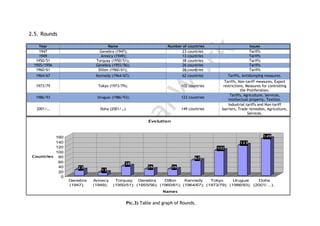
                                           Pic.3) Table and graph of Rounds.
3. Conclusion


    With this work I concluded that an organization that promotes trade (in

this case the WTO) is important for international relations. We could not talk

about international trade without talking about the WTO. Currently, the

WTO is also target of criticism; in particular, do not respect the principle of

nondiscrimination. We must know that the WTO is not an independent

organization but an organization that makes a decision only when all

countries are into agreement.

    We must also keep in mind that the less developed countries do not have

much influence in the organization, but also has the right to express their

opinion. It is indispensable the existence of the WTO, because if did not

exist, the trade was faced with a restriction products (less variety), as well

as their prices would be more expensive.

    With this work, in the course of Economic Diplomacy, I wanted to make

known the importance of the WTO (members, rounds, principles, etc). The

organization goes far beyond what was written in this paper because of its

scale. Finally, referencing that protectionism is not a good policy for any

country.


                                 Valter Telo                                  9
4. References


     Websites:


      http://www.wto.org/english/thewto_e/whatis_e/whatis_e.htm;

      http://en.wikipedia.org/wiki/World_Trade_Organization;

      http://www.wto.org/english/thewto_e/whatis_e/tif_e/fact2_e.htm;

      http://www.globalissues.org/article/42/the-wto-and-free-trade.

      http://www.iisd.org/trade/handbook/3_1.htm


     Books:


      “An introduction to the WTO Agreements”, By Bhagirath Lal Das.


                                            Valter Telo                  10

SeminarWork

  • 1.
    Seminar Work ValterTelo Erasmus Student
  • 2.
    INDEX 1. Abstract ............................................................................................................... 3 2. World Trade Organization ................................................................................. 4 2.1. Description .................................................................................................. 4 2.2. Story ............................................................................................................. 5 2.3. Principles ..................................................................................................... 6 - Non-Discrimination ......................................................................................... 6 - Reciprocity ...................................................................................................... 6 - Binding and enforceable commitments ....................................................... 6 - Transparency................................................................................................... 6 - Safety valves ................................................................................................... 7 2.4. Evolution...................................................................................................... 7 2.5. Rounds.......................................................................................................... 8 3. Conclusion ........................................................................................................... 9 4. References......................................................................................................... 10 Valter Telo 2
  • 3.
    1. Abstract I opted to choose this large subject which is "WTO - World Trade Organization" because it’s a field that is present all over the world and has tremendous influence both the government and society. WTO is designed to promote the economic, financial and trade among member states, as an essential condition to increase economic development. In this article I intend to inform a little of this big organization and we are able to understand the importance that the WTO has to trade market. The WTO is important because since the decade of 1990 the trade increased at an average rate of 7%. The WTO advantages are:  The system promotes good governance;  Trade increases the access;  A freer trade means lower cost of living;  The system helps promote peace. About 75% of WTO members are Developing Countries, which allows WTO members develop. Pic.1) Map of WTO members. Pic.1) Map of WTO members. Valter Telo 3
  • 4.
    2. World TradeOrganization 2.1. Description The organization was founded January 1, 1995 with the purpose of enforcing the rules established by the GATT, in particular as respect the increase in living standards and real income, the achievement of full employment, the optimization of global resources and the preservation of environment. The WTO includes 127 countries, 153 members (more than 97% of total world trade and 30 observers) and operates through a permanent International Conference and Ministerial Conference, its highest body, where each country is represented by a minister. The most important decisions are taken unanimously; the details of implementation of the measures are approved by majority vote. The WTO headquarters is at Geneva, Switzerland. Their objectives are: 1. To raise the levels of life; 2. To improve full employment; 3. To attain the objectives with sustainable development and environmental protection; 4. To ensure the rich and poor countries benefit from fair deals for both. Pic.2) WTO headquarters. Valter Telo 4
  • 5.
    2.2. Story At the end of World War II has been an important step for global trade. WTO arises from the junction of the International Trade Organization and the Havana’s letter, but was not accepted by the North Congress of USA. The principles (of ITO - Havana’s letter) were introduced into the GATT (1947, temporarily) aimed at removing trade barriers so as to facilitate the exchange of products between countries. There were 8 rounds of negotiations at GATT: 1. Genebra (1947); 6. Kennedy (1964/67); 2. Annecy (1949); 7. Tokyo (1973/79); 3. Torquay (1950/51); 8. Uruguai (1986/93); 4. Genebra (1955/56); 9. Doha (2001/…). 5. Dillon (1960/61); That after the Uruguay Round (1995) was established WTO. The WTO came into January 1, 1995. Slovenia joined the WTO on 30 July 1995. The actual director-general of WTO are Pascal Lamy since 2005. The structure of WTO is: The Ministerial Conference (council that makes decisions, meet periodically for two years); The General Council (solves trade disputes among members); The Councils on Trade in Goods; and The Secretariat and Director General (does not take decisions only helps administratively). Valter Telo 5
  • 6.
    2.3. Principles  Non-Discrimination:  Most favored nation (MFN): – (Non-discrimination between countries in the WTO, the measures taken by a member of WTO in relation to another, must be equal to all other members).  National treatment: – (This treatment should be applied to services, products, which require that there be no discrimination in domestic products and products of a member state.  Reciprocity – This principle assumes that, when Countries joins the organization, reducing tariff barriers, also hopes that member countries do the same.  Binding and enforceable commitments – This principle provides that trade agreements are listed in a "schedule" list of Concessions. If satisfaction of a transaction is not successful, the country concerned may claim the WTO.  Transparency – This principle requires an internal transparency forcing member states, to always notify the transactions of trade measures. There is the Trade Policy Review Mechanism (TPRM) to supervise the transparency. Valter Telo 6
  • 7.
     Safety valves– This principle requires WTO member may restrict trade for member states if and only if for:  Ensuring articles to "fair competition";  Attain articles to non-economic finishes;  Others (allow Intervention for Economic Reasons). 2.4. Evolution After the World War II it was necessary to build an organization for economic cooperation, at this time were created the IMF (International Monetary Fund) and GATT. In December 1945 USA took advantage of the fact that already knew their allies in war and therefore do business with low Tariffs, creating the ITO (International Trade Organization). In March 1948 letter from the ITO (Havana’s letter) was not successful, because North American Congress never approved it. On October 30 of 1947, 23 Countries have signed (Final Act authentic of the General Agreement on Tariffs and Trade). From 1948 to 1995 the GATT was the only organization to deal with international trade. After the Uruguay round of GATT was transformed to the WTO. Valter Telo 7
  • 8.
    2.5. Rounds Year Name Number of countries Issues 1947 Genebra (1947); 23 countries Tariffs 1949 Annecy (1949); 13 countries Tariffs 1950/51 Torquay (1950/51); 38 countries Tariffs 1955/1956 Genebra (1955/56); 26 countries Tariffs 1960/61 Dillon (1960/61); 26 countries Tariffs 1964/67 Kennedy (1964/67); 62 countries Tariffs, Antidumping measures. Tariffs, Non-tariff measures, Export 1973/79 Tokyo (1973/79); 102 countries restrictions, Measures for controlling the Proliferation. Tariffs, Agriculture, Services, 1986/93 Uruguai (1986/93); 123 countries Intellectual property, Textiles. Industrial tariffs and Non-tariff 2001/… Doha (2001/…). 149 countries barriers, Trade remedies, Agriculture, Services. Evolution 160 149 140 123 120 102 100 Countries 80 62 60 38 40 23 26 26 13 20 0 Genebra Annecy Torquay Genebra Dillon Kennedy Tokyo Uruguai Doha (1947); (1949); (1950/51); (1955/56); (1960/61); (1964/67); (1973/79); (1986/93); (2001/…). Names Pic.3) Table and graph of Rounds.
  • 9.
    3. Conclusion With this work I concluded that an organization that promotes trade (in this case the WTO) is important for international relations. We could not talk about international trade without talking about the WTO. Currently, the WTO is also target of criticism; in particular, do not respect the principle of nondiscrimination. We must know that the WTO is not an independent organization but an organization that makes a decision only when all countries are into agreement. We must also keep in mind that the less developed countries do not have much influence in the organization, but also has the right to express their opinion. It is indispensable the existence of the WTO, because if did not exist, the trade was faced with a restriction products (less variety), as well as their prices would be more expensive. With this work, in the course of Economic Diplomacy, I wanted to make known the importance of the WTO (members, rounds, principles, etc). The organization goes far beyond what was written in this paper because of its scale. Finally, referencing that protectionism is not a good policy for any country. Valter Telo 9
  • 10.
    4. References  Websites:  http://www.wto.org/english/thewto_e/whatis_e/whatis_e.htm;  http://en.wikipedia.org/wiki/World_Trade_Organization;  http://www.wto.org/english/thewto_e/whatis_e/tif_e/fact2_e.htm;  http://www.globalissues.org/article/42/the-wto-and-free-trade.  http://www.iisd.org/trade/handbook/3_1.htm  Books:  “An introduction to the WTO Agreements”, By Bhagirath Lal Das. Valter Telo 10