Getting Your Maps on the Web A Philosophical Approach Gateway Group Seminar- INSPIRE and Web Mapping Sandford on Thames, July 2008 Jo Cook Senior Applications Support  and Development Officer Oxford Archaeological Unit Ltd [email_address]
Introduction How INSPIRE is really all about open source software, and getting your data on the web
INSPIRE says...  “ reduce duplicated data collection and ... assist and promote the harmonisation, broad dissemination and use of data” “ increase efficiency” “ stimulate innovation” “ spatial information may be used to produce maps, which are a good way of communicating” Commission of the European Communities, 2004, Proposal for a directive of the European Parliament and of the council establishing an infrastructure for spatial information in the Community (INSPIRE)‏
Problems everyone can relate to “ The main problems relate to data gaps, missing information, incompatible spatial datasets and services due eg to varying standards, and barriers to the sharing and reuse of spatial data” The problems highlighted in INSPIRE can be found in every organisation... Commission of the European Communities, 2004, Proposal for a directive of the European Parliament and of the council establishing an infrastructure for spatial information in the Community (INSPIRE)‏
Problems everyone can relate to “ The loss of time and resources in searching for existing spatial data or in discovering if they may be used for a particular purpose is a key obstacle in the full exploitation of the data available” ... so increasing efficiency is a global goal Commission of the European Communities, 2004, Proposal for a directive of the European Parliament and of the council establishing an infrastructure for spatial information in the Community (INSPIRE)‏
Spatial Data Infrastructures for Everyone “ The infrastructures for spatial information... should be designed to ensure that spatial data are stored, made available and maintained at the most appropriate level; that it is possible to combine spatial data from different sources... in a consistent way and to share them between several users and applications” These aims are just as applicable to local government, and in fact anyone producing and working with geospatial data in a multi-user environment. Commission of the European Communities, 2004, Proposal for a directive of the European Parliament and of the council establishing an infrastructure for spatial information in the Community (INSPIRE)‏
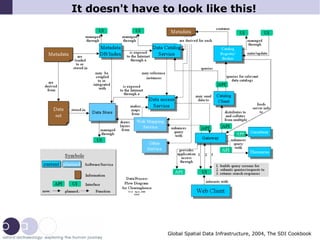
It doesn't have to look like this! Global Spatial Data Infrastructure, 2004, The SDI Cookbook
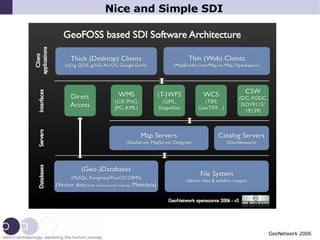
Nice and Simple SDI GeoNetwork 2006
Zawinski's Law and Modularity “ Every programme expands until it can read mail” Programmes can become over-complicated and bloated. Instead, choose a framework of smaller, interoperable tools or modules. “ ArcGIS 9.3 (available 3 rd  Quarter 2008) will fully support Windows Vista” (released January 2007)‏ Something doesn't work with your operating system? Elements can be replaced as necessary without jeopardising the rest of the stack. 1)  http://en.wikipedia.org/wiki/Jamie_Zawinski 2)  http://www.esri.com/news/releases/08_1qtr/arcgis93_vista.html  (emphasis mine)‏
Why Open Source? Supplier independence Transparency, controllability and manageability Interoperability Sustainability Also: Reliability Security Performance 1) Ministry of Economic Affairs (Netherlands), 2007, The Netherlands in Open Connection: An action plan for the use of Open Standards and  Open Source Software in the public and semi-public sector 2) http://www.dwheeler.com/oss_fs_why.html
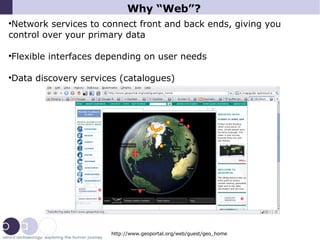
Why “Web”? Network services to connect front and back ends, giving you control over your primary data Flexible interfaces depending on user needs Data discovery services (catalogues)‏ http://www.geoportal.org/web/guest/geo_home
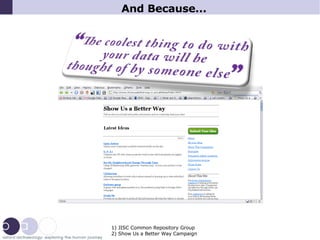
And Because... 1) JISC Common Repository Group 2) Show Us a Better Way Campaign
Where to go for information (and shameless plug)‏ http://www.osgeo.org http://wiki.osgeo.org/wiki/United_Kingdom

Gateway Seminar

  • 1.
    Getting Your Mapson the Web A Philosophical Approach Gateway Group Seminar- INSPIRE and Web Mapping Sandford on Thames, July 2008 Jo Cook Senior Applications Support and Development Officer Oxford Archaeological Unit Ltd [email_address]
  • 2.
    Introduction How INSPIREis really all about open source software, and getting your data on the web
  • 3.
    INSPIRE says... “ reduce duplicated data collection and ... assist and promote the harmonisation, broad dissemination and use of data” “ increase efficiency” “ stimulate innovation” “ spatial information may be used to produce maps, which are a good way of communicating” Commission of the European Communities, 2004, Proposal for a directive of the European Parliament and of the council establishing an infrastructure for spatial information in the Community (INSPIRE)‏
  • 4.
    Problems everyone canrelate to “ The main problems relate to data gaps, missing information, incompatible spatial datasets and services due eg to varying standards, and barriers to the sharing and reuse of spatial data” The problems highlighted in INSPIRE can be found in every organisation... Commission of the European Communities, 2004, Proposal for a directive of the European Parliament and of the council establishing an infrastructure for spatial information in the Community (INSPIRE)‏
  • 5.
    Problems everyone canrelate to “ The loss of time and resources in searching for existing spatial data or in discovering if they may be used for a particular purpose is a key obstacle in the full exploitation of the data available” ... so increasing efficiency is a global goal Commission of the European Communities, 2004, Proposal for a directive of the European Parliament and of the council establishing an infrastructure for spatial information in the Community (INSPIRE)‏
  • 6.
    Spatial Data Infrastructuresfor Everyone “ The infrastructures for spatial information... should be designed to ensure that spatial data are stored, made available and maintained at the most appropriate level; that it is possible to combine spatial data from different sources... in a consistent way and to share them between several users and applications” These aims are just as applicable to local government, and in fact anyone producing and working with geospatial data in a multi-user environment. Commission of the European Communities, 2004, Proposal for a directive of the European Parliament and of the council establishing an infrastructure for spatial information in the Community (INSPIRE)‏
  • 7.
    It doesn't haveto look like this! Global Spatial Data Infrastructure, 2004, The SDI Cookbook
  • 8.
    Nice and SimpleSDI GeoNetwork 2006
  • 9.
    Zawinski's Law andModularity “ Every programme expands until it can read mail” Programmes can become over-complicated and bloated. Instead, choose a framework of smaller, interoperable tools or modules. “ ArcGIS 9.3 (available 3 rd Quarter 2008) will fully support Windows Vista” (released January 2007)‏ Something doesn't work with your operating system? Elements can be replaced as necessary without jeopardising the rest of the stack. 1) http://en.wikipedia.org/wiki/Jamie_Zawinski 2) http://www.esri.com/news/releases/08_1qtr/arcgis93_vista.html (emphasis mine)‏
  • 10.
    Why Open Source?Supplier independence Transparency, controllability and manageability Interoperability Sustainability Also: Reliability Security Performance 1) Ministry of Economic Affairs (Netherlands), 2007, The Netherlands in Open Connection: An action plan for the use of Open Standards and Open Source Software in the public and semi-public sector 2) http://www.dwheeler.com/oss_fs_why.html
  • 11.
    Why “Web”? Networkservices to connect front and back ends, giving you control over your primary data Flexible interfaces depending on user needs Data discovery services (catalogues)‏ http://www.geoportal.org/web/guest/geo_home
  • 12.
    And Because... 1)JISC Common Repository Group 2) Show Us a Better Way Campaign
  • 13.
    Where to gofor information (and shameless plug)‏ http://www.osgeo.org http://wiki.osgeo.org/wiki/United_Kingdom