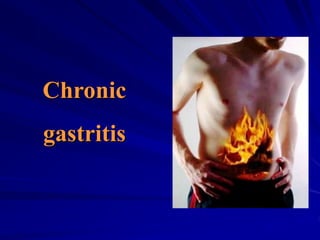
Сhronic
gastritis
Chronic gastritis is a polyetiologic diseases
with nonspecific chronic inflammation of
the stomach lining due to influence of
endo- and exogenic factors and may be
predictors of PUD or cancer
Classification CH G
(R.G. Strickland и J.R. Mackay,1973)
ChG
A (15%)
autoimmune
B (80%)
HP dependent
C (5%)
chemical-toxic
Classification CH G
Endoscopic :
Superficial
Erosive
Atrophic
Hemorragic
Hyperplasia
Clinical current
Exacerbation
Remission
Complication
Bleeding
Malignization
Functional
– Increase secretion
– Decrease secretion’
– Failure secretion
Etiology
Exogenic factors:
НP
Alimentary
Alcohol
Smoking
Prolong use drugs
Chemical agent
Radiation
Viral infections
Fungal (yeast)
infections
Parasites and worms
Endogenic factors
Genetic
EGDR;
Autoimmune
Endogenic intoxication
Hypoxemia
Chronic infection
Metabolic imbalance
Endocrine dysfunction
Hypovitaminosis
Reflexive actions
Helicobacter pylori (H. pylori)
A gram-negative, helical, rod-shaped bacterium, colonizes
the gastric mucosa of approximately one-half of the world
population and an estimated 30% to 40% of the U.S.
population.
H. Pylori is present in 95% of patients with duodenal ulcers
and in 70% of those with gastric ulcers.
It is typically transmitted via the fecal-oral route during
early childhood and persists for decades.
The bacterium is a known cause of gastric and duodenal
ulcers
HP is a risk factor for mucosa-associated lymphoid tissue
(MALT) lymphoma and gastric adenocarcinoma.
Due to HP
Primary contagious damage of epit cells
Activation of inflammatory cascades
Increase production of gastrine by G cells
and HCl and pepsin by parietal cells
Cellular regeneration abnormalities
Nonsteroidal anti-inflammatory
drugs (NSAIDs)
Aspirin (more than 300 drug products contain some form
of aspirin)
Nonsteroidal anti-inflammatory drugs (NSAIDs, such as
ibuprofen or naproxen)
Steroids (prednisone is one example)
Potassium supplements
Iron tablets
Cancer chemotherapy medications
Swallowing poisons or objects
Corrosives (acid or lye)
Alcohols of various types
Swallowed foreign bodies (paper clips or pins)
Medical and surgical conditions
Physical stress in people who are critically ill or injured
After medical procedures (such as endoscopy, in which a
specialist looks into the stomach with a small lighted tube)
After an operation to remove part of the stomach
After radiation treatment for cancer
Autoimmune diseases
Pernicious anemia
Chronic vomiting
CF
AP syndrome
AP or discomfort in the epigastric region
Irradiation - to the back
Character of pain - burning, aching,
gnawing, sharp, stabbing, or cutting.
Duration – 1-2 h
Dyspepsia
Belching: Belching usually either does not
relieve the pain or relieves it only briefly.
Nausea and vomiting: The vomit may be
clear, green or yellow, blood-streaked, or
completely bloody, depending on the
severity of the stomach inflammation.
Bloating
Feeling of fullness or burning in the upper
part of the belly
Exam-n
Blood cell counts (looking mostly for anemia, a low
blood count)
Liver and kidney functions
Urinalysis
Gallbladder and pancreas functions
Pregnancy test
H pylori tests
Stool, for blood
X-rays
ECG
Endoscopy.
Indications for Diagnosis and Treatment of H. pylori
Established (Am J Gastroenter 2007;102:1808–1825 )
Active peptic ulcer disease (gastric or duodenal ulcer)
Confirmed history of peptic ulcer disease (not previously
treated for H. pylori)
Gastric MALT lymphoma (low grade)
After endoscopic resection of early gastric cancer
Uninvestigated dyspepsia (depending upon H. pylori
prevalence)
Controversial
Nonulcer dyspepsia
Gastroesophageal reflux disease
Persons using nonsteroidal antiinflammatory drugs
Unexplained iron deficiency anemia
Populations at higher risk for gastric cancer
Diagnostic Testing for H pylori
Antibody testing (quantitative and qualitative)
Urea breath tests
Fecal antigen test
NM Treatment
H. pylori eradication .
NSAIDs are treated by stopping the drug and using antacids,
histamine blockers or proton pump inhibitors or PPIs,
Home remedies (for example, over-the-counter antacids or
histamine blockers) for gastritis usually do not treat the underlying
cause, but reduce symptoms.
Stop cigarette smoking.
Avoid drinking excessive amounts of alcohol.
Avoid caffeinated, decaffeinated, and carbonated dinks; and fruit
juices that contain citric acid, for example, grapefruit, orange,
pineapple, etc.
Avoid high-fat foods.
The growth of H. pylori may be stopped by a diet rich in fiber, and
foods that contain flavonoids, for example:
Certain teas, Onions, Garlic, Berries, Celery, Kale, Broccoli, Parsley,
Thyme, Soy foods, Legumes
1st line Toronto consensus. Gastroenterology
2016;151:51–69 – 14 days
Recommended option
Bi+
PPI+bismuth+metronidazole+tetracycline
Non Bi
PPI+amoxicillin+metronidazole+clarithromycin
Restricted option
PPI+amoxicillin+clarithromycin
PPI+metronidazole+clarithromycin
PPI+amoxicillin+metronidazole
NR
PPI+amoxicillin+levofloxacin
PPI+amoxicillin+metronidazole+clarithromycin
Doses for agents in bismuth
quadruple therapy
Bismuth X mg QID
Metronidazole 500 mg TID to QID
PPI Y mg BID
Tetracycline 500 mg QID
Bi dose depends on the formulation used
bismuth subsalicylate (262 mg), 2 tablets
QID;
colloidal bismuth subcitrate( 120 mg), 2
tablets BID or 1 tablet QID;
bismuth biskalcitrate (140 mg), 3 tablets
QID;
Pylera (Aptalis Pharma US, Inc) (the
combination pill; bismuth subcitrate
potassium; 140 mg), 3 tablets QID.
PPI
Amoxicillin 1000 mg BID
Clarithromycin 500 mg BID
Levofloxacin 500 mg QD
Metronidazole 500 mg BID
PPI Y mg BID
Rifabutin 150 mg BID
Prior treatment failure
Recommended option
PPI+bismuth+metronidazole+tetracycline
PPI+amoxicillin+levofloxacin
Restricted option
PPI+amoxicillin+rifabutin
NR
PPI+amoxicillin+metronidazole+clarithromycin
PPI
lansoprazole 30 mg p.o.,
omeprazole 20 mg p.o.,
pantoprazole 40 mg p.o.,
rabeprazole 20 mg p.o.,
esomeprazole 40 mg p.o.

gastritis 16.ppt

  • 2.
  • 4.
    Chronic gastritis isa polyetiologic diseases with nonspecific chronic inflammation of the stomach lining due to influence of endo- and exogenic factors and may be predictors of PUD or cancer
  • 5.
    Classification CH G (R.G.Strickland и J.R. Mackay,1973) ChG A (15%) autoimmune B (80%) HP dependent C (5%) chemical-toxic
  • 6.
    Classification CH G Endoscopic: Superficial Erosive Atrophic Hemorragic Hyperplasia Clinical current Exacerbation Remission Complication Bleeding Malignization Functional – Increase secretion – Decrease secretion’ – Failure secretion
  • 7.
    Etiology Exogenic factors: НP Alimentary Alcohol Smoking Prolong usedrugs Chemical agent Radiation Viral infections Fungal (yeast) infections Parasites and worms Endogenic factors Genetic EGDR; Autoimmune Endogenic intoxication Hypoxemia Chronic infection Metabolic imbalance Endocrine dysfunction Hypovitaminosis Reflexive actions
  • 8.
    Helicobacter pylori (H.pylori) A gram-negative, helical, rod-shaped bacterium, colonizes the gastric mucosa of approximately one-half of the world population and an estimated 30% to 40% of the U.S. population. H. Pylori is present in 95% of patients with duodenal ulcers and in 70% of those with gastric ulcers. It is typically transmitted via the fecal-oral route during early childhood and persists for decades. The bacterium is a known cause of gastric and duodenal ulcers HP is a risk factor for mucosa-associated lymphoid tissue (MALT) lymphoma and gastric adenocarcinoma.
  • 9.
    Due to HP Primarycontagious damage of epit cells Activation of inflammatory cascades Increase production of gastrine by G cells and HCl and pepsin by parietal cells Cellular regeneration abnormalities
  • 10.
    Nonsteroidal anti-inflammatory drugs (NSAIDs) Aspirin(more than 300 drug products contain some form of aspirin) Nonsteroidal anti-inflammatory drugs (NSAIDs, such as ibuprofen or naproxen) Steroids (prednisone is one example) Potassium supplements Iron tablets Cancer chemotherapy medications
  • 11.
    Swallowing poisons orobjects Corrosives (acid or lye) Alcohols of various types Swallowed foreign bodies (paper clips or pins) Medical and surgical conditions Physical stress in people who are critically ill or injured After medical procedures (such as endoscopy, in which a specialist looks into the stomach with a small lighted tube) After an operation to remove part of the stomach After radiation treatment for cancer Autoimmune diseases Pernicious anemia Chronic vomiting
  • 12.
    CF AP syndrome AP ordiscomfort in the epigastric region Irradiation - to the back Character of pain - burning, aching, gnawing, sharp, stabbing, or cutting. Duration – 1-2 h
  • 13.
    Dyspepsia Belching: Belching usuallyeither does not relieve the pain or relieves it only briefly. Nausea and vomiting: The vomit may be clear, green or yellow, blood-streaked, or completely bloody, depending on the severity of the stomach inflammation. Bloating Feeling of fullness or burning in the upper part of the belly
  • 14.
    Exam-n Blood cell counts(looking mostly for anemia, a low blood count) Liver and kidney functions Urinalysis Gallbladder and pancreas functions Pregnancy test H pylori tests Stool, for blood X-rays ECG Endoscopy.
  • 15.
    Indications for Diagnosisand Treatment of H. pylori Established (Am J Gastroenter 2007;102:1808–1825 ) Active peptic ulcer disease (gastric or duodenal ulcer) Confirmed history of peptic ulcer disease (not previously treated for H. pylori) Gastric MALT lymphoma (low grade) After endoscopic resection of early gastric cancer Uninvestigated dyspepsia (depending upon H. pylori prevalence) Controversial Nonulcer dyspepsia Gastroesophageal reflux disease Persons using nonsteroidal antiinflammatory drugs Unexplained iron deficiency anemia Populations at higher risk for gastric cancer
  • 16.
    Diagnostic Testing forH pylori Antibody testing (quantitative and qualitative) Urea breath tests Fecal antigen test
  • 17.
    NM Treatment H. pylorieradication . NSAIDs are treated by stopping the drug and using antacids, histamine blockers or proton pump inhibitors or PPIs, Home remedies (for example, over-the-counter antacids or histamine blockers) for gastritis usually do not treat the underlying cause, but reduce symptoms. Stop cigarette smoking. Avoid drinking excessive amounts of alcohol. Avoid caffeinated, decaffeinated, and carbonated dinks; and fruit juices that contain citric acid, for example, grapefruit, orange, pineapple, etc. Avoid high-fat foods. The growth of H. pylori may be stopped by a diet rich in fiber, and foods that contain flavonoids, for example: Certain teas, Onions, Garlic, Berries, Celery, Kale, Broccoli, Parsley, Thyme, Soy foods, Legumes
  • 18.
    1st line Torontoconsensus. Gastroenterology 2016;151:51–69 – 14 days Recommended option Bi+ PPI+bismuth+metronidazole+tetracycline Non Bi PPI+amoxicillin+metronidazole+clarithromycin Restricted option PPI+amoxicillin+clarithromycin PPI+metronidazole+clarithromycin PPI+amoxicillin+metronidazole NR PPI+amoxicillin+levofloxacin PPI+amoxicillin+metronidazole+clarithromycin
  • 19.
    Doses for agentsin bismuth quadruple therapy Bismuth X mg QID Metronidazole 500 mg TID to QID PPI Y mg BID Tetracycline 500 mg QID
  • 20.
    Bi dose dependson the formulation used bismuth subsalicylate (262 mg), 2 tablets QID; colloidal bismuth subcitrate( 120 mg), 2 tablets BID or 1 tablet QID; bismuth biskalcitrate (140 mg), 3 tablets QID; Pylera (Aptalis Pharma US, Inc) (the combination pill; bismuth subcitrate potassium; 140 mg), 3 tablets QID.
  • 21.
    PPI Amoxicillin 1000 mgBID Clarithromycin 500 mg BID Levofloxacin 500 mg QD Metronidazole 500 mg BID PPI Y mg BID Rifabutin 150 mg BID
  • 22.
    Prior treatment failure Recommendedoption PPI+bismuth+metronidazole+tetracycline PPI+amoxicillin+levofloxacin Restricted option PPI+amoxicillin+rifabutin NR PPI+amoxicillin+metronidazole+clarithromycin
  • 23.
    PPI lansoprazole 30 mgp.o., omeprazole 20 mg p.o., pantoprazole 40 mg p.o., rabeprazole 20 mg p.o., esomeprazole 40 mg p.o.