MNCPA Audits of Local Governments Conference
Mark Schulte, FSA, EA, MAAA
October 24, 2017
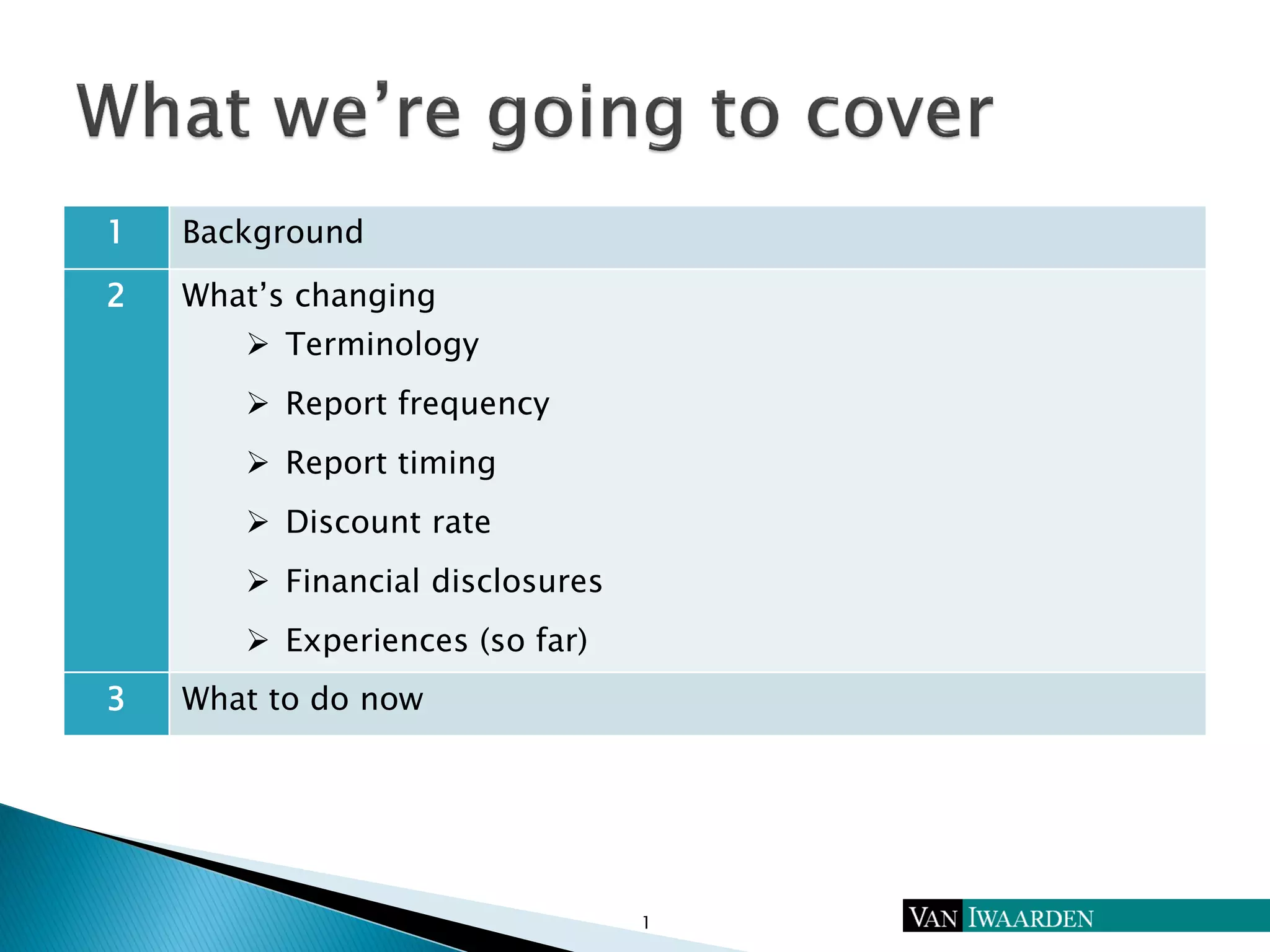
1 Background
2 What’s changing
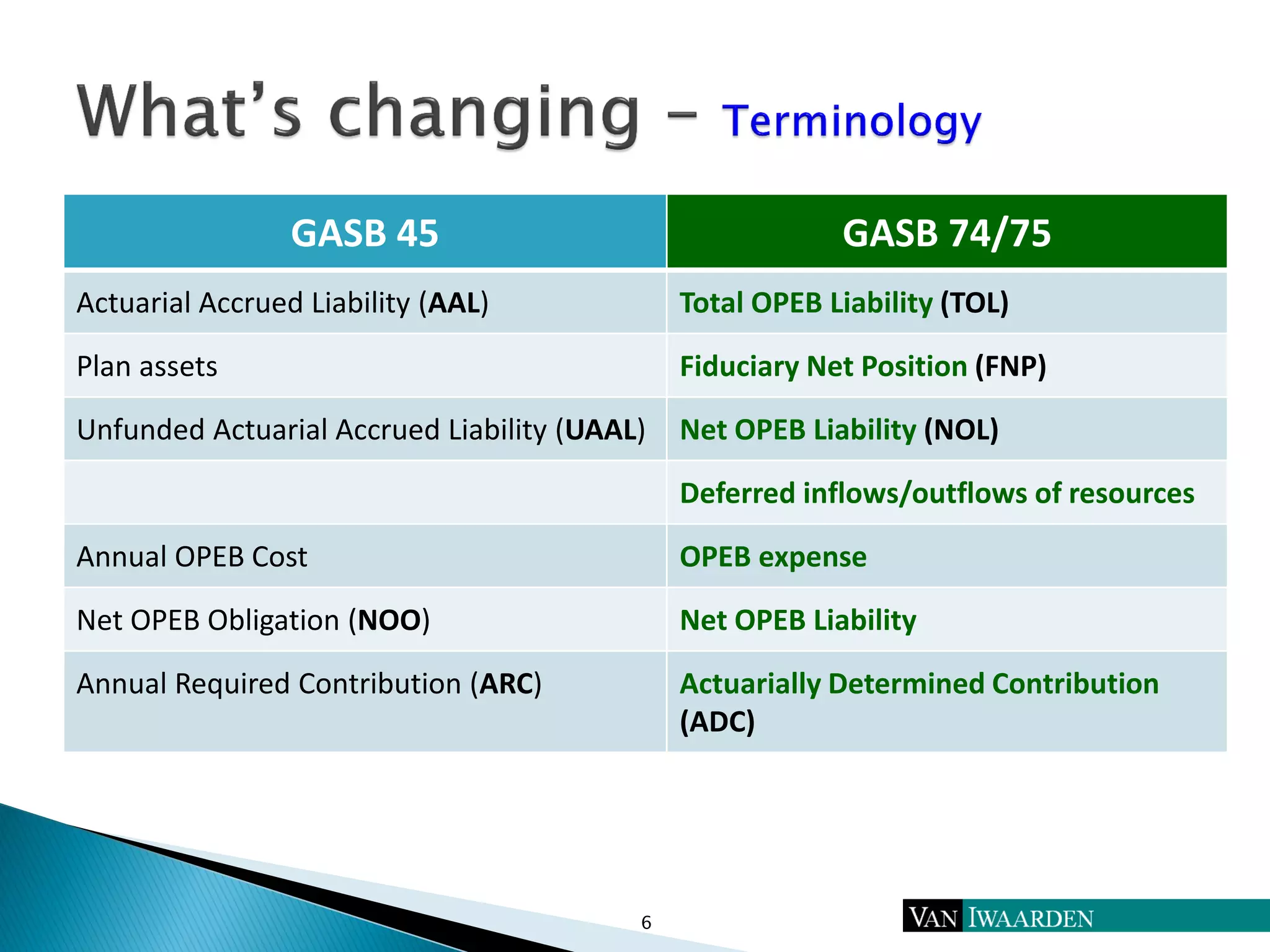
 Terminology
 Report frequency
 Report timing
 Discount rate
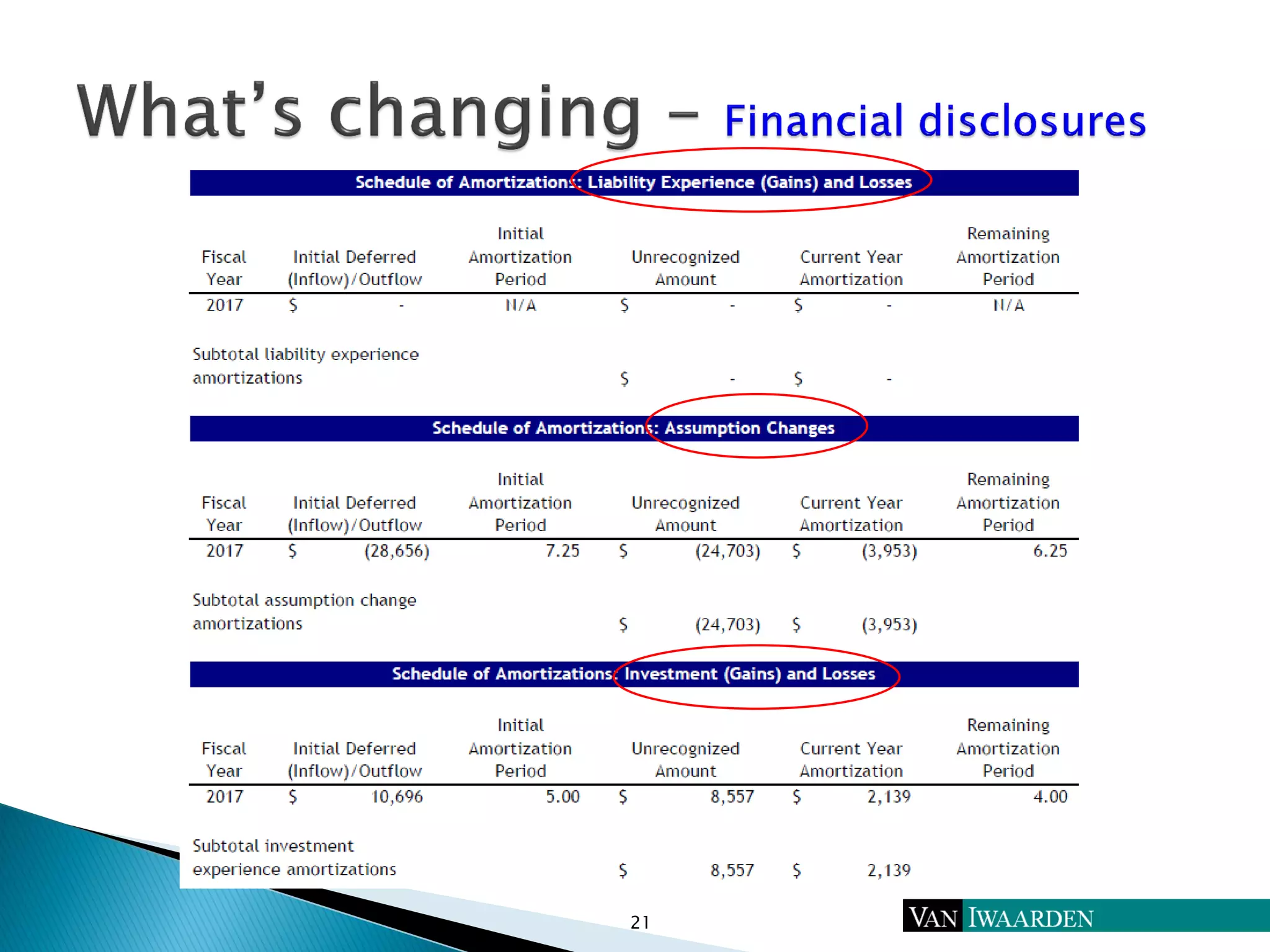
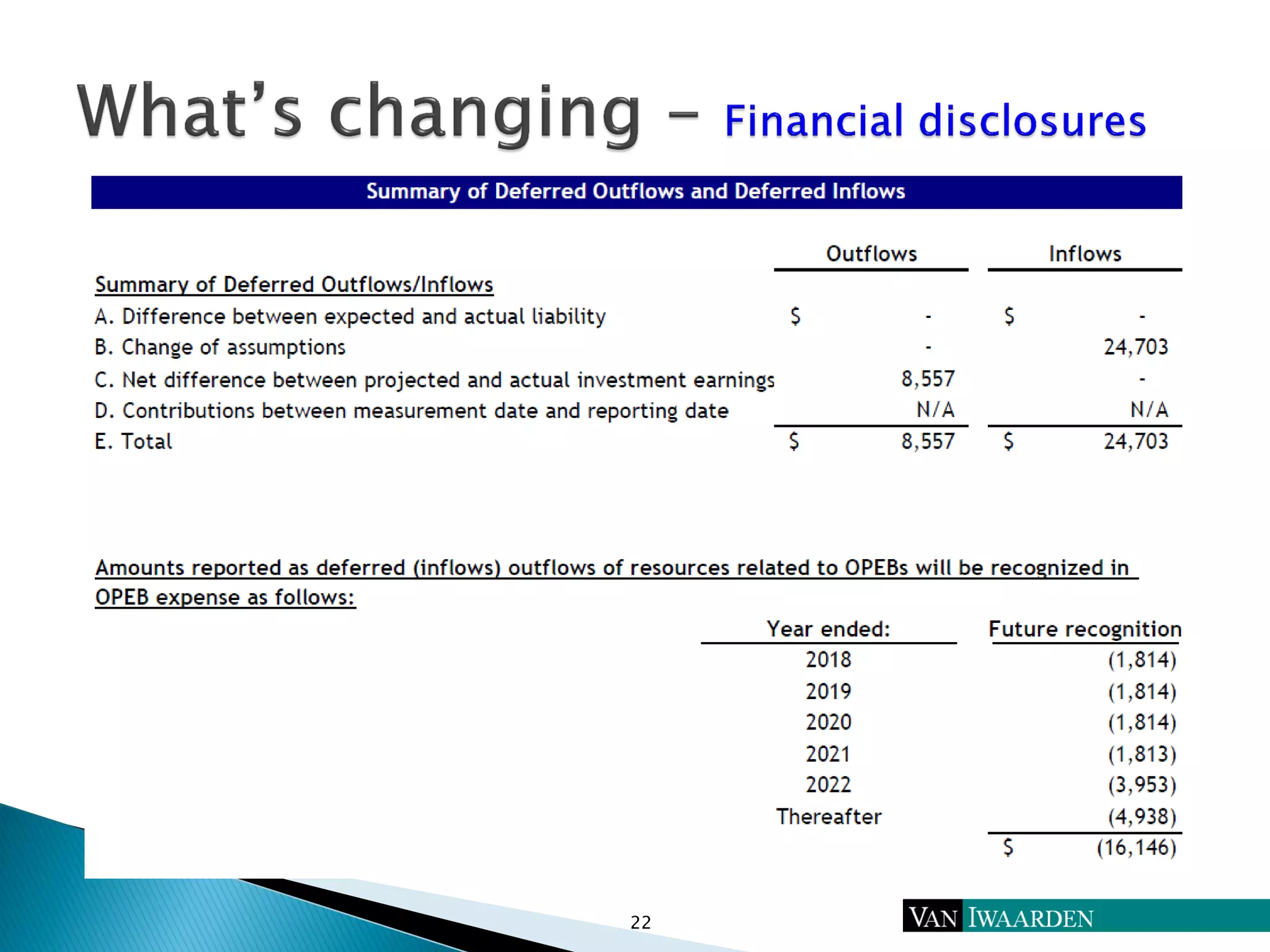
 Financial disclosures
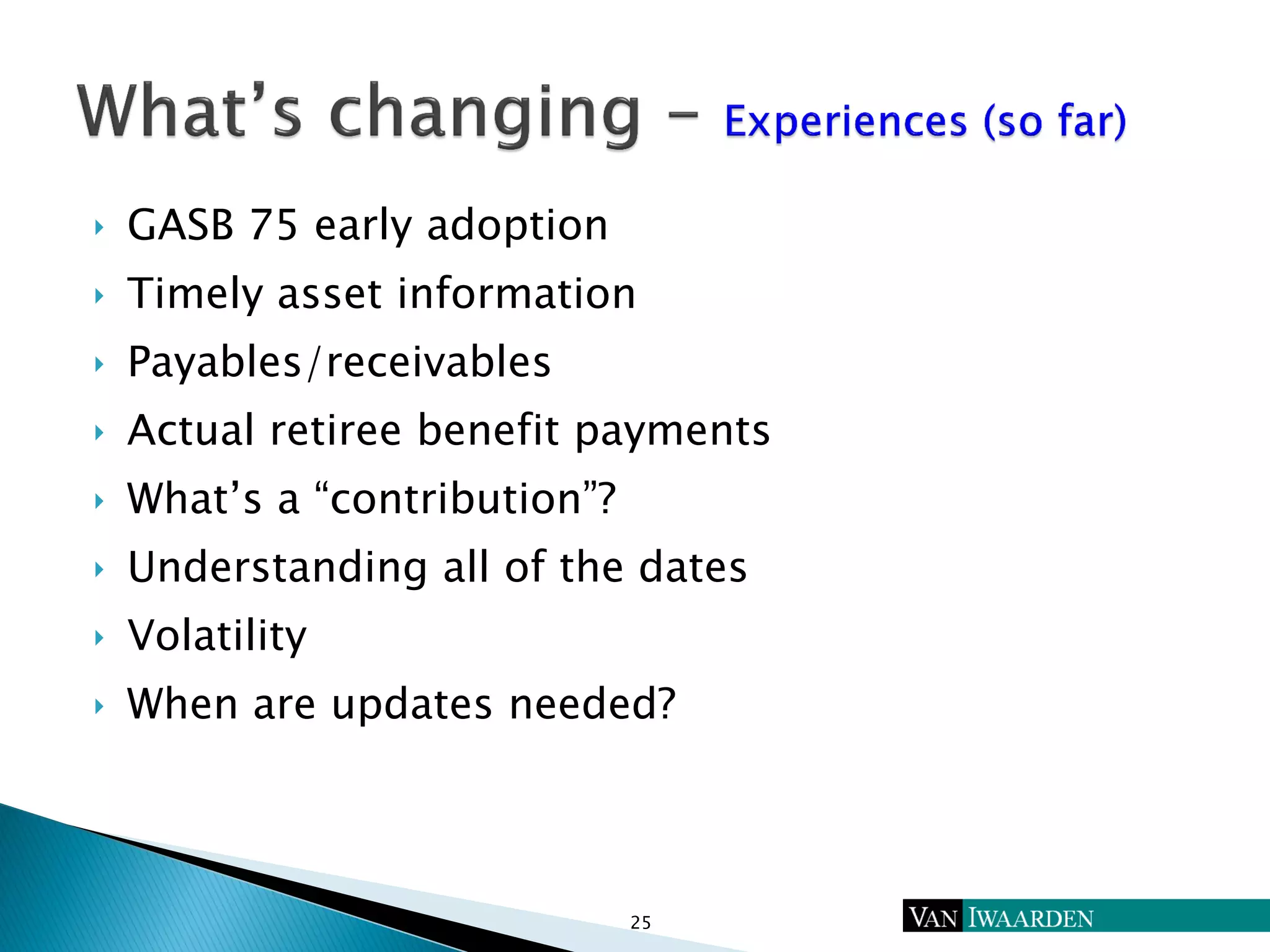
 Experiences (so far)
3 What to do now
1
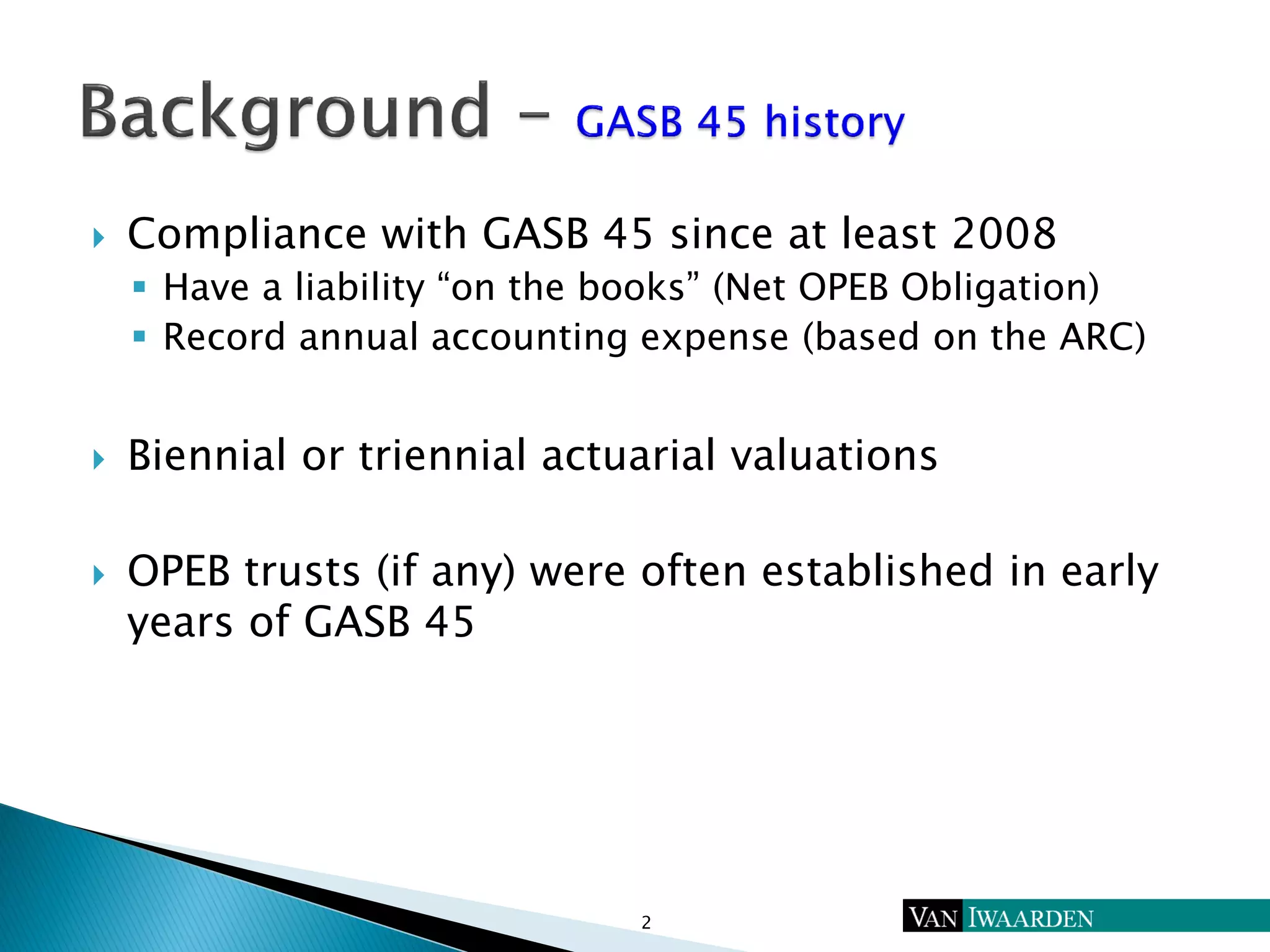
 Compliance with GASB 45 since at least 2008
 Have a liability “on the books” (Net OPEB Obligation)
 Record annual accounting expense (based on the ARC)
 Biennial or triennial actuarial valuations
 OPEB trusts (if any) were often established in early
years of GASB 45
2
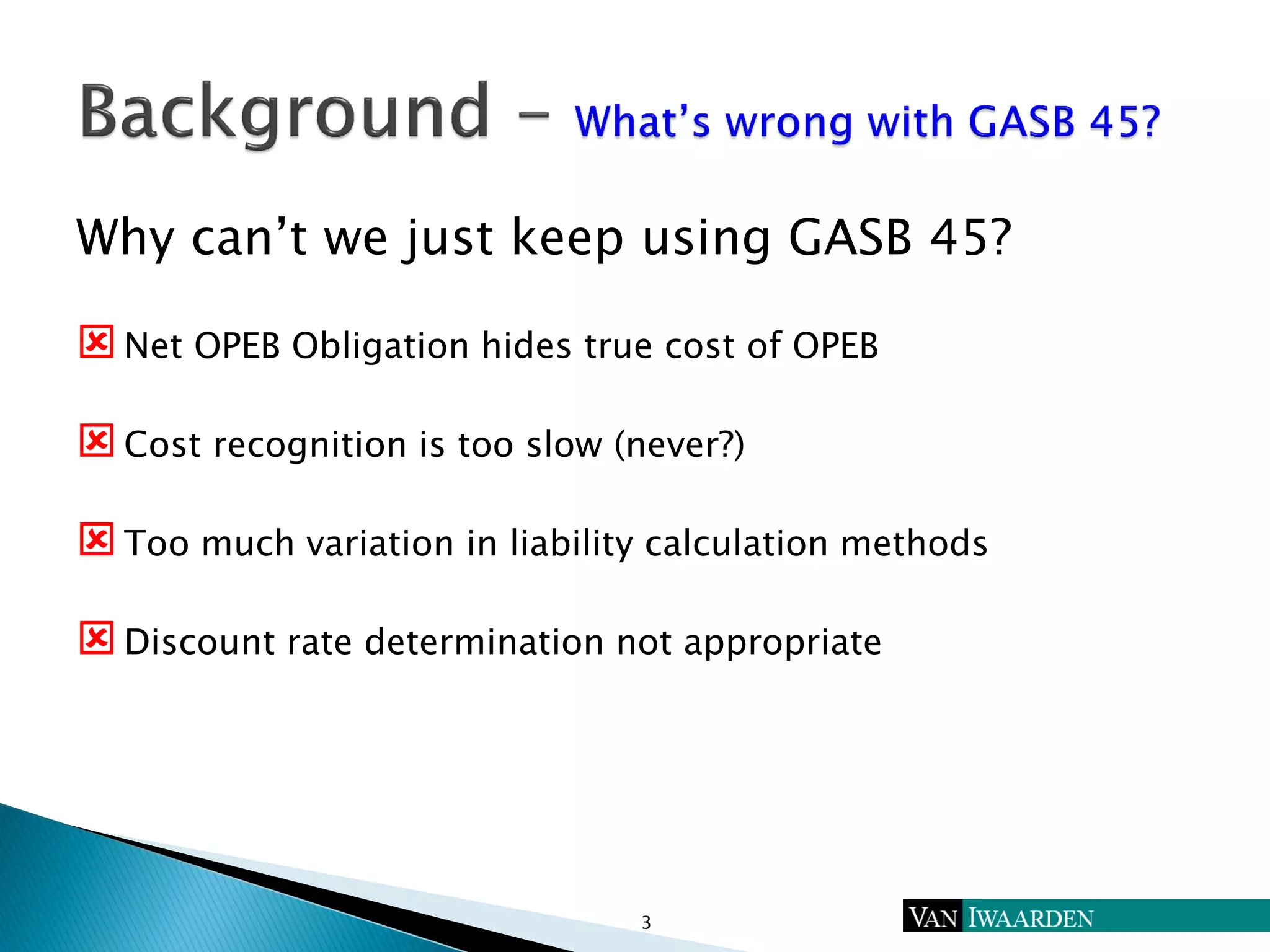
Why can’t we just keep using GASB 45?
Net OPEB Obligation hides true cost of OPEB
Cost recognition is too slow (never?)
Too much variation in liability calculation methods
Discount rate determination not appropriate
3
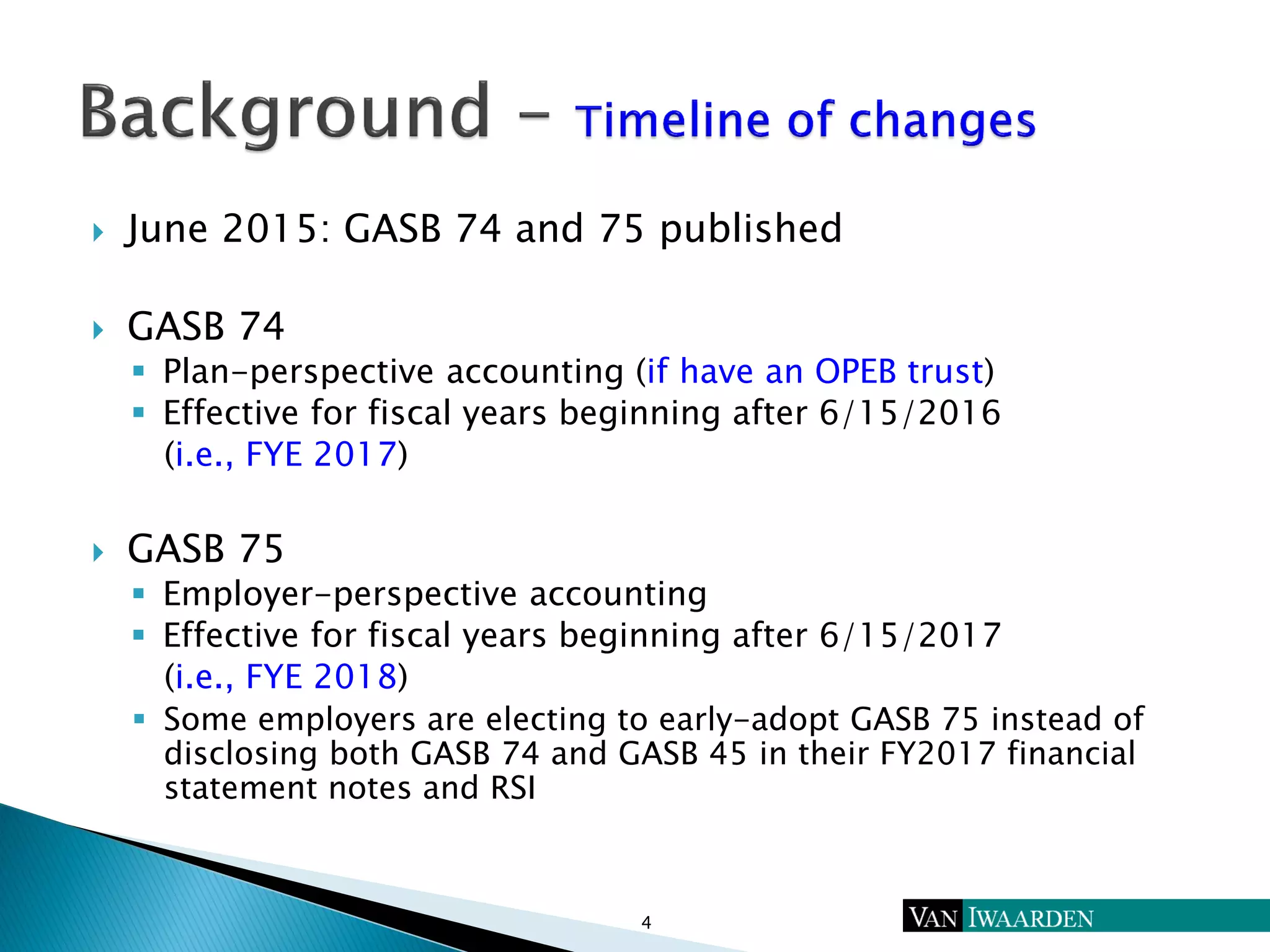
 June 2015: GASB 74 and 75 published
 GASB 74
 Plan-perspective accounting (if have an OPEB trust)
 Effective for fiscal years beginning after 6/15/2016
(i.e., FYE 2017)
 GASB 75
 Employer-perspective accounting
 Effective for fiscal years beginning after 6/15/2017
(i.e., FYE 2018)
 Some employers are electing to early-adopt GASB 75 instead of
disclosing both GASB 74 and GASB 45 in their FY2017 financial
statement notes and RSI
4
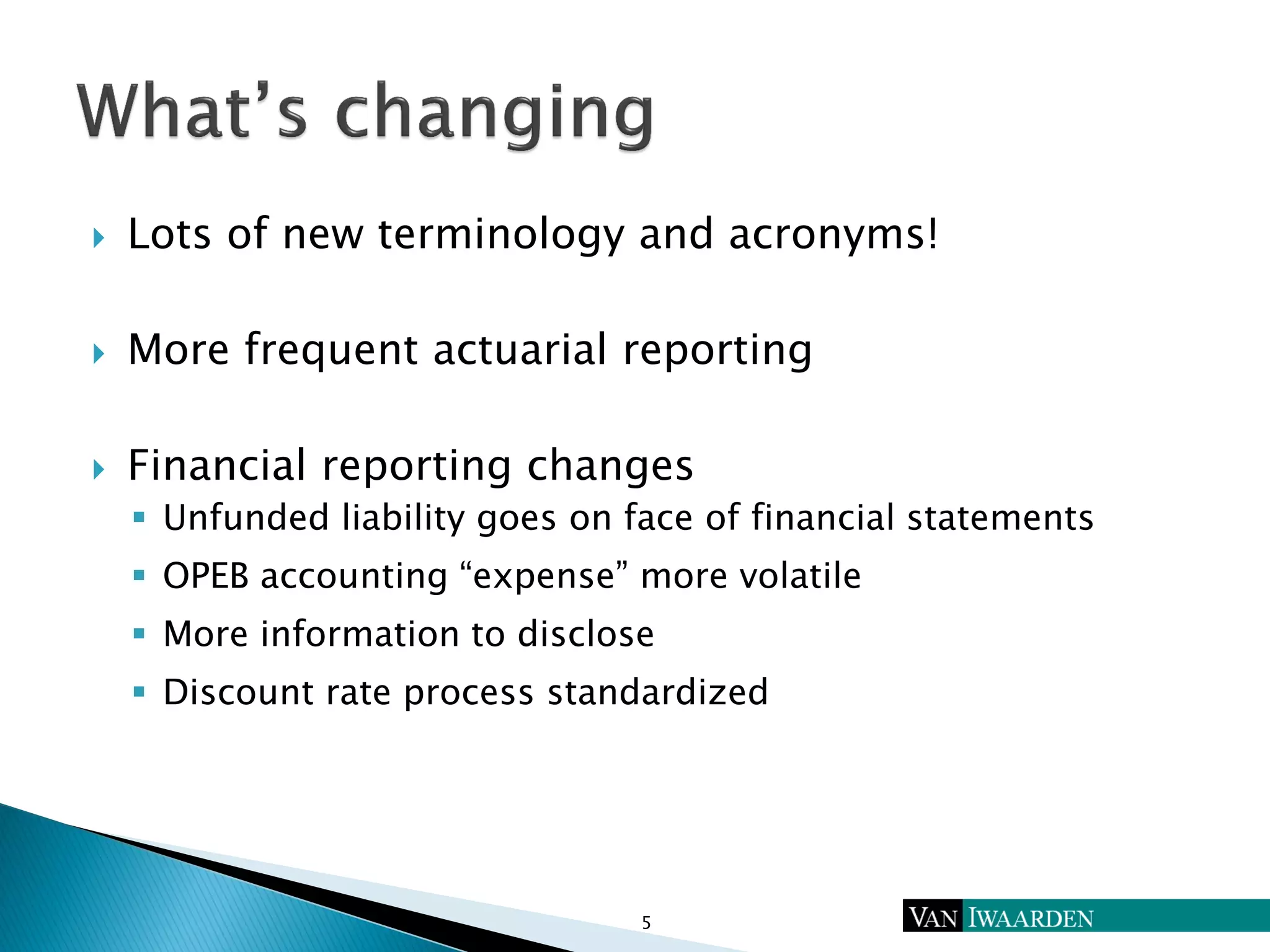
 Lots of new terminology and acronyms!
 More frequent actuarial reporting
 Financial reporting changes
 Unfunded liability goes on face of financial statements
 OPEB accounting “expense” more volatile
 More information to disclose
 Discount rate process standardized
5
6
GASB 45 GASB 74/75
Actuarial Accrued Liability (AAL) Total OPEB Liability (TOL)
Plan assets Fiduciary Net Position (FNP)
Unfunded Actuarial Accrued Liability (UAAL) Net OPEB Liability (NOL)
Deferred inflows/outflows of resources
Annual OPEB Cost OPEB expense
Net OPEB Obligation (NOO) Net OPEB Liability
Annual Required Contribution (ARC) Actuarially Determined Contribution
(ADC)
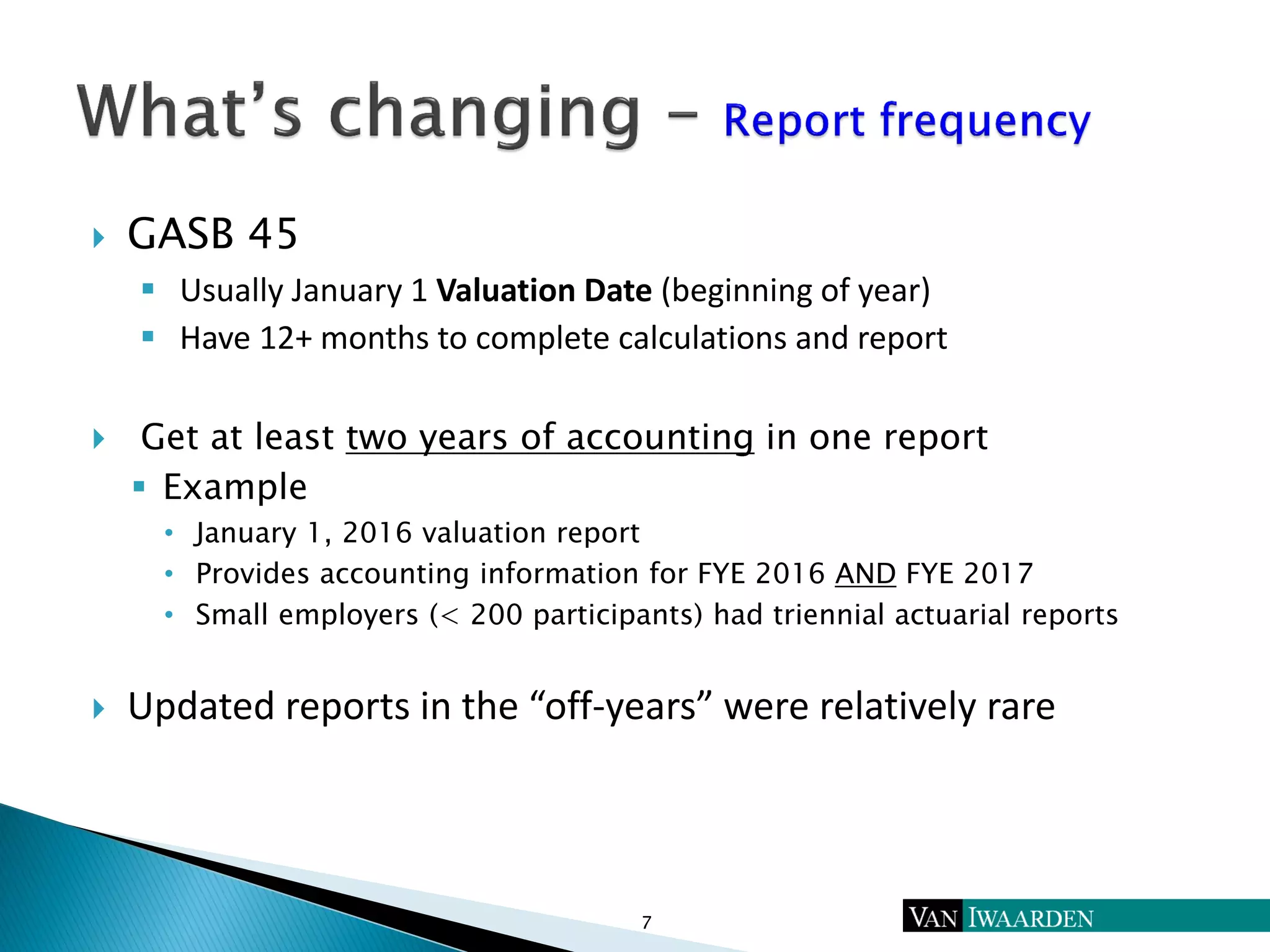
 GASB 45
 Usually January 1 Valuation Date (beginning of year)
 Have 12+ months to complete calculations and report
 Get at least two years of accounting in one report
 Example
• January 1, 2016 valuation report
• Provides accounting information for FYE 2016 AND FYE 2017
• Small employers (< 200 participants) had triennial actuarial reports
 Updated reports in the “off-years” were relatively rare
7
 GASB 74/75 require full actuarial reports every two
years for all employers
 “Update procedures” to reflect any changes since
the actuarial valuation date [GASB 74 Q&A #4.104]
 In most cases, employers will need an updated
“off-year” report to reflect certain changes
 Movement towards annual valuations because of
OPEB volatility
8
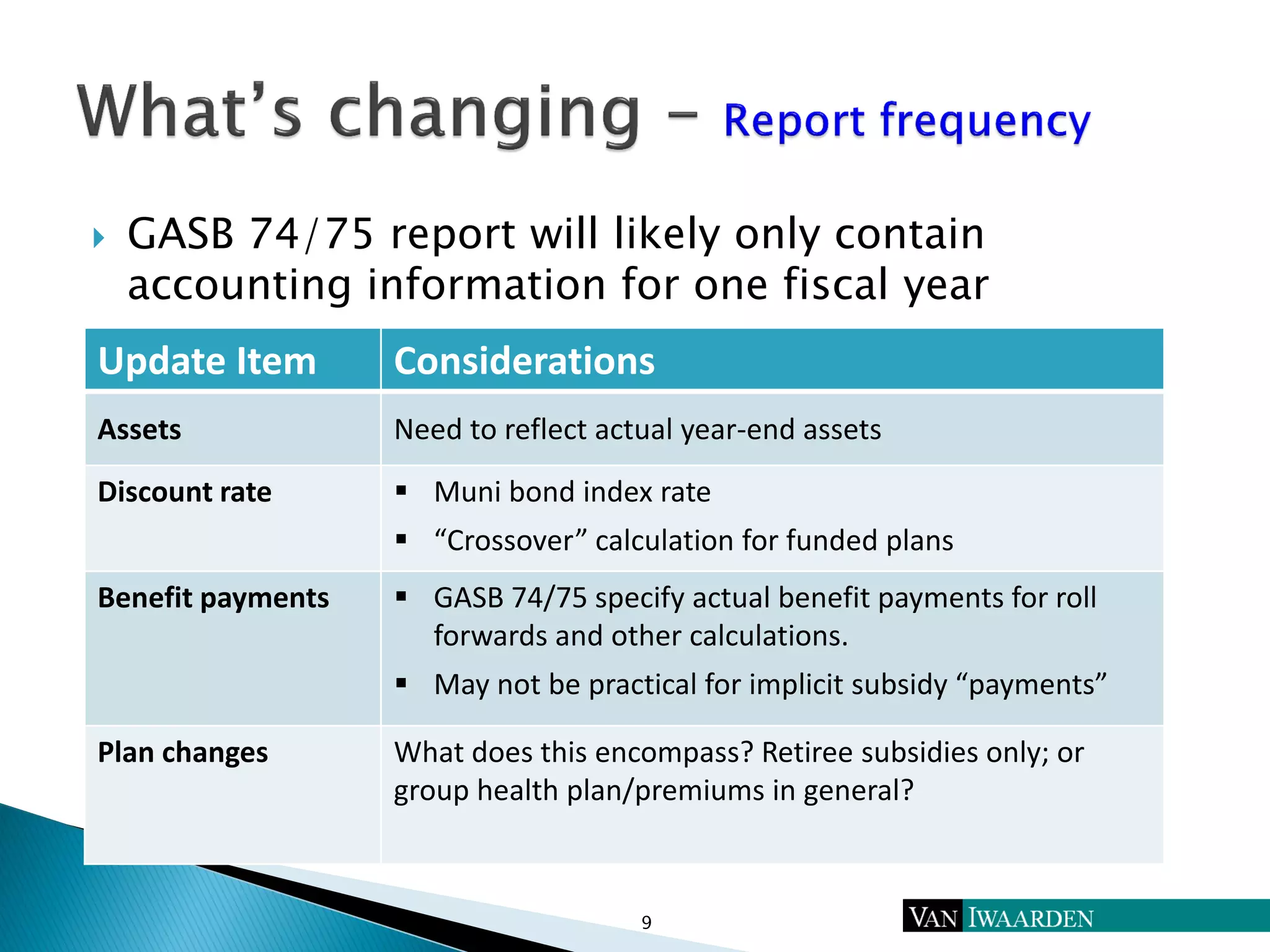
 GASB 74/75 report will likely only contain
accounting information for one fiscal year
9
Update Item Considerations
Assets Need to reflect actual year-end assets
Discount rate  Muni bond index rate
 “Crossover” calculation for funded plans
Benefit payments  GASB 74/75 specify actual benefit payments for roll
forwards and other calculations.
 May not be practical for implicit subsidy “payments”
Plan changes What does this encompass? Retiree subsidies only; or
group health plan/premiums in general?
10
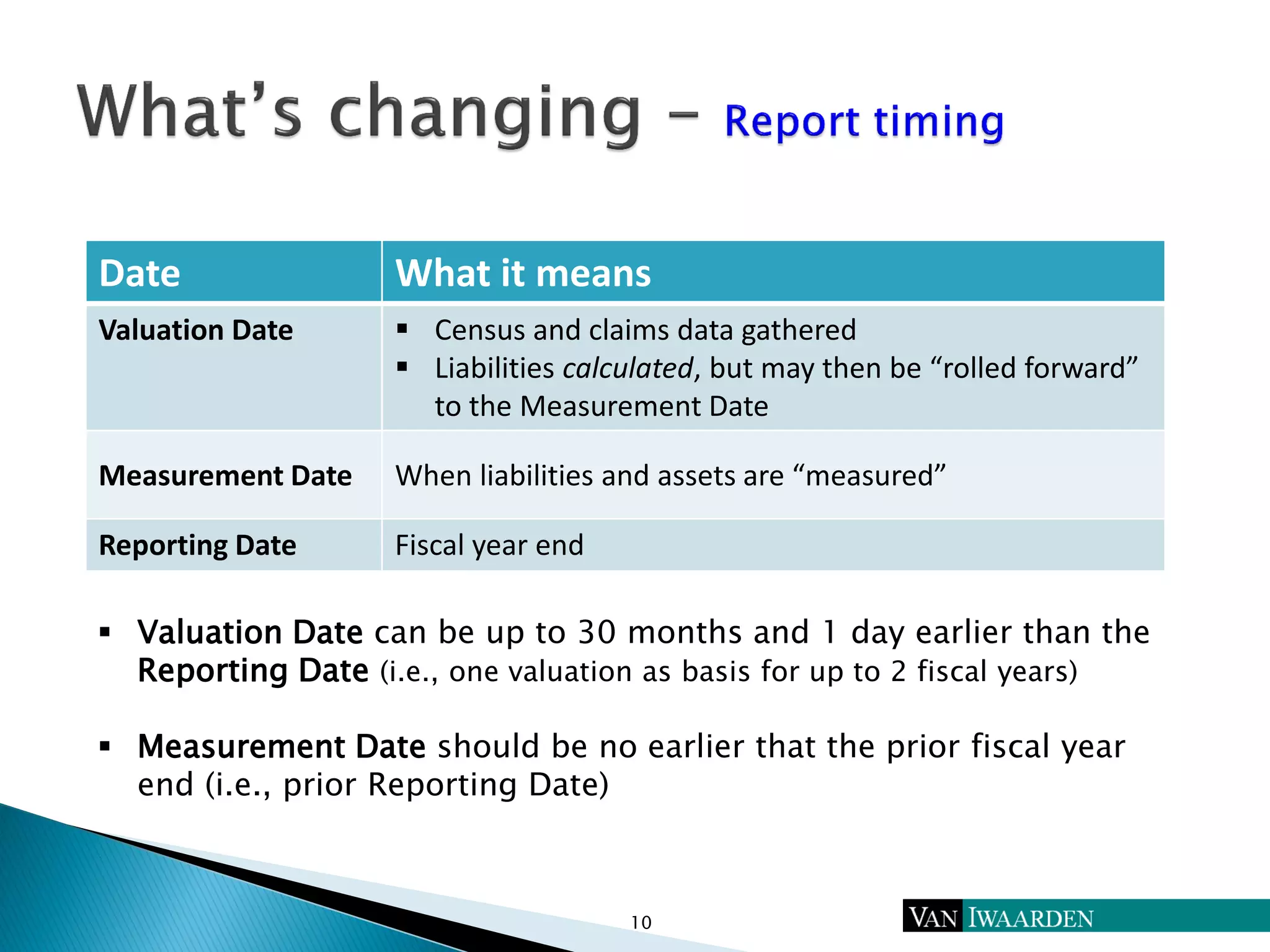
Date What it means
Valuation Date  Census and claims data gathered
 Liabilities calculated, but may then be “rolled forward”
to the Measurement Date
Measurement Date When liabilities and assets are “measured”
Reporting Date Fiscal year end
 Valuation Date can be up to 30 months and 1 day earlier than the
Reporting Date (i.e., one valuation as basis for up to 2 fiscal years)
 Measurement Date should be no earlier that the prior fiscal year
end (i.e., prior Reporting Date)
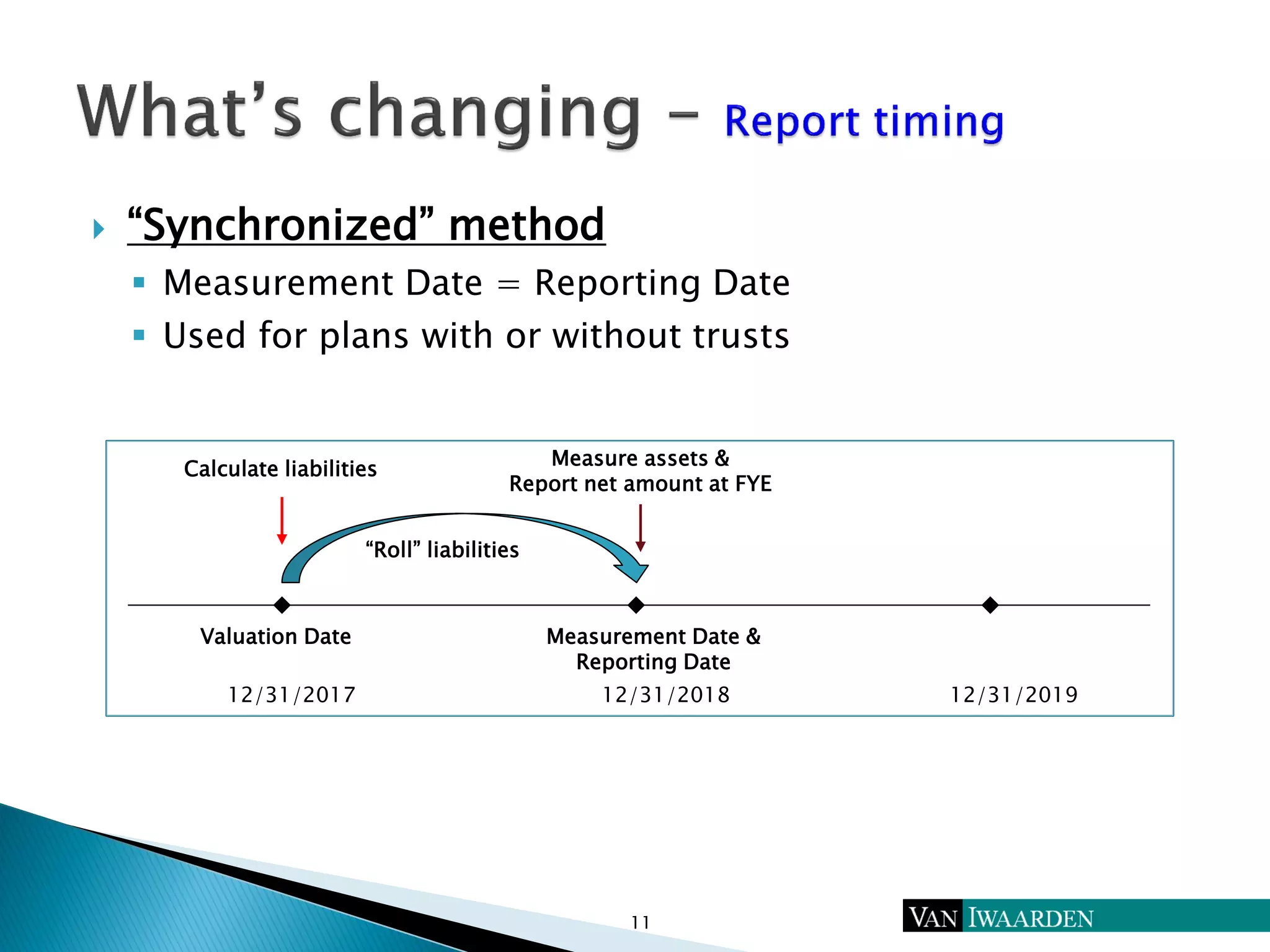
 “Synchronized” method
 Measurement Date = Reporting Date
 Used for plans with or without trusts
11
12/31/2017 12/31/2018 12/31/2019
Valuation Date Measurement Date &
Reporting Date
“Roll” liabilities
Measure assets &
Report net amount at FYE
Calculate liabilities
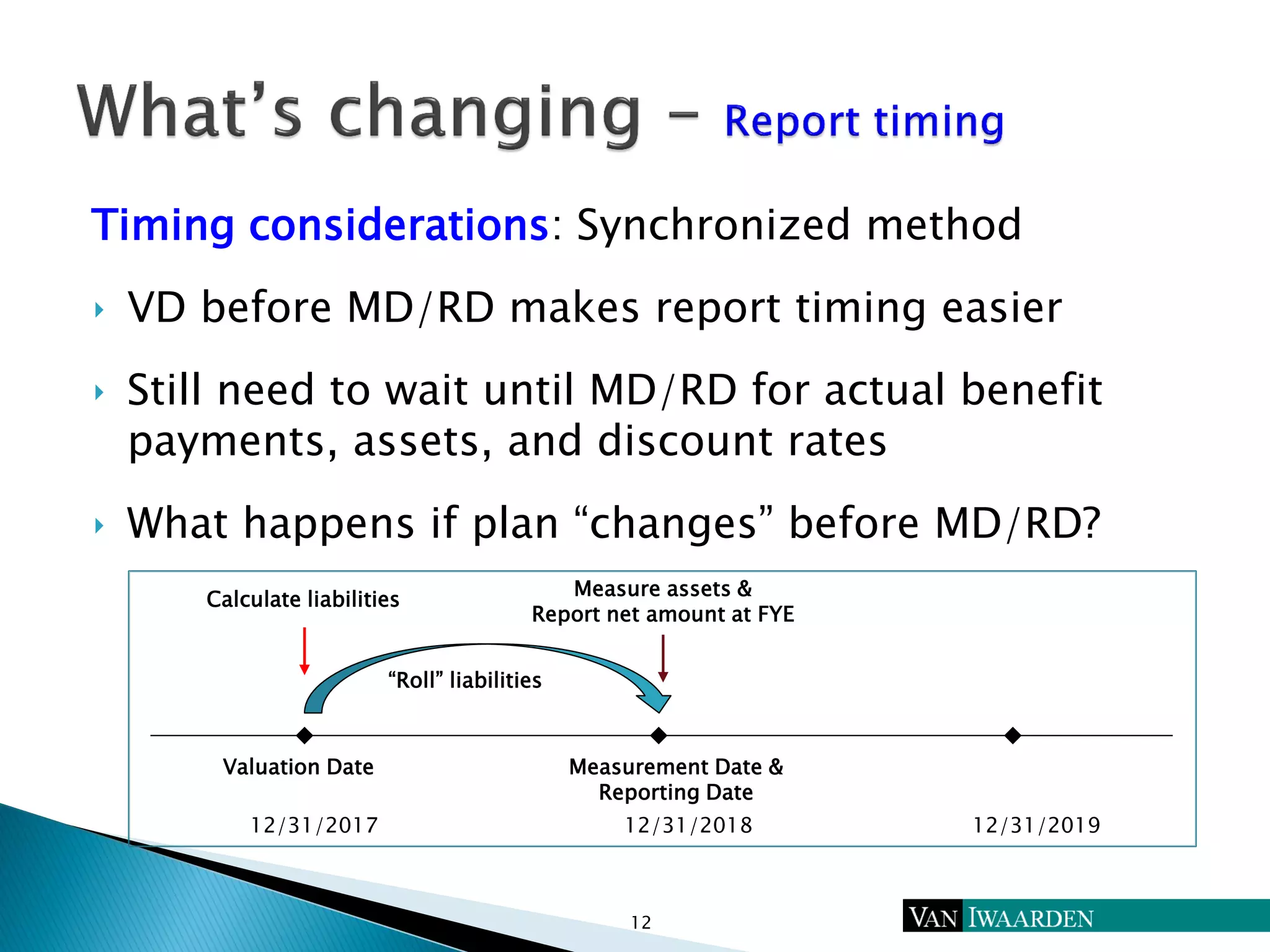
Timing considerations: Synchronized method
‣ VD before MD/RD makes report timing easier
‣ Still need to wait until MD/RD for actual benefit
payments, assets, and discount rates
‣ What happens if plan “changes” before MD/RD?
12
12/31/2017 12/31/2018 12/31/2019
Valuation Date Measurement Date &
Reporting Date
“Roll” liabilities
Measure assets &
Report net amount at FYE
Calculate liabilities
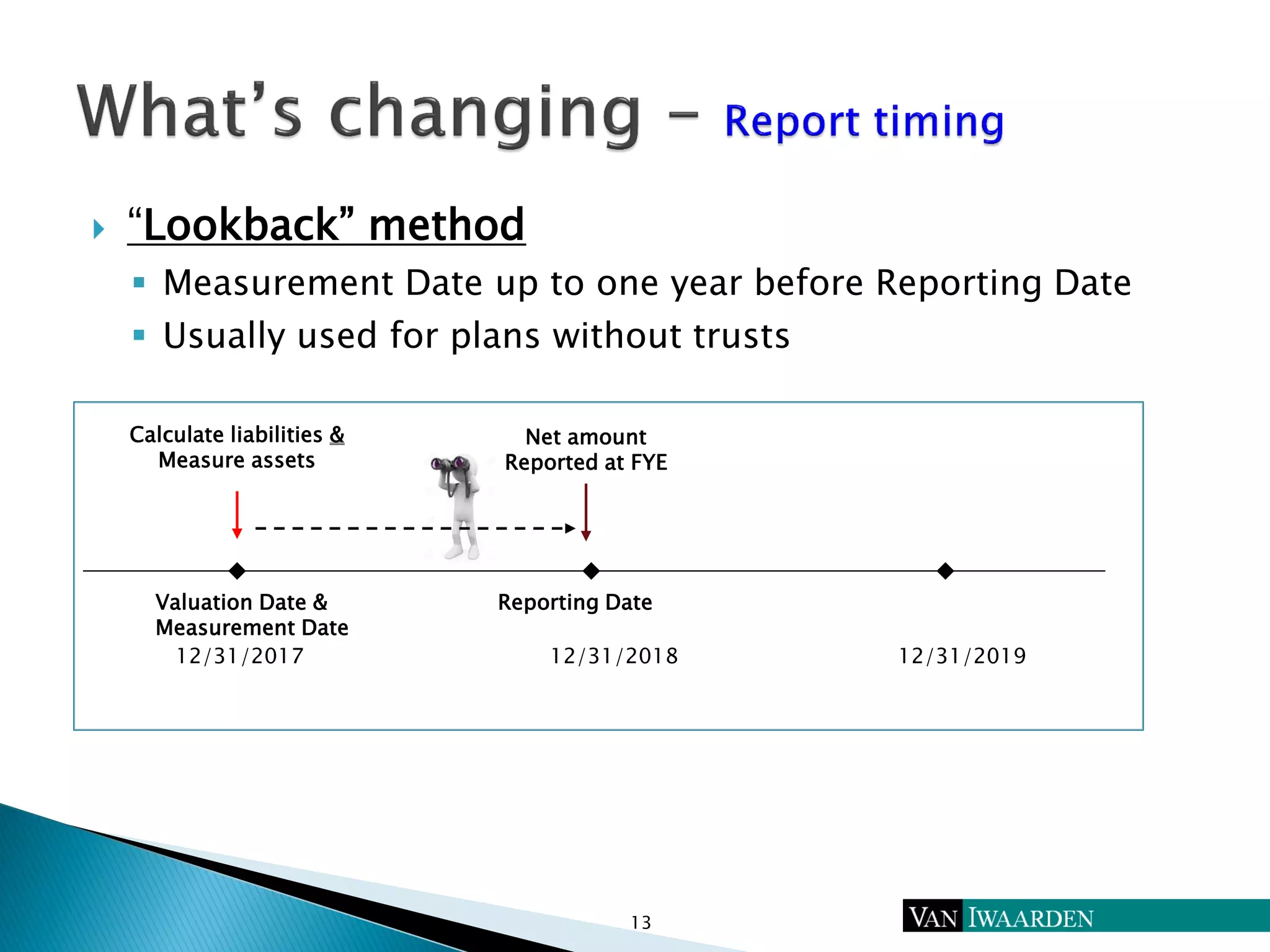
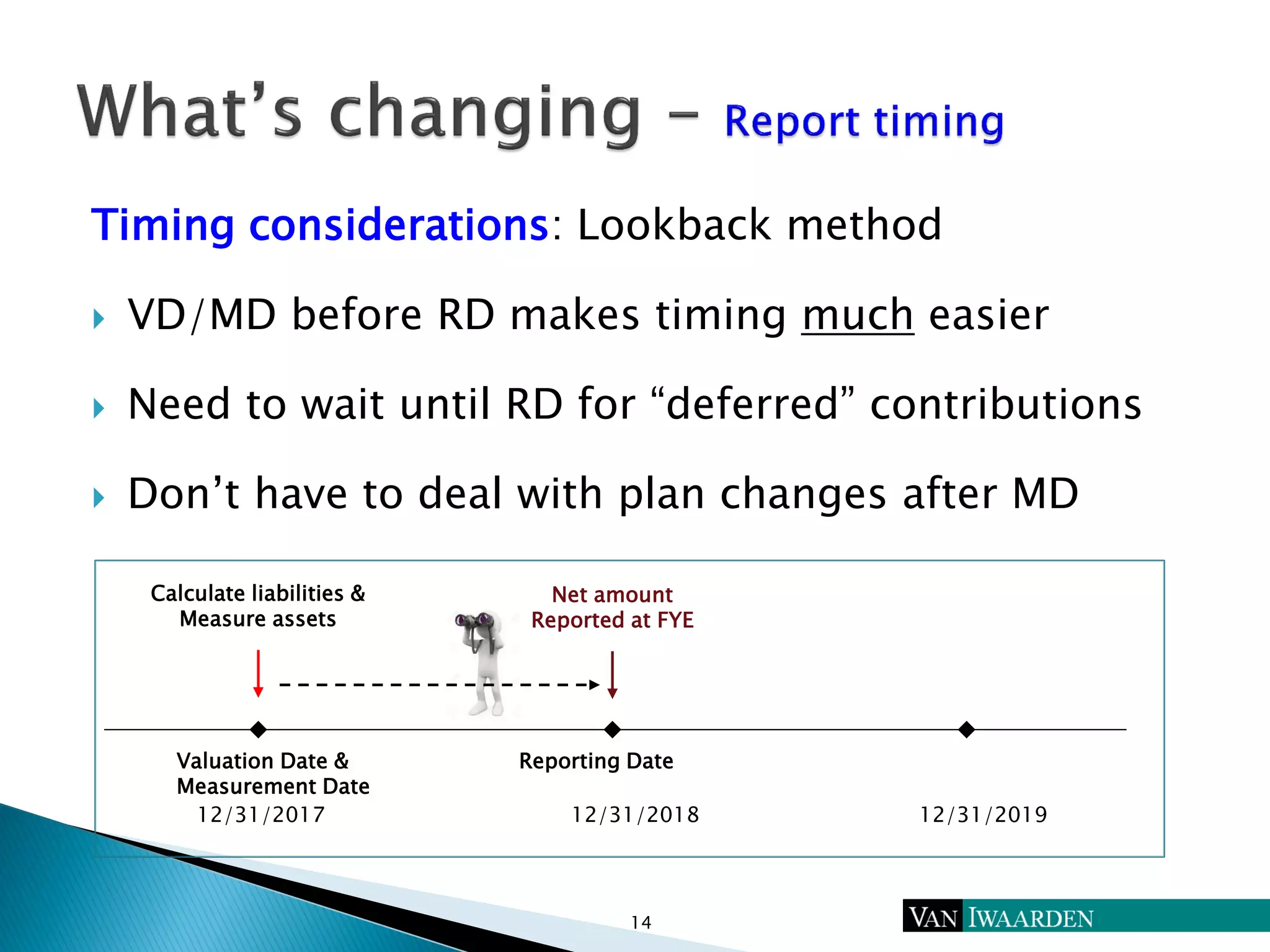
 “Lookback” method
 Measurement Date up to one year before Reporting Date
 Usually used for plans without trusts
13
Valuation Date &
Measurement Date
Reporting Date
Calculate liabilities &
Measure assets
12/31/2017 12/31/2018 12/31/2019
Net amount
Reported at FYE
Timing considerations: Lookback method
 VD/MD before RD makes timing much easier
 Need to wait until RD for “deferred” contributions
 Don’t have to deal with plan changes after MD
14
Valuation Date &
Measurement Date
Reporting Date
Net amount
Reported at FYE
Calculate liabilities &
Measure assets
12/31/2017 12/31/2018 12/31/2019
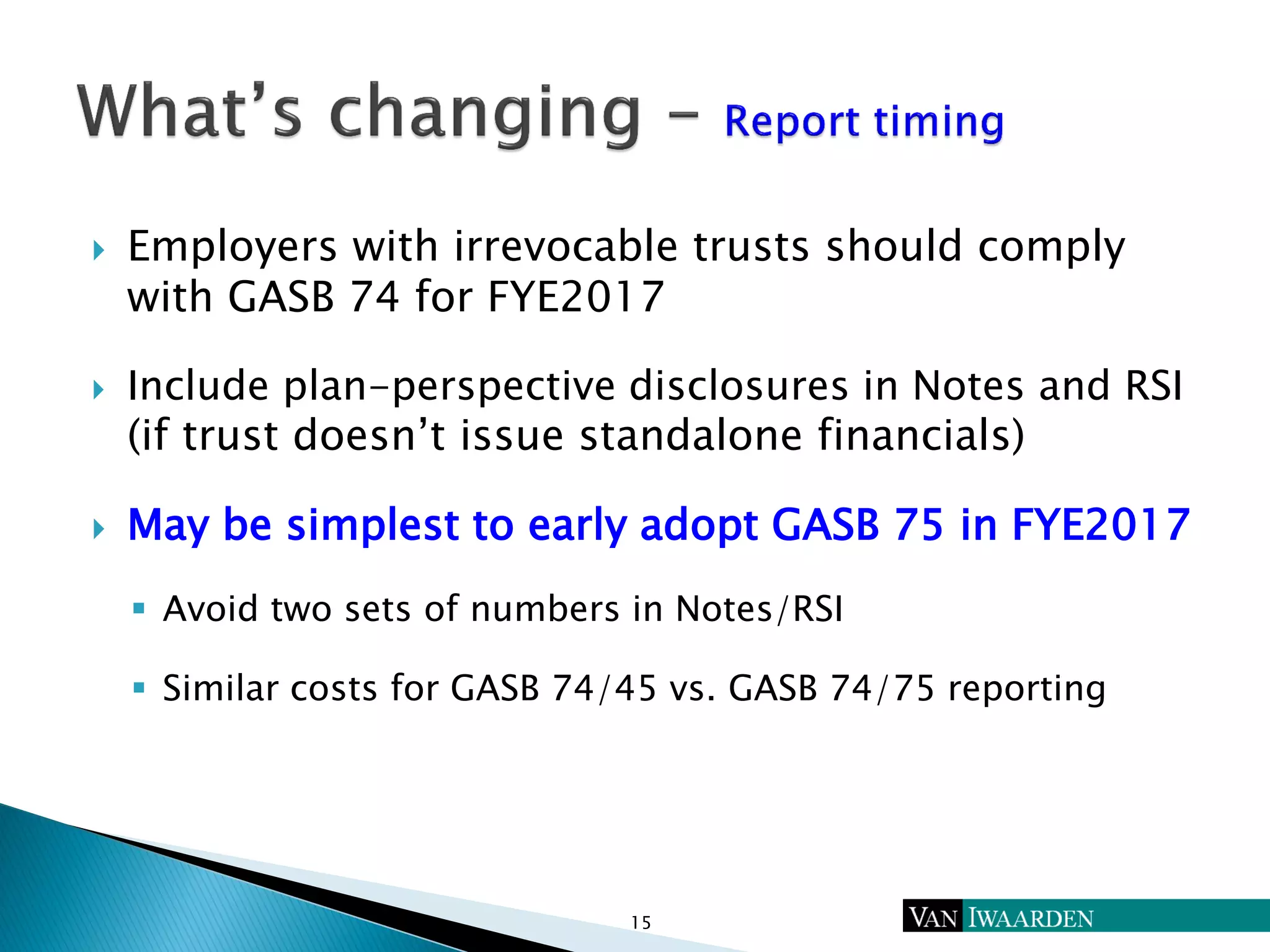
 Employers with irrevocable trusts should comply
with GASB 74 for FYE2017
 Include plan-perspective disclosures in Notes and RSI
(if trust doesn’t issue standalone financials)
 May be simplest to early adopt GASB 75 in FYE2017
 Avoid two sets of numbers in Notes/RSI
 Similar costs for GASB 74/45 vs. GASB 74/75 reporting
15
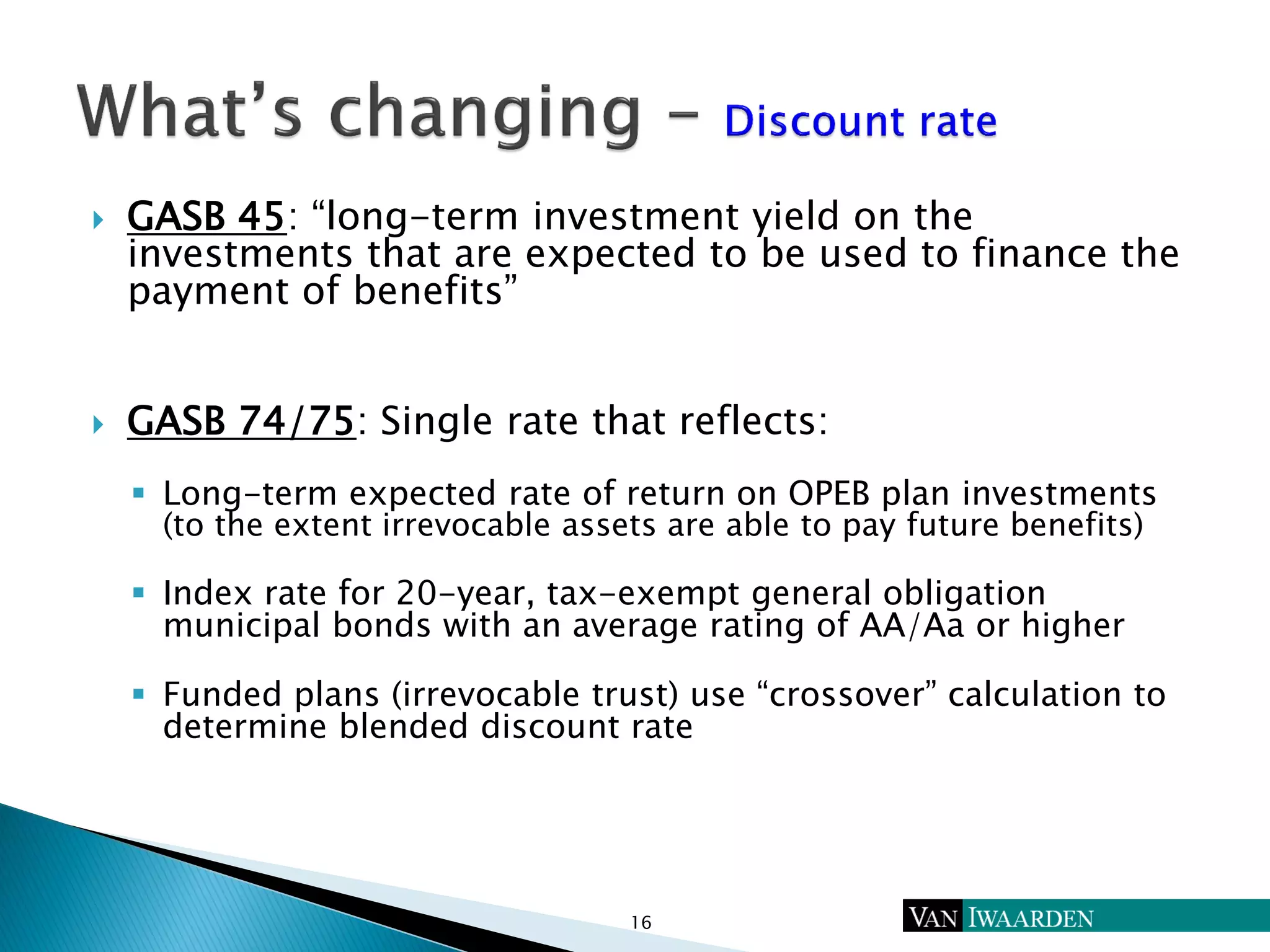
 GASB 45: “long-term investment yield on the
investments that are expected to be used to finance the
payment of benefits”
 GASB 74/75: Single rate that reflects:
 Long-term expected rate of return on OPEB plan investments
(to the extent irrevocable assets are able to pay future benefits)
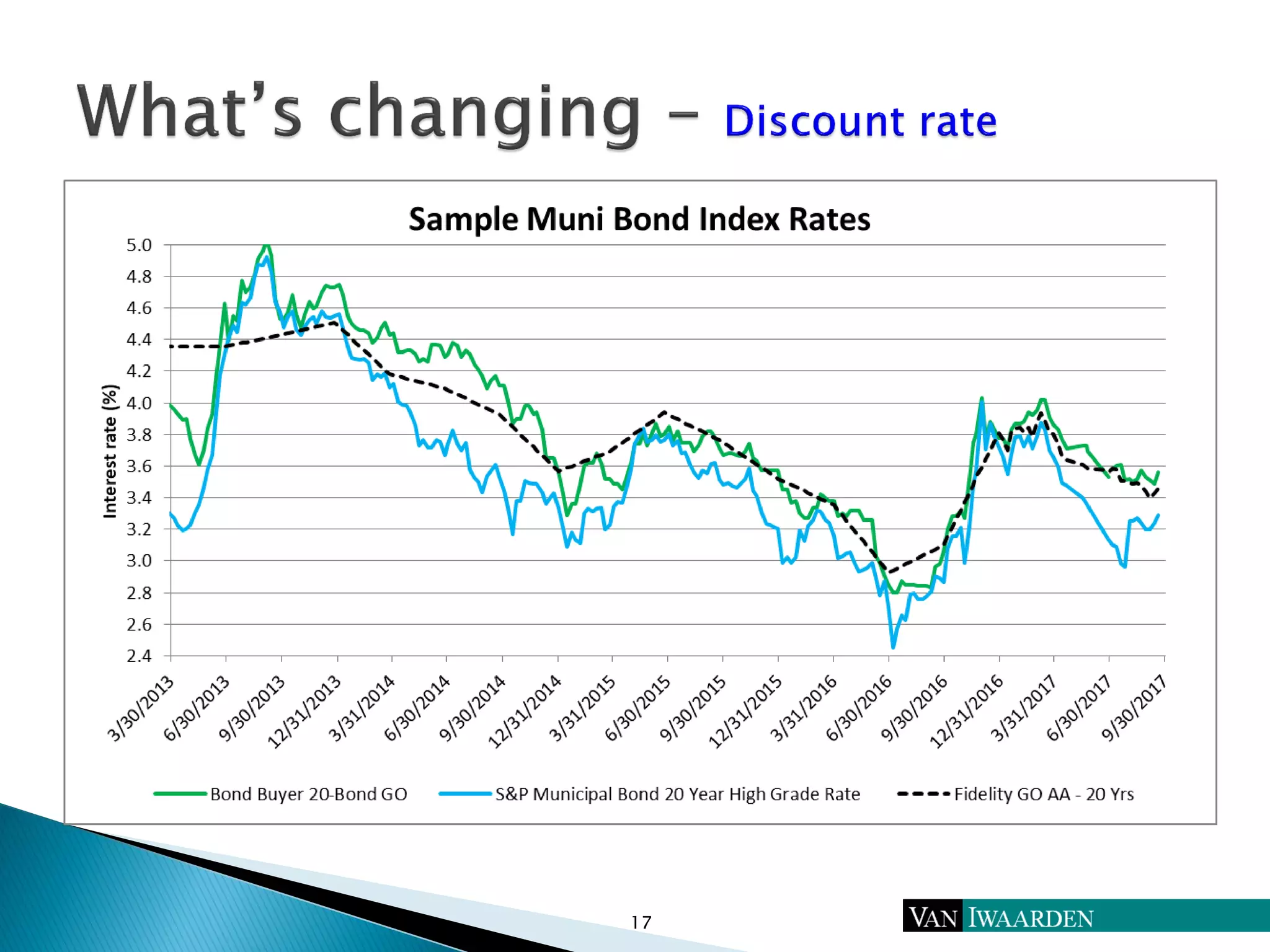
 Index rate for 20-year, tax-exempt general obligation
municipal bonds with an average rating of AA/Aa or higher
 Funded plans (irrevocable trust) use “crossover” calculation to
determine blended discount rate
16
17
18
19
20
21
22
23
24
‣ GASB 75 early adoption
‣ Timely asset information
‣ Payables/receivables
‣ Actual retiree benefit payments
‣ What’s a “contribution”?
‣ Understanding all of the dates
‣ Volatility
‣ When are updates needed?
25
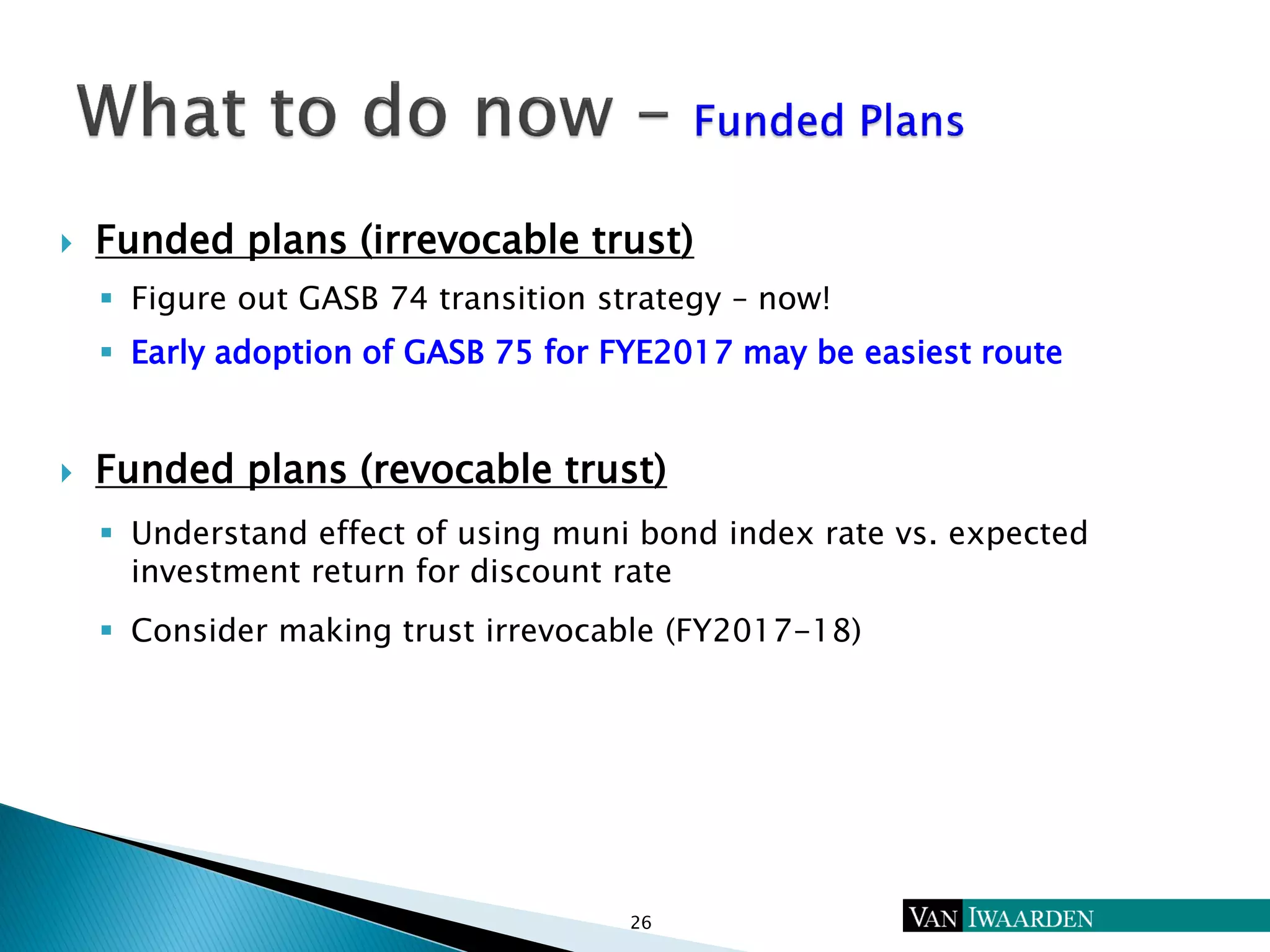
 Funded plans (irrevocable trust)
 Figure out GASB 74 transition strategy – now!
 Early adoption of GASB 75 for FYE2017 may be easiest route
 Funded plans (revocable trust)
 Understand effect of using muni bond index rate vs. expected
investment return for discount rate
 Consider making trust irrevocable (FY2017-18)
26
 All plans
 Figure out report timing and implementation options
 Synchronized vs. Lookback: Is it a big deal if liabilities are a year old?
 Better tracking of retiree benefit payments
 Worthwhile/feasible to pre-fund OPEB?
27
28
Mark Schulte, FSA, EA, MAAA
Van Iwaarden Associates
612.596.5960
marks@vaniwaarden.com
All information in this presentation is for general informational purposes only and should
not be relied upon without the express written consent of the author.
29

GASB 74/75 - Preparing for the New World of OPEB Accounting

  • 1.
    MNCPA Audits ofLocal Governments Conference Mark Schulte, FSA, EA, MAAA October 24, 2017
  • 2.
    1 Background 2 What’schanging  Terminology  Report frequency  Report timing  Discount rate  Financial disclosures  Experiences (so far) 3 What to do now 1
  • 3.
     Compliance withGASB 45 since at least 2008  Have a liability “on the books” (Net OPEB Obligation)  Record annual accounting expense (based on the ARC)  Biennial or triennial actuarial valuations  OPEB trusts (if any) were often established in early years of GASB 45 2
  • 4.
    Why can’t wejust keep using GASB 45? Net OPEB Obligation hides true cost of OPEB Cost recognition is too slow (never?) Too much variation in liability calculation methods Discount rate determination not appropriate 3
  • 5.
     June 2015:GASB 74 and 75 published  GASB 74  Plan-perspective accounting (if have an OPEB trust)  Effective for fiscal years beginning after 6/15/2016 (i.e., FYE 2017)  GASB 75  Employer-perspective accounting  Effective for fiscal years beginning after 6/15/2017 (i.e., FYE 2018)  Some employers are electing to early-adopt GASB 75 instead of disclosing both GASB 74 and GASB 45 in their FY2017 financial statement notes and RSI 4
  • 6.
     Lots ofnew terminology and acronyms!  More frequent actuarial reporting  Financial reporting changes  Unfunded liability goes on face of financial statements  OPEB accounting “expense” more volatile  More information to disclose  Discount rate process standardized 5
  • 7.
    6 GASB 45 GASB74/75 Actuarial Accrued Liability (AAL) Total OPEB Liability (TOL) Plan assets Fiduciary Net Position (FNP) Unfunded Actuarial Accrued Liability (UAAL) Net OPEB Liability (NOL) Deferred inflows/outflows of resources Annual OPEB Cost OPEB expense Net OPEB Obligation (NOO) Net OPEB Liability Annual Required Contribution (ARC) Actuarially Determined Contribution (ADC)
  • 8.
     GASB 45 Usually January 1 Valuation Date (beginning of year)  Have 12+ months to complete calculations and report  Get at least two years of accounting in one report  Example • January 1, 2016 valuation report • Provides accounting information for FYE 2016 AND FYE 2017 • Small employers (< 200 participants) had triennial actuarial reports  Updated reports in the “off-years” were relatively rare 7
  • 9.
     GASB 74/75require full actuarial reports every two years for all employers  “Update procedures” to reflect any changes since the actuarial valuation date [GASB 74 Q&A #4.104]  In most cases, employers will need an updated “off-year” report to reflect certain changes  Movement towards annual valuations because of OPEB volatility 8
  • 10.
     GASB 74/75report will likely only contain accounting information for one fiscal year 9 Update Item Considerations Assets Need to reflect actual year-end assets Discount rate  Muni bond index rate  “Crossover” calculation for funded plans Benefit payments  GASB 74/75 specify actual benefit payments for roll forwards and other calculations.  May not be practical for implicit subsidy “payments” Plan changes What does this encompass? Retiree subsidies only; or group health plan/premiums in general?
  • 11.
    10 Date What itmeans Valuation Date  Census and claims data gathered  Liabilities calculated, but may then be “rolled forward” to the Measurement Date Measurement Date When liabilities and assets are “measured” Reporting Date Fiscal year end  Valuation Date can be up to 30 months and 1 day earlier than the Reporting Date (i.e., one valuation as basis for up to 2 fiscal years)  Measurement Date should be no earlier that the prior fiscal year end (i.e., prior Reporting Date)
  • 12.
     “Synchronized” method Measurement Date = Reporting Date  Used for plans with or without trusts 11 12/31/2017 12/31/2018 12/31/2019 Valuation Date Measurement Date & Reporting Date “Roll” liabilities Measure assets & Report net amount at FYE Calculate liabilities
  • 13.
    Timing considerations: Synchronizedmethod ‣ VD before MD/RD makes report timing easier ‣ Still need to wait until MD/RD for actual benefit payments, assets, and discount rates ‣ What happens if plan “changes” before MD/RD? 12 12/31/2017 12/31/2018 12/31/2019 Valuation Date Measurement Date & Reporting Date “Roll” liabilities Measure assets & Report net amount at FYE Calculate liabilities
  • 14.
     “Lookback” method Measurement Date up to one year before Reporting Date  Usually used for plans without trusts 13 Valuation Date & Measurement Date Reporting Date Calculate liabilities & Measure assets 12/31/2017 12/31/2018 12/31/2019 Net amount Reported at FYE
  • 15.
    Timing considerations: Lookbackmethod  VD/MD before RD makes timing much easier  Need to wait until RD for “deferred” contributions  Don’t have to deal with plan changes after MD 14 Valuation Date & Measurement Date Reporting Date Net amount Reported at FYE Calculate liabilities & Measure assets 12/31/2017 12/31/2018 12/31/2019
  • 16.
     Employers withirrevocable trusts should comply with GASB 74 for FYE2017  Include plan-perspective disclosures in Notes and RSI (if trust doesn’t issue standalone financials)  May be simplest to early adopt GASB 75 in FYE2017  Avoid two sets of numbers in Notes/RSI  Similar costs for GASB 74/45 vs. GASB 74/75 reporting 15
  • 17.
     GASB 45:“long-term investment yield on the investments that are expected to be used to finance the payment of benefits”  GASB 74/75: Single rate that reflects:  Long-term expected rate of return on OPEB plan investments (to the extent irrevocable assets are able to pay future benefits)  Index rate for 20-year, tax-exempt general obligation municipal bonds with an average rating of AA/Aa or higher  Funded plans (irrevocable trust) use “crossover” calculation to determine blended discount rate 16
  • 18.
  • 19.
  • 20.
  • 21.
  • 22.
  • 23.
  • 24.
  • 25.
  • 26.
    ‣ GASB 75early adoption ‣ Timely asset information ‣ Payables/receivables ‣ Actual retiree benefit payments ‣ What’s a “contribution”? ‣ Understanding all of the dates ‣ Volatility ‣ When are updates needed? 25
  • 27.
     Funded plans(irrevocable trust)  Figure out GASB 74 transition strategy – now!  Early adoption of GASB 75 for FYE2017 may be easiest route  Funded plans (revocable trust)  Understand effect of using muni bond index rate vs. expected investment return for discount rate  Consider making trust irrevocable (FY2017-18) 26
  • 28.
     All plans Figure out report timing and implementation options  Synchronized vs. Lookback: Is it a big deal if liabilities are a year old?  Better tracking of retiree benefit payments  Worthwhile/feasible to pre-fund OPEB? 27
  • 29.
  • 30.
    Mark Schulte, FSA,EA, MAAA Van Iwaarden Associates 612.596.5960 marks@vaniwaarden.com All information in this presentation is for general informational purposes only and should not be relied upon without the express written consent of the author. 29