GAS WELDING
Gas welding is done by burning a combustible gas with Air
or oxygen .
Purpose of flame is to heat and melt the parent metal
and filler rod of a joint
Eg. Oxygen +Acetylene
Oxygen +hydrogen
Oxygen+ other fuel
Oxy –Acetylene welding
• Oxy Acetylene Welding is a type of Gas Welding Process that is used
to join the metals.
•Working Principle
• The working principle of Oxy Acetylene Welding is simple in the
process.. It uses the Fuel gases like Oxygen and Acetylene to weld the
material
• The temperature of the flame is about 3000 to 3,500
degrees centigrade.
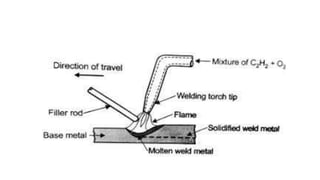
• In this process, the welding torch produces the high-
temperature flame with the help of oxygen and acetylene. Due to
the high temperature parent and filler metal melts.
• A filler material is used to fill the gaps between two workpieces. As
the filler is cooled, the two workpieces will be joined.
Oxy Acetylene Welding Equipment
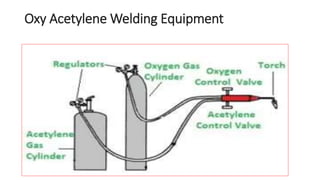
• Gas Cylinders: In the Gas Cylinders, the gases like Oxygen and Acetylene
are stored at high pressure whenever the welding needs to be done,
the gas is released manually.
• Regulator: A Regulator is a fixed part of the Cylinder; it is used to stop
or slow down the pressure of the gas that is used to weld.
• Welding Torch: A Welding Torch is the main component in the oxy
acetylene equipment where the flame is produced and used to weld . A
welding torch produces a high-temperature flame according to the
welding material.
• Non-Return Valve: Non-Return Valve is a type of valve that ensures the
flow of gas is in one direction.
Advantages Oxy Acetylene Welding
• It is simple in construction and easy to operate
• Not only for welding but also oxy acetylene is used to separate
or cut the materials into pieces.
• This type of Welding is cheaper.
• It can be used to weld ferrous and even non-
ferrous metals.
• The intensity of the flame can be adjusted to high and less by
using the valve.
• It can be used for high melting metals and even for low melting
metals.
Disadvantages of Oxy Acetylene Welding
• The temperature of the flame is less when compared to
the arc welding.
• As like arc welding, the oxy acetylene does not have
a high flux shield over the weld.
• It is suitable for thin materials and medium thin
materials whereas it is not suitable for thick materials.
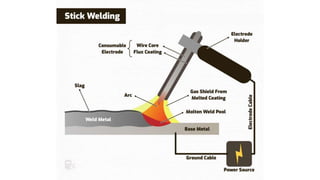
Arc welding
Electric arc welding
 Most extensively used
 Source of heat is Electric arc
 Current flows through ionized particles (plasma)
 Two types of electrodes – (Consumable and non-consumable)
 In case of non consumable electrode extra filler material is used
to generate pool of liquid
Fluxes
An electode has metal core surrounded by flux
coating
• Provide shielding to the metal pool from
atmosphere
• Forms slag by mixing with impurities
• Slag being lighter floats on the surface of the pool
(uniform cooling and no oxidation)
• Provide alloying element
Equipments
• AC or DC (transformer /Generator) (low voltage and high ampere)
(10-50 volt and 50 -300 A)
• Electrode (Bare /coated electrode)
• Elecrode holder , welding helmet ,hand gloves
Types of joint
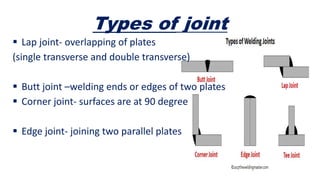
 Lap joint- overlapping of plates
(single transverse and double transverse)
 Butt joint –welding ends or edges of two plates
 Corner joint- surfaces are at 90 degree
 Edge joint- joining two parallel plates
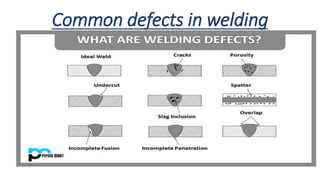
Common defects in welding

GAS WELDING(workshop manuf) useful ppt.pptx

  • 1.
    GAS WELDING Gas weldingis done by burning a combustible gas with Air or oxygen . Purpose of flame is to heat and melt the parent metal and filler rod of a joint Eg. Oxygen +Acetylene Oxygen +hydrogen Oxygen+ other fuel
  • 2.
    Oxy –Acetylene welding •Oxy Acetylene Welding is a type of Gas Welding Process that is used to join the metals. •Working Principle • The working principle of Oxy Acetylene Welding is simple in the process.. It uses the Fuel gases like Oxygen and Acetylene to weld the material • The temperature of the flame is about 3000 to 3,500 degrees centigrade. • In this process, the welding torch produces the high- temperature flame with the help of oxygen and acetylene. Due to the high temperature parent and filler metal melts. • A filler material is used to fill the gaps between two workpieces. As the filler is cooled, the two workpieces will be joined.
  • 3.
  • 5.
    • Gas Cylinders:In the Gas Cylinders, the gases like Oxygen and Acetylene are stored at high pressure whenever the welding needs to be done, the gas is released manually. • Regulator: A Regulator is a fixed part of the Cylinder; it is used to stop or slow down the pressure of the gas that is used to weld. • Welding Torch: A Welding Torch is the main component in the oxy acetylene equipment where the flame is produced and used to weld . A welding torch produces a high-temperature flame according to the welding material. • Non-Return Valve: Non-Return Valve is a type of valve that ensures the flow of gas is in one direction.
  • 6.
    Advantages Oxy AcetyleneWelding • It is simple in construction and easy to operate • Not only for welding but also oxy acetylene is used to separate or cut the materials into pieces. • This type of Welding is cheaper. • It can be used to weld ferrous and even non- ferrous metals. • The intensity of the flame can be adjusted to high and less by using the valve. • It can be used for high melting metals and even for low melting metals.
  • 7.
    Disadvantages of OxyAcetylene Welding • The temperature of the flame is less when compared to the arc welding. • As like arc welding, the oxy acetylene does not have a high flux shield over the weld. • It is suitable for thin materials and medium thin materials whereas it is not suitable for thick materials.
  • 9.
  • 11.
    Electric arc welding Most extensively used  Source of heat is Electric arc  Current flows through ionized particles (plasma)  Two types of electrodes – (Consumable and non-consumable)  In case of non consumable electrode extra filler material is used to generate pool of liquid
  • 12.
    Fluxes An electode hasmetal core surrounded by flux coating • Provide shielding to the metal pool from atmosphere • Forms slag by mixing with impurities • Slag being lighter floats on the surface of the pool (uniform cooling and no oxidation) • Provide alloying element
  • 13.
    Equipments • AC orDC (transformer /Generator) (low voltage and high ampere) (10-50 volt and 50 -300 A) • Electrode (Bare /coated electrode) • Elecrode holder , welding helmet ,hand gloves
  • 14.
    Types of joint Lap joint- overlapping of plates (single transverse and double transverse)  Butt joint –welding ends or edges of two plates  Corner joint- surfaces are at 90 degree  Edge joint- joining two parallel plates
  • 15.