Howcanearlygrowthratesbe
increased?(0-6weeks)
Whetheryouarerearingaheiferora
highperformancebeefcalf,goingfor
highermilkreplacerintakesearlyon
resultsinimprovedfeedconversion
efficiencyandbettergrowthrates.
Improvedearlynutritionandgrowth
ratesarecorrelatedwithincreased
plasmaIGF-1,ahormoneassociated
withincreasedgrowthrates,andthis
helpstosupportincreaseddisease
resistance,improvedimmuneresponse
anddecreasedmortality‚allvitalto
rearingandfinishinghealthycalves.
Benefitsofimprovednutritionand
fasterearlygrowth
•Earlierbullingandcalvingasaresultofimproved
growthrates.
•Increasedliveweightat1monthassociatedwith
reducedmortalityto6monthsofage.
•Researchshowsthatoptimisingweightatcalving
islinkedwithincreasedfirstlactationyield.
•Increasedwitherheightatweaningandatservice
allowsforgreaterrumencapacityinthemature
animal,helpingtomaximiseintakeandlifetime
milkyield.
•Heiferswhichare”fitnotfat”.
•Reachingthetargetof24monthscalvingsaves
£50permonth(EsslemontandKossaibati,1998).
ImprovingEarlyGrowthRates
04RearingforaReasonVolacFREEPHONE0800919808www.volac.com
1.Raisethevolumeofmilk
replacerofferedperfeedfrom2
to2.5oreven3litres.
2.Useanautomaticor
computerisedfeedertoincrease
intakes.
3.Maintainthevolumefed,but
increasetheconcentration
gradually,e.g.from10%to15%
solids.
4.Extendthemilkfeedingperiod
andweanlater.
Oracombinationoftheabove.
Increasingmilkreplacerintake
How to Wean from an Ad-lib System
24 Weaning Volac FREEPHONE 0800 919808 www.volac.com
Cold ad-lib
Offer water via the teats for a progressively
increasing period of time each day, thus cutting
back on the number of hours the calves have access
to milk each day. Allowing calves to drink plain
water from the existing teats instead, both up to
and for some time after weaning, may reduce stress
as well as providing crucial extra liquid during this
time.
Automatic feeders
This milk is normally fed warm so a gradual
reduction in temperature as weaning approaches,
for example by 4°C every 24 hours, will lead to a
progressive reduction in milk consumption and
increase in solid feed intake in around 10 days.
For Automatic feeders supplying groups of calves
of different ages, the transition towards weaning
can be helped by separating those calves ready for
weaning and offering cold milk, either by setting up
a separate cold milk container or by allowing the
milk in the line running from the machine to cool
down before reaching the teat (e.g. increasing the
length of the line to the teat or running the pipeline
through a bucket of cold water en-route to the pen).
Some successful rearers operate an abrupt weaning
policy and this process is simple enough, but be
prepared for a degree of growth set-back and loss
of efficiency whilst the animal adjusts to such a
dramatic transition.
For all ad-lib fed calves, a minimum solid feed
intake of 0.75 kg/calf/day for 3 successive days is a
realistic yardstick to aim for at weaning.
Weaning
21WeaningVolacFREEPHONE0800919808www.volac.com
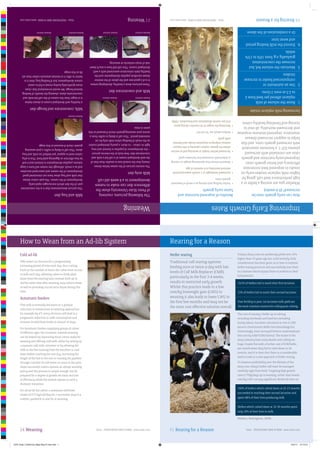
Thefollowingpictures,courtesy
ofPennStateUniversityshowthe
differencedietcanmaketorumen
developmentina6weekoldcalf.
Milkonlydiet
Theexteriorpictureoftherumenbelowshows
clearlythattheoverallsizeissmallerthanthatof
thewelldevelopedrumenofacalffedamilkand
concentratediet.Nowlookattheinteriorpicture
–thedevelopmentofpapillaeislimitedandvery
lightincolour–inshort,apoorlydevelopedrumen
astheresultoffeedingcalvesmilkonlyforan
extendedperiod.Thiscalfislikelytosufferfroma
severepost-weaninggrowthcheckifweanedatthis
pointintime.
Milkandconcentratediet
Thesepicturesshowahealthy,developingrumen.
Itisofagoodsizeandthephotooftheinterior
showsexcellentpapillaedevelopmentandthe
healthydarkcolourationassociatedwithawell
developedrumen.Thiscalfwillhaveamuchlower
riskofmajorsetbacksatweaning.
Milkandhaydiet
Thispicturedemonstratesthatitistheconcentrate
partofthedietwhichencouragesrapidearly
developmentoftherumen.Thepalecolourshows
thatmilkandhayalonehavenotstimulatedgood
developmentoftherumenandassociatedmicrobes
andasaresult,althoughtherumenwillhavealarge
volume,papillaedevelopmentislimitedanditwill
belesseffectiveatdigestingsolidfeed.Thisiswhy
calvestendtoappear‘pot-bellied’onmilkandhay
alone.Thiscalfislikelytosufferapost-weaning
growthcheckifweanedatthisstage.
Milk,concentrateandforagediet
Ahealthywelldevelopedrumenisshownbelow.
Itislargerthantherumenofthecalffedmilkand
concentratesalone,showingthebenefitoffeeding
limitedforage.Wewouldrecommendthatclean
straw(preferablybarleystraw)isfedtoassist
rumendevelopment,butiffeedinghay,thenitis
bettertoofferitinlimitedamountsratherthanad-
libatthisstage.
Rumenexterior
Rumeninterior
RumenexteriorRumenexterior
Rumeninterior
RumeninteriorRumeninterior
Heifer rearing
Traditional calf rearing systems
feeding once or twice-a-day with low
levels of Calf Milk Replacer (CMR),
particularly in the first 3-4 weeks,
results in restricted early growth.
Whilst this practice leads to a low
cost/kg liveweight gain (LWG) to
weaning it also leads to lower LWG in
the first few months and may not be
the most cost effective solution overall.
Today’s dairy cows are producing yields over 16%
higher than 10 years ago but, until recently, little
consideration has been given as to how to improve
heifer rearing practices and successfully rear them
in a manner which equips them to perform to their
full potential.
The cost of rearing a heifer up to calving,
including overheads and land but excluding
family labour, has been calculated at over £1200
(source: Greenmount Heifer benchmarking) but,
interestingly, most surveyed farmers underestimate
this cost by £400-£500/animal. The losses to the
dairy industry from early deaths and culling are
huge. Couple this with a further cost of £50/heifer
per month when they fail to calve down at 24
months, and it is clear that there is a considerable
need to look at a new approach to heifer rearing.
To improve profitability over the lifetime of the
dairy cow, today’s heifer calf must be managed
carefully right from birth. Targeting high growth
rates (>750g/day) up to weaning, rather than lowest
cost/kg LWG can pay significant dividends later on.
Rearing for a Reason
Volac FREEPHONE 0800 919808 www.volac.com01 Rearing for a Reason
14.5% of heifers fail to reach their first lactation.
33% of heifers fail to reach their second lactation.
Poor fertility or poor 1st lactation milk yield are
the most common reasons for culling post-calving.
(Wathes, Nottingham, 2009)
100% of heifers which calved down at 22-23 months
succeeded in reaching their second lactation and
spent 48% of their lives producing milk.
Heifers which calved down at 32-36 months spent
only 18% of their lives in milk.
GAS Volac CalfAdvice 28pp May10 Imp.indd 1GAS Volac CalfAdvice 28pp May10 Imp.indd 1 19/4/11 12:10:3119/4/11 12:10:31
Standardmixingrate
100gofmilkreplacerpluswatertomakeonelitreof
mixedmilk(ie10%solids).
Mixingtechnique
Addthemilkreplacertohalftherequiredvolume
ofwarmwater(40°C).Whiskintoanhomogeneous
solution.Topuptothecorrectvolumewithwater
andwhisklightly.
AVOIDEXCESSIVELYHOTWATER
Heatcanseriouslydamagethe
structureofthehighqualitymilk
protein.
Feedinginstructions
•Allcalvesshouldreceiveadequatecolostrum
(seeColostrumManagementTips,pages5-6).
•Donotfeedmilkattemperaturesover37°C.
•Feedingrecommendationsgivenareforacalf
enteringtheunitat40kg.Quantitiesshouldbe
reducedproportionatelyforsmallercalves,or
increasedforlargercalvesandwhenfastergrowth
ratesarerequired.
•Theimportanceofprovidingasourceofclean
freshwaterforallcalvesatalltimescannotbe
over-emphasised.
•Earlyaccess(day3)tosolidstarterfeedis
stronglyencouraged.
•Considerprovidingcleanstraw,asopposed
tohay,asafibresource.Thiscouldprovidea
costsavingandwillencouragefasterrumen
developmentbyallowingthecalftoconsume
sufficientconcentrate.
Gettinghigherperformancefroma
twice-a-daysystem
Thestandardtwice-a-dayfeedingsystemis
suitableforcalvesrequiringamediumgrowthrate
andlowerrearingcoststoweaning.However,with
thecorrectselectionoffeedsandtheuseofhigher
concentrationsofmilkreplacerthissystemcan
beadaptedtoachievethegrowthratesrequiredto
maximiselifetimeperformance.
Twice-a-dayMixingInstructions
08RearingSystemsVolacFREEPHONE0800919808www.volac.com
1-4
5
6
7-weaning
1.0
1.5
1.75
2.0
1.0
1.5
1.75
2.0
Twice-a-daybucketfeeding
Daysin
theunit
Litresfed
(am)
Litresfed
(pm)
Weaning can be defined as the
point when calves transfer from a
liquid to solid diet. This is carried out
successfully when the rumen has
developed sufficiently to support the
fermentation and digestion of
solid feed.
Rumen development
Rumen development can be influenced by diet.
A healthy rumen should have visible papillae and
a dark colouration, resulting from the development
of the rumen microbial population and large blood
vessels associated with tissue growth, ensuring
maximum absorption,transport and utilisation of
nutrients.
Oesophagus
Reticulum
5%
Rumen
60%
Abomasum
60%
Omasum
10%
From The Calf Rearing Guide © www.contextbookshop.com
Weaning
20 Weaning Volac FREEPHONE 0800 919808 www.volac.com
Oesophagus
Reticulum
5%
Rumen
65%
Abomasum
20%
Omasum
10%
From The Calf Rearing Guide © www.contextbookshop.com
Oesophagus
Reticulum
5%
Rumen
25%
Abomasum
60%
Omasum
10%
From The Calf Rearing Guide © www.contextbookshop.com
6 weeks
Consumption of solid feed and other factors
encourages development of the rumen wall and
rumen volume.
Stages of rumen development
Oesophagus
Reticulum
5%Rumen
80%
Abomasum 7%
Omasum
8%
From The Calf Rearing Guide © www.contextbookshop.com
0-6 weeks
Milk is bypassing the rumen directly into the
abomasum for digestion.
12-16 weeks
Post weaning the calf has a functional rumen which
provides the calf with its nutrient supply.
Mature ruminant
The rumen is now fully functional.
Illustrations from The Calf Rearing Guide
© www.contextbookshop.com
Strategicuseofwholemilk
Volachaveinvestigatedthetacticaluseofwhole
milkandhasputtogetheranumberoffeedingtips,
basedontrials,whichwillallowtheuseofwholemilk
withoutencouragingtheassociatedproblemsofcalf
scourandlowsolidfeedintake.
•Allcalvesshouldreceiveadequatecolostrum
(seeColostrumManagementTips,pages5-6).
•Introducecalvestotwice-a-dayfeedingofCMRat
2.3litrestwice-a-dayat100g/litre.
•Feedtheaboveregimefor4weeks,typical
consumptionwillbe13kgofmilkreplacer.Then
allowcalvesad-libaccesstocoldwholemilk,and
stopfeedingCMR.
•WeanCalvesabruptlyafterafurther3weeksas
longascalvesareconsumingatleast1kgsolid
feed/dayon3consecutivedays.
WholeMilk
17RearingSystemsVolacFREEPHONE0800919808www.volac.com
Howoftendoyoureviewyourcalf
rearingcosts?OnaverageMilk
Replaceris10pplcheaperthan
wholemilksoit’sworthchecking
costdifferencesonaregularbasis.
The ‘4 Q’s’ of Colostrum Management
05 Colostrum Management Volac FREEPHONE 0800 919808 www.volac.com
Colostrum of the right quality and
quantity, given to the calf at the right
time, is the cornerstone of success
for any calf rearing enterprise. It
supplies both essential nutrients and
antibodies.
A new-born calf has no protective antibodies to
resist disease challenges and these can only be
absorbed via colostrum. Poor health, low growth
rates and high mortality are most often seen in
calves that have received inadequate colostrum.
Quality
Feed calves with quality colostrum.
The production of quality colostrum may be
reduced under some circumstances such as:
• Age of cow - colostrum from cows in their first
lactation usually contains fewer antibodies to
help protect against disease as these animals
have not yet been exposed to a wide range of
pathogens.
• Breed of cow - Holstein colostrum typically
contains lower levels of antibodies than that from
Jersey cows.
• Short dry period (<3 weeks)
• High yielding cows - those producing more than
8 litres at first milking with poor transition diets.
• Poor hygiene - this can result in high levels of
bacteria in colostrum which has been shown to
reduce the uptake of antibodies by the calf.
Good quality colostrum may be frozen for future
use, when suitable colostrum is not available from
the dam. Alternatively, if considering the use of a
commercial alternative, ensure that the product has
been independently tested and is proven to
be successful.
It is difficult to visually detect if colostrum contains
sufficient antibodies. It is therefore recommended
that colostrum is tested if quality is doubtful.
Contact Volac for details of easy-to-use testing
equipment such as the colostrometer..
Quantity
Minimum 3 litres (6 pints) in the first 6 hours, split
into 2 feeds if necessary.
As a rule of thumb, a calf receiving at least 3 litres
of good quality colostrum in the first 6 hours of life
will have received sufficient antibodies. Remember,
a calf requires approximately 20 minutes of
continuous suckling to consume 3 litres of milk
from the cow.
Quickly
Ideally, as soon as possible after birth, and at latest
within the first 6 hours.
At birth the calf gut is permeable‚ which means that
it can absorb the large antibody molecules directly
into its bloodstream. Over the first 24 hours the gut
rapidly ‘closes’ and these molecules can no longer
be absorbed. For good immunity, low mortality and
future health, it is essential that the calf absorbs
sufficient antibodies as soon as possible after
birth before the gut ‘closes’. Feeding beyond 24
hours is still of value and the feeding of colostrum
for at least the first 3 days of life has been shown
to have other benefits as it encourages rapid gut
development and lays a solid foundation for fast
efficient growth in the future.
Quietly
Research has proven that calves that are stressed
when receiving colostrum will not absorb the
protective antibodies as efficiently as those that are
calm. This means that a stressed calf would require
more colostrum in order to achieve the same level
of immunity as a calf which was
not stressed.
Oesophagus
Reticulum
5%
Rumen
60%
Abomasum
25%
Omasum
10%
From The Calf Rearing Guide © www.contextbookshop.com
GAS Volac CalfAdvice 28pp May10 Imp.indd 2GAS Volac CalfAdvice 28pp May10 Imp.indd 2 19/4/11 12:10:3319/4/11 12:10:33
ComputerControlledFeeding
12RearingSystemsVolacFREEPHONE0800919808www.volac.com
7
6
5
4
3
2
1
0
Milk(litres/day)
051015202530354045505560
Gradualreduction
ofmilkto
encouragesolid
feedintakeand
rumendevelopment
andreducegrowth
setbacks.
Highearlyintakeof
milkwhenthecalf
convertsitmost
efficiently.
Milkisincreased
graduallyto
reducedigestive
upsets.
Itwilltake13‘manhours’tomanage
40calvesthroughtoweaningusing
thisfeedingsystem.
Daysonsystem
Thissystemcombinesallthe
strengthsoftheprevioussystems
whilstminimisingweaknessesand,
forthisreason,largescaleDairyand
BeefoperatorsacrossEuropeare
increasinglyrearingcalvesbythis
method.Computerisedcalffeedersare
designedtofeedandmanagegroup
housedcalvesonanindividualbasis.
Strengths
Allowsad-libperformancewiththecostcontrolof
arestrictedsystem.
Verylowroutinelabourneeds.
Allowseachindividualcalftobefedaccordingto
apre-setprogrammetomeetindividualneeds.
Recordsactualdailymilkintakepercalf.
Dailyactionlistshighlightsbehaviourchanges
andcalvesthatmightrequireattention.
Highlysuccessfulsteppedweaningwithminimal
set-backs.
Selfcleaning.
Compatiblewithsurplusmilksupplies.
Weaknesses
Highstockmanshipstandardsstillthekeyto
success.
Highcapitalcosts.
Goodhousing(drainageandventilation)
essential.
Strengthsandweaknessesofa
computercontrolledsystem
YourVolaccontactwillbeabletoadviseonthe
mostappropriatefeedcurveforyourcalfrearing
system.
Thefeedingcurve
Allcalvesarefedaccordingtoapre-set
programmedfeedingcurve,anexampleofafeeding
curveforaHolsteinFriesiancalfisshownbelow:
Whole Milk – What are the Risks?
16 Rearing Systems Volac FREEPHONE 0800 919808 www.volac.com
Scour
Scour affects many young calves and can be brought
on by nutritional upsets as well as by pathogens.
To reduce the risk of scour, calves should be given
sufficient good-quality milk on a consistent basis, i.e.
same temperature, concentration and time of feeding.
Whole milk can be difficult to feed at a consistent
temperature, and usually varies considerably in
nutrient content on a day-to-day basis.
A survey by the National Animal Disease Information
Service of over 250 farms where scour was a problem
concluded that the feeding of a milk replacer rather
than whole milk reduced the possibility of calves
developing scour.
Johne’s disease
Johne’s disease is present on a large number of UK
farms. Eradication is difficult and an effective control
scheme is needed on all farms to limit further spread
of the disease.
As part of a control scheme, it is recommended that
whole milk is not fed to calves as this is one of the
routes for the disease to spread. Johne’s disease
causes diarrhoea, weight loss and ultimately
the untimely culling of the animal due to poor
performance, with studies suggesting that the disease
can cost in excess of £2,500 per 100 cow herd.
Performance
Ultimately you want your calves to meet their
genetic potential in terms of milk yield, fertility
or meat production. With the health problems
associated with whole milk your calves may not meet
these expectations.
Recent trial work carried out at the University of
Central Lancashire, Myerscough College compared
the performance of dairy calves fed either CMR or
saleable whole milk. At weaning calves fed CMR
weighed a significant 15.4kg more on average than
those fed whole milk.
Furthermore, separate studies have concluded that
those calves which get off to a better start with higher
growth rates have been associated with better results
in terms of milk production and fertility during first
lactation.
Milk feeding regime
Milk intake (av. litres/calf/day)
Total feed cost to 12 weeks (£)
Cost/kg liveweight gain to 12 weeks (£)
Av. 6 week weaning weight (kg)
Av. 12 week weight (kg)
Ad-lib whole milk Ad-lib CMR
6.4
95.4
1.58
66.1
105.9
8.2
110.8
1.44
81.5
122.7
TheCostofLabourperCalftoWeaning
13RearingSystemsVolacFREEPHONE0800919808www.volac.com
CostingFormula:
Dairyherdsmanaverage(52.5hourweek)includingcraftsmanrates=£20,322(€22,557)peryear.
£7.42(€8.23)perhouror12p(13c)perminute.Cost=totalmins/calfx12p/min(Source:J.NixFarmManagementGuide2009).
•PreparationMeasuring,mixing,setupetc.
•FeedingBuckettocalf-removing.
•ClearingupWashingupetc.
•OtherstocktasksWatersupply,starterfeed.
Twice-a-daybucketfeeding
40mins
20mins
30mins
25minsTotal115mins/calf
Cost-£13.80/14.95euro
•PreparationMeasuring,mixing,setupetc.
•FeedingBuckettocalf-removing.
•ClearingupWashingupetc.
•OtherstocktasksWatersupply,starterfeed.
Once-a-daybucketfeeding
20mins
10mins
15mins
25minsTotal70mins/calf
Cost-£8.40/9.10euro
•PreparationMeasuring,mixing,setupetc.
•FeedingBuckettocalf-removing.
•ClearingupWashingupetc.
•OtherstocktasksWatersupply,starterfeed.
Warmorcoldad-libfeeding
15mins
5mins
5mins
15minsTotal40mins/calf
Cost-£4.80/5.50euro
•PreparationMeasuring,mixing,setupetc.
•FeedingBuckettocalf-removing.
•ClearingupWashingupetc.
•OtherstocktasksWatersupply,starterfeed.
Automaticfeeding
40mins
20mins
35mins
15minsTotal20mins/calf
Cost-£2.40/2.60euro
•PreparationMeasuring,mixing,setupetc.
•FeedingBuckettocalf-removing.
•ClearingupWashingupetc.
•OtherstocktasksWatersupply,starterfeed.
Computercontrolledfeeding
40mins
20mins
35mins
15minsTotal20mins/calf
Cost-£2.40/2.60euro
Once-a-day is a restricted feeding
system with very low labour input and
is ideal for the farmer with lower calf
growth rate requirements.
The system requires a high level of
stockmanship as calves are only seen
drinking once every 24 hours.
Strengths and weaknesses of once-a-
day milk feeding
Mixing and feeding instructions
100g of milk replacer in one litre of mixed milk.
Increase to 167g of milk replacer in a litre of mixed
milk from day 5.
Once-a-day Bucket Feeding
09 Rearing Systems Volac FREEPHONE 0800 919808 www.volac.com
1-2
3
4
5-6
7-weaning
1.0
1.5
1.75
2.25
2.75
1.0
1.5
1.75
Once-a-day bucket feeding
Days in
the unit
Litres fed
(am)
Litres fed
(pm)
Change to once-
a-day feeding
Strengths
Less labour - one less feed, less mixing, less
washing up.
Less CMR used.
Faster uptake of concentrate.
Not dependent on external power or mechanical
gadgets to operate.
Can be offered via teated or open bucket.
Relatively easy task to delegate.
Weaknesses
Significantly lower opportunity for observation
and supervision.
Time dependent.
Calves must be fed at same time each day.
Calf growth limited.
“It will take 47 ‘man hours’ to manage
40 calves through to weaning using
this feeding system.”
GAS Volac CalfAdvice 28pp May10 Imp.indd 3GAS Volac CalfAdvice 28pp May10 Imp.indd 3 19/4/11 12:10:3619/4/11 12:10:36
Thereisstillconsiderableroomfor
improvedefficiencyinthisareaas
surveysrecentlycarriedoutintheUK
andNorthernIrelandconcludedthat
65-75%ofheifersfailedtocalvedown
by25monthsofage.
InorderforaHolsteinheifertocalvedownat22-23
monthswithabodyweightof540-580kg,anaverage
dailyLWGof750-800g/dayisrequired.
Areyourheifersachievingthis?
ArecentUKsurveyreportedthatnearly25%of
heifercalvesweregrowingatsub-optimallevels
(<600g/day)duringtheirfirst6months,andthis
wasdirectlylinkedtoincreasedageatfirstcalving
andreducedreproductiveperformanceduringthe
firstlactation.Ontheotherhand,improvedearly
growth(600-800g/day)waslinkedtoreduced
mortalityandlowerageatfirstcalving.Increased
firstlactationmilkyieldhasalsobeenattributed
toimprovedgrowthratesinthepreweanedcalfby
researchersinanumberofdifferentcountries.
ToachieveimprovedLWGitisincreasingly
importanttoregularlyreviewtherearingsystem
andmeasurethegrowthofheifercalves,sothat
feedprogrammescanbemodifiedtoachievethe
targetgains,leadingtolongtermeconomicbenefits
fortheherd.
Reviewingthequality,notjustquantity,offeed,is
alsovitalatthisearlystage.Researchhasshown
thatincreasingmilkreplacerproteinlevelsto
26%,whilstlimitingtheoil%,permitshighgrowth
rateswithgreaterframegrowth,butwithless
bodyfatandmoreleantissuegrowth.Rearinga
heiferwhichis”fitnotfat”‚isessential.Published
researchdemonstratesadirectlinkbetweenhigher
bodyweightatcalvingandincreasedfirstlactation
milkyield,butiftheheiferis“fat”‚ratherthan“fit”‚
sheismorelikelytosufferfrompoorappetitepost
calving,leadingtoanenergydeficitandsubsequent
fertilityproblems.
VolacHeiferlacisspeciallydesignedforthemodern
heiferandisformulatedwithhighlevelsofpure
dairyprotein(26%),lactoseandvegetableoilsto
ensuretherighttypeofgrowthisachievedinorder
toreachtheoptimumsizeandweightforbulling
andcalving.
HeiferRearing
02RearingforaReasonVolacFREEPHONE0800919808www.volac.com
Weaning
22 Weaning Volac FREEPHONE 0800 919808 www.volac.com
Timing of weaning
The early intake of solid feed helps
to condition the immature rumen
and encourage it to develop so that
the calf can eventually obtain a high
proportion of its nutrient requirements
from solid rather than liquid feed at
an earlier time than would happen
naturally. As a result, we are able to
consider removing milk from the diet
after a period of weeks rather
than months.
Rather than weaning at a fixed time, it is best done
when the calf is consuming a minimum daily target
of 1kg of solid feed for 3 consecutive days. Some
calves achieve this at around 5 weeks, whilst others
will take almost 8 weeks to consume this amount.
Remember that your calf naturally consumes milk
for at least this length of time.
Irrespective of the type of rearing
system used on your farm easy access
to fresh water and calf starter from the
beginning of the rearing period will aid
earlier rumen development.
HowtoWeanfromaBucketRearingSystem
23WeaningVolacFREEPHONE0800919808www.volac.com
Abruptweaning–Switchfromaliquid
tosoliddietisimmediate
Thismethodcanleadtosignificantgrowth
setbacksifthecalf’srumenhasnotdeveloped
sufficientlytodigestandutilisesolidfeed
efficientlyatthisstage.Theresultisthatthe
nutrientuptakefromthesolidfeedcannot
completelyreplacethenutrientspreviously
suppliedbymilk.Rememberthatifacalfis
consuming1kg/dayofsolidfeedand4litresofmilk
@12.5%concentrationonedaybeforeweaning,it
needstoconsumenearly2kg/daysolidfeedthe
dayafterweaningtoreplacetheenergypreviously
suppliedbythemilk!
StepWeaning–Gradualreductionof
liquidmilkoveraperiodoftime
ResearchsponsoredbyVolacatWrittleCollege
lookedatanalternativeweaningstrategydesigned
tominimisethepotentialsetbackatweaning.
Resultsshowedthatbysteppingdowntheamount
ofmilkfedandnumberoffeeds/dayoverthe
last2weeksonmilk,thesolidfeedintakewas
increasedandtheefficiencyofgainandeconomic
performancewasimproved.Thisislinkedto
improvedrumendevelopmentatweaning,resulting
inasmoothertransitionontosolidfeed.
Anexampleofanidealstepweaning
systemwouldbeasfollows:
Stresscaninfluencetheimmune
systemofthecalfandincreased
stresscanincreasetheanimals’
susceptibilitytodisease.Avoiding
toomanylifestylechangesatone
timewillhelpyourcalvescope
morereadilywiththestressof
weaning.Foroptimalperformance,
trynottoalteraccommodation,
solidandliquidfeed,waterand
socialgroupallatthesametime.
Days0-3
Upto5weeks
6weeks
7weeks
Colostrum(seepages5-6)
2.5litrestwice-a-day
2.5litresonce-a-day
2litresonce-a-day
03 Rearing for a Reason Volac FREEPHONE 0800 919808 www.volac.com
Beef Calf Rearing
Significant numbers of beef calves are
now reared on units away from their
birthplace. Good management of these
animals immediately after arrival is
essential as, typically, animals will be
stressed and dehydrated.
A rehydration therapy, such as Volac
ASGold, can be very valuable as a first
feed. Clean, well ventilated housing
with plenty of clean dry bedding and
ad-lib fresh water and follow-on feeds
are other key components of success.
Whilst some specialist rearers will be targeting
high growth rates from the minute the calf arrives
on the farm (e.g. 12 month beef), many beef rearers
are aiming to grow their calves more slowly and
at the lowest cost/kg LWG. For these rearers, a
decision is often made to restrict intakes of CMR
and encourage earlier weaning as animals have
an opportunity to compensate with faster growth
later on. Volac Enerlac is an ideal CMR to use in
this situation as it will give exceptional growth at a
cost effective rate. It provides equal proportions of
protein (20%) and oil (20%) to give a high energy
feed resulting in good looking, well grown calves.
The specialist rearer aiming to market a finished
animal at 12 months of age needs to maximise
growth rates from birth to slaughter. This gives little
opportunity for compensatory growth and higher
growth rates are necessary in the first 6-8 weeks.
This might result in a higher cost per kg LWG but
can produce animals over 10kg heavier at 11 weeks,
which will save time and feed overall. Volac Blossom
is the CMR to use to achieve higher levels of growth.
It is formulated with 23% protein, 18% oil and no
fibre.
The feed conversion efficiency
achieved in the first 6 weeks of life is
better than that achieved at any other
stage of life.
GAS Volac CalfAdvice 28pp May10 Imp.indd 4GAS Volac CalfAdvice 28pp May10 Imp.indd 4 19/4/11 12:10:3619/4/11 12:10:36
ColostrumManagement
Storage
Colostrumcanbestoredinarefrigeratorforupto
aweekbeforetheantibodyconcentrationstartsto
fallanditmaybestoredinadeepfreezeforupto1
yearwithoutseriouslossofantibodyvalue.
Todefrostpriortouse,itisbesttostandthepack
ofcolostruminwarmwaterandallowittothaw
andheatupslowly.Useofamicrowaveshouldbe
avoidedifpossibleasthiscanresultin‘hot-spots’
whichwilldamagethesensitiveimmunoglobulin
(antibodies).
Gettingcolostrumintothecalf
Thereareanumberofwaystoensurethatthecalf
receivesadequatecolostrum.Themethodselected
willvary;butthekeyistohaveamanagementplan
foreachcalfandfollowiteverytime.
1.Allowcalftosuckledam
Supervisesucklingtoensurethatthedamallows
thecalftosuckleearlyenoughandforlongenough
toconsumesufficientcolostrum.Minimumof20
minutes.
2.Allowcalftosucklefrombottle
andteat
Usefuliffeedingstoredcolostrumoranalternative
andenablestheexactquantityfedtobemonitored.
3.Stomachtube
Seekadviceandtrainingfromaprofessionalbefore
usingthismethod.Itcanbestressfulbutitensures
thatthecalftakesinaknownquantity.
4.Useofcolostrumalternatives
Usewhenthedamisknowntohaveahighrisk
oftransmittingdiseasessuchasJohne’stothe
calforwhenfreshorfrozenhighqualitybovine
colostrumisnotavailable.Colostrumalternatives
areusefulinanemergency,orasa‘topup’whenan
unknownquantityofcolostrumhasbeensuckled
fromthedam.Checknutrientdensityofproduct
beforeselection.Highproteinoptionssuchas
VolacVolostrumhavebeendemonstratedtowork
effectivelyinindependenttrials.
06ColostrumManagementVolacFREEPHONE0800919808www.volac.com
Introduction to Housing
18 Housing Volac FREEPHONE 0800 919808 www.volac.com
In an ideal world, all calf housing would
be well ventilated and well drained to
ensure very low humidity at calf level,
reducing the risk of build up of stale
air and the spread of airborne diseases.
Calves would be in an environment
which is light and airy but free from
dampness, draughts and dust.
In reality, calf housing rarely meets these
standards on all counts. Whilst it does not need
to be luxurious, with careful planning it could be
adapted to meet more of the basic calf needs than
is often the case. This does not necessarily mean
spending vast sums of money, though common
sense and logic are often the only investments
required, as seemingly small alterations can have
a very big impact on comfort and calf performance.
Each housing situation will be different and any
troubleshooting will require an individual approach.
However, some basic factors are constant, and these
are described on the following page.
Should you be considering changes to your calf
housing then your local Volac Business Manager
will always be pleased to provide advice. We do not
claim to know everything, but the very nature of
our business enables us to see a lot of calves in a
wide variety of situations, and as such, we can often
provide some useful observations.
HousingRequirements
19HousingVolacFREEPHONE0800919808www.volac.com
Penspace
Environmentalrequirements
Allow1.1m2
forcalvesupto4weeksofage.
Allow1.8m2
forcalvesupto8weeksofage.
Nocalfshouldbeconfinedinanindividualpenafter8weeksofage.
(unlessdirectedbyaveterinarysurgeon).
Allpensshouldhaveperforatedwalls(exceptsickcalvesinisolation)
allowingcalvestohavedirectvisualandtactilecontactwithotheranimals.
Allow1.1m2
forcalvesupto8weeksofage.
Allow1.5m2
forcalvesupto12weeksofage.
Tworowsofpens-oneoneachsideofacentralpassage(1.2m).
Singlerowofpensononesideofthepassage(1m).
Feedingspaceforindividuallyfedcalves-350mmpercalf.
Individualcalves
Groupedcalves
Passagewidth
Troughfrontage
Acalfhouseshouldhaveaminimumcubicaircapacityof10m3
percalfupto
90kgs.Airoutletareasshouldbeaminimumof0.05m2
percalfandtobalance
this,theinletareashouldbe4timestheoutletareapercalfandsituated1.5
-2.5mabovetheinlet.Withbothnaturalandfanventilation,alwaysensurea
minimumventilationrateof6airchangesperhour.Inaridgedbuilding,asa
generalruleofthumb,allowaminimumof50mmofridgeopeningforevery
3mofbuildingwidth–soa20mwidebuildingwouldneedaridgeopening
about300mmwide.Smoketests(usingsmokepellets)areanidealwaytosee
howgoodorbadtheventilationreallyis.
Notcritical,providingitissimilartooutsideconditionsandcalvesare
shelteredfromdraughtsandbadweather.
Notrequiredinmonopitchorpitchedroofdesigns.
Localisedelectricheatingmayberequiredforsickcalves.Aquartzlinear
lampissuitableforgrouprearedcalves.Itheatsthecalfratherthanthe
airandsickcalvesmovenaturallyintotheheatedzone.
Beneathstrawbeddingprovideconcretefloorswithaslopeofat
least1in20.Passagesshouldbedomedandthefloorslopeinfeed
storageareasshouldbe1in40.
Individuallypenned-minimumofonewaterbucketforeachpen.
Grouppenned-minimumofonewaterbowlforevery10-12calves.
Natural-provide10%oftheroofastranslucentsheeting.
Artificial-provide100-200luxatcalfleveltoaidinspectionofcalves.
Environment
Temperature
Insulation
Heating
Floors/bedding
Water
Lighting
RearingSystems-Twice-a-dayBucketFeeding
07 Rearing Systems Volac FREEPHONE 0800 919808 www.volac.com
Twice-a-day is a restricted feeding
system, more flexible than once-a-day,
with a higher degree of supervision
and greater scope for increasing
milk feed intakes and early LWG.
With appropriate feeds and feeding
management this system can also
be adapted to achieve very high
performance in situations where
ad-lib feeding is neither possible nor
practical.
Strengths
Close control over volume fed, therefore lower
feed costs.
Very good supervision of animals.
Not dependent on external power or mechanical
gadgets to operate.
Can adapt to use surplus whole milk or CMR
very easily.
Can be offered via teated or open bucket.
Relatively easy task to delegate.
Strengths and weaknesses of twice-a-
day bucket feeding
Weaknesses
Very labour intensive.
Time dependent: calves must be fed at the same
time(s) each day.
Calf growth may be limited.
It will take 77 ‘man hours’ to
manage 40 calves through to
weaning using this feeding system.
Volumes fed on many units have
not altered in generations, for
example; 2 litres per feed, 2 times
a day, from 2 weeks to 2 months.
GAS Volac CalfAdvice 28pp May10 Imp.indd 5GAS Volac CalfAdvice 28pp May10 Imp.indd 5 19/4/11 12:10:4019/4/11 12:10:40
NonautomatedColdorWarmAd-Lib
10RearingSystemsVolacFREEPHONE0800919808www.volac.com
Asimplelargebucketandteatcanbe
setuptofeedcoldmilkonanad-lib
basisor,ifwarmmilkisrequired,a
heatcontrolledsystem,liketheVolac
Mini-Mum,canbeusedtoprovidean
ad-libsupplyofwarmmilk.Popular
withunitswhereallcalvesareunder
closescrutiny.Successdepends
onsupplyingmilkataconsistent
strengthandtemperature.
Mixingandfeedinginstructionsforall
ad-libsystems
100gofmilkreplacerpluswatertomakeonelitre
ofmixedmilk(i.e.10%solids).Themixingratemay
beincreasedto125gofmilkreplacerpluswaterto
makeeachlitreifrequired.
Strengthsandweaknessesofthe
ad-libfeedingsystem
Strengths
Lowcostequipmentandsetup.
Lowerlabourcostinhours/day.
Freedomfromspecificfeedingtimes.
Flexibleapplication:Cansuitanytypeof
applicationandcanbeadaptedtosuitmost
groupsizes.
Notdependentonexternalpoweriffeedingcold.
Fastgrowthrates.
Allows24hourmilkconsumption.
Canusesurplus/wholemilk.
Weaknesses
Reduced‘compulsory’supervision
(so,stockmanshipskillsmustbehigh).
Potentialforbacterialgrowthifhygiene
standardsnot100%.
Greaterurineproductionincreasesbedding
requirement.
HigherCMRconsumptionthanforrestricted
systems.
Concentrateintakelimitedatallstages.
Canposemanagementproblemsincold
weather(pipesfreezing).
“Itwilltake27‘manhours’to
manage40calvesthroughto
weaningusingthisfeedingsystem.”
Cost Comparison of Different Rearing Systems
14 Rearing Systems Volac FREEPHONE 0800 919808 www.volac.com
Cost comparison of different rearing systems
for calves entering the unit at 46kg liveweight
Restricted feeding Ad-lib feeding
Twice daily Once daily Computer fed Cold ad-lib Automatic
‘little and often’ machine
CMR (kg) 18 21 26 30 42
Costs @ £1400/tonne £25.20 £29.40 £36.40 £42.00 £58.80
Concentrates to 11 weeks (kg) 125 130 120 110 96
Costs @ £220/tonne £27.50 £28.60 £26.40 £24.20 £21.12
Overheads to weaning £27.80 £27.80 £37.30 £27.80 £28.90
(Vaccination, vet and med,
straw, energy, feeder hire)
Labour to weaning (minutes) 115 70 20 40 20
Cost/calf @ £7.42/hour £13.80 £8.40 £2.40 £4.80 £2.40
Costs/calf to 11 weeks:
- Feed costs £52.70 £58.00 £62.80 £66.20 £79.92
- All overhead costs £41.60 £36.20 £39.70 £32.60 £31.30
- Total: £94.30 £94.20 £102.50 £98.80 £111.20
Calf weight at 11 weeks (kg) 102 105 108 108 114
TOTAL REARING COST
(£/kg liveweight gain) £1.68 £1.59 £1.65 £1.59 £1.63
*This is a rough guide to compare systems. Performance will also be influenced by other factors
(colostrum status, disease level, hygiene etc).
ChoosingaRearingSystem
15RearingSystemsVolacFREEPHONE0800919808www.volac.com
Herearesomekeypointstohelpyou
whenconsideringthebestfeeding
systemforyourneeds.
Thetargetmarket
•Areweinthisforthelongrun?
•Isthisashortterm‘fix’toutilisecurrent
marketopportunity?
•Howmanyanimalswillrequirecareat
anyonetime?
Skillsavailable
•Whowilldoit?
•Howexperiencedarethey?
•Howwouldtheyadapttochange?
•Whatlevelofstockmanshipisavailable?
(rememberthecommentsrelatingto
ad-libfeeding).
•Whowilldothejobwhenkeypersonnel
areabsent?
•Whatlevelofmechanicalknowledge
isavailable?
•Canwetrainotherstodothiswork?
Services
Water
•Mains/Borehole/Spring?
•Normalpressure(constant)?
•Clarity(clean)?
•Wouldanupdateproveabigexpense?
Power
•Issupplyconsistent/reliableandavailable
atalltimesoftheyear?
•Dowehaveaback-upsupply?
•Howmodernisthewiringonthefarm?
Bedding-Supplyandremoval
•Availabilityandstorageforcleanbedding?
•Optionsfordisposalofsoiledbedding?
•Will‘CalfStaff’beexpectedtodothis?
•Towhatdegreearethesetasks
mechanised(tractors,loaders,handling
equipmentetc)?
Unitlayout
Buildingdesign(see‘Housing’section,pages18-19)
•Howsuitableisthecurrentunit?
•Canwemodifyiteasily?
•Shouldwebuildfromnew?
•Howcanweeasethedailyworkload?
Ventilation(see‘Housing’section,pages18-19)
•Howcanweimproveourexisting
accommodation?
•Hasventilationbeentakenintoaccount
inanynewdesigns?
Drainage(see‘Housing’section,pages18-19)
•Haveweconsideredthisinourplans?
Movements
•Haveweconsideredthesmoothmovement
ofmaterialsandanimalsinourplans?
Strengths
Automatic Machine Feeding
11 Rearing Systems Volac FREEPHONE 0800 919808 www.volac.com
This system can considerably reduce
the time and labour needed to rear
calves. A high standard of supervision,
observation and overall management
is essential as there is not the same
opportunity to see the calves feeding
as there is on more labour intensive
systems.
Strengths and weaknesses of the ad-lib
feeding system
Weaknesses
Freedom from a regular feeding routine can
result in a lower level of supervision.
The temptation to slacken hygiene standards
must be avoided.
Weaning management skills must be good
- to allow maximum intake of starter
feed whilst drinking ad-lib milk before
weaning.
- to minimise stress and weight loss
post-weaning.
Unrestricted intakes will conflict with a strict
cost control system. Up to 50% more CMR
consumed per calf.
Lower starter feed intakes due to ad-lib milk
pre-weaning.
Greater milk intake leads to increased urine
production, particularly after feeding, so
drainage must be good in the feeding area (a
1/10 slope around drinking area is essential).
“It will take 13 ‘man hours’ to manage
40 calves using this feeding system.”
Allows 24 hour milk consumption.
Maximises early calf growth.
Low routine labour requirements.
Fewer staff can manage larger stock numbers.
Flexible and portable.
Can be easily adapted into a variety of
existing types of accommodation.
Works well all year round.
High growth rates and improved feed
conversion rates pre weaning.
Equipment costs can be spread via hire
and finance schemes.
Tips for success
When using equipment which automatically
mixes milk, it is essential to check the powder/
water calibration regularly.
Regular cleaning of the mix bowl and pipes is
essential.
Training calves at entry requires time and
patience.
A reliable up to date power supply with back
up is needed and a clean supply of water under
constant pressure.
For ventilation requirements see ‘Housing’
section.
GAS Volac CalfAdvice 28pp May10 Imp.indd 6GAS Volac CalfAdvice 28pp May10 Imp.indd 6 19/4/11 12:10:4219/4/11 12:10:42
Index
IntroductionVolacFREEPHONE0800919808www.volac.com
Introduction
ThereputationofVolachasbeenbuiltarounddairynutritionandproduct
innovation.Wehavedevelopeduniquemanufacturingtechniquesthatnow
producethousandsoftonnesofhighqualitymilkreplacer,colostrumalternatives
andhumanfoodsupplementseveryyear.
Volacoffersasystemsapproachtocalfrearing,providingeverythingfromnatural
alternativestocolostrum,milkreplacersandarangeoflaboursavingfeeding
equipmenttosuitalltypesofrearingneeds.
AllVolacproductsaresupportedbyourstrongtechnical,salesandmarketing
teams,whoaimtobringyoutimelyhusbandryandmanagementinformation,to
helpyougetthemostfromyourcalves.
Pages01-04RearingforaReason
Pages05-06ColostrumManagement
Pages07-17RearingSystems
Pages18-19Housing
Pages20-25Weaning
7080410L
FREEPHONE 0800 919808
Volac International Limited
Volac House, Orwell, Royston, Hertfordshire, SG8 5QX, United Kingdom
T +44 (0)1223 208 021 F +44 (0)1223 207 629 enquire@volac.com www.volac.com
Volac Ireland
Volac House, Church Street, Killeshandra, Co. Cavan, Eire
T +353 494 334 755 F +353 494 334 760 infoireland@volac.com www.volac.ie
Volac Agro-Best
Volac Agro-Best spol. s r.o. Beˇstovice 115, 565 01 Chocenˇ, Czech Republic
Tel/Fax +420 465 471 763 agrobest@agrobest.cz www.agrobest.cz
Volac Socoor
Via Mauro Macchi 65, 20124 Milano, Italy
Tel +39 02 6701043 Fax +39 02 6692916 info@volac.it www.volac.it
HowtoWeanfromaComputerisedCalfFeeder
25WeaningVolacFREEPHONE0800919808www.volac.com
Thelatestgenerationofcomputer
controlledfeedersnowcombine
thelabour-savingadvantagesofa
machinerearingsystemwiththe
individualcontrolpreviouslyrestricted
totraditionalbucketrearingsystems.
Onemajoradvantageisthatthe
computercanautomaticallyreduce
thedailyvolumeofferedtothecalf
overapre-setperiodinthelead-upto
weaning.Thisresultsinanautomated
step-weaningsystemwhichrequires
noadditionallabourinputandallows
thecalftoachieveasmoothweaning
transition,providingasignificant
benefittoboththecalfandtherearer.
Thekeyfactorsforsuccessfulweaning
fromanyrearingsystemare:
1)Freshwateravailableatalltimes–
toencouragerumendevelopment.
2)Highqualitystarterfeedavailable
butofferedinsmallquantitiesfresh
eachday.
4)Accesstolongfibre(e.g.strawinracksto
encouragesolidfeedintake).
5)Eatingminimum1kgofsolidfeed
dailyfor3consecutivedays.
F a r m e r s
Helping Farmers to
provide for their Calves
Calf
Advice
GAS Volac CalfAdvice 28pp May10 Imp.indd 7GAS Volac CalfAdvice 28pp May10 Imp.indd 7 19/4/11 12:10:4219/4/11 12:10:42

Gas volac cal