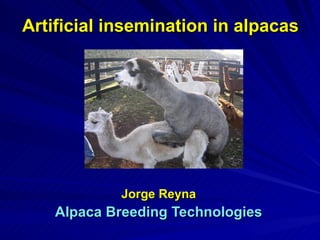
Artificial insemination in alpacas Jorge Reyna Alpaca Breeding Technologies
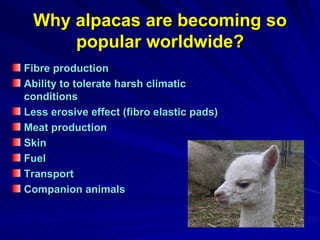
Why alpacas are becoming so popular worldwide? Fibre production Ability to tolerate harsh climatic conditions Less erosive effect (fibro elastic pads) Meat production Skin Fuel Transport Companion animals
Genetic improvement data collection  statistical and prediction models  selection  reproductive technologies (AI, ET, IVP) as a tool to disseminate the best genes in the population.
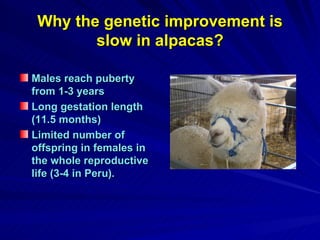
Why the genetic improvement is slow in alpacas? Males reach puberty from 1-3 years Long gestation length (11.5 months) Limited number of offspring in females in the whole reproductive life (3-4 in Peru).
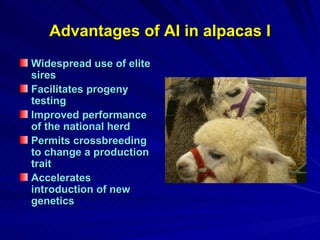
Advantages of AI in alpacas I Widespread use of elite sires Facilitates progeny testing Improved performance of the national herd Permits crossbreeding to change a production trait Accelerates introduction of new genetics
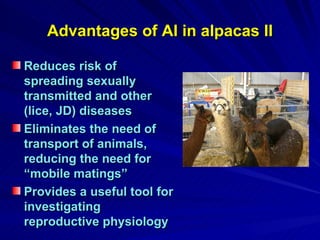
Advantages of AI in alpacas II Reduces risk of spreading sexually transmitted and other (lice, JD) diseases Eliminates the need of transport of animals, reducing the need for “mobile matings” Provides a useful tool for investigating reproductive physiology
Current limitations of the AI in alpacas   Need reliable technique to collect sperm. Length of copulation 25.65 minutes (17 to 43) The unique mucoid character of the sperm. Low spermatozoa concentration and low motility in the ejaculate. Frequency of use of the male. Lack of techniques to store sperm in chilled or frozen form. The characteristic of induced ovulation in the female – timing of AI?
Ejaculatory process in alpacas Copula takes up to 40 minutes. Urethral contractions are distributed evenly during the ejaculatory process. Ejaculation process is constantly (dribbling) Seminal plasma is gelatinous and holds sperm until ovulation takes place. > time of copulation > chance to find sperm on the ejaculate.
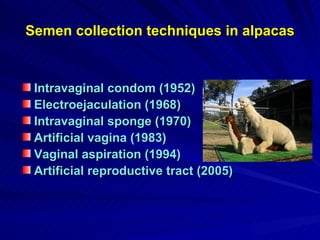
Semen collection techniques in alpacas Intravaginal condom (1952) Electroejaculation (1968) Intravaginal sponge (1970) Artificial vagina (1983)  Vaginal aspiration (1994) Artificial reproductive tract (2005)
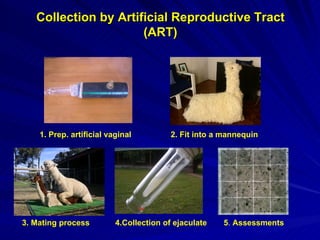
Collection by Artificial Reproductive Tract (ART) 1. Prep. artificial vaginal 2. Fit into a mannequin   3. Mating process 4.Collection of ejaculate 5 .  Assessments
Parameters of alpaca semen (5 males, 3 locations, 15 collections) Macroscopic evaluation: Volume 2.57 ml (1 to 6) Colour (Milky white) Consistency (Viscous, gelatinous) Microscopic evaluation: Motility 56.67 % (10 to 70%) Concentration 87.43 x 10 6  sperm/ml (4.8 - 220) Live sperm (58 – 83 %) Abnormalities (heads 3-13%, tails 9-15%)
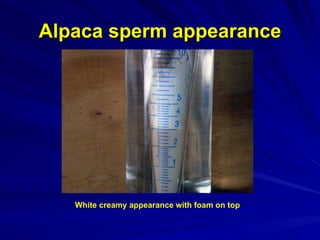
Alpaca sperm appearance White creamy appearance with foam on top
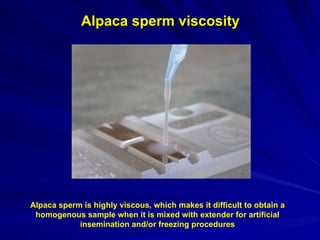
Alpaca sperm viscosity Alpaca sperm is highly viscous, which makes it difficult to obtain a homogenous sample when it is mixed with extender for artificial insemination and/or freezing procedures
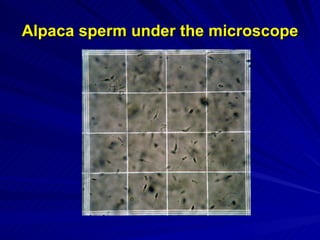
Alpaca sperm under the microscope
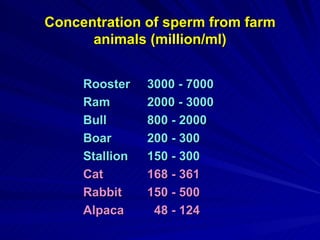
Concentration of sperm from farm animals (million/ml) Rooster 3000 - 7000 Ram 2000 - 3000 Bull  800 - 2000 Boar  200 - 300 Stallion  150 - 300 Cat 168 - 361 Rabbit 150 - 500 Alpaca    48 - 124
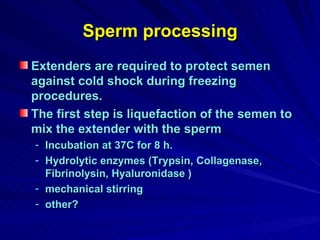
Sperm processing Extenders are required to protect semen against cold shock during freezing procedures. The first step is liquefaction of the semen to mix the extender with the sperm  Incubation at 37C for 8 h. Hydrolytic enzymes (Trypsin, Collagenase, Fibrinolysin, Hyaluronidase ) mechanical stirring other?
Cryopreservation An excellent extender has the following functions: Provides nutrients as a source of energy. Protects against the harmful effect of rapid cooling Ensures the pH will be maintained (buffer) Maintains osmotic pressure and electrolyte balance Inhibits bacterial growth Increases the volume of semen Protects sperm cells during freezing
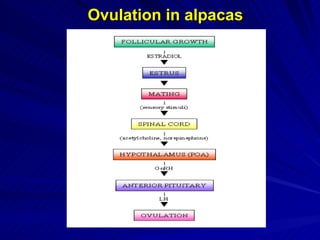
Ovulation in alpacas
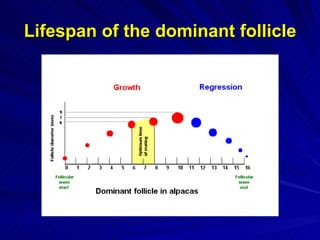
Lifespan of the dominant follicle
Preparation of the females for AI Induction of ovulation is required using a vasectomised males or with hormones like GnRH or hCG and inseminate at ????? hours later. Another technique that is being used in Peru is seminal plasma (0.8 -1.0 ml) i.m achieving 60 % of pregnancies.
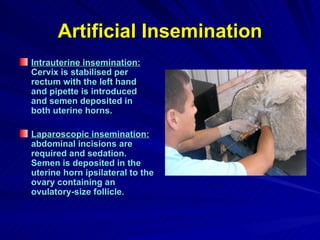
Artificial Insemination Intrauterine insemination:  Cervix is stabilised per rectum with the left hand and pipette is introduced and semen deposited in both uterine horns. Laparoscopic insemination:  abdominal incisions are required and sedation. Semen is deposited in the uterine horn ipsilateral to the ovary containing an ovulatory-size follicle.
Contact us Jorge Reyna BSc (Hons), MScVetSc (Sydney Univ.) 2/122 Newington Rd, Petersham, NSW 2049 Australia Phone: +61 2 9568 1370 Mobile: +61 428 ALPACA  E-mail:  [email_address]

Artificial Insemination in Alpacas

  • 1.
    Artificial insemination inalpacas Jorge Reyna Alpaca Breeding Technologies
  • 2.
    Why alpacas arebecoming so popular worldwide? Fibre production Ability to tolerate harsh climatic conditions Less erosive effect (fibro elastic pads) Meat production Skin Fuel Transport Companion animals
  • 3.
    Genetic improvement datacollection statistical and prediction models selection reproductive technologies (AI, ET, IVP) as a tool to disseminate the best genes in the population.
  • 4.
    Why the geneticimprovement is slow in alpacas? Males reach puberty from 1-3 years Long gestation length (11.5 months) Limited number of offspring in females in the whole reproductive life (3-4 in Peru).
  • 5.
    Advantages of AIin alpacas I Widespread use of elite sires Facilitates progeny testing Improved performance of the national herd Permits crossbreeding to change a production trait Accelerates introduction of new genetics
  • 6.
    Advantages of AIin alpacas II Reduces risk of spreading sexually transmitted and other (lice, JD) diseases Eliminates the need of transport of animals, reducing the need for “mobile matings” Provides a useful tool for investigating reproductive physiology
  • 7.
    Current limitations ofthe AI in alpacas Need reliable technique to collect sperm. Length of copulation 25.65 minutes (17 to 43) The unique mucoid character of the sperm. Low spermatozoa concentration and low motility in the ejaculate. Frequency of use of the male. Lack of techniques to store sperm in chilled or frozen form. The characteristic of induced ovulation in the female – timing of AI?
  • 8.
    Ejaculatory process inalpacas Copula takes up to 40 minutes. Urethral contractions are distributed evenly during the ejaculatory process. Ejaculation process is constantly (dribbling) Seminal plasma is gelatinous and holds sperm until ovulation takes place. > time of copulation > chance to find sperm on the ejaculate.
  • 9.
    Semen collection techniquesin alpacas Intravaginal condom (1952) Electroejaculation (1968) Intravaginal sponge (1970) Artificial vagina (1983) Vaginal aspiration (1994) Artificial reproductive tract (2005)
  • 10.
    Collection by ArtificialReproductive Tract (ART) 1. Prep. artificial vaginal 2. Fit into a mannequin 3. Mating process 4.Collection of ejaculate 5 . Assessments
  • 11.
    Parameters of alpacasemen (5 males, 3 locations, 15 collections) Macroscopic evaluation: Volume 2.57 ml (1 to 6) Colour (Milky white) Consistency (Viscous, gelatinous) Microscopic evaluation: Motility 56.67 % (10 to 70%) Concentration 87.43 x 10 6 sperm/ml (4.8 - 220) Live sperm (58 – 83 %) Abnormalities (heads 3-13%, tails 9-15%)
  • 12.
    Alpaca sperm appearanceWhite creamy appearance with foam on top
  • 13.
    Alpaca sperm viscosityAlpaca sperm is highly viscous, which makes it difficult to obtain a homogenous sample when it is mixed with extender for artificial insemination and/or freezing procedures
  • 14.
    Alpaca sperm underthe microscope
  • 15.
    Concentration of spermfrom farm animals (million/ml) Rooster 3000 - 7000 Ram 2000 - 3000 Bull 800 - 2000 Boar 200 - 300 Stallion 150 - 300 Cat 168 - 361 Rabbit 150 - 500 Alpaca 48 - 124
  • 16.
    Sperm processing Extendersare required to protect semen against cold shock during freezing procedures. The first step is liquefaction of the semen to mix the extender with the sperm Incubation at 37C for 8 h. Hydrolytic enzymes (Trypsin, Collagenase, Fibrinolysin, Hyaluronidase ) mechanical stirring other?
  • 17.
    Cryopreservation An excellentextender has the following functions: Provides nutrients as a source of energy. Protects against the harmful effect of rapid cooling Ensures the pH will be maintained (buffer) Maintains osmotic pressure and electrolyte balance Inhibits bacterial growth Increases the volume of semen Protects sperm cells during freezing
  • 18.
  • 19.
    Lifespan of thedominant follicle
  • 20.
    Preparation of thefemales for AI Induction of ovulation is required using a vasectomised males or with hormones like GnRH or hCG and inseminate at ????? hours later. Another technique that is being used in Peru is seminal plasma (0.8 -1.0 ml) i.m achieving 60 % of pregnancies.
  • 21.
    Artificial Insemination Intrauterineinsemination: Cervix is stabilised per rectum with the left hand and pipette is introduced and semen deposited in both uterine horns. Laparoscopic insemination: abdominal incisions are required and sedation. Semen is deposited in the uterine horn ipsilateral to the ovary containing an ovulatory-size follicle.
  • 22.
    Contact us JorgeReyna BSc (Hons), MScVetSc (Sydney Univ.) 2/122 Newington Rd, Petersham, NSW 2049 Australia Phone: +61 2 9568 1370 Mobile: +61 428 ALPACA E-mail: [email_address]