Paolo MalinvernoResearch Vice PresidentThe Cloudy Future of Business Commerce – Multienterprise B2B Collaboration
WhenStarsCollidee-Invoicinge-ProcurementB2BImage sources: nasa.gov
We’re Not in Kansas AnymoreMultienterprise B2B and e-procurement are morphing one into the otherElectronic invoicing is one of the main morphing agentsand is growing massively, especially in Europe and South AmericaThere much more than buying and selling in Multienterprise B2BMultienterprise processes are more and more pushed in the cloud2
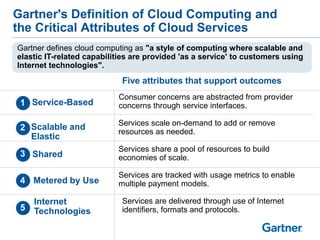
Gartner defines cloud computing as "a style of computing where scalable and elastic IT-related capabilities are provided 'as a service' to customers using Internet technologies".Five attributes that support outcomesConsumer concerns are abstracted from provider concerns through service interfaces.Service-Based1Services scale on-demand to add or remove resources as needed.Scalable and Elastic2Services share a pool of resources to build economies of scale. 3SharedServices are tracked with usage metrics to enable multiple payment models.4Metered by UseServices are delivered through use of Internet identifiers, formats and protocols.Internet Technologies5Gartner's Definition of Cloud Computing and the Critical Attributes of Cloud Services
The E-Procurement Roller CoasterFirst specialty procurement application
Most overhyped / customized solution
2009 / 2010 recession sparked a renaissance
E-procurement Spending
2.3 billion (US $)
6.5 CAGR in the next 3 years4
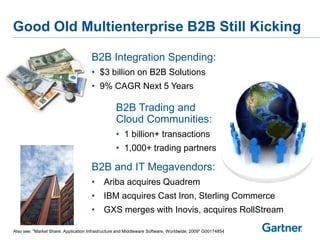
Good Old Multienterprise B2B Still KickingB2B Integration Spending:$3 billion on B2B Solutions
9% CAGR Next 5 YearsB2B Trading and Cloud Communities:1 billion+ transactions
1,000+ trading partnersB2B and IT Megavendors:Ariba acquires Quadrem
IBM acquires Cast Iron, Sterling Commerce
GXS merges with Inovis, acquires RollStreamAlso see: "Market Share: Application Infrastructure and Middleware Software, Worldwide, 2009" G00174854
Your B2B Infrastructure*Cloud Provider(application: HR, sales automation, payroll)Customer, Order Master Data, HR & Payroll dataIntegration as a Servicefor Cloud/SaaS (API) IntegrationStand-alone B2B Gateway Software or B2B-enabled Enterprise Service BusSuppliers(application: order entry)Orders, InvoicesOrders, ASNsCustomers(application: procurement)Payment InstructionsManaged File Transfer Software or MFTaaS(Integration as a Service)Integration as a Service combined with B2B Integration Outsourcing Bank(application: cash management)* Ok, it's likely that your B2B integration infrastructure is more complicated than this 
Strategic Planning AssumptionIn 2015, over 50% of integration projects will address a combination of internal (A2A), traditional e-commerce (B2B), managed file transfer (MFT) and SaaS/cloud services integration requirements versus less than 10% today.

Gartner Presentation AribaLIVE London

  • 1.
    Paolo MalinvernoResearch VicePresidentThe Cloudy Future of Business Commerce – Multienterprise B2B Collaboration
  • 2.
  • 3.
    We’re Not inKansas AnymoreMultienterprise B2B and e-procurement are morphing one into the otherElectronic invoicing is one of the main morphing agentsand is growing massively, especially in Europe and South AmericaThere much more than buying and selling in Multienterprise B2BMultienterprise processes are more and more pushed in the cloud2
  • 4.
    Gartner defines cloudcomputing as "a style of computing where scalable and elastic IT-related capabilities are provided 'as a service' to customers using Internet technologies".Five attributes that support outcomesConsumer concerns are abstracted from provider concerns through service interfaces.Service-Based1Services scale on-demand to add or remove resources as needed.Scalable and Elastic2Services share a pool of resources to build economies of scale. 3SharedServices are tracked with usage metrics to enable multiple payment models.4Metered by UseServices are delivered through use of Internet identifiers, formats and protocols.Internet Technologies5Gartner's Definition of Cloud Computing and the Critical Attributes of Cloud Services
  • 5.
    The E-Procurement RollerCoasterFirst specialty procurement application
  • 6.
    Most overhyped /customized solution
  • 7.
    2009 / 2010recession sparked a renaissance
  • 8.
  • 9.
  • 10.
    6.5 CAGR inthe next 3 years4
  • 11.
    Good Old MultienterpriseB2B Still KickingB2B Integration Spending:$3 billion on B2B Solutions
  • 12.
    9% CAGR Next5 YearsB2B Trading and Cloud Communities:1 billion+ transactions
  • 13.
    1,000+ trading partnersB2Band IT Megavendors:Ariba acquires Quadrem
  • 14.
    IBM acquires CastIron, Sterling Commerce
  • 15.
    GXS merges withInovis, acquires RollStreamAlso see: "Market Share: Application Infrastructure and Middleware Software, Worldwide, 2009" G00174854
  • 16.
    Your B2B Infrastructure*CloudProvider(application: HR, sales automation, payroll)Customer, Order Master Data, HR & Payroll dataIntegration as a Servicefor Cloud/SaaS (API) IntegrationStand-alone B2B Gateway Software or B2B-enabled Enterprise Service BusSuppliers(application: order entry)Orders, InvoicesOrders, ASNsCustomers(application: procurement)Payment InstructionsManaged File Transfer Software or MFTaaS(Integration as a Service)Integration as a Service combined with B2B Integration Outsourcing Bank(application: cash management)* Ok, it's likely that your B2B integration infrastructure is more complicated than this 
  • 17.
    Strategic Planning AssumptionIn2015, over 50% of integration projects will address a combination of internal (A2A), traditional e-commerce (B2B), managed file transfer (MFT) and SaaS/cloud services integration requirements versus less than 10% today.

Editor's Notes

  • #4 During the past 15 years, a continuing trend toward IT industrialization has grown in popularity. IT services delivered via hardware, software and people are becoming repeatable and usable by a wide range of customers and service providers. This is partly because of the commoditization and standardization of technologies, virtualization and the rise of service-oriented software architectures, and (most importantly) the dramatic growth in popularity/use of the Internet and the Web. These things, taken together, constitute the basis of a discontinuity that amounts to a new opportunity to shape the relationship between those who use IT services and those who sell them. The discontinuity implies that the ability to deliver specialized services in IT can now be paired with the ability to deliver those services in an industrialized and pervasive way. The reality of this implication is that users of IT-related services can focus on what the services provide them, rather than how the services are implemented or hosted. Just as utility companies sell power to subscribers, and telephone companies sell voice and data services, IT services (such as network security management, data center hosting or even departmental billing) can now be easily delivered as a contractual service. The buying decision then shifts from buying products that enable the delivery of some function (like billing) toward contracting, with someone else delivering those functions. This isn't new, but it does represent a different model from the license-based, on-premises models that have dominated the IT industry for so long. Names for this type of operation have come into vogue at different times. Utility computing, SaaS, application service providers — all have their places in the pantheon of industrialized delivery models. However, none has garnered widespread acceptance as the central theme for how any and all IT-related services can be delivered globally.
  • #6 There is plenty of evidence to support the increase in importance of B2B. Companies are implementing ever more B2B projects that involve ever larger B2B trading communities — some private ones have thousands of trading partners and execute over a billion transactions a year. Between various forms of B2B integration software and integration services, companies will spend about $3 billion in 2010, and that spending, on average across all forms of B2B integration solutions, will increase at 9% CAGR over the next five years. The CAGR for some categories of B2B, such as integration as a service (IaaS) for cloud scenarios, is 25%.After nearly 10 years of largely ignoring B2B, the IT megavendors, such as IBM and SAP, have begun moving decisively to strengthen their B2B offerings and more clearly articulate a B2B strategy. B2B providers themselves, such as GXS and Liaison, continue to actively invest and refine their strategies to better serve their customers and effectively capitalize on the growing B2B opportunity. Companies should expect substantial M&A activity in the B2B vendor landscape. Because B2B is increasingly important, acquisitions are likely to be from acquiring companies that are either consolidating the B2B market or plugging a significant gap in their own B2B portfolio. This is a positive move, since the acquiring company will most likely have good intentions regarding continued support for existing products, services and customers. However, this will sometimes impact integration product and service road maps.
  • #7 Authors create "composite characters" to depict someone that matches their (stereotypical) perception of someone from a particular ethnicity, lifestyle or other dimension. Here, we have created a "composite B2B infrastructure" to depict our perception of an IT user company with a stereotypical B2B infrastructure to address a variety of B2B integration problems. While this IT user is fiction, this combination of B2B problems to be solved and types of solutions used to address them is quite common. B2B problems include: Automating the procure-to-pay process with suppliers: Often addressed via B2B integration software (as illustrated), sometimes via VAN services plus translation software, or wholly by B2B integration outsourcing. Automating the order-to-cash process: Same options as for supplier integration, but having to support different types of connections for each customer makes B2B integration outsourcing a bit more attractive. Integration cloud-based functionality with on-premises applications: Again, either B2B software or services will work, but many cloud services users are comfortable also using IaaS. Automating the payment process: Often some form of B2B software, typically MFT (well entrenched in financial services), but MFTaaS (a form of integration as a service) is a viable new option.While B2B requirements vary across industries and regions, the general approach to solving B2B integration remains the same: You can typically either use B2B software or services — it's an IT outsourcing decision.
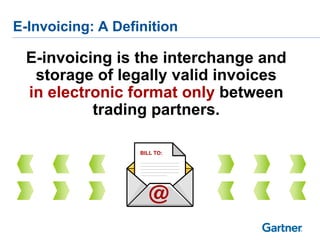
  • #9 The interchange does not use or require paper-based invoices. E-invoices have legal validity, and can be used to prove compliance or serve as tax originals. This presentation is about e-invoicing in general. Most considerations apply whether you are sending e-invoices or receiving them, unless otherwise stated. Operationally: The seller must ensure that the invoice contains the correct data and that it is authentic. The buyer must verify the authenticity of the invoice, match it to goods or services received, and execute payment. The seller and the buyer (or a third party on their behalf) must store the readable and authentic (this comes with a lot of added strong security) invoice for a period of time, and make it available to a tax authority on request.
  • #10 Payments for goods and services account for about 30% of the gross domestic product of most countries; several countries implement a value-added tax (VAT) over those payments (for goods and services): We are talking about a lot of money, made up of a lot of invoices. With good reason, government tax authorities have a strong interest in ensuring that companies exchange and store invoices in a secure and reliable way to prevent taxation errors, and to minimize fraud. Thus, tax authorities typically rely heavily on the invoice to establish the commercial and tax implications of a specific transaction.E-invoicing affects internal business processes, mutual agreements among business partners, financial transactions, taxes and legal compliance, and a lot of the IT infrastructure that supports all that. The business processes to get invoices paid change slightly by company (and sometimes within a specific company, depending on trading-partner agreements, business practices in different parts of the world, or the type of invoice); (tax) laws and security norms (for example, e-signatures and how advanced/qualified they are, or the rules for issuing them or building certificates). On the other hand, for many buyer-supplier communities, the continued prevalence of paper-based or fax-based invoices and the inertia it has produced has severely limited the ability to leverage e-invoices to automate the purchase-order-to-invoice reconciliation processes and the rest of the payment process.
  • #11 So far in this presentation, we have identified several arguments against using e-invoicing, and we have covered, in some detail, the complexities associated with it. However, there are excellent reasons that prompt companies to face these complexities, deal with them and invest in e-invoicing.Most of the e-invoice savings are due to more-streamlined payment processes, taking humans out of the picture as much as possible, and providing the whole set of data that is needed to reconcile the invoice with the goods or services received (typically, by integration with an ERP package). The vast majority of e-invoicing implementers that have done invoice printing and scanning have found that it is not enough and have moved to something else. If you need to send e-invoices to the governments in Europe or the supply chain masters who mandated (or will shortly mandate) e-invoices, then printing and scanning will be of little use.Whichever way you decide to demonstrate savings, the clear indication from case studies is that the savings for companies that have to deal with a large volume of invoices (more than 100 per day, inbound and outbound) are significant (see "Supplier E-Invoicing Networks," G00163578), because of the economies of scale obtained by aligning technical, business and compliance strategies.
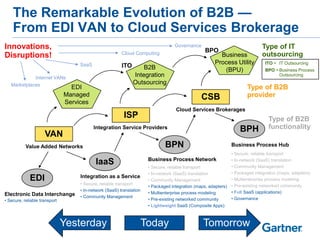
  • #13 An inevitable consequence of the rapid evolution of IT is that companies frequently implement hybrid combinations of legacy, contemporary and innovative business functionality. For B2B projects, this may mean running a combination of legacy EDI, contemporary AS2 or RosettaNet, and innovative cloud APIs. On the surface, such diversity seems haphazard, and calls into doubt the durability and viability of different B2B technologies and standards, as well as the IT providers who deliver them. And, in fact, the high rate of IT evolution is disruptive to B2B technology and the B2B vendor landscape, but this doesn't mean that there is no order to how these will evolve. Looking at B2B through the lens of consumption of integration functionality, we have outlined the evolution of B2B integration technology, and some key categories of B2B providers and IT outsourcing. Integration technology itself has evolved from EDI (a simple B2B transaction mapping technology) to business process networks (preconfigured integration of multienterprise processes for pre-plumbed communities of companies using those processes). EDI VANs have already evolved into integration service providers, and those that endure will be acquired to enable or evolve directly into cloud services brokerages. IT outsourcing related to B2B projects has evolved from custom managed service projects to business process utilities — a form of cloud-enabled business process outsourcing that can be applied to specific multienterprise processes. All of these changes will take many years, and in the meantime, companies will — by necessity — continue to consume B2B integration functionality for various projects along the spectrum of evolving B2B technology, providers and sourcing.
  • #14 In human civilization, the concept of brokerage (or intermediation) is a well-established practice. In the world of IT, this is less widely spread, but still commonplace. As cloud computing grows, the need for more intermediation must be met by a corresponding group of markets that establish intermediation as a critical line of business. Cloud services brokerage leverages the teachings of many different industries in using brokerage to facilitate enhanced services, insurance protection, travel arrangements, peer references, and aggregation of services. Financial services and travel lead the way in unscientific samplings of our clients as the most prevalent industries that use brokerage to facilitate complex supplier/consumer relationships. And while utilities and retail lag behind, the reality still remains that these industries use brokerage in supply chain operations on a daily basis. Cloud services brokerage (CSB) is a third party (intermediary) that works on behalf of the consumer of one or more cloud services to add value to the service(s) being consumed. The benefits of implementing cloud services using CSB include value-added services (e.g., consistent billing, security), the CSB is responsible for federating diverse cloud services and APIs, and the CSB can offer normalized governance. Challenges include the CSB "getting in the way" of direct relationships with providers, potential CSB "middle-man" costs and the potential impact of confusion or disruption associated with the relatively immature CSB market.
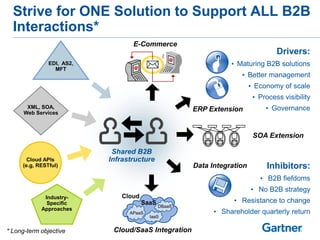
  • #16 Why do companies use different approaches for B2B integration? Because different approaches to B2B solve different kinds of integration problems — for example, multistep process integration (such as vendor-managed inventory) versus synchronizing master data (such as customer). Many B2B standards aren't very standard — for example, in the petroleum industry, you will likely use PDIX, and in high-tech manufacturing, RosettaNet. Different processes are supported by different B2B standards — for example, SWIFT for electronic payments and Commerce XML for procurement. Different technologies solve different problems — for example, FTP or AS2 for smaller files such as e-commerce transactions, and MFT for larger files such as engineering documents and lab images. Different IT ecosystems use different approaches – for example, cloud providers often use the REST-based APIs to expose services, while e-commerce providers still typically use FTP/EDI. Diversity is fueled by differences in control — for example, a manufacturer has more leverage over its suppliers than its customers. Each company has a different level of IT maturity — for example, in one company, EDI may be well-entrenched, while another uses Web services. Most midsize to large companies must support multiple approaches to B2B, so it is natural to implement one B2B infrastructure to support all B2B projects. Particularly if you are consolidating existing B2B infrastructure, this could take years and, in some cases, full consolidation may not even be practical. Vendors are responding by expanding their solutions to address different needs — e.g., GXS adding MFT to its IaaS capabilities, and IBM acquiring Cast Iron for cloud and Sterling Commerce for e-commerce integration — so it's possible that your existing provider offers new approaches to B2B. Benefits of consolidation include lower B2B project costs (from economies of scale), more consistency, better provisioning tools, as well as improved security, process visibility and governance.