Manufacturing
Process
IED/Natalie Chow
30-May-2024
Introduction
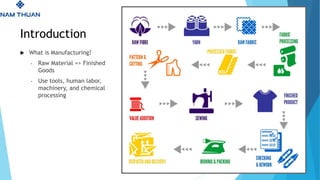
 What is Manufacturing?
- Raw Material => Finished
Goods
- Use tools, human labor,
machinery, and chemical
processing
Introduction
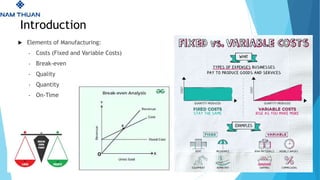
 Elements of Manufacturing:
- Costs (Fixed and Variable Costs)
- Break-even
- Quality
- Quantity
- On-Time
Introduction
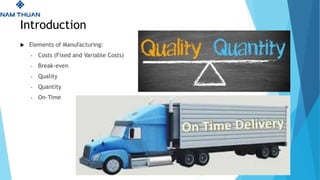
 Elements of Manufacturing:
- Costs (Fixed and Variable Costs)
- Break-even
- Quality
- Quantity
- On-Time
Introduction
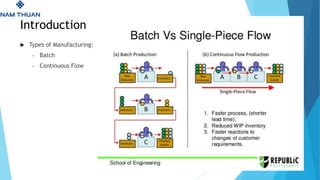
 Types of Manufacturing:
- Batch
- Continuous Flow
Manufacturing Flow
1. The flow of raw material – Accessories, Fabrics etc.
2. The flow of work-in-process – Cut Panel, WIP etc.
3. The flow of finished goods
4. The flow of operators
5. The flow of machines
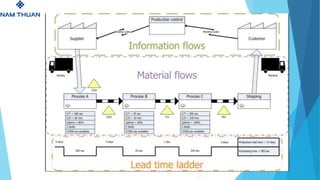
6. The flow of information – Quality Standards, WI etc.
7. The flow of engineering – Line balancing, Process Improvements
Barriers to Flow
 Examples of Physical Barriers to Flow:
1. Distance: Items are collected and shipped in bulk
2. Long Setup Times: Changeover takes a long time, larger batches are run
3. Batch-Oriented Machines: Some machines are designed to be most efficient with large runs.
4. Poor Maintenance: Machines break down frequently.
 Examples of Intangible Barriers to Flow:
1. Unreliable Deliveries: No confirmation that parts will arrive on time, extras are kept on hand
2. Unreliable Quality: If many parts will be rejected or will require rework, extras will be kept on hand
3. Approval Processes: Approver is seldom standing by, so work is piled up until get the go-ahead.
4. Lack of Faith: Some people just don’t believe flow is possible, so don’t even try
5. Resistance to Change: Some people think flow might work, but like things to stay the same.
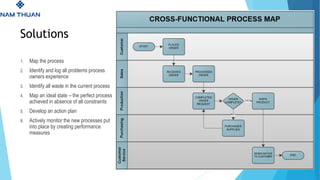
Solutions
1. Map the process
2. Identify and log all problems process
owners experience
3. Identify all waste in the current process
4. Map an ideal state – the perfect process
achieved in absence of all constraints
5. Develop an action plan
6. Actively monitor the new processes put
into place by creating performance
measures
The End

Garment Manufacturing Process Introduction

  • 1.
  • 2.
    Introduction  What isManufacturing? - Raw Material => Finished Goods - Use tools, human labor, machinery, and chemical processing
  • 3.
    Introduction  Elements ofManufacturing: - Costs (Fixed and Variable Costs) - Break-even - Quality - Quantity - On-Time
  • 4.
    Introduction  Elements ofManufacturing: - Costs (Fixed and Variable Costs) - Break-even - Quality - Quantity - On-Time
  • 5.
    Introduction  Types ofManufacturing: - Batch - Continuous Flow
  • 6.
    Manufacturing Flow 1. Theflow of raw material – Accessories, Fabrics etc. 2. The flow of work-in-process – Cut Panel, WIP etc. 3. The flow of finished goods 4. The flow of operators 5. The flow of machines 6. The flow of information – Quality Standards, WI etc. 7. The flow of engineering – Line balancing, Process Improvements
  • 8.
    Barriers to Flow Examples of Physical Barriers to Flow: 1. Distance: Items are collected and shipped in bulk 2. Long Setup Times: Changeover takes a long time, larger batches are run 3. Batch-Oriented Machines: Some machines are designed to be most efficient with large runs. 4. Poor Maintenance: Machines break down frequently.  Examples of Intangible Barriers to Flow: 1. Unreliable Deliveries: No confirmation that parts will arrive on time, extras are kept on hand 2. Unreliable Quality: If many parts will be rejected or will require rework, extras will be kept on hand 3. Approval Processes: Approver is seldom standing by, so work is piled up until get the go-ahead. 4. Lack of Faith: Some people just don’t believe flow is possible, so don’t even try 5. Resistance to Change: Some people think flow might work, but like things to stay the same.
  • 9.
    Solutions 1. Map theprocess 2. Identify and log all problems process owners experience 3. Identify all waste in the current process 4. Map an ideal state – the perfect process achieved in absence of all constraints 5. Develop an action plan 6. Actively monitor the new processes put into place by creating performance measures
  • 10.