www.schoolofpublicpolicy.sk.ca
Rubens Yanes
JSGS 865 -Fall 2020
Garbage Can Model
Cohen, M., J. March and J. Olsen. 1972
www.schoolofpublicpolicy.sk.ca
Two different paradigms
Garbage Can Model
2
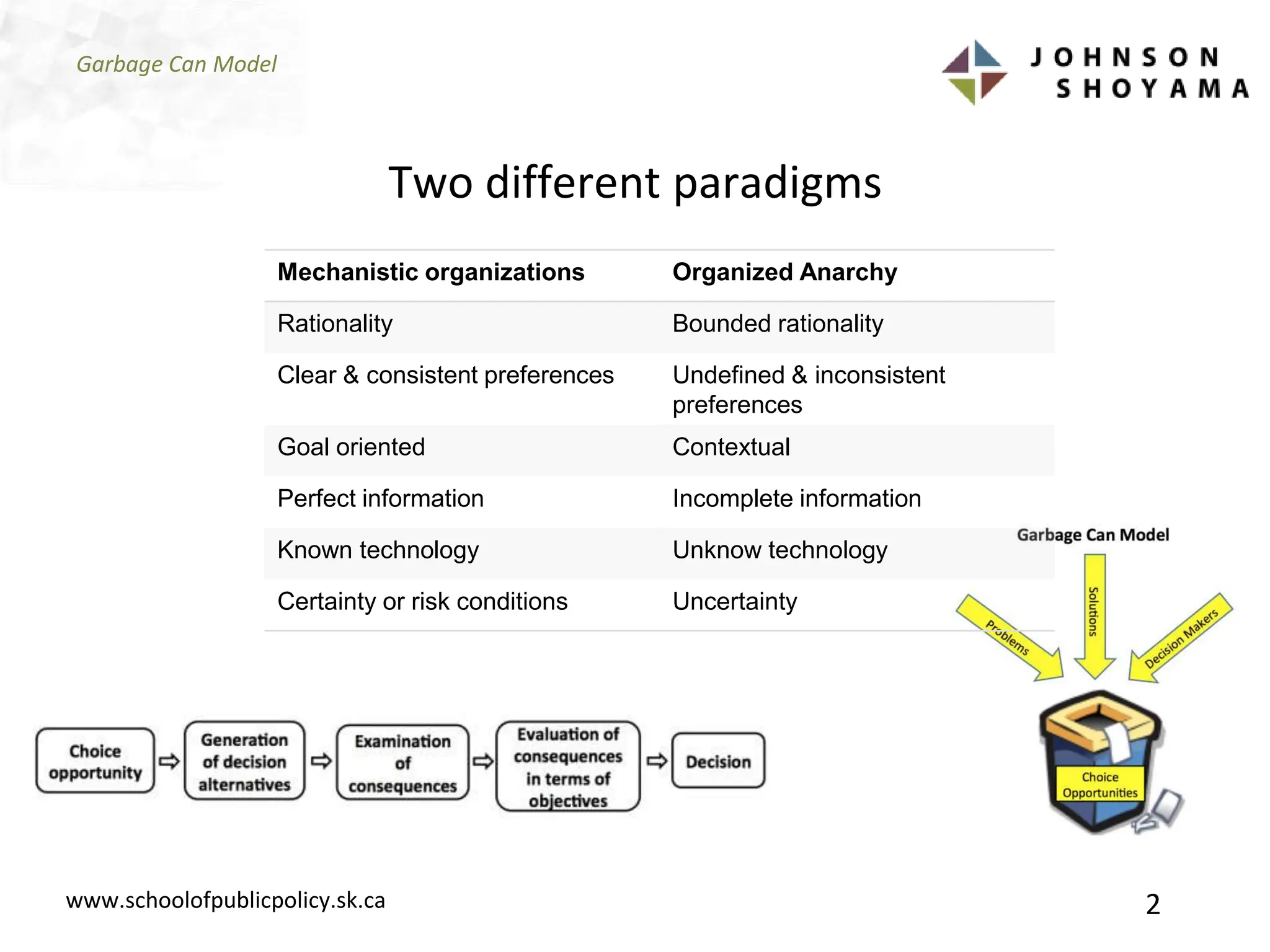
Mechanistic organizations Organized Anarchy
Rationality Bounded rationality
Clear & consistent preferences Undefined & inconsistent
preferences
Goal oriented Contextual
Perfect information Incomplete information
Known technology Unknow technology
Certainty or risk conditions Uncertainty
www.schoolofpublicpolicy.sk.ca
Basic Assumptions of the model
Garbage Can Model
3
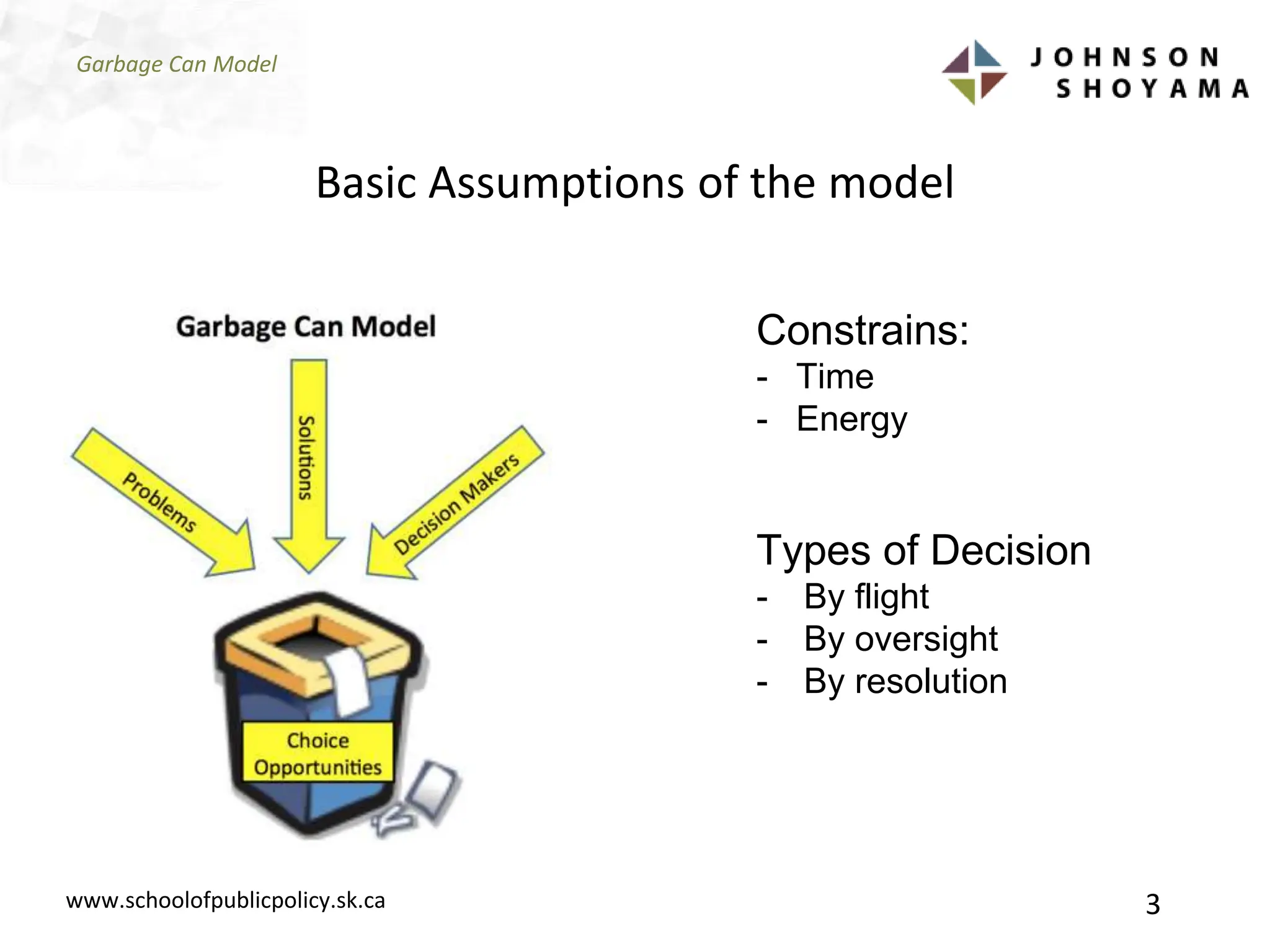
Constrains:
- Time
- Energy
Types of Decision
- By flight
- By oversight
- By resolution
www.schoolofpublicpolicy.sk.ca
Different Organizational Structures
Garbage Can Model
4
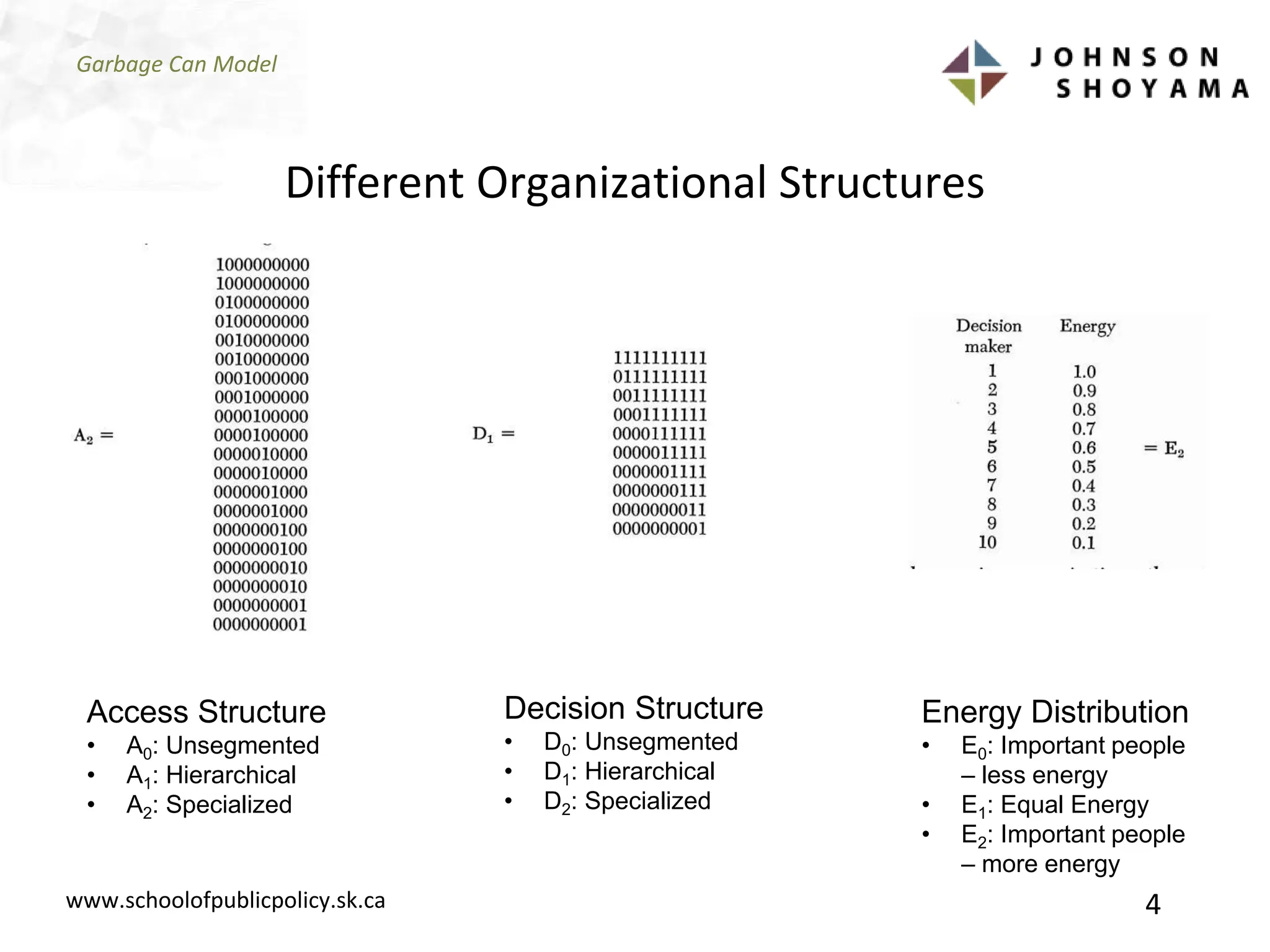
Access Structure
• A0: Unsegmented
• A1: Hierarchical
• A2: Specialized
Decision Structure
• D0: Unsegmented
• D1: Hierarchical
• D2: Specialized
Energy Distribution
• E0: Important people
– less energy
• E1: Equal Energy
• E2: Important people
– more energy
www.schoolofpublicpolicy.sk.ca
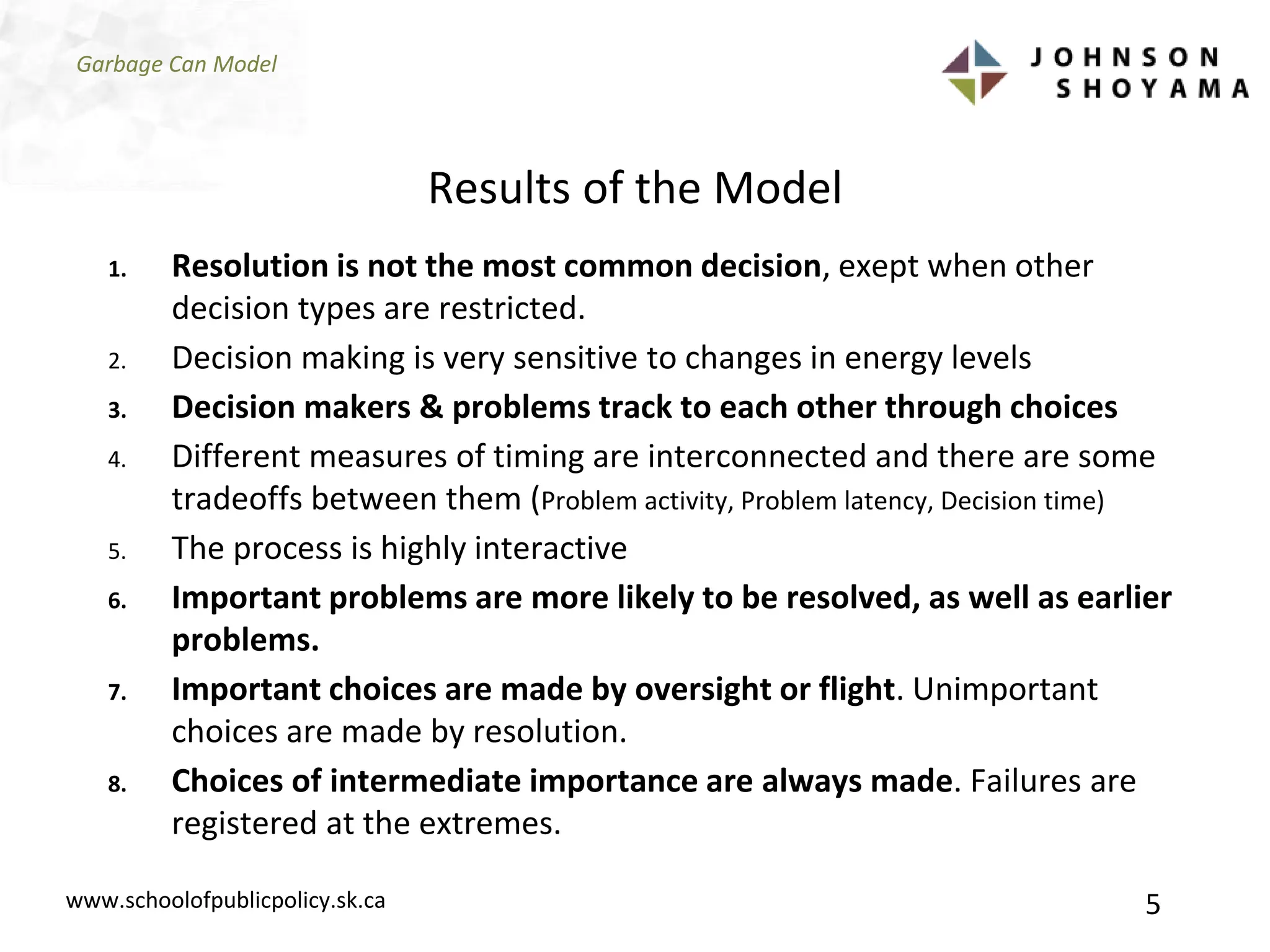
1. Resolution is not the most common decision, exept when other
decision types are restricted.
2. Decision making is very sensitive to changes in energy levels
3. Decision makers & problems track to each other through choices
4. Different measures of timing are interconnected and there are some
tradeoffs between them (Problem activity, Problem latency, Decision time)
5. The process is highly interactive
6. Important problems are more likely to be resolved, as well as earlier
problems.
7. Important choices are made by oversight or flight. Unimportant
choices are made by resolution.
8. Choices of intermediate importance are always made. Failures are
registered at the extremes.
Results of the Model
Garbage Can Model
5
www.schoolofpublicpolicy.sk.ca
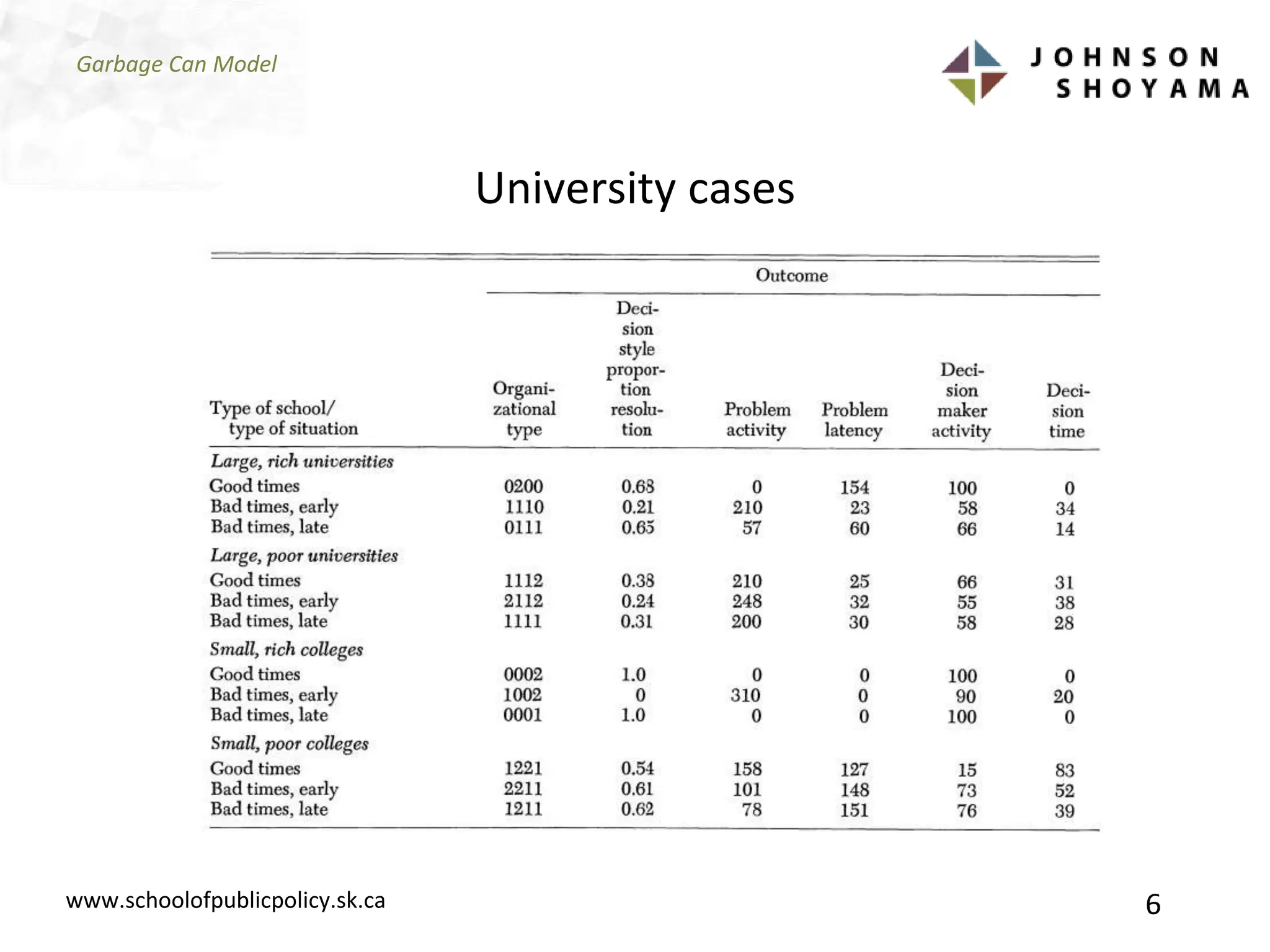
University cases
Garbage Can Model
6
www.schoolofpublicpolicy.sk.ca
Assessment
Garbage Can Model
7
1. Organizations are far from being perfect
solving-problem machines
2. As it happens with cognitive biases, we
can´t avoid organizational flaws but we
need to learn to live with them
3. The model provides some suggestions on
how to structure organizations if we
want to make them more effective, but
there are not magic solutions since
tradeoffs emerged.
4. Deadlines and empowering decision
making are other available options to
improve organization’s performance.

Garbage Can Model by Cohen, March and Olsen

  • 1.
    www.schoolofpublicpolicy.sk.ca Rubens Yanes JSGS 865-Fall 2020 Garbage Can Model Cohen, M., J. March and J. Olsen. 1972
  • 2.
    www.schoolofpublicpolicy.sk.ca Two different paradigms GarbageCan Model 2 Mechanistic organizations Organized Anarchy Rationality Bounded rationality Clear & consistent preferences Undefined & inconsistent preferences Goal oriented Contextual Perfect information Incomplete information Known technology Unknow technology Certainty or risk conditions Uncertainty
  • 3.
    www.schoolofpublicpolicy.sk.ca Basic Assumptions ofthe model Garbage Can Model 3 Constrains: - Time - Energy Types of Decision - By flight - By oversight - By resolution
  • 4.
    www.schoolofpublicpolicy.sk.ca Different Organizational Structures GarbageCan Model 4 Access Structure • A0: Unsegmented • A1: Hierarchical • A2: Specialized Decision Structure • D0: Unsegmented • D1: Hierarchical • D2: Specialized Energy Distribution • E0: Important people – less energy • E1: Equal Energy • E2: Important people – more energy
  • 5.
    www.schoolofpublicpolicy.sk.ca 1. Resolution isnot the most common decision, exept when other decision types are restricted. 2. Decision making is very sensitive to changes in energy levels 3. Decision makers & problems track to each other through choices 4. Different measures of timing are interconnected and there are some tradeoffs between them (Problem activity, Problem latency, Decision time) 5. The process is highly interactive 6. Important problems are more likely to be resolved, as well as earlier problems. 7. Important choices are made by oversight or flight. Unimportant choices are made by resolution. 8. Choices of intermediate importance are always made. Failures are registered at the extremes. Results of the Model Garbage Can Model 5
  • 6.
  • 7.
    www.schoolofpublicpolicy.sk.ca Assessment Garbage Can Model 7 1.Organizations are far from being perfect solving-problem machines 2. As it happens with cognitive biases, we can´t avoid organizational flaws but we need to learn to live with them 3. The model provides some suggestions on how to structure organizations if we want to make them more effective, but there are not magic solutions since tradeoffs emerged. 4. Deadlines and empowering decision making are other available options to improve organization’s performance.