Downloaded 20 times


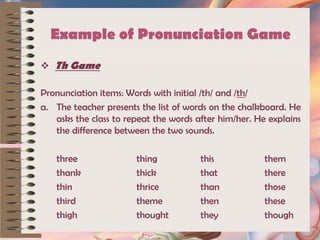



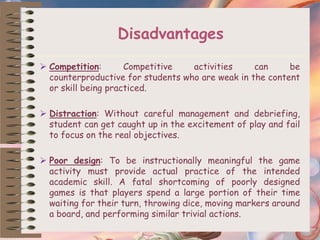


Games are activities with goals, rules and rewards that provide formalized expressions of play. They offer social and cognitive experiences and learning. While games are designed to amuse, educational games also have cognitive and social purposes. Examples provided discuss a pronunciation game to practice differentiating between /th/ and /th/ sounds and a reading game using word roots. Guidelines recommend games be related to educational objectives and include discussion to clarify skills learned. Advantages include engagement and team building, while disadvantages can include competition causing distraction or poor design failing to practice intended skills.


![[RELO] Let's Play! Games in the English Classroom](https://cdn.slidesharecdn.com/ss_thumbnails/gameswebinar-131114151204-phpapp01-thumbnail.jpg?width=640&height=640&fit=bounds)


