Game Setting Research

Fantasy - Commonly uses magic and other supernatural phenomena as a primary plot element,
theme, or setting. Many works within the genre take place in imaginary worlds where magic and
magical creatures are common. Fantasy is generally distinguished from the genres of science fiction
and horror by the expectation that it steers clear of scientific and macabre themes, respectively,
though there is a great deal of overlap between the three, all of which are subgenres of speculative
fiction.
Many fantasy games use medieval weaponry like swords, bow and arrows and even larger weapons
like catapults.
The identifying traits of fantasy are the inclusion of fantastic elements in a self-coherent (internally
consistent) setting, where inspiration from mythology and folklore remains a consistent theme.
Within such a structure, any location of the fantastical element is possible: it may be hidden in, or
leak into the apparently real world setting, it may draw the characters into a world with such
elements, or it may occur entirely in a fantasy world setting, where such elements are part of the
world. Essentially, fantasy follows rules of its own making, allowing magic and other fantastic devices
to be used and still be internally cohesive.
Everyday – modern technology; vehicles, weapons, clothes.
I plan on combining the Fantasy setting with an Everyday setting, putting magic and modern tech
together as well as modern weapons like guns and more medieval weapons like swords, as well as
combining cities and towns of the real world with plants, creatures and people from a fantasy
setting.
http://en.wikipedia.org/wiki/Fantasy
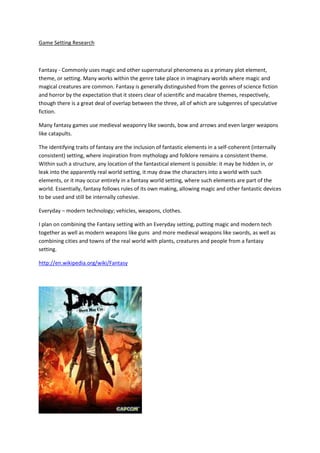
Devil May Cry is a good example of a more dark fantasy setting being combined with the real world
in which demons rule the world and hide in limbo to prevent humans from discovering them.
http://en.wikipedia.org/wiki/DmC:_Devil_May_Cry

Game setting research

  • 1.
    Game Setting Research Fantasy- Commonly uses magic and other supernatural phenomena as a primary plot element, theme, or setting. Many works within the genre take place in imaginary worlds where magic and magical creatures are common. Fantasy is generally distinguished from the genres of science fiction and horror by the expectation that it steers clear of scientific and macabre themes, respectively, though there is a great deal of overlap between the three, all of which are subgenres of speculative fiction. Many fantasy games use medieval weaponry like swords, bow and arrows and even larger weapons like catapults. The identifying traits of fantasy are the inclusion of fantastic elements in a self-coherent (internally consistent) setting, where inspiration from mythology and folklore remains a consistent theme. Within such a structure, any location of the fantastical element is possible: it may be hidden in, or leak into the apparently real world setting, it may draw the characters into a world with such elements, or it may occur entirely in a fantasy world setting, where such elements are part of the world. Essentially, fantasy follows rules of its own making, allowing magic and other fantastic devices to be used and still be internally cohesive. Everyday – modern technology; vehicles, weapons, clothes. I plan on combining the Fantasy setting with an Everyday setting, putting magic and modern tech together as well as modern weapons like guns and more medieval weapons like swords, as well as combining cities and towns of the real world with plants, creatures and people from a fantasy setting. http://en.wikipedia.org/wiki/Fantasy
  • 2.
    Devil May Cryis a good example of a more dark fantasy setting being combined with the real world in which demons rule the world and hide in limbo to prevent humans from discovering them. http://en.wikipedia.org/wiki/DmC:_Devil_May_Cry