@agatestudio 
Game programming 
Restya 
Producer 
Agate Studio
GAME PROGRAMMING PATTERNS 
Restya – TDS Agate Oktober
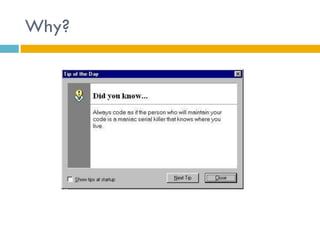
Why?
Chapters 
Design Patterns Revisited 
Sequencing Patterns 
Behavioral Patterns 
Decoupling Patterns 
Optimization Patterns
We’ll be focussed on 
Design Patterns Revisited 
Command 
Flyweight 
Observer 
Prototype 
Singleton 
State
Design Pattern
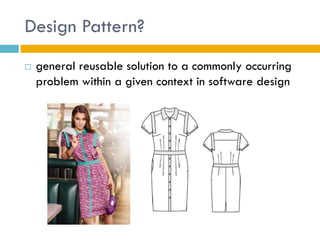
Design Pattern? 
general reusable solution to a commonly occurring problem within a given context in software design
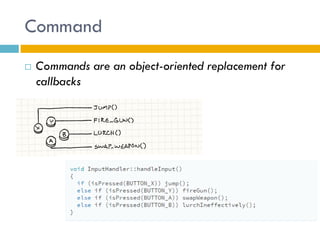
Command 
Commands are an object-oriented replacement for callbacks
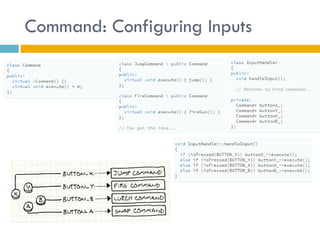
Command: Configuring Inputs
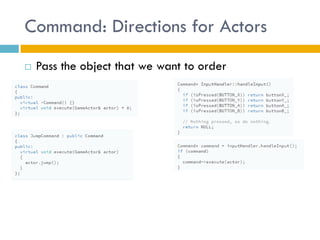
Command: Directions for Actors 
Pass the object that we want to order
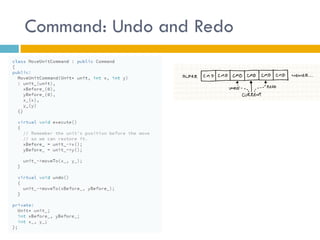
Command: Undo and Redo
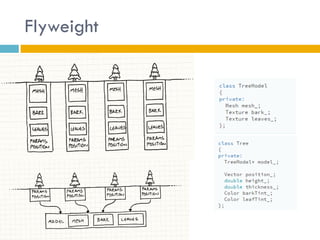
Flyweight
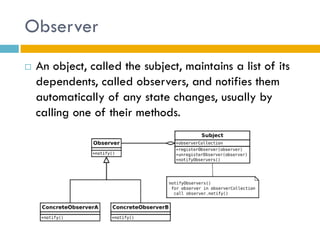
Observer 
An object, called the subject, maintains a list of its dependents, called observers, and notifies them automatically of any state changes, usually by calling one of their methods.
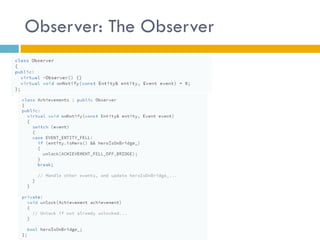
Observer: The Observer
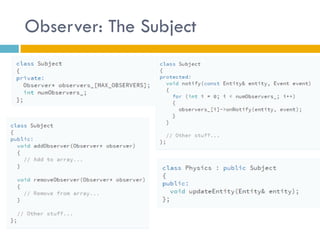
Observer: The Subject
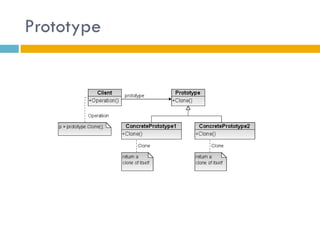
Prototype
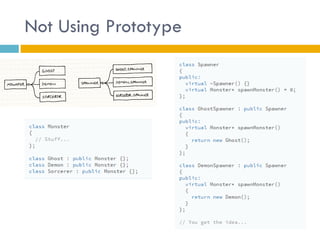
Not Using Prototype
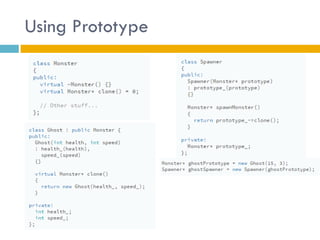
Using Prototype
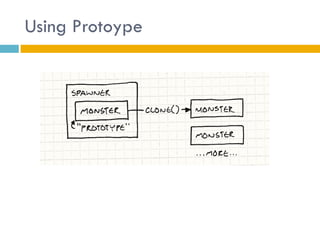
Using Protoype
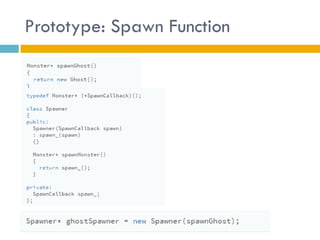
Prototype: Spawn Function
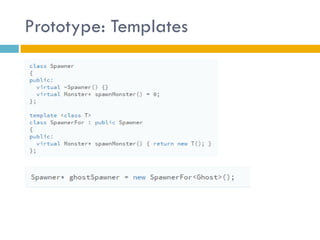
Prototype: Templates
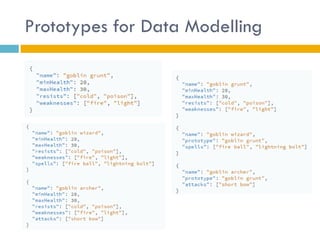
Prototypes for Data Modelling
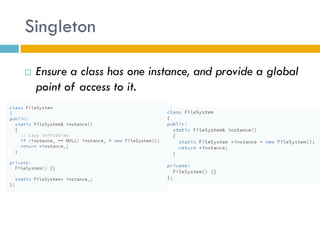
Singleton 
Ensure a class has one instance, and provide a global point of access to it.
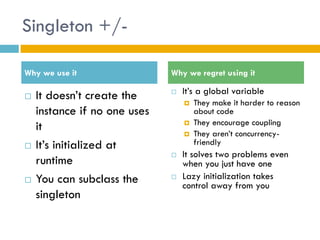
Singleton +/- 
It doesn’t create the instance if no one uses it 
It’s initialized at runtime 
You can subclass the singleton 
It’s a global variable 
They make it harder to reason about code 
They encourage coupling 
They aren’t concurrency- friendly 
It solves two problems even when you just have one 
Lazy initialization takes control away from you 
Why we use it 
Why we regret using it
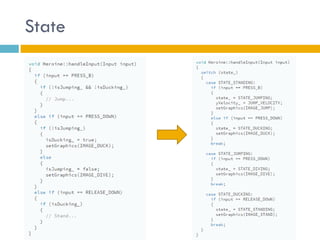
State
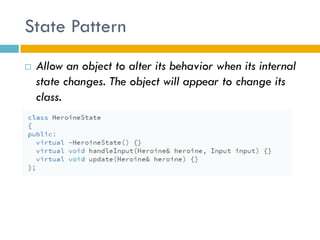
State Pattern 
Allow an object to alter its behavior when its internal state changes. The object will appear to change its class.
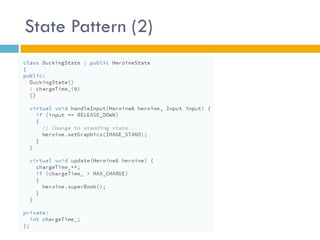
State Pattern (2)
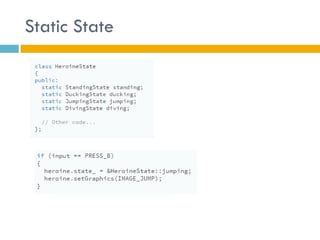
Static State
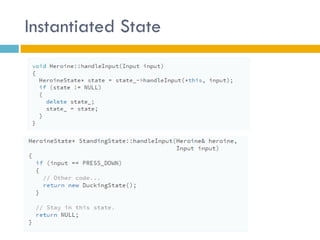
Instantiated State
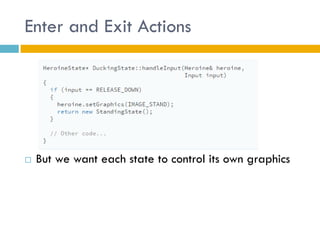
Enter and Exit Actions 
But we want each state to control its own graphics
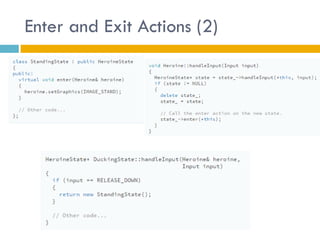
Enter and Exit Actions (2)
Source: http://gameprogrammingpatterns.com/ 
Udah Gitu Aja

Game Programming Pattern by Restya