Using Design Patterns
Introduction to Patterns
Each pattern describes a problem which occurs over and over again in
our environment, and then describes the core of the solution to that
problem, in such a way that you can use this solution a million times
over.
Advantages of using Patterns
•Promote reuse.
•Use the experiences of software developers.
•A shared library used by developers.
•“Design patterns help a designer get a design right faster”.
•Are based on the principles of object-oriented programming:
abstraction, inheritance, polymorphism and association.
•Are solutions to recurring problems to software design.
Which is Good Pattern?
A good pattern should
• Be as general as possible
• Contain a solution that has been proven to effectively solve the problem in the
indicated context.
Studying patterns is an effective way to learn from the experience of others
Example:
Jim Coplein, a software engineer:
“I like to relate this definition to dress patterns…”
• What are dress patterns?
• “... I could tell you how to make a dress by specifying the route of
a scissors through a piece of cloth in terms of angles and lengths
of cut. Or, I could give you a pattern. Reading the specification,
you would have no idea what was being built or if you had built
the right thing when you were finished. The pattern foreshadows
the product: it is the rule for making the thing, but it is also, in
many respects,
the thing itself.”
Patterns in engineering
How do other engineers find and use patterns?
• Mature engineering disciplines have handbooks
describing successful solutions to known problems
• Automobile designers don't design cars from scratch
using the laws of physics, Instead, they reuse standard designs with
successful track records, learning from experience.
What is a Design Pattern?
A technique to repeat designer success.
Borrowed from Civil and Electrical Engineering domains.
 A (Problem, Solution) pair.
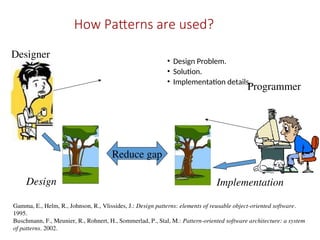
How Patterns are used?
• Design Problem.
• Solution.
• Implementation details.
Reduce gap
Design Implementation
Designer
Programmer
Gamma, E., Helm, R., Johnson, R., Vlissides, J.: Design patterns: elements of reusable object-oriented software.
1995.
Buschmann, F., Meunier, R., Rohnert, H., Sommerlad, P., Stal, M.: Pattern-oriented software architecture: a system
of patterns. 2002.
Pattern description
Context:
• The general situation in which the pattern applies
Problem:
• A short sentence or two raising the main difficulty.
Forces:
• The issues or concerns to consider when solving the problem
Solution:
• The recommended way to solve the problem in the given context.
—‘to balance the forces’
USEFUL DESIGN PATTERN
The most useful patterns that can be used in OO design and modeling
using UML are as follows:
• The general hierarchy pattern
• The singleton pattern
• The façade pattern
• The factory pattern
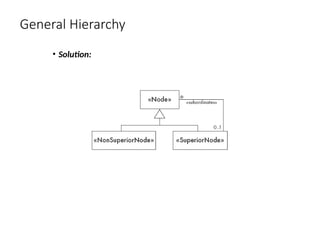
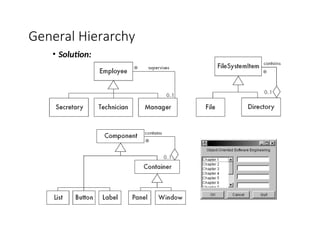
The General Hierarchy Pattern
• Context:
• objects in a hierarchy can have one or more objects above them (superiors),
• and one or more objects below them (subordinates).
• Some objects cannot have any subordinates
• Problem:
• How do you represent a hierarchy of objects, in which some objects cannot have
subordinates?
The General Hierarchy Pattern
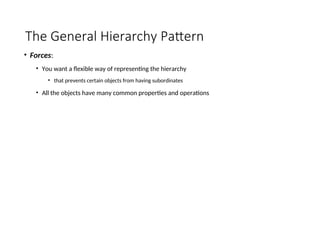
• Forces:
• You want a flexible way of representing the hierarchy
• that prevents certain objects from having subordinates
• All the objects have many common properties and operations
General Hierarchy
• Solution:
General Hierarchy
• Solution:
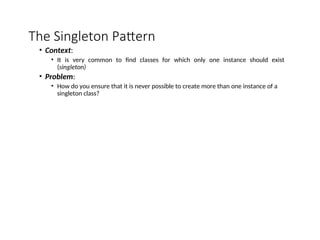
The Singleton Pattern
• Context:
• It is very common to find classes for which only one instance should exist
(singleton)
• Problem:
• How do you ensure that it is never possible to create more than one instance of a
singleton class?
The Singleton Pattern
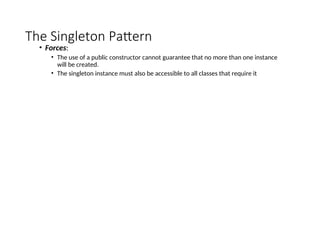
• Forces:
• The use of a public constructor cannot guarantee that no more than one instance
will be created.
• The singleton instance must also be accessible to all classes that require it
The Singleton Pattern
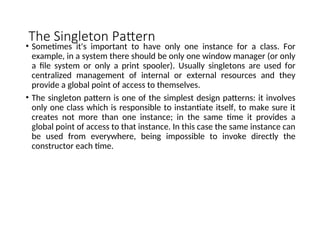
• Sometimes it's important to have only one instance for a class. For
example, in a system there should be only one window manager (or only
a file system or only a print spooler). Usually singletons are used for
centralized management of internal or external resources and they
provide a global point of access to themselves.
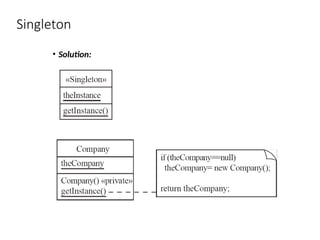
• The singleton pattern is one of the simplest design patterns: it involves
only one class which is responsible to instantiate itself, to make sure it
creates not more than one instance; in the same time it provides a
global point of access to that instance. In this case the same instance can
be used from everywhere, being impossible to invoke directly the
constructor each time.
Singleton
• Solution:
The Façade Pattern
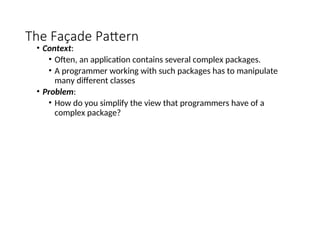
• Context:
• Often, an application contains several complex packages.
• A programmer working with such packages has to manipulate
many different classes
• Problem:
• How do you simplify the view that programmers have of a
complex package?
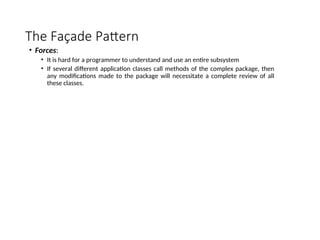
The Façade Pattern
• Forces:
• It is hard for a programmer to understand and use an entire subsystem
• If several different application classes call methods of the complex package, then
any modifications made to the package will necessitate a complete review of all
these classes.
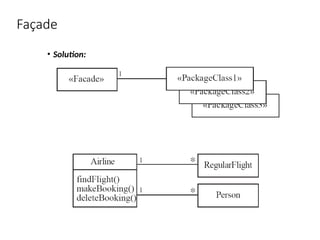
Façade
• Solution:
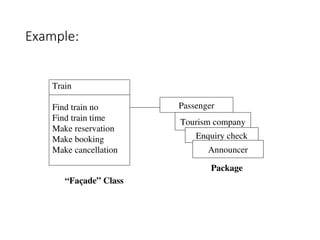
Example:
In the railway reservation and ticketing system, the most sought
after requirements are put on façade class train, and the
requirements changed most often are put on package class
passenger, tourism company, enquiry clerk and announcer at the
railway station.
Example:
Train
Find train no
Find train time
Make reservation
Make booking
Make cancellation
Passenger
Tourism company
Enquiry check
Announcer
Package
“Façade” Class
The Factory Pattern
• Context:
• A reusable framework needs to create objects; however the class of the created
objects depends on the application.
• Problem:
• How do you enable a programmer to add new application-specific class into a
system built on such a framework?
The Factory Pattern
• Forces:
• We want to have the framework create and work with
application-specific classes that the framework does not yet
know about.
• Solution:
• The framework delegates the creation of application-specific
classes to a specialized class, the Factory.
• The Factory is a generic interface defined in the framework.
• The factory interface declares a method whose purpose is to
create some subclass of a generic class.
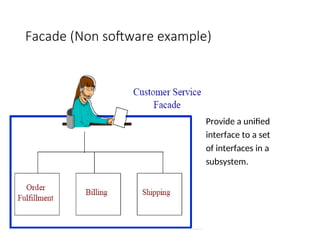
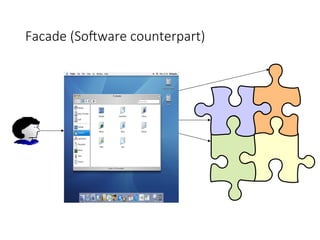
Facade (Non software example)
Provide a unified
interface to a set
of interfaces in a
subsystem.
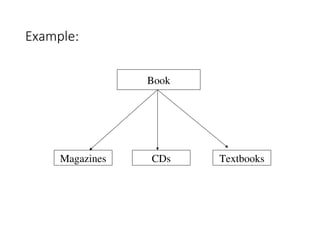
Example:
•Library application system may introduce different library items
from time to time
e.g. originally issue/receipt of books only ; now offers magazines,
novels, downloaded clippings from internet, CDs, DVDs and CD
magazines etc
•Adding a new library item should not result in making a change to
the entire application.
Example:
Book
Magazines CDs Textbooks
Facade (Software counterpart)
Benefits of Patterns
•Design reuse
•Uniform design vocabulary
•Enhance understanding, restructuring, & team
communication
•Basis for automation
•Transcends language-centric biases/myopia
•Abstracts away from many unimportant details
Liabilities of Patterns
•Require significant tedious & error-prone human
effort to handcraft pattern implementations design
reuse
•Can be deceptively simple uniform design
vocabulary
•May limit design options
•Leaves some important details unresolved

6 Design Pattern.ppt design pattern in softeare engineering

  • 1.
  • 2.
    Introduction to Patterns Eachpattern describes a problem which occurs over and over again in our environment, and then describes the core of the solution to that problem, in such a way that you can use this solution a million times over.
  • 3.
    Advantages of usingPatterns •Promote reuse. •Use the experiences of software developers. •A shared library used by developers. •“Design patterns help a designer get a design right faster”. •Are based on the principles of object-oriented programming: abstraction, inheritance, polymorphism and association. •Are solutions to recurring problems to software design.
  • 4.
    Which is GoodPattern? A good pattern should • Be as general as possible • Contain a solution that has been proven to effectively solve the problem in the indicated context. Studying patterns is an effective way to learn from the experience of others
  • 5.
    Example: Jim Coplein, asoftware engineer: “I like to relate this definition to dress patterns…” • What are dress patterns? • “... I could tell you how to make a dress by specifying the route of a scissors through a piece of cloth in terms of angles and lengths of cut. Or, I could give you a pattern. Reading the specification, you would have no idea what was being built or if you had built the right thing when you were finished. The pattern foreshadows the product: it is the rule for making the thing, but it is also, in many respects, the thing itself.”
  • 6.
    Patterns in engineering Howdo other engineers find and use patterns? • Mature engineering disciplines have handbooks describing successful solutions to known problems • Automobile designers don't design cars from scratch using the laws of physics, Instead, they reuse standard designs with successful track records, learning from experience.
  • 7.
    What is aDesign Pattern? A technique to repeat designer success. Borrowed from Civil and Electrical Engineering domains.  A (Problem, Solution) pair.
  • 8.
    How Patterns areused? • Design Problem. • Solution. • Implementation details. Reduce gap Design Implementation Designer Programmer Gamma, E., Helm, R., Johnson, R., Vlissides, J.: Design patterns: elements of reusable object-oriented software. 1995. Buschmann, F., Meunier, R., Rohnert, H., Sommerlad, P., Stal, M.: Pattern-oriented software architecture: a system of patterns. 2002.
  • 9.
    Pattern description Context: • Thegeneral situation in which the pattern applies Problem: • A short sentence or two raising the main difficulty. Forces: • The issues or concerns to consider when solving the problem Solution: • The recommended way to solve the problem in the given context. —‘to balance the forces’
  • 10.
    USEFUL DESIGN PATTERN Themost useful patterns that can be used in OO design and modeling using UML are as follows: • The general hierarchy pattern • The singleton pattern • The façade pattern • The factory pattern
  • 11.
    The General HierarchyPattern • Context: • objects in a hierarchy can have one or more objects above them (superiors), • and one or more objects below them (subordinates). • Some objects cannot have any subordinates • Problem: • How do you represent a hierarchy of objects, in which some objects cannot have subordinates?
  • 12.
    The General HierarchyPattern • Forces: • You want a flexible way of representing the hierarchy • that prevents certain objects from having subordinates • All the objects have many common properties and operations
  • 13.
  • 14.
  • 15.
    The Singleton Pattern •Context: • It is very common to find classes for which only one instance should exist (singleton) • Problem: • How do you ensure that it is never possible to create more than one instance of a singleton class?
  • 16.
    The Singleton Pattern •Forces: • The use of a public constructor cannot guarantee that no more than one instance will be created. • The singleton instance must also be accessible to all classes that require it
  • 17.
    The Singleton Pattern •Sometimes it's important to have only one instance for a class. For example, in a system there should be only one window manager (or only a file system or only a print spooler). Usually singletons are used for centralized management of internal or external resources and they provide a global point of access to themselves. • The singleton pattern is one of the simplest design patterns: it involves only one class which is responsible to instantiate itself, to make sure it creates not more than one instance; in the same time it provides a global point of access to that instance. In this case the same instance can be used from everywhere, being impossible to invoke directly the constructor each time.
  • 18.
  • 19.
    The Façade Pattern •Context: • Often, an application contains several complex packages. • A programmer working with such packages has to manipulate many different classes • Problem: • How do you simplify the view that programmers have of a complex package?
  • 20.
    The Façade Pattern •Forces: • It is hard for a programmer to understand and use an entire subsystem • If several different application classes call methods of the complex package, then any modifications made to the package will necessitate a complete review of all these classes.
  • 21.
  • 22.
    Example: In the railwayreservation and ticketing system, the most sought after requirements are put on façade class train, and the requirements changed most often are put on package class passenger, tourism company, enquiry clerk and announcer at the railway station.
  • 23.
    Example: Train Find train no Findtrain time Make reservation Make booking Make cancellation Passenger Tourism company Enquiry check Announcer Package “Façade” Class
  • 24.
    The Factory Pattern •Context: • A reusable framework needs to create objects; however the class of the created objects depends on the application. • Problem: • How do you enable a programmer to add new application-specific class into a system built on such a framework?
  • 25.
    The Factory Pattern •Forces: • We want to have the framework create and work with application-specific classes that the framework does not yet know about. • Solution: • The framework delegates the creation of application-specific classes to a specialized class, the Factory. • The Factory is a generic interface defined in the framework. • The factory interface declares a method whose purpose is to create some subclass of a generic class.
  • 26.
    Facade (Non softwareexample) Provide a unified interface to a set of interfaces in a subsystem.
  • 27.
    Example: •Library application systemmay introduce different library items from time to time e.g. originally issue/receipt of books only ; now offers magazines, novels, downloaded clippings from internet, CDs, DVDs and CD magazines etc •Adding a new library item should not result in making a change to the entire application.
  • 28.
  • 29.
  • 30.
    Benefits of Patterns •Designreuse •Uniform design vocabulary •Enhance understanding, restructuring, & team communication •Basis for automation •Transcends language-centric biases/myopia •Abstracts away from many unimportant details
  • 31.
    Liabilities of Patterns •Requiresignificant tedious & error-prone human effort to handcraft pattern implementations design reuse •Can be deceptively simple uniform design vocabulary •May limit design options •Leaves some important details unresolved