@agatestudio 
Freemium Concept 
Marvin 
Finance 
Agate Studio
@agatestudio 
Freemium Concept and Analytics to Drive Revenue in SaaS Business 
TDS – 18 Oktober 2014 
Lee Marvin- lee.marvin@agategames.com
@agatestudio 
Let’s discuss about these 
1.Freemium Concept 
–Brief Definition 
–Bertrand Paradox: Why Freemium flourishes in SaaS 
–Handicap Principle: The Motivation of Buying Virtual Goods 
–The Curve: Bringing Superfans to your product 
2.Freemium Analytics 
–Retention: Is your product already in market fit? 
–Engagement: What feature is matters to your users? 
–Monetization: Give users what they truly value 
–Growth: Scale up your product’s impact
@agatestudio 
FREEMIUM CONCEPT
@agatestudio 
Brief Definition 
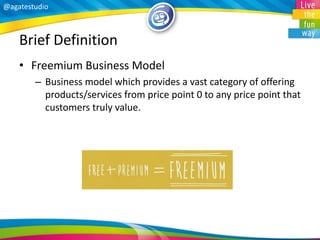
•Freemium Business Model 
–Business model which provides a vast category of offering products/services from price point 0 to any price point that customers truly value.
@agatestudio 
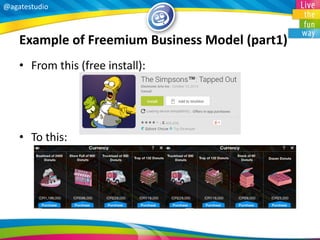
Example of Freemium Business Model (part1) 
•From this (free install): 
•To this:
@agatestudio 
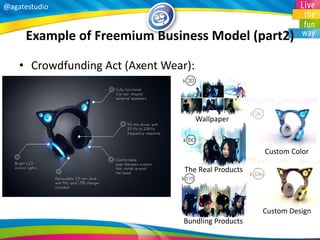
Example of Freemium Business Model (part2) 
•Crowdfunding Act (Axent Wear): 
The Real Products 
Wallpaper 
Bundling Products 
Custom Color 
Custom Design
@agatestudio 
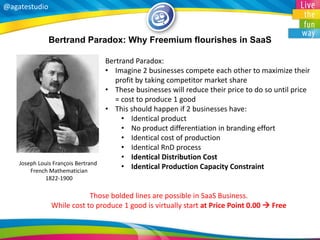
Bertrand Paradox: Why Freemium flourishes in SaaS 
Joseph Louis François Bertrand French Mathematician 1822-1900 
Bertrand Paradox: 
•Imagine 2 businesses compete each other to maximize their profit by taking competitor market share 
•These businesses will reduce their price to do so until price = cost to produce 1 good 
•This should happen if 2 businesses have: 
•Identical product 
•No product differentiation in branding effort 
•Identical cost of production 
•Identical RnD process 
•Identical Distribution Cost 
•Identical Production Capacity Constraint 
Those bolded lines are possible in SaaS Business. 
While cost to produce 1 good is virtually start at Price Point 0.00  Free
@agatestudio 
Handicap Principle: The Motivation of Buying Virtual Goods 
•Why male peacock have extravagant tail? 
•Why Antler have horns bigger than their head? 
•Why luxury cars still exist regardless of their functionality?
@agatestudio 
Handicap Principle: The Motivation of Buying Virtual Goods (cont’d) 
•Proposed by Biologist Amotz Zahavi in 1975 
–Living creatures do/have useless biological properties regarding for survival functionality 
–The purpose of properties are to find the best mate therefore keeping the species in the best shape as possible 
The concept of to find the best mate as possible in human society blur the “value” of things. Virtual Goods give human vast choices of perceive value in its society.
@agatestudio 
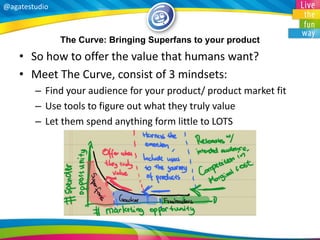
The Curve: Bringing Superfans to your product 
•So how to offer the value that humans want? 
•Meet The Curve, consist of 3 mindsets: 
–Find your audience for your product/ product market fit 
–Use tools to figure out what they truly value 
–Let them spend anything form little to LOTS
@agatestudio 
FREEMIUM ANALYTICS 
The Tools to Figure Out What Customers Truly Value
@agatestudio 
Retention: Is your product already in market fit? 
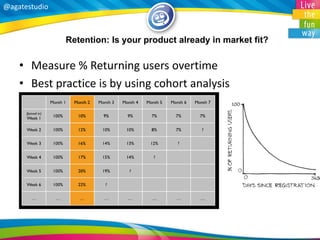
• Measure % Returning users overtime 
• Best practice is by using cohort analysis
@agatestudio 
Retention: Is your product already in market fit? 
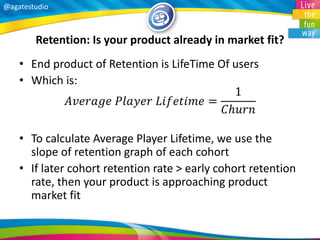
•End product of Retention is LifeTime Of users 
•Which is: 퐴푣푒푟푎푔푒 푃푙푎푦푒푟 퐿푖푓푒푡푖푚푒= 1 퐶푕푢푟푛 
•To calculate Average Player Lifetime, we use the slope of retention graph of each cohort 
•If later cohort retention rate > early cohort retention rate, then your product is approaching product market fit
@agatestudio 
Engagement: What feature is matters the most to your users? 
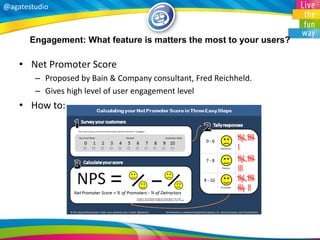
•Net Promoter Score 
–Proposed by Bain & Company consultant, Fred Reichheld. 
–Gives high level of user engagement level 
•How to:
@agatestudio 
Engagement: What feature is matters the most to your users? 
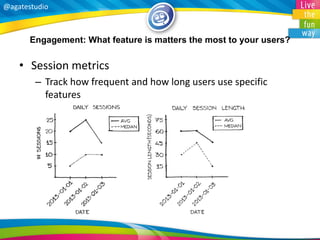
•Session metrics 
–Track how frequent and how long users use specific features
@agatestudio 
Engagement: What feature is matters the most to your users? 
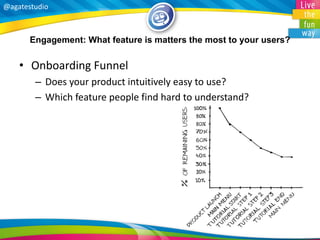
•Onboarding Funnel 
–Does your product intuitively easy to use? 
–Which feature people find hard to understand?
@agatestudio 
Monetization: Give users what they truly value 
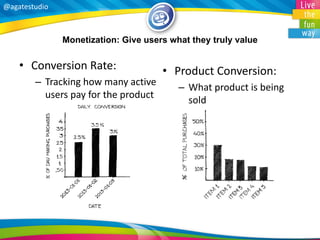
• Conversion Rate: 
– Tracking how many active 
users pay for the product 
• Product Conversion: 
– What product is being 
sold
@agatestudio 
Monetization: Give users what they truly value 
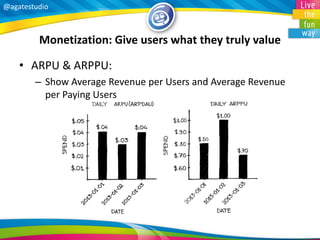
•ARPU & ARPPU: 
–Show Average Revenue per Users and Average Revenue per Paying Users
@agatestudio 
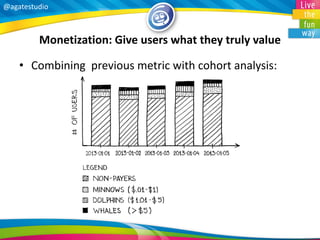
Monetization: Give users what they truly value 
•Combining previous metric with cohort analysis:
@agatestudio 
Monetization: Give users what they truly value 
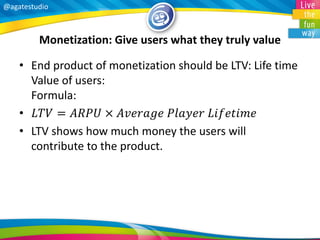
•End product of monetization should be LTV: Life time Value of users: Formula: 
•퐿푇푉=퐴푅푃푈×퐴푣푒푟푎푔푒 푃푙푎푦푒푟 퐿푖푓푒푡푖푚푒 
•LTV shows how much money the users will contribute to the product.
@agatestudio 
Growth: Scale up your product’s impact 
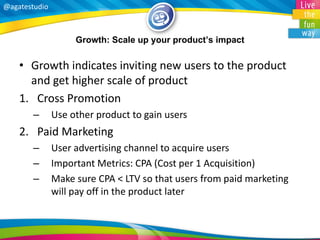
•Growth indicates inviting new users to the product and get higher scale of product 
1.Cross Promotion 
–Use other product to gain users 
2.Paid Marketing 
–User advertising channel to acquire users 
–Important Metrics: CPA (Cost per 1 Acquisition) 
–Make sure CPA < LTV so that users from paid marketing will pay off in the product later
@agatestudio 
Growth: Scale up your product’s impact 
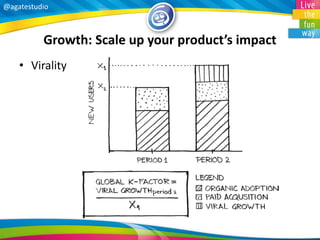
•Virality
@agatestudio 
Growth: Scale up your product’s impact 
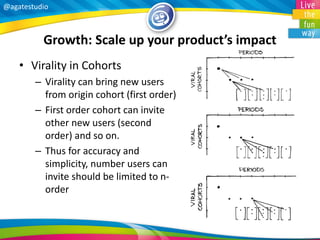
•Virality in Cohorts 
–Virality can bring new users from origin cohort (first order) 
–First order cohort can invite other new users (second order) and so on. 
–Thus for accuracy and simplicity, number users can invite should be limited to n- order
@agatestudio 
Growth: Scale up your product’s impact 
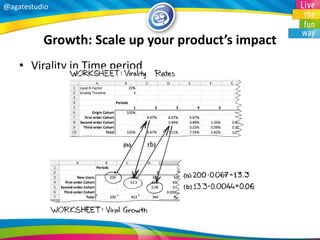
•Virality in Time period
Thank You 
References:

Freemium conceptanalytics leemarvin

  • 1.
    @agatestudio Freemium Concept Marvin Finance Agate Studio
  • 2.
    @agatestudio Freemium Conceptand Analytics to Drive Revenue in SaaS Business TDS – 18 Oktober 2014 Lee Marvin- lee.marvin@agategames.com
  • 3.
    @agatestudio Let’s discussabout these 1.Freemium Concept –Brief Definition –Bertrand Paradox: Why Freemium flourishes in SaaS –Handicap Principle: The Motivation of Buying Virtual Goods –The Curve: Bringing Superfans to your product 2.Freemium Analytics –Retention: Is your product already in market fit? –Engagement: What feature is matters to your users? –Monetization: Give users what they truly value –Growth: Scale up your product’s impact
  • 4.
  • 5.
    @agatestudio Brief Definition •Freemium Business Model –Business model which provides a vast category of offering products/services from price point 0 to any price point that customers truly value.
  • 6.
    @agatestudio Example ofFreemium Business Model (part1) •From this (free install): •To this:
  • 7.
    @agatestudio Example ofFreemium Business Model (part2) •Crowdfunding Act (Axent Wear): The Real Products Wallpaper Bundling Products Custom Color Custom Design
  • 8.
    @agatestudio Bertrand Paradox:Why Freemium flourishes in SaaS Joseph Louis François Bertrand French Mathematician 1822-1900 Bertrand Paradox: •Imagine 2 businesses compete each other to maximize their profit by taking competitor market share •These businesses will reduce their price to do so until price = cost to produce 1 good •This should happen if 2 businesses have: •Identical product •No product differentiation in branding effort •Identical cost of production •Identical RnD process •Identical Distribution Cost •Identical Production Capacity Constraint Those bolded lines are possible in SaaS Business. While cost to produce 1 good is virtually start at Price Point 0.00  Free
  • 9.
    @agatestudio Handicap Principle:The Motivation of Buying Virtual Goods •Why male peacock have extravagant tail? •Why Antler have horns bigger than their head? •Why luxury cars still exist regardless of their functionality?
  • 10.
    @agatestudio Handicap Principle:The Motivation of Buying Virtual Goods (cont’d) •Proposed by Biologist Amotz Zahavi in 1975 –Living creatures do/have useless biological properties regarding for survival functionality –The purpose of properties are to find the best mate therefore keeping the species in the best shape as possible The concept of to find the best mate as possible in human society blur the “value” of things. Virtual Goods give human vast choices of perceive value in its society.
  • 11.
    @agatestudio The Curve:Bringing Superfans to your product •So how to offer the value that humans want? •Meet The Curve, consist of 3 mindsets: –Find your audience for your product/ product market fit –Use tools to figure out what they truly value –Let them spend anything form little to LOTS
  • 12.
    @agatestudio FREEMIUM ANALYTICS The Tools to Figure Out What Customers Truly Value
  • 13.
    @agatestudio Retention: Isyour product already in market fit? • Measure % Returning users overtime • Best practice is by using cohort analysis
  • 14.
    @agatestudio Retention: Isyour product already in market fit? •End product of Retention is LifeTime Of users •Which is: 퐴푣푒푟푎푔푒 푃푙푎푦푒푟 퐿푖푓푒푡푖푚푒= 1 퐶푕푢푟푛 •To calculate Average Player Lifetime, we use the slope of retention graph of each cohort •If later cohort retention rate > early cohort retention rate, then your product is approaching product market fit
  • 15.
    @agatestudio Engagement: Whatfeature is matters the most to your users? •Net Promoter Score –Proposed by Bain & Company consultant, Fred Reichheld. –Gives high level of user engagement level •How to:
  • 16.
    @agatestudio Engagement: Whatfeature is matters the most to your users? •Session metrics –Track how frequent and how long users use specific features
  • 17.
    @agatestudio Engagement: Whatfeature is matters the most to your users? •Onboarding Funnel –Does your product intuitively easy to use? –Which feature people find hard to understand?
  • 18.
    @agatestudio Monetization: Giveusers what they truly value • Conversion Rate: – Tracking how many active users pay for the product • Product Conversion: – What product is being sold
  • 19.
    @agatestudio Monetization: Giveusers what they truly value •ARPU & ARPPU: –Show Average Revenue per Users and Average Revenue per Paying Users
  • 20.
    @agatestudio Monetization: Giveusers what they truly value •Combining previous metric with cohort analysis:
  • 21.
    @agatestudio Monetization: Giveusers what they truly value •End product of monetization should be LTV: Life time Value of users: Formula: •퐿푇푉=퐴푅푃푈×퐴푣푒푟푎푔푒 푃푙푎푦푒푟 퐿푖푓푒푡푖푚푒 •LTV shows how much money the users will contribute to the product.
  • 22.
    @agatestudio Growth: Scaleup your product’s impact •Growth indicates inviting new users to the product and get higher scale of product 1.Cross Promotion –Use other product to gain users 2.Paid Marketing –User advertising channel to acquire users –Important Metrics: CPA (Cost per 1 Acquisition) –Make sure CPA < LTV so that users from paid marketing will pay off in the product later
  • 23.
    @agatestudio Growth: Scaleup your product’s impact •Virality
  • 24.
    @agatestudio Growth: Scaleup your product’s impact •Virality in Cohorts –Virality can bring new users from origin cohort (first order) –First order cohort can invite other new users (second order) and so on. –Thus for accuracy and simplicity, number users can invite should be limited to n- order
  • 25.
    @agatestudio Growth: Scaleup your product’s impact •Virality in Time period
  • 26.