Biliary Tree
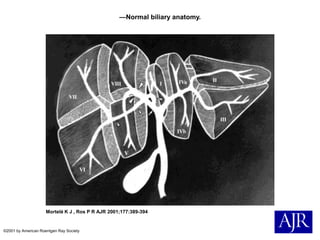
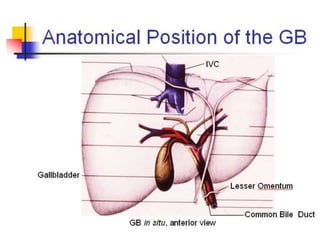
—Normal biliary anatomy.
MortelĂŠ K J , Ros P R AJR 2001;177:389-394
Š2001 by American Roentgen Ray Society
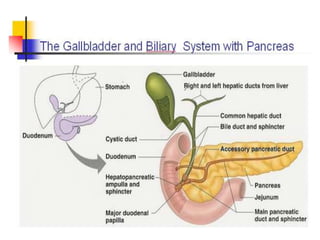
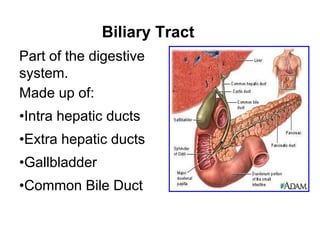
Biliary Tract
Part of the digestive
system.
Made up of:
•Intra hepatic ducts
•Extra hepatic ducts
•Gallbladder
•Common Bile Duct
Overview
• Gallstones
• Biliary tract tumours
• Other conditions
– Acute acalculous cholecystitis
– Mirizzi’s syndrome
– Primary Biliary Cirrhosis
– Primary Sclerosing Cholangitis
– Biliary tract cysts
• Biliary strictures
Complications
• In the gallbladder
– Biliary colic
– Acute and chronic cholecystitis
– Empyema
– Mucocoele
– Carcinoma
• In the bile ducts
– Obstructive jaundice
– Pancreatitis
– Cholangitis
• In the Gut
– Gallstone ileus
Overview
• Gallstones
• Biliary tract tumours
• Other conditions
–Acute acalculous cholecystitis
–Mirizzi’s syndrome
–Primary Biliary Cirrhosis
–Primary Sclerosing Cholangitis
–Biliary tract cysts
• Biliary strictures
Overview
•Gallstones
•Biliary tract tumours
•
Other conditions
–
Acute acalculous cholecystitis
–
Mirizzi’s syndrome
–
Primary Biliary Cirrhosis
–
Primary Sclerosing Cholangitis
–
Biliary tract cysts
•
Biliary strictures
Gallstones – Frequency
•most common and costly of all digestive
diseases
•9% of those > 60 years
•In USA, 6.3 million men and 14.2 million
women aged 20-74 years have gallbladder
disease
•Incidence - 1 million new cases per year
•Prevalence is 20 million cases in USA
Gall stones
Sex
• Higher among females than males (lifetime risk
of 35% vs 20%, respectively)
– Due to endogenous sex hormones (enhance
cholesterol secretion and increase bile cholesterol
saturation)
– Progesterone may contribute by relaxing smooth
muscle and impairing gallbladder emptying.
Age
• Increased age is associated with lithogenic bile
and increased rate of gallstones
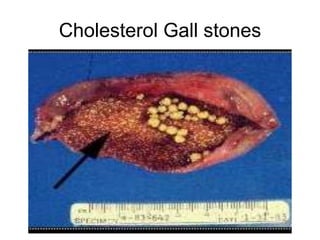
Cholesterol Gall stones
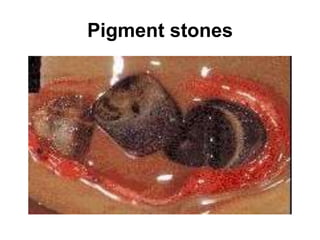
Pigment stones
Gallstones – Types
• Two main types:
–Cholesterol stones (85%):
–2 subtypes—pure (90-100% cholesterol) or
mixed (50-90% cholesterol).
• Pure stones often are solitary, whitish, and
larger than 2.5 cm in diameter.
• Mixed stones usually are smaller, multiple in
number, and occur in various shapes and
colors.
Stones
– Pigment stones (15%) occur in 2 subtypes—
brown and black.
• Brown stones are made up of calcium
bilirubinate and calcium-soaps. Bacteria
involved in formation via secretion of beta
glucuronidase and phospholipase
• Black stones result when excess bilirubin
enters the bile and polymerizes into
calcium bilirubinate (patients with chronic
hemolysis)
Gallstones – Diverse symptoms
• Abdominal pain
– Aching or tightness, typically severe and located in the epigastrium
– May develop suddenly, last for 15 minutes to several hours, and
then resolve suddenly
• Referred pain – posterior scapula or right shoulder area
• Nausea and vomiting
• Jaundice
• Pruritus: Itching, typically worse at night
• Fatigue, weight loss
• Miscellaneous:
– Fatty food intolerance, bloating, dyspepsia , gas
Obstructive Jaundice
•Blockage of the biliary tree by gallstones
• Symptoms
–Pain, Jaundice, dark urine, pale stools
• Signs
–Jaundice.
• Investigations
–Bloods – U&E, FBC, LFT, Amylase, CRP, Hepatitis
screen, Coagulation screen
–Ultrasound of abdomen, MRCP
• Treatment
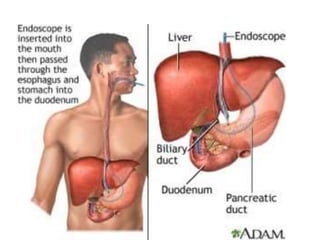
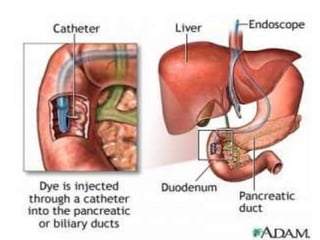
–Endoscopic Retrograde CholangioPancreatogram
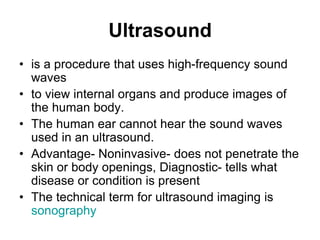
Ultrasound
• is a procedure that uses high-frequency sound
waves
• to view internal organs and produce images of
the human body.
• The human ear cannot hear the sound waves
used in an ultrasound.
• Advantage- Noninvasive- does not penetrate the
skin or body openings, Diagnostic- tells what
disease or condition is present
• The technical term for ultrasound imaging is
sonography
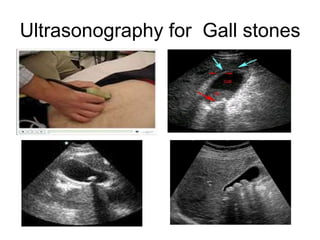
Ultrasonography for Gall stones
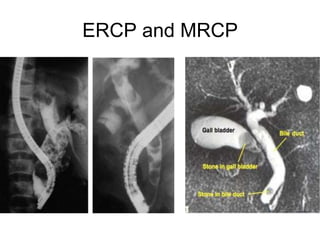
ERCP and MRCP
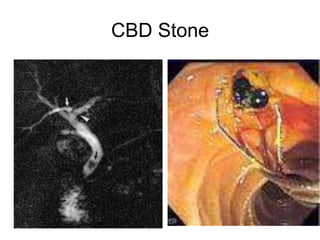
CBD Stone
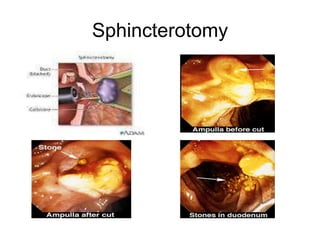
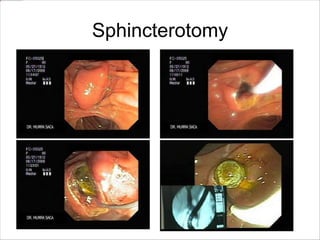
Sphincterotomy
Sphincterotomy
Ascending Cholangitis
• Obstruction of biliary tree with bile duct infection
• Symptoms
– Unwell, pain, jaundice, dark urine, pale stools
– Charcot triad (ie, fever, right upper quadrant pain, jaundice) occurs
in only 20-70% of cases
• Signs
– Sepsis (Fever, tachycardia, low BP), Jaundice.
• Investigations
– Bloods – U&E, FBC, LFT, Amylase, CRP, Coagulation screen
– Ultrasound of abdomen
• Treatment
– Intravenous antibiotics
– Endoscopic Retrograde CholangioPancreatogram -ERCP
Acute Pancreatitis
• Acute inflammation of pancreas and other retroperitoneal tissues.
• Symptoms
–Severe central abdominal pain radiating to back, vomiting
• Signs
–Variable – None to Sepsis (Fever, tachycardia, low BP),
Jaundice, acute abdomen
• Investigations
–Bloods – U&E, FBC, LFT, Amylase, CRP
–Ultrasound of abdomen
–MRCP
–CT Pancreas
• Treatment
–Supportive
–Endoscopic Retrograde CholangioPancreatogram
Gallstone ileus
• Obstruction of the small bowel by a large gallstone
– A stone ulcerates through the gallbladder into the duodenum and
causes obstruction at the terminal ileum
• Symptoms
– Small bowel obstruction (vomiting, abdominal pain, distension, nil pr)
• Signs
– Abdominal distension, obstructive bowel sounds.
• Investigations
– Bloods – U&E, FBC, LFT, Amylase, CRP, Hepatitis screen,
Coagulation screen
– Plain film of abdomen – Air in CBD, small bowel fluid levels and stone
• Treatment
– Laparotomy and removal of stone from small bowel.
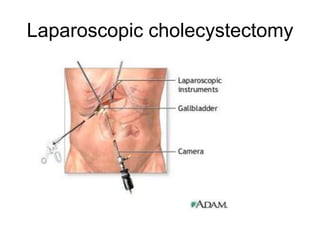
Laparoscopic cholecystectomy
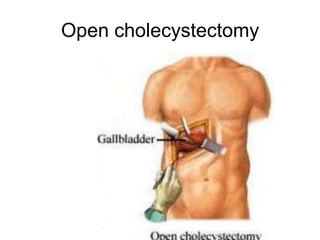
Open cholecystectomy
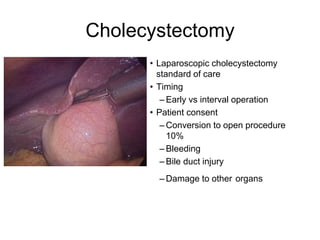
Cholecystectomy
• Laparoscopic cholecystectomy
standard of care
• Timing
– Early vs interval operation
• Patient consent
– Conversion to open procedure
10%
– Bleeding
– Bile duct injury
– Damage to other organs
Acute Acalculous Cholecystitis
• Presence of an inflamed gallbladder in the absence of an obstructed
cystic or common bile duct
• Typically occurs in the setting of a critically ill patient (eg, severe
burns, multiple traumas, lengthy postoperative care, prolonged
intensive care)
• Accounts for 5% of cholecystectomies
• Aetiology is thought to have ischemic basis, and gangrenous
gallbladder may result
• Increased rate of complications and mortality
• An uncommon subtype known as acute emphysematous cholecystitis
generally is caused by infection with clostridial organisms and
occlusion of the cystic artery associated with atherosclerotic vascular
disease and, often, diabetes.
• Biliary Tract Tumours-
Cholangiocarcinoma
Cancer of the Gall Bladder
Biliary Tree Neoplasms
•Clinical symptoms:
– Weight loss (77%)
– Nausea (60%)
– Anorexia (56%)
– Abdominal pain (56%)
– Fatigue (63%)
– Pruritus (51%)
• Symptomatic patients usually have advanced disease, with spread to
hilar lymph nodes before obstructive jaundice occurs
• Associated with a poor prognosis.
• Fever (21%)
• Malaise (19%)
• Diarrheoa (19%)
• Constipation (16%)
• Abdominal fullness (16%).
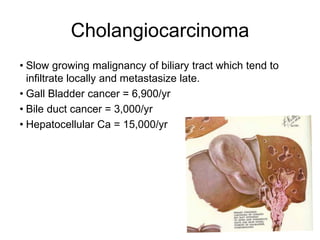
Cholangiocarcinoma
• Slow growing malignancy of biliary tract which tend to
infiltrate locally and metastasize late.
• Gall Bladder cancer = 6,900/yr
• Bile duct cancer = 3,000/yr
• Hepatocellular Ca = 15,000/yr
Cholangiocarcinoma
Diagnosis and Initial Workup
•Jaundice
• Weight loss, anorexia, abdominal pain, fever
• US – bile duct dilatation
• Quadruple phase CT
• MRCP/MRI
• ERCP with Stent and Brush Biopsy
• Percutaneous Cholangiogram with Internal Stent and
Brush Biopsy
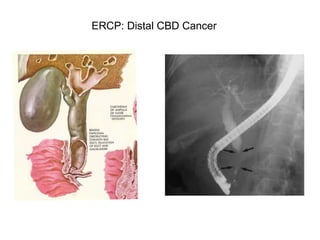
ERCP: Distal CBD Cancer
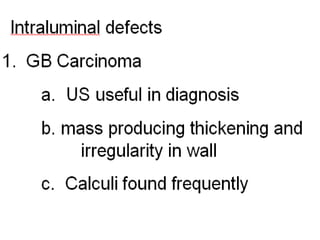
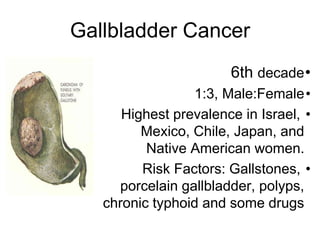
Gallbladder Cancer
•
6th decade
•
1:3, Male:Female
•
Highest prevalence in Israel,
Mexico, Chile, Japan, and
Native American women.
•
Risk Factors: Gallstones,
porcelain gallbladder, polyps,
chronic typhoid and some drugs
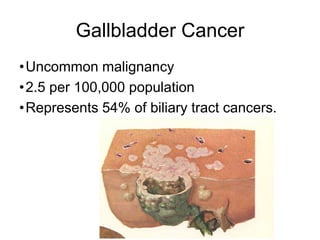
Gallbladder Cancer
•Uncommon malignancy
•2.5 per 100,000 population
•Represents 54% of biliary tract cancers.
biliary_tree_lecture.ppt

biliary_tree_lecture.ppt

  • 1.
  • 2.
    —Normal biliary anatomy. MorteléK J , Ros P R AJR 2001;177:389-394 ©2001 by American Roentgen Ray Society
  • 16.
    Biliary Tract Part ofthe digestive system. Made up of: •Intra hepatic ducts •Extra hepatic ducts •Gallbladder •Common Bile Duct
  • 17.
    Overview • Gallstones • Biliarytract tumours • Other conditions – Acute acalculous cholecystitis – Mirizzi’s syndrome – Primary Biliary Cirrhosis – Primary Sclerosing Cholangitis – Biliary tract cysts • Biliary strictures
  • 18.
    Complications • In thegallbladder – Biliary colic – Acute and chronic cholecystitis – Empyema – Mucocoele – Carcinoma • In the bile ducts – Obstructive jaundice – Pancreatitis – Cholangitis • In the Gut – Gallstone ileus
  • 19.
    Overview • Gallstones • Biliarytract tumours • Other conditions –Acute acalculous cholecystitis –Mirizzi’s syndrome –Primary Biliary Cirrhosis –Primary Sclerosing Cholangitis –Biliary tract cysts • Biliary strictures
  • 22.
    Overview •Gallstones •Biliary tract tumours • Otherconditions – Acute acalculous cholecystitis – Mirizzi’s syndrome – Primary Biliary Cirrhosis – Primary Sclerosing Cholangitis – Biliary tract cysts • Biliary strictures
  • 25.
    Gallstones – Frequency •mostcommon and costly of all digestive diseases •9% of those > 60 years •In USA, 6.3 million men and 14.2 million women aged 20-74 years have gallbladder disease •Incidence - 1 million new cases per year •Prevalence is 20 million cases in USA
  • 27.
    Gall stones Sex • Higheramong females than males (lifetime risk of 35% vs 20%, respectively) – Due to endogenous sex hormones (enhance cholesterol secretion and increase bile cholesterol saturation) – Progesterone may contribute by relaxing smooth muscle and impairing gallbladder emptying. Age • Increased age is associated with lithogenic bile and increased rate of gallstones
  • 28.
  • 29.
  • 30.
    Gallstones – Types •Two main types: –Cholesterol stones (85%): –2 subtypes—pure (90-100% cholesterol) or mixed (50-90% cholesterol). • Pure stones often are solitary, whitish, and larger than 2.5 cm in diameter. • Mixed stones usually are smaller, multiple in number, and occur in various shapes and colors.
  • 31.
    Stones – Pigment stones(15%) occur in 2 subtypes— brown and black. • Brown stones are made up of calcium bilirubinate and calcium-soaps. Bacteria involved in formation via secretion of beta glucuronidase and phospholipase • Black stones result when excess bilirubin enters the bile and polymerizes into calcium bilirubinate (patients with chronic hemolysis)
  • 32.
    Gallstones – Diversesymptoms • Abdominal pain – Aching or tightness, typically severe and located in the epigastrium – May develop suddenly, last for 15 minutes to several hours, and then resolve suddenly • Referred pain – posterior scapula or right shoulder area • Nausea and vomiting • Jaundice • Pruritus: Itching, typically worse at night • Fatigue, weight loss • Miscellaneous: – Fatty food intolerance, bloating, dyspepsia , gas
  • 33.
    Obstructive Jaundice •Blockage ofthe biliary tree by gallstones • Symptoms –Pain, Jaundice, dark urine, pale stools • Signs –Jaundice. • Investigations –Bloods – U&E, FBC, LFT, Amylase, CRP, Hepatitis screen, Coagulation screen –Ultrasound of abdomen, MRCP • Treatment –Endoscopic Retrograde CholangioPancreatogram
  • 34.
    Ultrasound • is aprocedure that uses high-frequency sound waves • to view internal organs and produce images of the human body. • The human ear cannot hear the sound waves used in an ultrasound. • Advantage- Noninvasive- does not penetrate the skin or body openings, Diagnostic- tells what disease or condition is present • The technical term for ultrasound imaging is sonography
  • 35.
  • 36.
  • 37.
  • 40.
  • 41.
  • 42.
    Ascending Cholangitis • Obstructionof biliary tree with bile duct infection • Symptoms – Unwell, pain, jaundice, dark urine, pale stools – Charcot triad (ie, fever, right upper quadrant pain, jaundice) occurs in only 20-70% of cases • Signs – Sepsis (Fever, tachycardia, low BP), Jaundice. • Investigations – Bloods – U&E, FBC, LFT, Amylase, CRP, Coagulation screen – Ultrasound of abdomen • Treatment – Intravenous antibiotics – Endoscopic Retrograde CholangioPancreatogram -ERCP
  • 44.
    Acute Pancreatitis • Acuteinflammation of pancreas and other retroperitoneal tissues. • Symptoms –Severe central abdominal pain radiating to back, vomiting • Signs –Variable – None to Sepsis (Fever, tachycardia, low BP), Jaundice, acute abdomen • Investigations –Bloods – U&E, FBC, LFT, Amylase, CRP –Ultrasound of abdomen –MRCP –CT Pancreas • Treatment –Supportive –Endoscopic Retrograde CholangioPancreatogram
  • 45.
    Gallstone ileus • Obstructionof the small bowel by a large gallstone – A stone ulcerates through the gallbladder into the duodenum and causes obstruction at the terminal ileum • Symptoms – Small bowel obstruction (vomiting, abdominal pain, distension, nil pr) • Signs – Abdominal distension, obstructive bowel sounds. • Investigations – Bloods – U&E, FBC, LFT, Amylase, CRP, Hepatitis screen, Coagulation screen – Plain film of abdomen – Air in CBD, small bowel fluid levels and stone • Treatment – Laparotomy and removal of stone from small bowel.
  • 46.
  • 47.
  • 48.
    Cholecystectomy • Laparoscopic cholecystectomy standardof care • Timing – Early vs interval operation • Patient consent – Conversion to open procedure 10% – Bleeding – Bile duct injury – Damage to other organs
  • 49.
    Acute Acalculous Cholecystitis •Presence of an inflamed gallbladder in the absence of an obstructed cystic or common bile duct • Typically occurs in the setting of a critically ill patient (eg, severe burns, multiple traumas, lengthy postoperative care, prolonged intensive care) • Accounts for 5% of cholecystectomies • Aetiology is thought to have ischemic basis, and gangrenous gallbladder may result • Increased rate of complications and mortality • An uncommon subtype known as acute emphysematous cholecystitis generally is caused by infection with clostridial organisms and occlusion of the cystic artery associated with atherosclerotic vascular disease and, often, diabetes.
  • 50.
    • Biliary TractTumours- Cholangiocarcinoma Cancer of the Gall Bladder
  • 51.
    Biliary Tree Neoplasms •Clinicalsymptoms: – Weight loss (77%) – Nausea (60%) – Anorexia (56%) – Abdominal pain (56%) – Fatigue (63%) – Pruritus (51%) • Symptomatic patients usually have advanced disease, with spread to hilar lymph nodes before obstructive jaundice occurs • Associated with a poor prognosis. • Fever (21%) • Malaise (19%) • Diarrheoa (19%) • Constipation (16%) • Abdominal fullness (16%).
  • 52.
    Cholangiocarcinoma • Slow growingmalignancy of biliary tract which tend to infiltrate locally and metastasize late. • Gall Bladder cancer = 6,900/yr • Bile duct cancer = 3,000/yr • Hepatocellular Ca = 15,000/yr
  • 53.
    Cholangiocarcinoma Diagnosis and InitialWorkup •Jaundice • Weight loss, anorexia, abdominal pain, fever • US – bile duct dilatation • Quadruple phase CT • MRCP/MRI • ERCP with Stent and Brush Biopsy • Percutaneous Cholangiogram with Internal Stent and Brush Biopsy
  • 54.
  • 55.
    Gallbladder Cancer • 6th decade • 1:3,Male:Female • Highest prevalence in Israel, Mexico, Chile, Japan, and Native American women. • Risk Factors: Gallstones, porcelain gallbladder, polyps, chronic typhoid and some drugs
  • 56.
    Gallbladder Cancer •Uncommon malignancy •2.5per 100,000 population •Represents 54% of biliary tract cancers.