Final Presentation
1. Goal Articulation
2. Site Analysis
3. Permaculture Principles
4. Crop Choices
5. Nutrient Cycling
6. Integrate and Connect
Goal Articulation
● My major goal in this design is not to become
totally self sufficient but to supplement my
household and give back a bit to my
community while reducing waste and energy
use.
● I'd know that I have achieved my goals when I
successful obtain a yield, give back to my
neighbors, and spend less time taking out
trash/driving to grocery store and water bill
goes down.
Goal Articulation
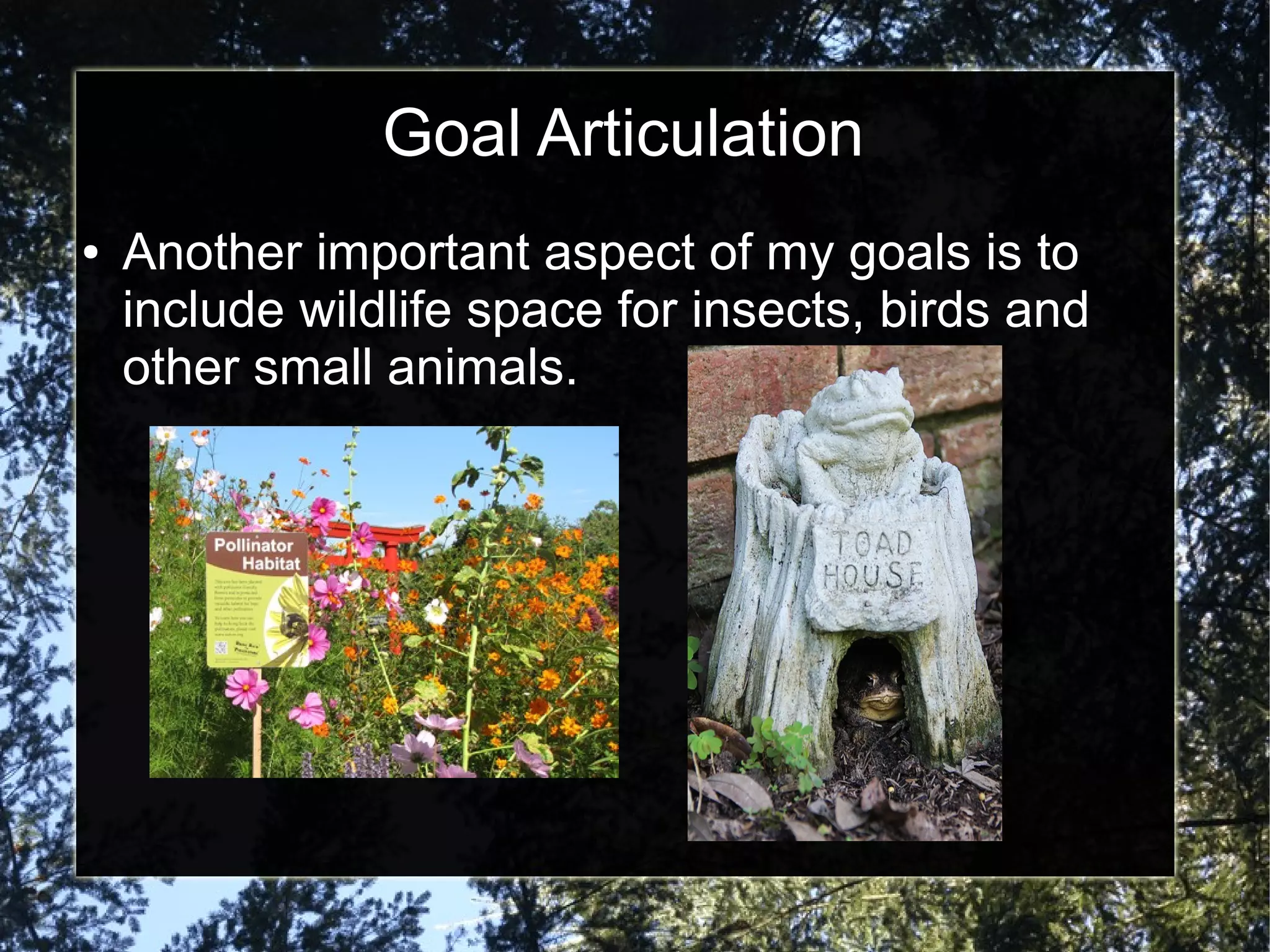
● Another important aspect of my goals is to
include wildlife space for insects, birds and
other small animals.
Site Analysis
● My permaculture site is full of challenges and
also strengths. It is fairly narrow and small,
mostly part sun. There are many options
though for creative space use, micro climates,
relatively flat, covered already in wildflowers
and nitrogen fixers. The soil is compact but
once fixed, would be great over time. The site
is protect from the northwest winds in the
winter and has two sources of water from the
roof during storms.
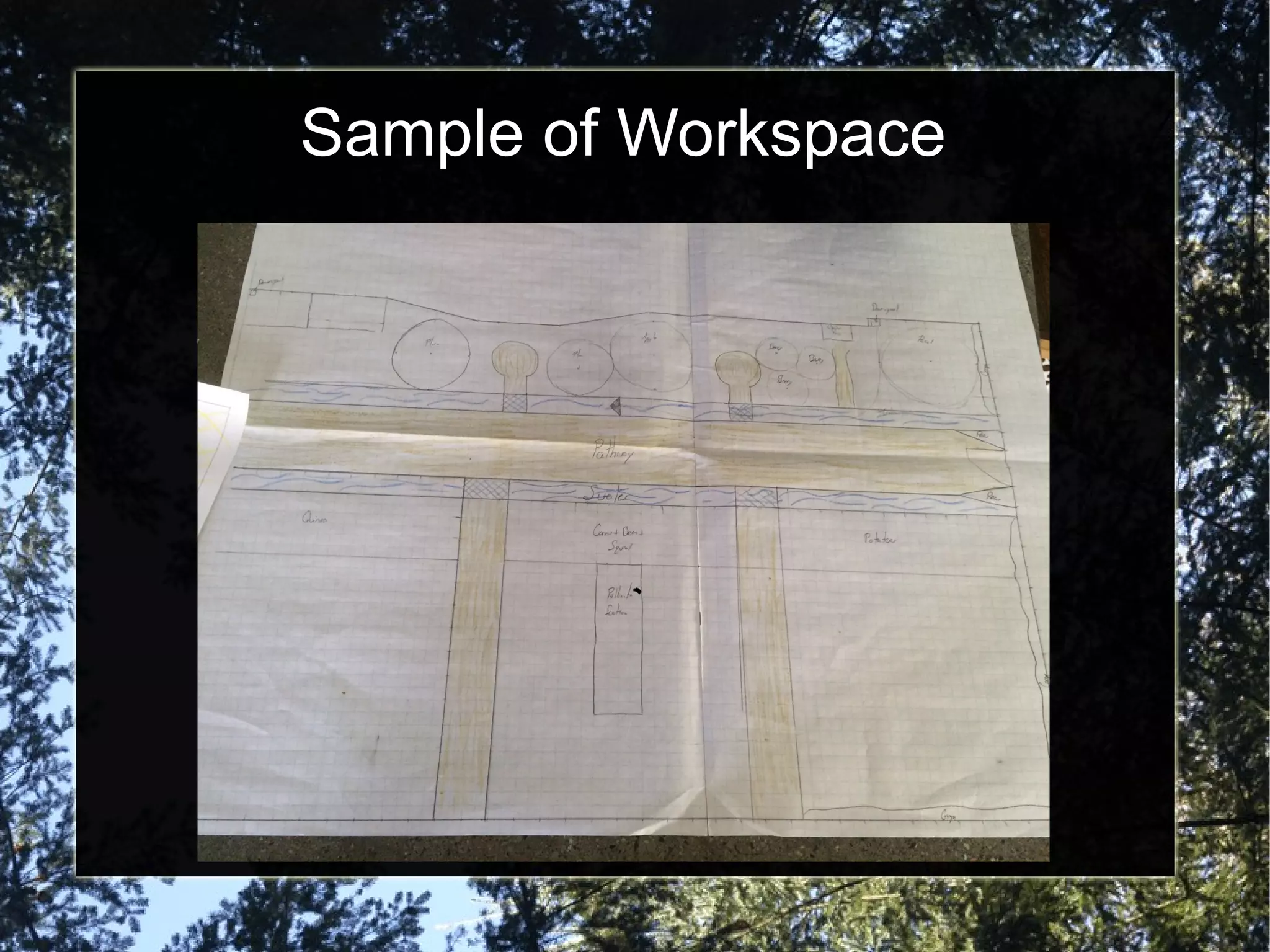
Sample of Workspace
Permaculture Principles
● There are 3 principles I'd like to mainly focus
on: Redundancy, Multiple Functions, and
Integrate rather than segregate
● Redundancy: I want to incorporate a multitude
of companion community plantings, with slight
differences in each (be it variety, or pollinator
species mixed in, or one species exchanged
for another). So not one species dominates
and try to maximize companion benefits.
Permaculture Principles
● Multiple Functions: I would seriously need to
be creative in my tight space for it to be
successful I'd use my fences which define the
property for vertical growing space. The fruit
trees will have multiple cultivators grafted onto
them to better. Certain crops enrich soil with
nitrogen. Companion planting helps stack
functions. Any chance we get, we will use for
multiple things.
Permaculture Principles
● Integrate than Segregate: I think this is our
biggest principle for this sight. We don't have
the space to have big plots of even mixed
crops. So we need to condense, we need to
stack functions, we need to sacrifice a little
from everything. If we added quail, the birds
would freely roam the garden, enrich soil, help
keep pests and weeds away. Companion
planting saves space and adds benefits.
Grafting saves space. Our neighbors would be
a next step to integrate and possibly take
some of their waste and turn it into garden
food.
Crops
● Veggies: Onions, Peppers, Broccoli, Spinach,
Tomato, Carrots, Winter Squash (pumpkins),
Beans, Peas, Lettuce
● Fruit: Apples, Plums, Strawberry, Peach,
Grapes
● Calorie: Quinoa, Potato, Corn
● Protein: Soybean, Chickpea, Beans
Crops
● I chose the crops that I did based on what we
normally eat, and some things we want to try
as well. We've grown almost all of these
things in our lot before (or currently) except
carrots and chickpeas so we know it can. And
with soil improvements, proper placement, we
can get it to thrive I believe. We have a good
variety of grain, calorie, protein, fruit, and
veggies that are ready throughout the year
rather than at one time.
Nutrient Cycling
● I'd like our garden to be a sink when it comes
to organic waste collection. I would
incorporate worm composting, chop and
dropping, no till work, and maybe if it is
efficient enough, start taking neighbors
kitchen scraps as well. Nothing produced in
the yard will end up in a trash can. Water as
well will be slowed and used wisely using
gabions and swales. Collected in rain barrels.
Sunlight as well will try to be used most
efficiently with planting placement and
layering.
Integrate and Connect
● Finally, as part of my goal, connecting to those
around me will cap off my garden. Starting
with the people I live with. We can learn
together how to cook again, how to grow food,
reduce waste of products and energy. We can
bond with our neighbors that we do not know
very well at all. And from their, maybe set up a
stand at the farmers market and teach others
how to garden.
Thank You

Gagnon_Final_Project

  • 1.
    Final Presentation 1. GoalArticulation 2. Site Analysis 3. Permaculture Principles 4. Crop Choices 5. Nutrient Cycling 6. Integrate and Connect
  • 2.
    Goal Articulation ● Mymajor goal in this design is not to become totally self sufficient but to supplement my household and give back a bit to my community while reducing waste and energy use. ● I'd know that I have achieved my goals when I successful obtain a yield, give back to my neighbors, and spend less time taking out trash/driving to grocery store and water bill goes down.
  • 3.
    Goal Articulation ● Anotherimportant aspect of my goals is to include wildlife space for insects, birds and other small animals.
  • 4.
    Site Analysis ● Mypermaculture site is full of challenges and also strengths. It is fairly narrow and small, mostly part sun. There are many options though for creative space use, micro climates, relatively flat, covered already in wildflowers and nitrogen fixers. The soil is compact but once fixed, would be great over time. The site is protect from the northwest winds in the winter and has two sources of water from the roof during storms.
  • 5.
  • 6.
    Permaculture Principles ● Thereare 3 principles I'd like to mainly focus on: Redundancy, Multiple Functions, and Integrate rather than segregate ● Redundancy: I want to incorporate a multitude of companion community plantings, with slight differences in each (be it variety, or pollinator species mixed in, or one species exchanged for another). So not one species dominates and try to maximize companion benefits.
  • 7.
    Permaculture Principles ● MultipleFunctions: I would seriously need to be creative in my tight space for it to be successful I'd use my fences which define the property for vertical growing space. The fruit trees will have multiple cultivators grafted onto them to better. Certain crops enrich soil with nitrogen. Companion planting helps stack functions. Any chance we get, we will use for multiple things.
  • 8.
    Permaculture Principles ● Integratethan Segregate: I think this is our biggest principle for this sight. We don't have the space to have big plots of even mixed crops. So we need to condense, we need to stack functions, we need to sacrifice a little from everything. If we added quail, the birds would freely roam the garden, enrich soil, help keep pests and weeds away. Companion planting saves space and adds benefits. Grafting saves space. Our neighbors would be a next step to integrate and possibly take some of their waste and turn it into garden food.
  • 9.
    Crops ● Veggies: Onions,Peppers, Broccoli, Spinach, Tomato, Carrots, Winter Squash (pumpkins), Beans, Peas, Lettuce ● Fruit: Apples, Plums, Strawberry, Peach, Grapes ● Calorie: Quinoa, Potato, Corn ● Protein: Soybean, Chickpea, Beans
  • 10.
    Crops ● I chosethe crops that I did based on what we normally eat, and some things we want to try as well. We've grown almost all of these things in our lot before (or currently) except carrots and chickpeas so we know it can. And with soil improvements, proper placement, we can get it to thrive I believe. We have a good variety of grain, calorie, protein, fruit, and veggies that are ready throughout the year rather than at one time.
  • 11.
    Nutrient Cycling ● I'dlike our garden to be a sink when it comes to organic waste collection. I would incorporate worm composting, chop and dropping, no till work, and maybe if it is efficient enough, start taking neighbors kitchen scraps as well. Nothing produced in the yard will end up in a trash can. Water as well will be slowed and used wisely using gabions and swales. Collected in rain barrels. Sunlight as well will try to be used most efficiently with planting placement and layering.
  • 12.
    Integrate and Connect ●Finally, as part of my goal, connecting to those around me will cap off my garden. Starting with the people I live with. We can learn together how to cook again, how to grow food, reduce waste of products and energy. We can bond with our neighbors that we do not know very well at all. And from their, maybe set up a stand at the farmers market and teach others how to garden.
  • 13.