Becky Bujaki
*
*
*Although my front yard is small, I hope to
capture as many elements as I can into the
usable space and make use of all areas in
front of my house. The major goal for this
present home site is to turn a green lawn
that requires mowing and gives me very
little in return into a green “home produce
store” that provides fresh food and looks
beautiful.
*
*My ultimate goal is to retire in a few years and be
able to spend my time at home receiving output of
food from my yard instead of the grocery store. I
want to be able to supplement my retirement
income by being able to feed myself from many
vegetables and fruits grown on my homestead, and
sharing or selling my abundance with my local
community. In my retirement years, I want to be
able to truly enjoy my homestead and the
sitting/viewing area will give me a place to relax
and observe my environment which makes me
happy and content.
*
*I will have a homestead that provides me with
a peaceful setting where I can enjoy the
tranquility of nature’s drumbeat as well as
providing me a source of food nourishment and
abundance. My homestead will provide enough
food resources to reduce my grocery store food
consumption by at least 25% and I will preserve
overabundance by canning, freezing, drying
and other methods of putting food by so that I
can enjoy food grown on my homestead year-
round.
*
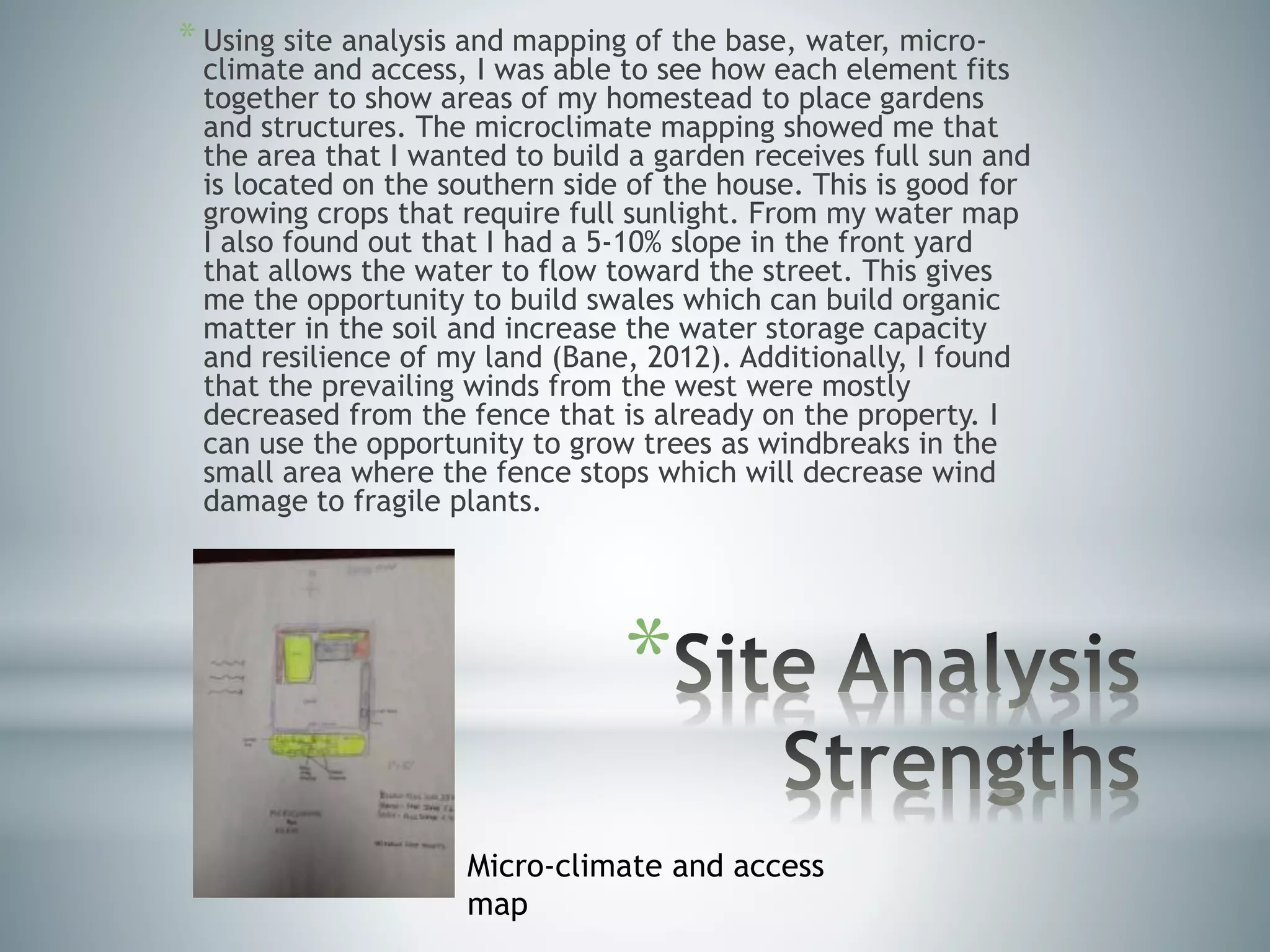
* Using site analysis and mapping of the base, water, micro-
climate and access, I was able to see how each element fits
together to show areas of my homestead to place gardens
and structures. The microclimate mapping showed me that
the area that I wanted to build a garden receives full sun and
is located on the southern side of the house. This is good for
growing crops that require full sunlight. From my water map
I also found out that I had a 5-10% slope in the front yard
that allows the water to flow toward the street. This gives
me the opportunity to build swales which can build organic
matter in the soil and increase the water storage capacity
and resilience of my land (Bane, 2012). Additionally, I found
that the prevailing winds from the west were mostly
decreased from the fence that is already on the property. I
can use the opportunity to grow trees as windbreaks in the
small area where the fence stops which will decrease wind
damage to fragile plants.
Micro-climate and access
map
*
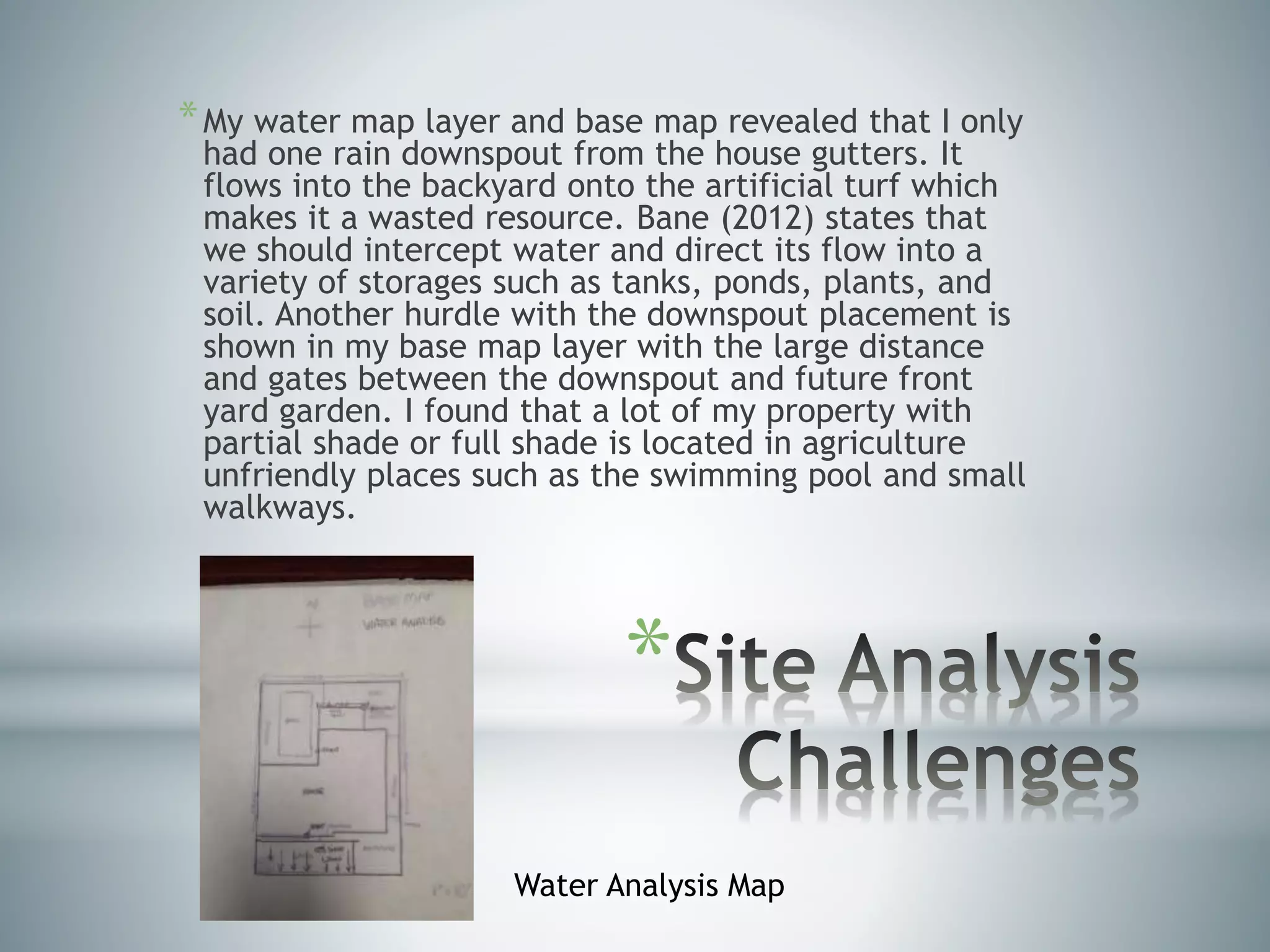
*My water map layer and base map revealed that I only
had one rain downspout from the house gutters. It
flows into the backyard onto the artificial turf which
makes it a wasted resource. Bane (2012) states that
we should intercept water and direct its flow into a
variety of storages such as tanks, ponds, plants, and
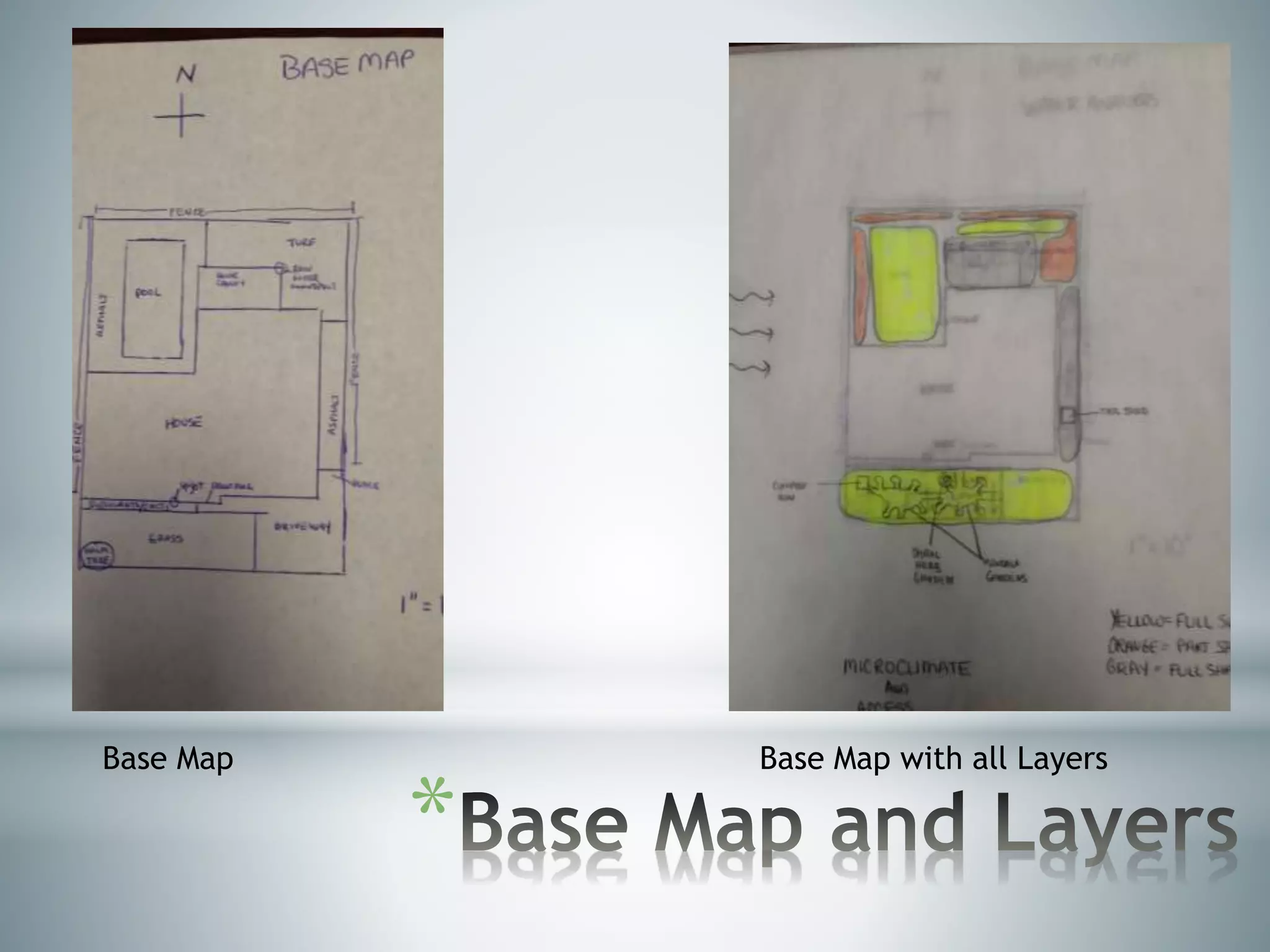
soil. Another hurdle with the downspout placement is
shown in my base map layer with the large distance
and gates between the downspout and future front
yard garden. I found that a lot of my property with
partial shade or full shade is located in agriculture
unfriendly places such as the swimming pool and small
walkways.
Water Analysis Map
*
Base Map Base Map with all Layers
*
* “We are now in a period of great release of stored energy
from the deep geologic past enabled by the human
exploitation of fossil fuels” (Bane 2012, pg. 30). I have a lot
of full sun areas on my property that I will try to capture the
energy from. By planting crops and trees in areas that
require full sun, I will make the maximum use of this space
by also planting part shade-loving plants in the understories
of the trees and shadows. I also envision using a rain
catchment storage tank to collect the rain water from the
downspout, while using solar-driven pumps to transfer the
water to the front yard garden where it will be used. Solar
powered pumps can be placed on the asphalted areas around
the swimming pool where full sun shines and this allows me
to decrease the use of fossil fuels as well as re-purposing the
rain water.
*
*“Make no waste” is a principle that Bane (2012)
explains as a well-organized system that links the
yields, surpluses or wastes of one element with the
needs of another. Simply put, I can transform
something that I don’t want into something that my
plants or livestock can thrive on. I will have a compost
pile that will eventually be rich humus full of nutrients
for my soil. A simple worm bin can feed off of food
scraps that become casting to be used with planting
seeds in my garden. I also plan to repurpose products
instead of throwing them in the trash. A used
biodegradable egg carton becomes a seed starter tray
just as the eggshells can also be a seed’s first home.
*
*In my homestead, I will receive many uses for each
element of my garden. For instance, the trees that I
plant can provide fruit or nuts, I can plant them in a
place that will provide a windbreak, and also use
them for shade. The existing fences on my property
will give me privacy from my neighbors, a support
structure for climbing vines and plants, and
provides protection from unwanted animals. By
having at least three or more functions for each
element on my homestead, a more stable and
diverse food growing system is created because
each element is connected and supporting each
other (Harland, 2015).
Examples from www.resilance.org:
Daylily: Edible, fiber product,
hummingbird attractor
Garlic: Nutrient accumulator,
edible, pest repellant
Jerusalem Artichoke: Edible roots,
insectary, pig forage, mulch plant
Daikon Radish: Edible, nutrient
accumulator
*
* My front yard garden in my homestead is small- 20’ x 10’, but can
support a modest range of perennial and annual crops. I would plant
one chestnut tree and one olive tree, which both grow well in my
climate and would provide food and oil. A spiral herb garden will be
by my front door will be planted with rosemary, lavender, chive and
mint which grow year-round in California (Herbs for California
Gardens, 2016). I would plant warm-season (basil, oregano, etc.) and
cool-season (cilantro, dill, etc.) herbs as the seasons change. By
estimating the size of beds that I would need for certain plants, I
could plant tomatoes, onions, peppers, cucumber, carrots and
strawberries and would have half of my garden space left to plant
perennials such as California poppies, asparagus and lovage. I will
practice crop rotation with my annual plants and start small so that I
slowly work toward achieving a full garden with each element in the
right space with companion plants and aspects.
Lovage plant
*
* Compost and a worm bin on my homestead will provide some
percentage of nutrients for my homestead. Bane (2012)
states that compost should be seen as a special resource for
selective application for soil enrichment and not for soil
repair (pg. 211). Compost will be useful to me for the
microbial life, but I will supplement my soil with free mulch
locally from Miramar Greenery, a department of the Miramar
Landfill. Special care will be needed when inspecting and
using this mulch, but due to constraints in homestead size
and costs, this is a good way to start small. Another way that
I can provide fertility to my homestead is by crop rotation
and including legumes in my annual crops. These nitrogen
fixing plants will provide nitrogen to my soil when turned
under. I can also have soil testing performed and use the
results to better understand other nutrients that may be
lacking in my soil.
*
* I see my homestead and my front yard garden as a “circle of
life,” with one element supporting another and making
mutual connections. I will not rely on only one food/plant
source so that if one fails, I am able to rely on other plants,
trees or food sources. Each element provides many
functions, and I will use each potential function to generate
ideas of additional elements to add. As example of this on
my homestead is that I can plant edible flowers on my
garden that can not only be used as a food source but also as
a butterfly and bee attractant which helps pollination. I need
to constantly observe and react to changes, such as when my
trees are established and growing, then I can add the
element of bird houses in the trees which will attract
beneficial birds. Tree trunks can also be used as supports for
vining plants and shade-loving plants can be planted in the
cooler micro-climate of the tree shade.
Grapes grown on tree trunks
*
* “It’s not always about just doing it [permaculture] without groups, with people who
already get it, we need to get it out there to people who have never heard of
permaculture before.” Jessica Schilke
* EACH ONE TEACH ONE: Finally, Bane (2012) points out that permaculture’s designs and
systems are not trivial and are to be shared. In my suburban homestead, my front yard
garden will be in sight and touch of all my neighbors who walk their dog, ride their
bike or take a walk down my road. I want to be able to share my bounty and let them
pick a cherry tomato as they walk by, to appreciate and become curious of the living
landscape before them. I would like to ensure that I have enough planted in my garden
for my own needs, but also to share with my neighbors and help educate friends on the
principles and design concepts of sustainable agriculture and permaculture. Food is a
way to the heart, soul, and mind. I can capitalize on this to spread the word by sharing
by harvest and bounty.
* “Permaculture is the art and science of creating community ecosystems in which
plants, animals, and people interact to produce a fecund, ecological system that has
the means to support itself indefinitely.” – Marisha Auerbach
*
*P. Bane, 2012. The permaculture handbook: Garden
farming for town and country.
*M. Harland, 2015. “Each Element Performs Many
Functions - An Original Permaculture Design Principle.”
Retrieved from
http://www.permaculture.co.uk/articles/2-each-
element-performs-many-functions-original-
permaculture-design-principle.
*“Herbs for California Gardens.” 2016. Retrieved from
http://www.armstronggarden.com/pages/herbs-for-
california-gardens.

Bujaki final project

  • 1.
  • 2.
    * *Although my frontyard is small, I hope to capture as many elements as I can into the usable space and make use of all areas in front of my house. The major goal for this present home site is to turn a green lawn that requires mowing and gives me very little in return into a green “home produce store” that provides fresh food and looks beautiful.
  • 3.
    * *My ultimate goalis to retire in a few years and be able to spend my time at home receiving output of food from my yard instead of the grocery store. I want to be able to supplement my retirement income by being able to feed myself from many vegetables and fruits grown on my homestead, and sharing or selling my abundance with my local community. In my retirement years, I want to be able to truly enjoy my homestead and the sitting/viewing area will give me a place to relax and observe my environment which makes me happy and content.
  • 4.
    * *I will havea homestead that provides me with a peaceful setting where I can enjoy the tranquility of nature’s drumbeat as well as providing me a source of food nourishment and abundance. My homestead will provide enough food resources to reduce my grocery store food consumption by at least 25% and I will preserve overabundance by canning, freezing, drying and other methods of putting food by so that I can enjoy food grown on my homestead year- round.
  • 5.
    * * Using siteanalysis and mapping of the base, water, micro- climate and access, I was able to see how each element fits together to show areas of my homestead to place gardens and structures. The microclimate mapping showed me that the area that I wanted to build a garden receives full sun and is located on the southern side of the house. This is good for growing crops that require full sunlight. From my water map I also found out that I had a 5-10% slope in the front yard that allows the water to flow toward the street. This gives me the opportunity to build swales which can build organic matter in the soil and increase the water storage capacity and resilience of my land (Bane, 2012). Additionally, I found that the prevailing winds from the west were mostly decreased from the fence that is already on the property. I can use the opportunity to grow trees as windbreaks in the small area where the fence stops which will decrease wind damage to fragile plants. Micro-climate and access map
  • 6.
    * *My water maplayer and base map revealed that I only had one rain downspout from the house gutters. It flows into the backyard onto the artificial turf which makes it a wasted resource. Bane (2012) states that we should intercept water and direct its flow into a variety of storages such as tanks, ponds, plants, and soil. Another hurdle with the downspout placement is shown in my base map layer with the large distance and gates between the downspout and future front yard garden. I found that a lot of my property with partial shade or full shade is located in agriculture unfriendly places such as the swimming pool and small walkways. Water Analysis Map
  • 7.
    * Base Map BaseMap with all Layers
  • 8.
    * * “We arenow in a period of great release of stored energy from the deep geologic past enabled by the human exploitation of fossil fuels” (Bane 2012, pg. 30). I have a lot of full sun areas on my property that I will try to capture the energy from. By planting crops and trees in areas that require full sun, I will make the maximum use of this space by also planting part shade-loving plants in the understories of the trees and shadows. I also envision using a rain catchment storage tank to collect the rain water from the downspout, while using solar-driven pumps to transfer the water to the front yard garden where it will be used. Solar powered pumps can be placed on the asphalted areas around the swimming pool where full sun shines and this allows me to decrease the use of fossil fuels as well as re-purposing the rain water.
  • 9.
    * *“Make no waste”is a principle that Bane (2012) explains as a well-organized system that links the yields, surpluses or wastes of one element with the needs of another. Simply put, I can transform something that I don’t want into something that my plants or livestock can thrive on. I will have a compost pile that will eventually be rich humus full of nutrients for my soil. A simple worm bin can feed off of food scraps that become casting to be used with planting seeds in my garden. I also plan to repurpose products instead of throwing them in the trash. A used biodegradable egg carton becomes a seed starter tray just as the eggshells can also be a seed’s first home.
  • 10.
    * *In my homestead,I will receive many uses for each element of my garden. For instance, the trees that I plant can provide fruit or nuts, I can plant them in a place that will provide a windbreak, and also use them for shade. The existing fences on my property will give me privacy from my neighbors, a support structure for climbing vines and plants, and provides protection from unwanted animals. By having at least three or more functions for each element on my homestead, a more stable and diverse food growing system is created because each element is connected and supporting each other (Harland, 2015). Examples from www.resilance.org: Daylily: Edible, fiber product, hummingbird attractor Garlic: Nutrient accumulator, edible, pest repellant Jerusalem Artichoke: Edible roots, insectary, pig forage, mulch plant Daikon Radish: Edible, nutrient accumulator
  • 11.
    * * My frontyard garden in my homestead is small- 20’ x 10’, but can support a modest range of perennial and annual crops. I would plant one chestnut tree and one olive tree, which both grow well in my climate and would provide food and oil. A spiral herb garden will be by my front door will be planted with rosemary, lavender, chive and mint which grow year-round in California (Herbs for California Gardens, 2016). I would plant warm-season (basil, oregano, etc.) and cool-season (cilantro, dill, etc.) herbs as the seasons change. By estimating the size of beds that I would need for certain plants, I could plant tomatoes, onions, peppers, cucumber, carrots and strawberries and would have half of my garden space left to plant perennials such as California poppies, asparagus and lovage. I will practice crop rotation with my annual plants and start small so that I slowly work toward achieving a full garden with each element in the right space with companion plants and aspects. Lovage plant
  • 12.
    * * Compost anda worm bin on my homestead will provide some percentage of nutrients for my homestead. Bane (2012) states that compost should be seen as a special resource for selective application for soil enrichment and not for soil repair (pg. 211). Compost will be useful to me for the microbial life, but I will supplement my soil with free mulch locally from Miramar Greenery, a department of the Miramar Landfill. Special care will be needed when inspecting and using this mulch, but due to constraints in homestead size and costs, this is a good way to start small. Another way that I can provide fertility to my homestead is by crop rotation and including legumes in my annual crops. These nitrogen fixing plants will provide nitrogen to my soil when turned under. I can also have soil testing performed and use the results to better understand other nutrients that may be lacking in my soil.
  • 13.
    * * I seemy homestead and my front yard garden as a “circle of life,” with one element supporting another and making mutual connections. I will not rely on only one food/plant source so that if one fails, I am able to rely on other plants, trees or food sources. Each element provides many functions, and I will use each potential function to generate ideas of additional elements to add. As example of this on my homestead is that I can plant edible flowers on my garden that can not only be used as a food source but also as a butterfly and bee attractant which helps pollination. I need to constantly observe and react to changes, such as when my trees are established and growing, then I can add the element of bird houses in the trees which will attract beneficial birds. Tree trunks can also be used as supports for vining plants and shade-loving plants can be planted in the cooler micro-climate of the tree shade. Grapes grown on tree trunks
  • 14.
    * * “It’s notalways about just doing it [permaculture] without groups, with people who already get it, we need to get it out there to people who have never heard of permaculture before.” Jessica Schilke * EACH ONE TEACH ONE: Finally, Bane (2012) points out that permaculture’s designs and systems are not trivial and are to be shared. In my suburban homestead, my front yard garden will be in sight and touch of all my neighbors who walk their dog, ride their bike or take a walk down my road. I want to be able to share my bounty and let them pick a cherry tomato as they walk by, to appreciate and become curious of the living landscape before them. I would like to ensure that I have enough planted in my garden for my own needs, but also to share with my neighbors and help educate friends on the principles and design concepts of sustainable agriculture and permaculture. Food is a way to the heart, soul, and mind. I can capitalize on this to spread the word by sharing by harvest and bounty. * “Permaculture is the art and science of creating community ecosystems in which plants, animals, and people interact to produce a fecund, ecological system that has the means to support itself indefinitely.” – Marisha Auerbach
  • 15.
    * *P. Bane, 2012.The permaculture handbook: Garden farming for town and country. *M. Harland, 2015. “Each Element Performs Many Functions - An Original Permaculture Design Principle.” Retrieved from http://www.permaculture.co.uk/articles/2-each- element-performs-many-functions-original- permaculture-design-principle. *“Herbs for California Gardens.” 2016. Retrieved from http://www.armstronggarden.com/pages/herbs-for- california-gardens.