Republic of the Philippines
Department of Education
SCHOOLS DIVISION OF BULACAN
IN-SERVICE TRAINING
WEEK-EMPOWERING EDUCATORS:
Transforming Classrooms into Inclusive, Innovative, and
Intellectually Engaging Spaces
PRC Accredited CPD Program (12 Credit Units)
of Department of Education (DepEd)
Schools Division of Bulacan (PTR-2024-501)
November 27-29, 2024
Day 1
FORTUNATO VALENCIA
DISCUSSANT
Gender
Sensitivity
in the
Educational
Setting
Division of Bulacan
Session 1: Pre-Test
FORTUNATO VALENCIA
DISCUSSANT
Gender
Sensitivity
in the
Educational
Setting
Division of Bulacan
Workshop Overview:
• Understand the concept of
gender sensitivity and its role in
promoting an inclusive
educational environment.
• Develop awareness of gender-
sensitive language and
communication techniques.
• Commit to specific actions to
support a gender-sensitive
environment in schools.
Introduction
to Gender
Sensitivity
• Content
Highlights:
o Why gender
sensitivity matters
in education?
DepEd efforts to promote gender equality and
responsiveness within the education system.
1. DepEd Order No. 32, s. 2017
Title: "Gender-Responsive Basic Education Policy “
Policy Description: This order provides the policy framework for integrating gender
equality, equity, and sensitivity in DepEd programs, projects, and activities.
2. DepEd Order No. 63, s. 2012
Title: "Guidelines on the Preparation of Annual Gender and Development (GAD) Plans and
Budgets and Accomplishment Reports to Implement the Magna Carta of Women
Description: This order provides guidelines for the preparation and submission of annual
GAD plans and budgets, as well as accomplishment reports, in compliance with the Magna
Carta of Women.
3. DepEd Order No. 16, s. 2020
Title: "Guidelines on the Implementation of the Results-Based Performance Management
System (RPMS) for School Year 2019-2020“
Description: Outlines the inclusion of GAD principles in the performance management
system for educators.
4. DepEd Order No. 55, s. 2013
Title: Implementing Rules and Regulations (IRR) of Republic Act (RA) No. 10627 Otherwise
Known as the Anti-Bullying Act of 2013 “
Description: DepEd iterates zero tolerance policy vs child abuse, bullying
To ensure that cases and instances of abuse are closely monitored at school level, DepEd
issued the DepEd Order No. 40, series of 2012, or the DepEd Child Protection Policy, which
requires all elementary and secondary schools—both public and private—to create their
own Child Protection Committee (CPC).
In a press briefing, Education Secretary Leonor Magtolis Briones said, “Ang Child
Protection Policy natin, mandato yan ng United Nations, mandato yan ng ating
pamahalaan na lahat ng bata ay kailangang i-protect from bullying. Yun ang
pinagbabasehan ng ating policy. So at the level of the school, merong Child Protection
Gender sensitivity, defined as the
ability to recognize and highlight
existing gender differences,
issues, and inequalities (Figueroa
Vélez and Vélez Ochoa 2021), is
essential not only to attract but
also to retain female talent in the
organization. This, in turn,
contributes to the enhancement
of workplace gender equality
(Chang and Milkman 2020).
Gender Sensitivity is the
awareness and understanding of
the ways that gender influences
attitudes, behaviors, and
perceptions in various contexts,
including the educational setting.
It involves recognizing that each
student has a unique identity and
experience, shaped by their
gender, and that these identities
deserve respect and equal
opportunity.
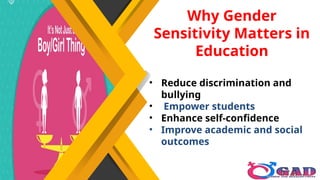
Why Gender
Sensitivity Matters in
Education
• Reduce discrimination and
bullying
• Empower students
• Enhance self-confidence
• Improve academic and social
outcomes
Why Gender Sensitivity
Matters in Education
1. Improved Academic Performance
•Studies show that gender-sensitive learning
environments lead to better academic
performance for both boys and girls. When
students feel valued and respected, their
motivation and engagement improve, resulting in
higher academic achievements.
•For example, UNESCO found that gender-
sensitive policies lead to a 5-10% increase in girls'
enrollment in school, especially in developing
countries.
•UNESCO. (2019). Gender sensitivity in education: A
global overview. UNESCO.
https://unesdoc.unesco.org/ark:/48223/pf0000370932
• 2. Enhanced Classroom
Participation
• Research indicates that classrooms
with gender-sensitive teachers and
materials encourage more equal
participation.
• A study by the Brookings Institution
found that in gender-sensitive
classrooms, girls' classroom
participation increased by 20-30%.This
leads to higher confidence levels, with
students feeling more comfortable
expressing their ideas and questions.
3. Reduction in Gender-Based Violence (GBV) and
Bullying
• Data suggests that schools implementing
gender-sensitive policies experience a
reduction in gender-based violence and
bullying.
• The Global School-based Student Health
Survey showed that 42% of girls and 33% of
boys in secondary school experienced some
form of bullying, often gender-related.
Gender-sensitive training for staff and
students helps reduce these incidents,
creating a safer school environment.
• The Global School-based Student Health Survey (GSHS) is conducted
by the World Health Organization (WHO) in collaboration with the
Centers for Disease Control and Prevention (CDC) and other partners.
It collects data on health-related behaviors among students, including
experiences with bullying, which can help inform policies on creating
safer and more inclusive school environments.
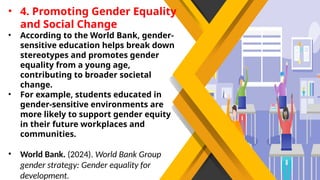
• 4. Promoting Gender Equality
and Social Change
• According to the World Bank, gender-
sensitive education helps break down
stereotypes and promotes gender
equality from a young age,
contributing to broader societal
change.
• For example, students educated in
gender-sensitive environments are
more likely to support gender equity
in their future workplaces and
communities.

• World Bank. (2024). World Bank Group
gender strategy: Gender equality for
development.
5. Mental Health Benefits
• Evidence from the World Health
Organization highlights that
gender bias and stereotyping in
schools can contribute to mental
health challenges, particularly for
girls.
• By adopting a gender-sensitive
approach, schools foster a more
supportive environment, which
can reduce anxiety and improve
overall mental health for all
students.
• Key Concepts in Gender Sensitivity
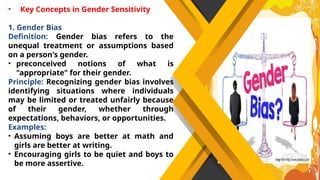
1. Gender Bias
Definition: Gender bias refers to the
unequal treatment or assumptions based
on a person's gender.
• preconceived notions of what is
"appropriate" for their gender.
Principle: Recognizing gender bias involves
identifying situations where individuals
may be limited or treated unfairly because
of their gender, whether through
expectations, behaviors, or opportunities.
Examples:
• Assuming boys are better at math and
girls are better at writing.
• Encouraging girls to be quiet and boys to
be more assertive.
• 2. Gender Inclusivity
• Definition: Gender inclusivity refers to
creating an environment where all
individuals, regardless of their gender
identity, feel respected, valued, and
supported.
• Principle: A gender-inclusive approach
ensures that policies, language, and
practices do not exclude or marginalize
individuals based on gender.
• Examples: Offering gender-neutral
bathroom facilities.
• Providing opportunities for students of all
genders to participate in various roles or
activities.
Key Concepts in Gender Sensitivity
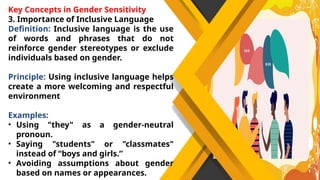
3. Importance of Inclusive Language
Definition: Inclusive language is the use
of words and phrases that do not
reinforce gender stereotypes or exclude
individuals based on gender.
Principle: Using inclusive language helps
create a more welcoming and respectful
environment
Examples:
• Using "they" as a gender-neutral
pronoun.
• Saying "students" or "classmates"
instead of “boys and girls.”
• Avoiding assumptions about gender
based on names or appearances.
Activity:
Group
Activity
Engagement/ Group Activity:
• Group 1: Gender Stereotypes
in Classroom Activities
• Focus on how certain subjects
or activities are often
associated with specific
genders.
• Task: Discuss ways to
encourage all students to
explore a variety of subjects
and activities, regardless of
gender.
Engagement/ Group Activity:
• Group 2: Language and
Communication
• Explore the impact of
gendered language in the
classroom and how teachers
can use gender-sensitive
language.
• Task: Identify common
phrases or behaviors that
may reinforce stereotypes
and propose gender-neutral
alternatives.
Engagement/ Group Activity:
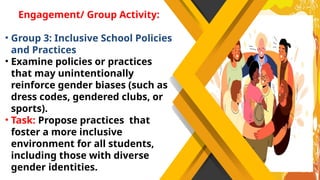
• Group 3: Inclusive School Policies
and Practices
• Examine policies or practices
that may unintentionally
reinforce gender biases (such as
dress codes, gendered clubs, or
sports).
• Task: Propose practices that
foster a more inclusive
environment for all students,
including those with diverse
gender identities.
Engagement/ Group
Activity:
•Group 4: Promoting
Diverse Role Models
•Task: Discuss the
importance of
representation and role
models from all genders in
curriculum and activities.
Presentation
of
GROUP
Output
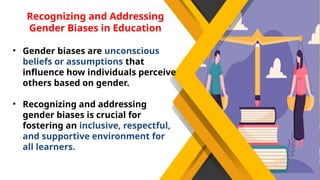
Recognizing and Addressing
Gender Biases in Education
• Gender biases are unconscious
beliefs or assumptions that
influence how individuals perceive
others based on gender.
• Recognizing and addressing
gender biases is crucial for
fostering an inclusive, respectful,
and supportive environment for
all learners.
Practical Strategies for a Gender-Inclusive
Classroom
1. Use Inclusive Language
What: Replace gendered terms (like "boys
and girls") with inclusive ones (such as
"students" or "everyone").
How: Encourage the use of preferred
pronouns, ask students for their
pronouns, and make it a norm in the
classroom.
Why: Inclusive language respects all
identities, avoids reinforcing stereotypes,
and creates a welcoming environment.
Practical Strategies for a Gender-
Inclusive Classroom
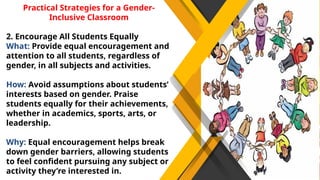
2. Encourage All Students Equally
What: Provide equal encouragement and
attention to all students, regardless of
gender, in all subjects and activities.
How: Avoid assumptions about students’
interests based on gender. Praise
students equally for their achievements,
whether in academics, sports, arts, or
leadership.
Why: Equal encouragement helps break
down gender barriers, allowing students
to feel confident pursuing any subject or
activity they’re interested in.
Practical Strategies for a Gender-Inclusive
Classroom
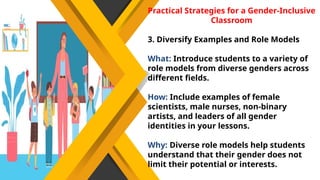
3. Diversify Examples and Role Models
What: Introduce students to a variety of
role models from diverse genders across
different fields.
How: Include examples of female
scientists, male nurses, non-binary
artists, and leaders of all gender
identities in your lessons.
Why: Diverse role models help students
understand that their gender does not
limit their potential or interests.
Practical Strategies for a Gender-
Inclusive Classroom
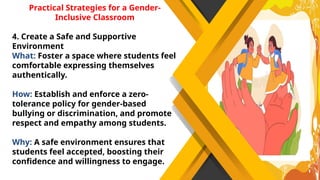
4. Create a Safe and Supportive
Environment
What: Foster a space where students feel
comfortable expressing themselves
authentically.
How: Establish and enforce a zero-
tolerance policy for gender-based
bullying or discrimination, and promote
respect and empathy among students.
Why: A safe environment ensures that
students feel accepted, boosting their
confidence and willingness to engage.
Practical Strategies for a Gender-Inclusive
Classroom
5. Challenge Gender Stereotypes
What: Actively discuss and question
traditional gender roles with students to
encourage critical thinking.
How: Use classroom discussions, books,
and media that depict a range of gender
expressions and break gender norms.
Why: Challenging stereotypes empowers
students to think independently and
supports a mindset of equality.
Practical Strategies for a Gender-
Inclusive Classroom
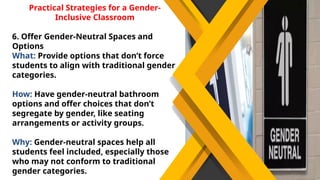
6. Offer Gender-Neutral Spaces and
Options
What: Provide options that don’t force
students to align with traditional gender
categories.
How: Have gender-neutral bathroom
options and offer choices that don’t
segregate by gender, like seating
arrangements or activity groups.
Why: Gender-neutral spaces help all
students feel included, especially those
who may not conform to traditional
gender categories.
Practical Strategies for a Gender-Inclusive
Classroom
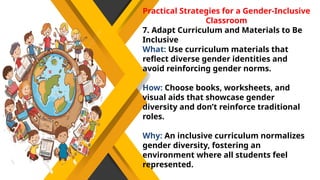
7. Adapt Curriculum and Materials to Be
Inclusive
What: Use curriculum materials that
reflect diverse gender identities and
avoid reinforcing gender norms.
How: Choose books, worksheets, and
visual aids that showcase gender
diversity and don’t reinforce traditional
roles.
Why: An inclusive curriculum normalizes
gender diversity, fostering an
environment where all students feel
represented.
Practical Strategies for a Gender-
Inclusive Classroom
8. Continuously Educate Yourself and
Reflect on Teaching Practices
What: Regularly seek out training,
workshops, and resources on gender
inclusivity and equity.
How: Reflect on your own practices,
biases, and assumptions, and stay
informed on best practices for a gender-
inclusive classroom.
Why: Ongoing self-education enables
educators to create an environment that
supports all students and evolves with
societal changes.
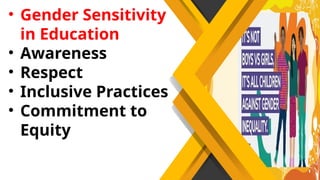
• Gender Sensitivity
in Education
• Awareness
• Respect
• Inclusive Practices
• Commitment to
Equity
Activity # 3
REFLECTION
TIME!
REFLECTION TIME!
1. Ano ang isa mong bagong natutunan tungkol sa
sensitibong pagtugon sa kasarian at ang epekto
nito sa mga mag-aaral?
2. Sa iyong kasalukuyang mga pamamaraan sa
pagtuturo, may mga hindi sinasadyang pag-
uugaling may kinalaman sa kasarian ka bang
napansin?
3. Paano mo ito masusubukan na baguhin sa
hinaharap?Anong partikular na hakbang ang
maaari mong gawin upang gawing mas inclusive
o walang kinikilingan ang iyong wika at
pakikipag-ugnayan sa mga mag-aaral?
4. Anong mga hamon ang nakikita mong maaaring
harapin sa pagpapatupad ng sensitibong
pagtugon sa kasarian, at paano mo ito
malalampasan?
5. Paano ka maaaring aktibong magsulong ng
pagkakapantay-pantay at paggalang para sa
lahat ng pagkakakilanlan sa iyong silid-aralan?
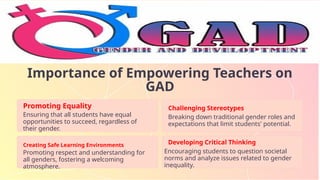
Importance of Empowering Teachers on
GAD
Promoting Equality
Ensuring that all students have equal
opportunities to succeed, regardless of
their gender.
Challenging Stereotypes
Breaking down traditional gender roles and
expectations that limit students' potential.
Creating Safe Learning Environments
Promoting respect and understanding for
all genders, fostering a welcoming
atmosphere.
Developing Critical Thinking
Encouraging students to question societal
norms and analyze issues related to gender
inequality.
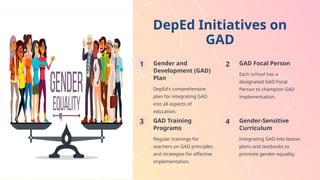
DepEd Initiatives on
GAD
1 Gender and
Development (GAD)
Plan
DepEd's comprehensive
plan for integrating GAD
into all aspects of
education.
2 GAD Focal Person
Each school has a
designated GAD Focal
Person to champion GAD
implementation.
3 GAD Training
Programs
Regular trainings for
teachers on GAD principles
and strategies for effective
implementation.
4 Gender-Sensitive
Curriculum
Integrating GAD into lesson
plans and textbooks to
promote gender equality.
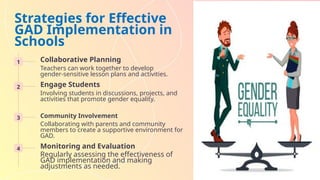
Strategies for Effective
GAD Implementation in
Schools
1 Collaborative Planning
Teachers can work together to develop
gender-sensitive lesson plans and activities.
2 Engage Students
Involving students in discussions, projects, and
activities that promote gender equality.
3 Community Involvement
Collaborating with parents and community
members to create a supportive environment for
GAD.
4 Monitoring and Evaluation
Regularly assessing the effectiveness of
GAD implementation and making
adjustments as needed.
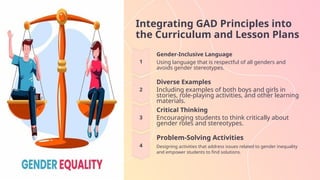
Integrating GAD Principles into
the Curriculum and Lesson Plans
Gender-Inclusive Language
Using language that is respectful of all genders and
avoids gender stereotypes.
Diverse Examples
Including examples of both boys and girls in
stories, role-playing activities, and other learning
materials.
Critical Thinking
Encouraging students to think critically about
gender roles and stereotypes.
Problem-Solving Activities
Designing activities that address issues related to gender inequality
and empower students to find solutions.
Fostering a Gender-Sensitive Classroom
Environment
Respect and Equality
Creating a classroom where
all students feel valued and
respected.
Inclusive Activities
Planning activities that
encourage participation from
all students, regardless of
their gender.
Open Communication
Establishing a safe space for
students to express their
thoughts and feelings on
gender issues.
Role Models
Highlighting both male and
female role models who
challenge gender
stereotypes.
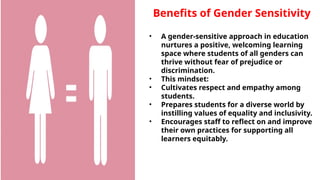
Benefits of Gender Sensitivity
• A gender-sensitive approach in education
nurtures a positive, welcoming learning
space where students of all genders can
thrive without fear of prejudice or
discrimination.
• This mindset:
• Cultivates respect and empathy among
students.
• Prepares students for a diverse world by
instilling values of equality and inclusivity.
• Encourages staff to reflect on and improve
their own practices for supporting all
learners equitably.
Activity # 4
• Title: Creating Your Action Plan
Instructions: "Write down 2-3
strategies from today’s session
that you will implement in your
classroom.“
Visuals: Template for action plan
with bullet points or checklist
icons.
Thank You
F O R L I S T E N I N G !
Division of Bulacan

GAD-Presentation-INSET-day-...........1.pptx

  • 1.
    Republic of thePhilippines Department of Education SCHOOLS DIVISION OF BULACAN IN-SERVICE TRAINING WEEK-EMPOWERING EDUCATORS: Transforming Classrooms into Inclusive, Innovative, and Intellectually Engaging Spaces PRC Accredited CPD Program (12 Credit Units) of Department of Education (DepEd) Schools Division of Bulacan (PTR-2024-501) November 27-29, 2024 Day 1
  • 3.
  • 4.
  • 5.
  • 6.
    Workshop Overview: • Understandthe concept of gender sensitivity and its role in promoting an inclusive educational environment. • Develop awareness of gender- sensitive language and communication techniques. • Commit to specific actions to support a gender-sensitive environment in schools.
  • 7.
  • 8.
    • Content Highlights: o Whygender sensitivity matters in education?
  • 9.
    DepEd efforts topromote gender equality and responsiveness within the education system. 1. DepEd Order No. 32, s. 2017 Title: "Gender-Responsive Basic Education Policy “ Policy Description: This order provides the policy framework for integrating gender equality, equity, and sensitivity in DepEd programs, projects, and activities. 2. DepEd Order No. 63, s. 2012 Title: "Guidelines on the Preparation of Annual Gender and Development (GAD) Plans and Budgets and Accomplishment Reports to Implement the Magna Carta of Women Description: This order provides guidelines for the preparation and submission of annual GAD plans and budgets, as well as accomplishment reports, in compliance with the Magna Carta of Women.
  • 10.
    3. DepEd OrderNo. 16, s. 2020 Title: "Guidelines on the Implementation of the Results-Based Performance Management System (RPMS) for School Year 2019-2020“ Description: Outlines the inclusion of GAD principles in the performance management system for educators. 4. DepEd Order No. 55, s. 2013 Title: Implementing Rules and Regulations (IRR) of Republic Act (RA) No. 10627 Otherwise Known as the Anti-Bullying Act of 2013 “ Description: DepEd iterates zero tolerance policy vs child abuse, bullying To ensure that cases and instances of abuse are closely monitored at school level, DepEd issued the DepEd Order No. 40, series of 2012, or the DepEd Child Protection Policy, which requires all elementary and secondary schools—both public and private—to create their own Child Protection Committee (CPC). In a press briefing, Education Secretary Leonor Magtolis Briones said, “Ang Child Protection Policy natin, mandato yan ng United Nations, mandato yan ng ating pamahalaan na lahat ng bata ay kailangang i-protect from bullying. Yun ang pinagbabasehan ng ating policy. So at the level of the school, merong Child Protection
  • 11.
    Gender sensitivity, definedas the ability to recognize and highlight existing gender differences, issues, and inequalities (Figueroa Vélez and Vélez Ochoa 2021), is essential not only to attract but also to retain female talent in the organization. This, in turn, contributes to the enhancement of workplace gender equality (Chang and Milkman 2020).
  • 12.
    Gender Sensitivity isthe awareness and understanding of the ways that gender influences attitudes, behaviors, and perceptions in various contexts, including the educational setting. It involves recognizing that each student has a unique identity and experience, shaped by their gender, and that these identities deserve respect and equal opportunity.
  • 13.
    Why Gender Sensitivity Mattersin Education • Reduce discrimination and bullying • Empower students • Enhance self-confidence • Improve academic and social outcomes
  • 14.
    Why Gender Sensitivity Mattersin Education 1. Improved Academic Performance •Studies show that gender-sensitive learning environments lead to better academic performance for both boys and girls. When students feel valued and respected, their motivation and engagement improve, resulting in higher academic achievements. •For example, UNESCO found that gender- sensitive policies lead to a 5-10% increase in girls' enrollment in school, especially in developing countries. •UNESCO. (2019). Gender sensitivity in education: A global overview. UNESCO. https://unesdoc.unesco.org/ark:/48223/pf0000370932
  • 15.
    • 2. EnhancedClassroom Participation • Research indicates that classrooms with gender-sensitive teachers and materials encourage more equal participation. • A study by the Brookings Institution found that in gender-sensitive classrooms, girls' classroom participation increased by 20-30%.This leads to higher confidence levels, with students feeling more comfortable expressing their ideas and questions.
  • 16.
    3. Reduction inGender-Based Violence (GBV) and Bullying • Data suggests that schools implementing gender-sensitive policies experience a reduction in gender-based violence and bullying. • The Global School-based Student Health Survey showed that 42% of girls and 33% of boys in secondary school experienced some form of bullying, often gender-related. Gender-sensitive training for staff and students helps reduce these incidents, creating a safer school environment. • The Global School-based Student Health Survey (GSHS) is conducted by the World Health Organization (WHO) in collaboration with the Centers for Disease Control and Prevention (CDC) and other partners. It collects data on health-related behaviors among students, including experiences with bullying, which can help inform policies on creating safer and more inclusive school environments.
  • 17.
    • 4. PromotingGender Equality and Social Change • According to the World Bank, gender- sensitive education helps break down stereotypes and promotes gender equality from a young age, contributing to broader societal change. • For example, students educated in gender-sensitive environments are more likely to support gender equity in their future workplaces and communities. • World Bank. (2024). World Bank Group gender strategy: Gender equality for development.
  • 18.
    5. Mental HealthBenefits • Evidence from the World Health Organization highlights that gender bias and stereotyping in schools can contribute to mental health challenges, particularly for girls. • By adopting a gender-sensitive approach, schools foster a more supportive environment, which can reduce anxiety and improve overall mental health for all students.
  • 19.
    • Key Conceptsin Gender Sensitivity 1. Gender Bias Definition: Gender bias refers to the unequal treatment or assumptions based on a person's gender. • preconceived notions of what is "appropriate" for their gender. Principle: Recognizing gender bias involves identifying situations where individuals may be limited or treated unfairly because of their gender, whether through expectations, behaviors, or opportunities. Examples: • Assuming boys are better at math and girls are better at writing. • Encouraging girls to be quiet and boys to be more assertive.
  • 20.
    • 2. GenderInclusivity • Definition: Gender inclusivity refers to creating an environment where all individuals, regardless of their gender identity, feel respected, valued, and supported. • Principle: A gender-inclusive approach ensures that policies, language, and practices do not exclude or marginalize individuals based on gender. • Examples: Offering gender-neutral bathroom facilities. • Providing opportunities for students of all genders to participate in various roles or activities.
  • 21.
    Key Concepts inGender Sensitivity 3. Importance of Inclusive Language Definition: Inclusive language is the use of words and phrases that do not reinforce gender stereotypes or exclude individuals based on gender. Principle: Using inclusive language helps create a more welcoming and respectful environment Examples: • Using "they" as a gender-neutral pronoun. • Saying "students" or "classmates" instead of “boys and girls.” • Avoiding assumptions about gender based on names or appearances.
  • 22.
  • 23.
    Engagement/ Group Activity: •Group 1: Gender Stereotypes in Classroom Activities • Focus on how certain subjects or activities are often associated with specific genders. • Task: Discuss ways to encourage all students to explore a variety of subjects and activities, regardless of gender.
  • 24.
    Engagement/ Group Activity: •Group 2: Language and Communication • Explore the impact of gendered language in the classroom and how teachers can use gender-sensitive language. • Task: Identify common phrases or behaviors that may reinforce stereotypes and propose gender-neutral alternatives.
  • 25.
    Engagement/ Group Activity: •Group 3: Inclusive School Policies and Practices • Examine policies or practices that may unintentionally reinforce gender biases (such as dress codes, gendered clubs, or sports). • Task: Propose practices that foster a more inclusive environment for all students, including those with diverse gender identities.
  • 26.
    Engagement/ Group Activity: •Group 4:Promoting Diverse Role Models •Task: Discuss the importance of representation and role models from all genders in curriculum and activities.
  • 27.
  • 28.
    Recognizing and Addressing GenderBiases in Education • Gender biases are unconscious beliefs or assumptions that influence how individuals perceive others based on gender. • Recognizing and addressing gender biases is crucial for fostering an inclusive, respectful, and supportive environment for all learners.
  • 29.
    Practical Strategies fora Gender-Inclusive Classroom 1. Use Inclusive Language What: Replace gendered terms (like "boys and girls") with inclusive ones (such as "students" or "everyone"). How: Encourage the use of preferred pronouns, ask students for their pronouns, and make it a norm in the classroom. Why: Inclusive language respects all identities, avoids reinforcing stereotypes, and creates a welcoming environment.
  • 30.
    Practical Strategies fora Gender- Inclusive Classroom 2. Encourage All Students Equally What: Provide equal encouragement and attention to all students, regardless of gender, in all subjects and activities. How: Avoid assumptions about students’ interests based on gender. Praise students equally for their achievements, whether in academics, sports, arts, or leadership. Why: Equal encouragement helps break down gender barriers, allowing students to feel confident pursuing any subject or activity they’re interested in.
  • 31.
    Practical Strategies fora Gender-Inclusive Classroom 3. Diversify Examples and Role Models What: Introduce students to a variety of role models from diverse genders across different fields. How: Include examples of female scientists, male nurses, non-binary artists, and leaders of all gender identities in your lessons. Why: Diverse role models help students understand that their gender does not limit their potential or interests.
  • 32.
    Practical Strategies fora Gender- Inclusive Classroom 4. Create a Safe and Supportive Environment What: Foster a space where students feel comfortable expressing themselves authentically. How: Establish and enforce a zero- tolerance policy for gender-based bullying or discrimination, and promote respect and empathy among students. Why: A safe environment ensures that students feel accepted, boosting their confidence and willingness to engage.
  • 33.
    Practical Strategies fora Gender-Inclusive Classroom 5. Challenge Gender Stereotypes What: Actively discuss and question traditional gender roles with students to encourage critical thinking. How: Use classroom discussions, books, and media that depict a range of gender expressions and break gender norms. Why: Challenging stereotypes empowers students to think independently and supports a mindset of equality.
  • 34.
    Practical Strategies fora Gender- Inclusive Classroom 6. Offer Gender-Neutral Spaces and Options What: Provide options that don’t force students to align with traditional gender categories. How: Have gender-neutral bathroom options and offer choices that don’t segregate by gender, like seating arrangements or activity groups. Why: Gender-neutral spaces help all students feel included, especially those who may not conform to traditional gender categories.
  • 35.
    Practical Strategies fora Gender-Inclusive Classroom 7. Adapt Curriculum and Materials to Be Inclusive What: Use curriculum materials that reflect diverse gender identities and avoid reinforcing gender norms. How: Choose books, worksheets, and visual aids that showcase gender diversity and don’t reinforce traditional roles. Why: An inclusive curriculum normalizes gender diversity, fostering an environment where all students feel represented.
  • 36.
    Practical Strategies fora Gender- Inclusive Classroom 8. Continuously Educate Yourself and Reflect on Teaching Practices What: Regularly seek out training, workshops, and resources on gender inclusivity and equity. How: Reflect on your own practices, biases, and assumptions, and stay informed on best practices for a gender- inclusive classroom. Why: Ongoing self-education enables educators to create an environment that supports all students and evolves with societal changes.
  • 37.
    • Gender Sensitivity inEducation • Awareness • Respect • Inclusive Practices • Commitment to Equity
  • 38.
  • 39.
    REFLECTION TIME! 1. Anoang isa mong bagong natutunan tungkol sa sensitibong pagtugon sa kasarian at ang epekto nito sa mga mag-aaral? 2. Sa iyong kasalukuyang mga pamamaraan sa pagtuturo, may mga hindi sinasadyang pag- uugaling may kinalaman sa kasarian ka bang napansin? 3. Paano mo ito masusubukan na baguhin sa hinaharap?Anong partikular na hakbang ang maaari mong gawin upang gawing mas inclusive o walang kinikilingan ang iyong wika at pakikipag-ugnayan sa mga mag-aaral? 4. Anong mga hamon ang nakikita mong maaaring harapin sa pagpapatupad ng sensitibong pagtugon sa kasarian, at paano mo ito malalampasan? 5. Paano ka maaaring aktibong magsulong ng pagkakapantay-pantay at paggalang para sa lahat ng pagkakakilanlan sa iyong silid-aralan?
  • 40.
    Importance of EmpoweringTeachers on GAD Promoting Equality Ensuring that all students have equal opportunities to succeed, regardless of their gender. Challenging Stereotypes Breaking down traditional gender roles and expectations that limit students' potential. Creating Safe Learning Environments Promoting respect and understanding for all genders, fostering a welcoming atmosphere. Developing Critical Thinking Encouraging students to question societal norms and analyze issues related to gender inequality.
  • 41.
    DepEd Initiatives on GAD 1Gender and Development (GAD) Plan DepEd's comprehensive plan for integrating GAD into all aspects of education. 2 GAD Focal Person Each school has a designated GAD Focal Person to champion GAD implementation. 3 GAD Training Programs Regular trainings for teachers on GAD principles and strategies for effective implementation. 4 Gender-Sensitive Curriculum Integrating GAD into lesson plans and textbooks to promote gender equality.
  • 42.
    Strategies for Effective GADImplementation in Schools 1 Collaborative Planning Teachers can work together to develop gender-sensitive lesson plans and activities. 2 Engage Students Involving students in discussions, projects, and activities that promote gender equality. 3 Community Involvement Collaborating with parents and community members to create a supportive environment for GAD. 4 Monitoring and Evaluation Regularly assessing the effectiveness of GAD implementation and making adjustments as needed.
  • 43.
    Integrating GAD Principlesinto the Curriculum and Lesson Plans Gender-Inclusive Language Using language that is respectful of all genders and avoids gender stereotypes. Diverse Examples Including examples of both boys and girls in stories, role-playing activities, and other learning materials. Critical Thinking Encouraging students to think critically about gender roles and stereotypes. Problem-Solving Activities Designing activities that address issues related to gender inequality and empower students to find solutions.
  • 44.
    Fostering a Gender-SensitiveClassroom Environment Respect and Equality Creating a classroom where all students feel valued and respected. Inclusive Activities Planning activities that encourage participation from all students, regardless of their gender. Open Communication Establishing a safe space for students to express their thoughts and feelings on gender issues. Role Models Highlighting both male and female role models who challenge gender stereotypes.
  • 45.
    Benefits of GenderSensitivity • A gender-sensitive approach in education nurtures a positive, welcoming learning space where students of all genders can thrive without fear of prejudice or discrimination. • This mindset: • Cultivates respect and empathy among students. • Prepares students for a diverse world by instilling values of equality and inclusivity. • Encourages staff to reflect on and improve their own practices for supporting all learners equitably.
  • 46.
    Activity # 4 •Title: Creating Your Action Plan Instructions: "Write down 2-3 strategies from today’s session that you will implement in your classroom.“ Visuals: Template for action plan with bullet points or checklist icons.
  • 47.
    Thank You F OR L I S T E N I N G ! Division of Bulacan