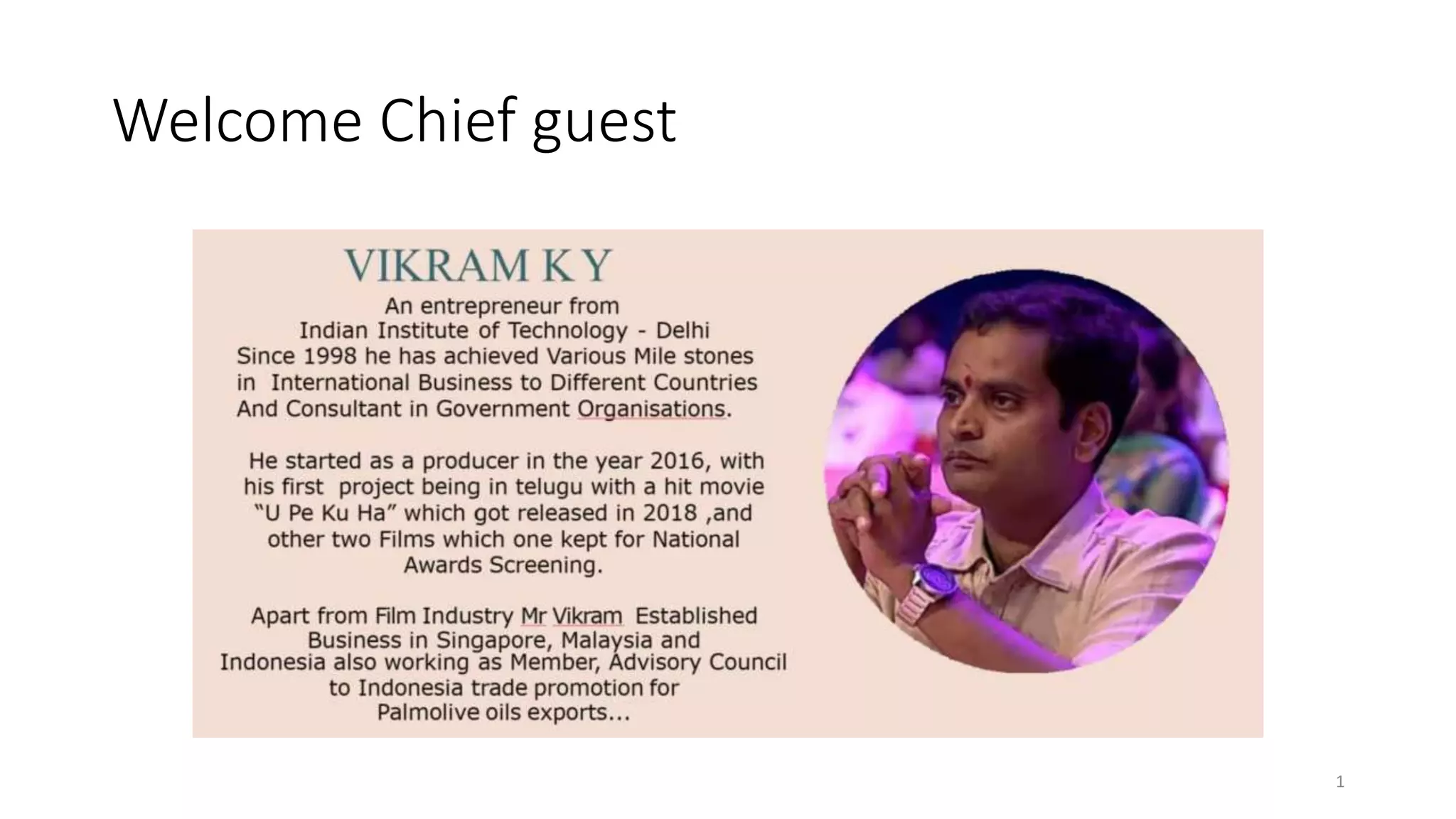
Welcome Chief guest
1
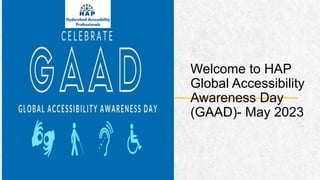
Welcome to HAP
Global Accessibility
Awareness Day
(GAAD)- May 2023
About HAP
• Hyderabad Accessibility Professionals (HAP)
is a group of accessibility enthusiasts and
professionals committed to creating a more
accessible world.
• We work together to raise awareness about
the importance of accessibility and organize
various events to promote it.
• HAP believes that accessibility is not only a
legal requirement but also a fundamental
human right.
3
HAP Team • Suman Damera
• Syeda Anwar Sulthana
• Samyuktha Chadaram
• Radha Vydehi
• Naveen Gandamalla
4
Preapproved CAECs by IAAP
HAP session has been pre-approved by IAAP for the CPACC and CPWA CAECS
5
Our Sponsors
• Phenom
• International Institute of Information Technology,
Hyderabad
• Sammilitha Foundation
6
Global Accessibility Awareness Day
Global Accessibility Awareness Day is an
awareness day focusing on Digital
access and inclusion for the more than one billion
people with disabilities and impairments. It
is marked annually on the third Thursday of May
it is on May 19, 2023.
According to the Global Accessibility Awareness
Day website, "The purpose of GAAD is to get
everyone talking, thinking and learning about
digital (web, software, mobile, etc.) access or
inclusion and people with different disabilities."
7
Why is GAAD
important?
8
Ensures that
everyone can
access and
interact with
digital content
without barriers.
Technology is
increasingly used
in our daily lives.
People with
disabilities
should not be
excluded from
using
technology.
Making digital
content
accessible
benefits
everyone.
What is covered in GAAD?
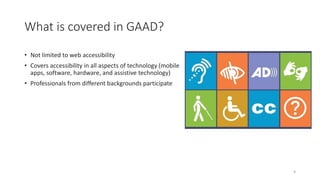
• Not limited to web accessibility
• Covers accessibility in all aspects of technology (mobile
apps, software, hardware, and assistive technology)
• Professionals from different backgrounds participate
9
How is GAAD celebrated?
• Events are organized both online and offline
• Organizations, institutions, and individuals can participate
• Events include webinars, workshops, and training sessions on accessibility
10
what is digital accessibility
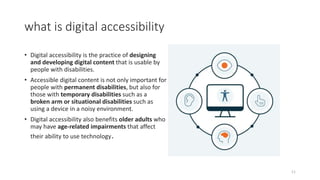
• Digital accessibility is the practice of designing
and developing digital content that is usable by
people with disabilities.
• Accessible digital content is not only important for
people with permanent disabilities, but also for
those with temporary disabilities such as a
broken arm or situational disabilities such as
using a device in a noisy environment.
• Digital accessibility also benefits older adults who
may have age-related impairments that affect
their ability to use technology.
11
why digital accessibility
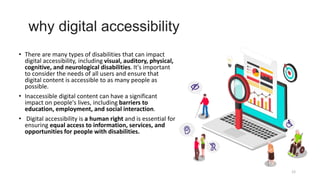
• There are many types of disabilities that can impact
digital accessibility, including visual, auditory, physical,
cognitive, and neurological disabilities. It's important
to consider the needs of all users and ensure that
digital content is accessible to as many people as
possible.
• Inaccessible digital content can have a significant
impact on people's lives, including barriers to
education, employment, and social interaction.
• Digital accessibility is a human right and is essential for
ensuring equal access to information, services, and
opportunities for people with disabilities.
12
VISUAL IMPARED ACTIVITY
13
Script-1 guideline zooming the text
Characters :
1.Mother ()
2.Daughter
3.TC in the train
• This is the small story about the daughter who has a low vision, and she fails to bring an ID proof while
travelling in a train because of the important text got truncated on zooming while booking the tickets.
Step 1: Daughter and Mother plans for a happy journey.
Step 2: Daughter book the tickets in online ticket providing application on zooming the page as she is a low
vision user.
Step 3: On booking the ticket they will check for all the instructions.
Step 4: Most of the instructions gets truncated which includes even “carrying the government identity proof is
mandatory”.
Step 5: On the day of travel, they will board the train, ticket collector will check their ticket details and ask for
the government ID proof.
Step 6: As they haven’t carried with them ticket collector will ask for off-boarding the train or else paying the
fine for not carrying the ID proof.
Step 7: Both the mother and daughter will be in a panic situation, which they have not faced it before.
14
ASSISTIVE TECHONOLOGIES FOR VISUAL
IMPAIRMENT
• Screen readers
• Screen Magnifiers
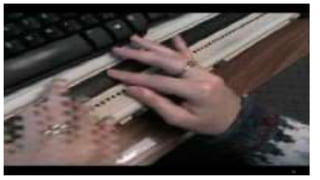
• Refreshable Braille display
• Magnifier
• ZoomText
15
Siva Priya TALK on challenges faced by People
with disabilites
16
QUIZ-1
17
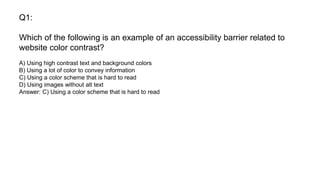
Q1:
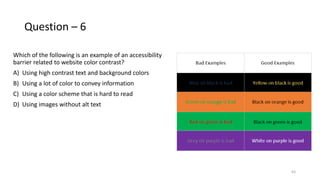
Which of the following is an example of an accessibility barrier related to
website color contrast?
A) Using high contrast text and background colors
B) Using a lot of color to convey information
C) Using a color scheme that is hard to read
D) Using images without alt text
Answer: C) Using a color scheme that is hard to read
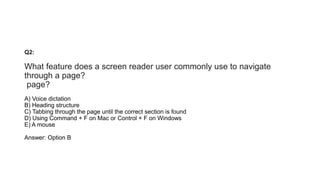
Q2:
What feature does a screen reader user commonly use to navigate
through a page?
page?
A) Voice dictation
B) Heading structure
C) Tabbing through the page until the correct section is found
D) Using Command + F on Mac or Control + F on Windows
E) A mouse
Answer: Option B
HEARING IMPAIRED ACTIVITY
20
21
22
ASSISTIVE TECHNOLOGIES FOR HEARING
IMPARMENT
• Closed Captions
• Video Rely services (VRS)
• Speech to Text
• Hearing aids
23
QUIZ-2
24
Q1:
What is the minimum font size for text required to be Section 508
compliant?
A) 5
B) 18
C) 38
Answer: Option B
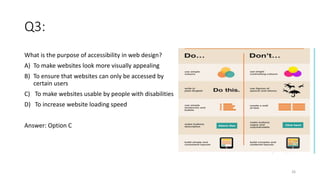
Q3:
What is the purpose of accessibility in web design?
A) To make websites look more visually appealing
B) To ensure that websites can only be accessed by
certain users
C) To make websites usable by people with disabilities
D) To increase website loading speed
Answer: Option C
26
MOTOR IMPAIRMENT ACTIVITY
27
Fold your hands ACTIVITY
•Motor disability tie the hand and ask the person
to call to their friends for help.
•Order food from zomato or swiggy
28
ASSISTIVE TECHNOLOGIES FOR MOTOR
IMPAIRMENT
• Alternative keyboards
• SIP N PUFF
• Switch devices
• Eye tracking technology
• Voice Assistant (Siri, VoiceControl, Cortana, Alexa)
• DRAGORN Speech to text
29
OTHER DISABILITIES
30
Other Disabilities
•Cognitive
•Seizures
•Profound Disability
• Speech Impairment
31
NEHA AGARWAL TALK ON PERSONAL JOURNEY
AND DISABILITY ETIQUETTE
32
QUIZ-3
33
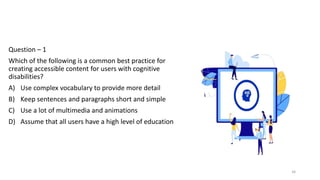
Question – 1
Which of the following is a common best practice for
creating accessible content for users with cognitive
disabilities?
A) Use complex vocabulary to provide more detail
B) Keep sentences and paragraphs short and simple
C) Use a lot of multimedia and animations
D) Assume that all users have a high level of education
34
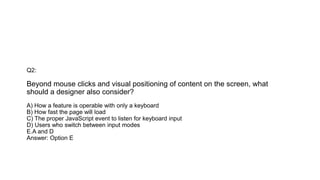
Q2:
Beyond mouse clicks and visual positioning of content on the screen, what
should a designer also consider?
A) How a feature is operable with only a keyboard
B) How fast the page will load
C) The proper JavaScript event to listen for keyboard input
D) Users who switch between input modes
E.A and D
Answer: Option E
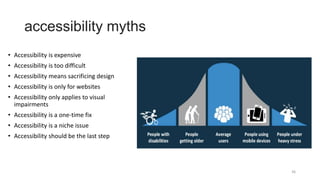
accessibility myths
• Accessibility is expensive
• Accessibility is too difficult
• Accessibility means sacrificing design
• Accessibility is only for websites
• Accessibility only applies to visual
impairments
• Accessibility is a one-time fix
• Accessibility is a niche issue
• Accessibility should be the last step
36
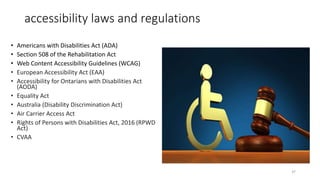
accessibility laws and regulations
• Americans with Disabilities Act (ADA)
• Section 508 of the Rehabilitation Act
• Web Content Accessibility Guidelines (WCAG)
• European Accessibility Act (EAA)
• Accessibility for Ontarians with Disabilities Act
(AODA)
• Equality Act
• Australia (Disability Discrimination Act)
• Air Carrier Access Act
• Rights of Persons with Disabilities Act, 2016 (RPWD
Act)
• CVAA
37
Accessibility Business
case
38
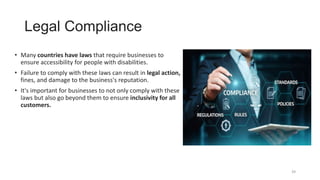
Legal Compliance
• Many countries have laws that require businesses to
ensure accessibility for people with disabilities.
• Failure to comply with these laws can result in legal action,
fines, and damage to the business's reputation.
• It's important for businesses to not only comply with these
laws but also go beyond them to ensure inclusivity for all
customers.
39
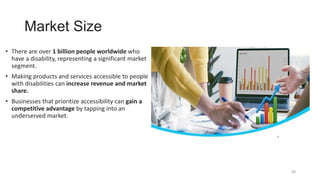
Market Size
• There are over 1 billion people worldwide who
have a disability, representing a significant market
segment.
• Making products and services accessible to people
with disabilities can increase revenue and market
share.
• Businesses that prioritize accessibility can gain a
competitive advantage by tapping into an
underserved market.
40
Social Responsibility
• Businesses have an ethical and social
responsibility to ensure that their products and
services are accessible to all.
• Prioritizing accessibility is not only the right
thing to do but also a smart business decision.
• By investing in accessibility, businesses can not
only improve their bottom line but also
contribute to a more inclusive and equitable
society.
41
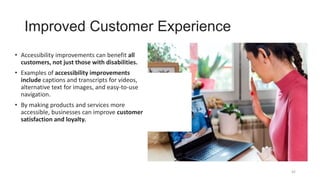
Improved Customer Experience
• Accessibility improvements can benefit all
customers, not just those with disabilities.
• Examples of accessibility improvements
include captions and transcripts for videos,
alternative text for images, and easy-to-use
navigation.
• By making products and services more
accessible, businesses can improve customer
satisfaction and loyalty.
42
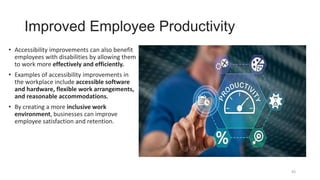
Improved Employee Productivity
• Accessibility improvements can also benefit
employees with disabilities by allowing them
to work more effectively and efficiently.
• Examples of accessibility improvements in
the workplace include accessible software
and hardware, flexible work arrangements,
and reasonable accommodations.
• By creating a more inclusive work
environment, businesses can improve
employee satisfaction and retention.
43
SHIVA SURESH TALK ON TRENDING
TECHNOLOGIES
44
QUIZ-4
45
Q1:
What combination of keys do keyboard-only users use to
navigate through a page?
A) All keys
B) Left and Right Arrow keys
C) Tab and Left and Right Arrow keys
D) Shift and Arrow keys
E) Tab and Arrow keys
Answer E
Q2:
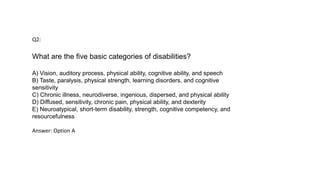
What are the five basic categories of disabilities?
A) Vision, auditory process, physical ability, cognitive ability, and speech
B) Taste, paralysis, physical strength, learning disorders, and cognitive
sensitivity
C) Chronic illness, neurodiverse, ingenious, dispersed, and physical ability
D) Diffused, sensitivity, chronic pain, physical ability, and dexterity
E) Neuroatypical, short-term disability, strength, cognitive competency, and
resourcefulness
Answer: Option A
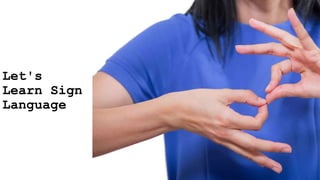
Let's
Learn Sign
Language
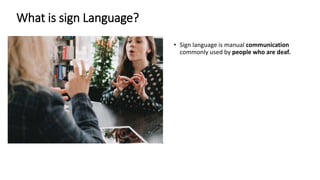
What is sign Language?
• Sign language is manual communication
commonly used by people who are deaf.
Basic of Sign Language
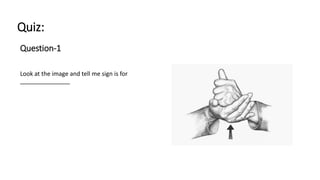
Quiz:
Question-1
Look at the image and tell me sign is for
_______________
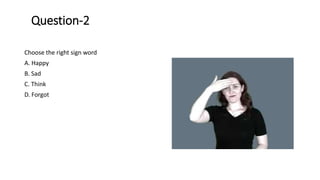
Question-2
Choose the right sign word
A. Happy
B. Sad
C. Think
D. Forgot
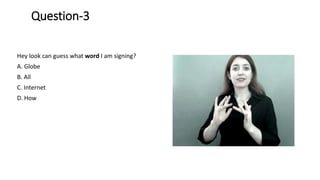
Question-3
Hey look can guess what word I am signing?
A. Globe
B. All
C. Internet
D. How
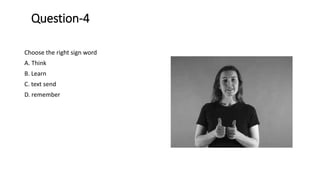
Question-4
Choose the right sign word
A. Think
B. Learn
C. text send
D. remember
Question-5
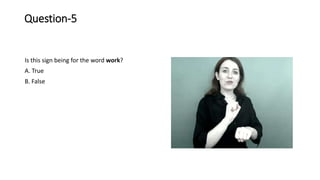
Is this sign being for the word work?
A. True
B. False
56
TOKEN OF APPRECIATION
• All the winners
• Guest Speakers
57
58
Quiz-5 SPARE questions
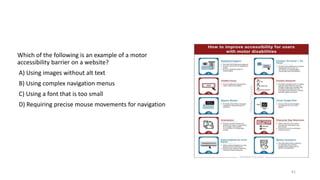
Which of the following is an example of a motor
accessibility barrier on a website?
A) Using images without alt text
B) Using complex navigation menus
C) Using a font that is too small
D) Requiring precise mouse movements for navigation
61
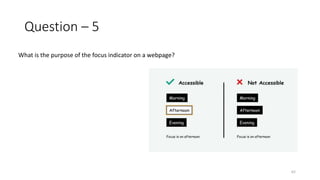
Question – 5
What is the purpose of the focus indicator on a webpage?
62
Question – 6
Which of the following is an example of an accessibility
barrier related to website color contrast?
A) Using high contrast text and background colors
B) Using a lot of color to convey information
C) Using a color scheme that is hard to read
D) Using images without alt text
63
• What is meant by 'Operable'?
• A.
• Web content can be accessed on different devices, including through assistive technology.
• B.
• The web content output is available in different sensory ways (sight, sound, touch).
• C.
• The web content input methods are available through different input devices (keyboard, mouse, speech recognition, etc.).
• D.
• Web content and interfaces are understandable
Question – 3
What is the purpose of the Access Board?
65
Question – 6
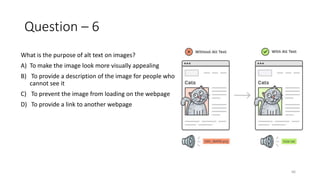
What is the purpose of alt text on images?
A) To make the image look more visually appealing
B) To provide a description of the image for people who
cannot see it
C) To prevent the image from loading on the webpage
D) To provide a link to another webpage
66

GAAD_EVENT_V3.pptx

  • 1.
  • 2.
    Welcome to HAP GlobalAccessibility Awareness Day (GAAD)- May 2023
  • 3.
    About HAP • HyderabadAccessibility Professionals (HAP) is a group of accessibility enthusiasts and professionals committed to creating a more accessible world. • We work together to raise awareness about the importance of accessibility and organize various events to promote it. • HAP believes that accessibility is not only a legal requirement but also a fundamental human right. 3
  • 4.
    HAP Team •Suman Damera • Syeda Anwar Sulthana • Samyuktha Chadaram • Radha Vydehi • Naveen Gandamalla 4
  • 5.
    Preapproved CAECs byIAAP HAP session has been pre-approved by IAAP for the CPACC and CPWA CAECS 5
  • 6.
    Our Sponsors • Phenom •International Institute of Information Technology, Hyderabad • Sammilitha Foundation 6
  • 7.
    Global Accessibility AwarenessDay Global Accessibility Awareness Day is an awareness day focusing on Digital access and inclusion for the more than one billion people with disabilities and impairments. It is marked annually on the third Thursday of May it is on May 19, 2023. According to the Global Accessibility Awareness Day website, "The purpose of GAAD is to get everyone talking, thinking and learning about digital (web, software, mobile, etc.) access or inclusion and people with different disabilities." 7
  • 8.
    Why is GAAD important? 8 Ensuresthat everyone can access and interact with digital content without barriers. Technology is increasingly used in our daily lives. People with disabilities should not be excluded from using technology. Making digital content accessible benefits everyone.
  • 9.
    What is coveredin GAAD? • Not limited to web accessibility • Covers accessibility in all aspects of technology (mobile apps, software, hardware, and assistive technology) • Professionals from different backgrounds participate 9
  • 10.
    How is GAADcelebrated? • Events are organized both online and offline • Organizations, institutions, and individuals can participate • Events include webinars, workshops, and training sessions on accessibility 10
  • 11.
    what is digitalaccessibility • Digital accessibility is the practice of designing and developing digital content that is usable by people with disabilities. • Accessible digital content is not only important for people with permanent disabilities, but also for those with temporary disabilities such as a broken arm or situational disabilities such as using a device in a noisy environment. • Digital accessibility also benefits older adults who may have age-related impairments that affect their ability to use technology. 11
  • 12.
    why digital accessibility •There are many types of disabilities that can impact digital accessibility, including visual, auditory, physical, cognitive, and neurological disabilities. It's important to consider the needs of all users and ensure that digital content is accessible to as many people as possible. • Inaccessible digital content can have a significant impact on people's lives, including barriers to education, employment, and social interaction. • Digital accessibility is a human right and is essential for ensuring equal access to information, services, and opportunities for people with disabilities. 12
  • 13.
  • 14.
    Script-1 guideline zoomingthe text Characters : 1.Mother () 2.Daughter 3.TC in the train • This is the small story about the daughter who has a low vision, and she fails to bring an ID proof while travelling in a train because of the important text got truncated on zooming while booking the tickets. Step 1: Daughter and Mother plans for a happy journey. Step 2: Daughter book the tickets in online ticket providing application on zooming the page as she is a low vision user. Step 3: On booking the ticket they will check for all the instructions. Step 4: Most of the instructions gets truncated which includes even “carrying the government identity proof is mandatory”. Step 5: On the day of travel, they will board the train, ticket collector will check their ticket details and ask for the government ID proof. Step 6: As they haven’t carried with them ticket collector will ask for off-boarding the train or else paying the fine for not carrying the ID proof. Step 7: Both the mother and daughter will be in a panic situation, which they have not faced it before. 14
  • 15.
    ASSISTIVE TECHONOLOGIES FORVISUAL IMPAIRMENT • Screen readers • Screen Magnifiers • Refreshable Braille display • Magnifier • ZoomText 15
  • 16.
    Siva Priya TALKon challenges faced by People with disabilites 16
  • 17.
  • 18.
    Q1: Which of thefollowing is an example of an accessibility barrier related to website color contrast? A) Using high contrast text and background colors B) Using a lot of color to convey information C) Using a color scheme that is hard to read D) Using images without alt text Answer: C) Using a color scheme that is hard to read
  • 19.
    Q2: What feature doesa screen reader user commonly use to navigate through a page? page? A) Voice dictation B) Heading structure C) Tabbing through the page until the correct section is found D) Using Command + F on Mac or Control + F on Windows E) A mouse Answer: Option B
  • 20.
  • 21.
  • 22.
  • 23.
    ASSISTIVE TECHNOLOGIES FORHEARING IMPARMENT • Closed Captions • Video Rely services (VRS) • Speech to Text • Hearing aids 23
  • 24.
  • 25.
    Q1: What is theminimum font size for text required to be Section 508 compliant? A) 5 B) 18 C) 38 Answer: Option B
  • 26.
    Q3: What is thepurpose of accessibility in web design? A) To make websites look more visually appealing B) To ensure that websites can only be accessed by certain users C) To make websites usable by people with disabilities D) To increase website loading speed Answer: Option C 26
  • 27.
  • 28.
    Fold your handsACTIVITY •Motor disability tie the hand and ask the person to call to their friends for help. •Order food from zomato or swiggy 28
  • 29.
    ASSISTIVE TECHNOLOGIES FORMOTOR IMPAIRMENT • Alternative keyboards • SIP N PUFF • Switch devices • Eye tracking technology • Voice Assistant (Siri, VoiceControl, Cortana, Alexa) • DRAGORN Speech to text 29
  • 30.
  • 31.
  • 32.
    NEHA AGARWAL TALKON PERSONAL JOURNEY AND DISABILITY ETIQUETTE 32
  • 33.
  • 34.
    Question – 1 Whichof the following is a common best practice for creating accessible content for users with cognitive disabilities? A) Use complex vocabulary to provide more detail B) Keep sentences and paragraphs short and simple C) Use a lot of multimedia and animations D) Assume that all users have a high level of education 34
  • 35.
    Q2: Beyond mouse clicksand visual positioning of content on the screen, what should a designer also consider? A) How a feature is operable with only a keyboard B) How fast the page will load C) The proper JavaScript event to listen for keyboard input D) Users who switch between input modes E.A and D Answer: Option E
  • 36.
    accessibility myths • Accessibilityis expensive • Accessibility is too difficult • Accessibility means sacrificing design • Accessibility is only for websites • Accessibility only applies to visual impairments • Accessibility is a one-time fix • Accessibility is a niche issue • Accessibility should be the last step 36
  • 37.
    accessibility laws andregulations • Americans with Disabilities Act (ADA) • Section 508 of the Rehabilitation Act • Web Content Accessibility Guidelines (WCAG) • European Accessibility Act (EAA) • Accessibility for Ontarians with Disabilities Act (AODA) • Equality Act • Australia (Disability Discrimination Act) • Air Carrier Access Act • Rights of Persons with Disabilities Act, 2016 (RPWD Act) • CVAA 37
  • 38.
  • 39.
    Legal Compliance • Manycountries have laws that require businesses to ensure accessibility for people with disabilities. • Failure to comply with these laws can result in legal action, fines, and damage to the business's reputation. • It's important for businesses to not only comply with these laws but also go beyond them to ensure inclusivity for all customers. 39
  • 40.
    Market Size • Thereare over 1 billion people worldwide who have a disability, representing a significant market segment. • Making products and services accessible to people with disabilities can increase revenue and market share. • Businesses that prioritize accessibility can gain a competitive advantage by tapping into an underserved market. 40
  • 41.
    Social Responsibility • Businesseshave an ethical and social responsibility to ensure that their products and services are accessible to all. • Prioritizing accessibility is not only the right thing to do but also a smart business decision. • By investing in accessibility, businesses can not only improve their bottom line but also contribute to a more inclusive and equitable society. 41
  • 42.
    Improved Customer Experience •Accessibility improvements can benefit all customers, not just those with disabilities. • Examples of accessibility improvements include captions and transcripts for videos, alternative text for images, and easy-to-use navigation. • By making products and services more accessible, businesses can improve customer satisfaction and loyalty. 42
  • 43.
    Improved Employee Productivity •Accessibility improvements can also benefit employees with disabilities by allowing them to work more effectively and efficiently. • Examples of accessibility improvements in the workplace include accessible software and hardware, flexible work arrangements, and reasonable accommodations. • By creating a more inclusive work environment, businesses can improve employee satisfaction and retention. 43
  • 44.
    SHIVA SURESH TALKON TRENDING TECHNOLOGIES 44
  • 45.
  • 46.
    Q1: What combination ofkeys do keyboard-only users use to navigate through a page? A) All keys B) Left and Right Arrow keys C) Tab and Left and Right Arrow keys D) Shift and Arrow keys E) Tab and Arrow keys Answer E
  • 47.
    Q2: What are thefive basic categories of disabilities? A) Vision, auditory process, physical ability, cognitive ability, and speech B) Taste, paralysis, physical strength, learning disorders, and cognitive sensitivity C) Chronic illness, neurodiverse, ingenious, dispersed, and physical ability D) Diffused, sensitivity, chronic pain, physical ability, and dexterity E) Neuroatypical, short-term disability, strength, cognitive competency, and resourcefulness Answer: Option A
  • 48.
  • 49.
    What is signLanguage? • Sign language is manual communication commonly used by people who are deaf.
  • 50.
    Basic of SignLanguage
  • 51.
    Quiz: Question-1 Look at theimage and tell me sign is for _______________
  • 52.
    Question-2 Choose the rightsign word A. Happy B. Sad C. Think D. Forgot
  • 53.
    Question-3 Hey look canguess what word I am signing? A. Globe B. All C. Internet D. How
  • 54.
    Question-4 Choose the rightsign word A. Think B. Learn C. text send D. remember
  • 55.
    Question-5 Is this signbeing for the word work? A. True B. False
  • 56.
  • 57.
    TOKEN OF APPRECIATION •All the winners • Guest Speakers 57
  • 58.
  • 60.
  • 61.
    Which of thefollowing is an example of a motor accessibility barrier on a website? A) Using images without alt text B) Using complex navigation menus C) Using a font that is too small D) Requiring precise mouse movements for navigation 61
  • 62.
    Question – 5 Whatis the purpose of the focus indicator on a webpage? 62
  • 63.
    Question – 6 Whichof the following is an example of an accessibility barrier related to website color contrast? A) Using high contrast text and background colors B) Using a lot of color to convey information C) Using a color scheme that is hard to read D) Using images without alt text 63
  • 64.
    • What ismeant by 'Operable'? • A. • Web content can be accessed on different devices, including through assistive technology. • B. • The web content output is available in different sensory ways (sight, sound, touch). • C. • The web content input methods are available through different input devices (keyboard, mouse, speech recognition, etc.). • D. • Web content and interfaces are understandable
  • 65.
    Question – 3 Whatis the purpose of the Access Board? 65
  • 66.
    Question – 6 Whatis the purpose of alt text on images? A) To make the image look more visually appealing B) To provide a description of the image for people who cannot see it C) To prevent the image from loading on the webpage D) To provide a link to another webpage 66

Editor's Notes

  • #48 ? Answer: The Accessibility Guidelines Working Group is a working group of the World Wide Web Consortium (W3C) that is responsible for developing and maintaining the Web Content Accessibility Guidelines (WCAG)."