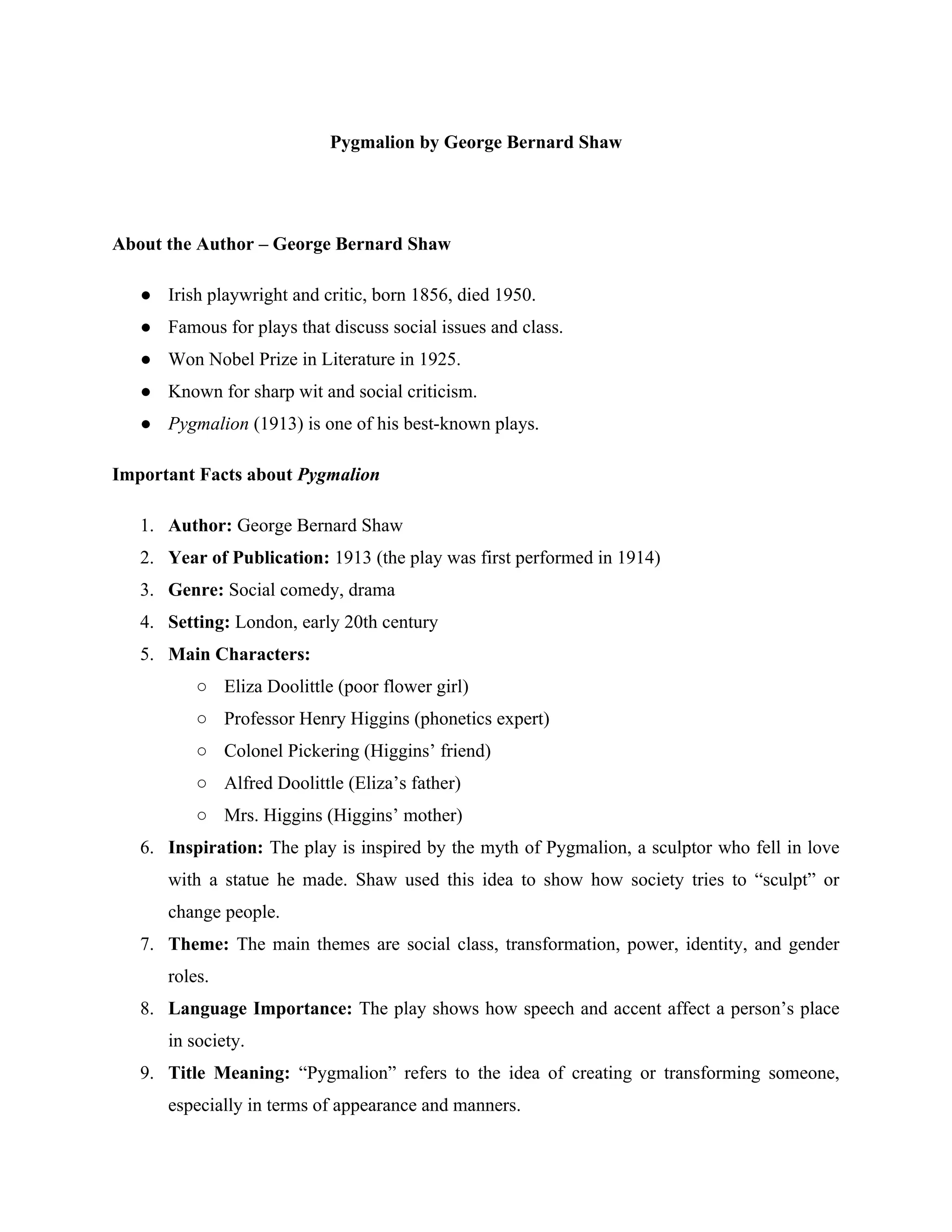
Pygmalion by George Bernard Shaw
About the Author – George Bernard Shaw
● Irish playwright and critic, born 1856, died 1950.
● Famous for plays that discuss social issues and class.
● Won Nobel Prize in Literature in 1925.
● Known for sharp wit and social criticism.
● Pygmalion (1913) is one of his best-known plays.
Important Facts about Pygmalion
1. Author: George Bernard Shaw
2. Year of Publication: 1913 (the play was first performed in 1914)
3. Genre: Social comedy, drama
4. Setting: London, early 20th century
5. Main Characters:
○ Eliza Doolittle (poor flower girl)
○ Professor Henry Higgins (phonetics expert)
○ Colonel Pickering (Higgins’ friend)
○ Alfred Doolittle (Eliza’s father)
○ Mrs. Higgins (Higgins’ mother)
6. Inspiration: The play is inspired by the myth of Pygmalion, a sculptor who fell in love
with a statue he made. Shaw used this idea to show how society tries to “sculpt” or
change people.
7. Theme: The main themes are social class, transformation, power, identity, and gender
roles.
8. Language Importance: The play shows how speech and accent affect a person’s place
in society.
9. Title Meaning: “Pygmalion” refers to the idea of creating or transforming someone,
especially in terms of appearance and manners.
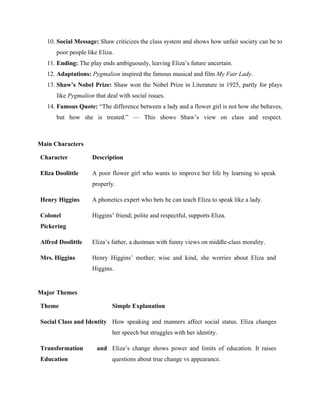
10. Social Message: Shaw criticizes the class system and shows how unfair society can be to
poor people like Eliza.
11. Ending: The play ends ambiguously, leaving Eliza’s future uncertain.
12. Adaptations: Pygmalion inspired the famous musical and film My Fair Lady.
13. Shaw’s Nobel Prize: Shaw won the Nobel Prize in Literature in 1925, partly for plays
like Pygmalion that deal with social issues.
14. Famous Quote: “The difference between a lady and a flower girl is not how she behaves,
but how she is treated.” — This shows Shaw’s view on class and respect.
Main Characters
Character Description
Eliza Doolittle A poor flower girl who wants to improve her life by learning to speak
properly.
Henry Higgins A phonetics expert who bets he can teach Eliza to speak like a lady.
Colonel
Pickering
Higgins’ friend; polite and respectful, supports Eliza.
Alfred Doolittle Eliza’s father, a dustman with funny views on middle-class morality.
Mrs. Higgins Henry Higgins’ mother; wise and kind, she worries about Eliza and
Higgins.
Major Themes
Theme Simple Explanation
Social Class and Identity How speaking and manners affect social status. Eliza changes
her speech but struggles with her identity.
Transformation and
Education
Eliza’s change shows power and limits of education. It raises
questions about true change vs appearance.
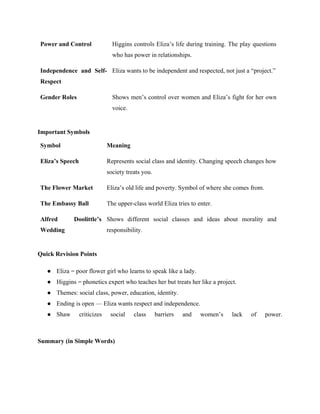
Power and Control Higgins controls Eliza’s life during training. The play questions
who has power in relationships.
Independence and Self-
Respect
Eliza wants to be independent and respected, not just a “project.”
Gender Roles Shows men’s control over women and Eliza’s fight for her own
voice.
Important Symbols
Symbol Meaning
Eliza’s Speech Represents social class and identity. Changing speech changes how
society treats you.
The Flower Market Eliza’s old life and poverty. Symbol of where she comes from.
The Embassy Ball The upper-class world Eliza tries to enter.
Alfred Doolittle’s
Wedding
Shows different social classes and ideas about morality and
responsibility.
Quick Revision Points
● Eliza = poor flower girl who learns to speak like a lady.
● Higgins = phonetics expert who teaches her but treats her like a project.
● Themes: social class, power, education, identity.
● Ending is open — Eliza wants respect and independence.
● Shaw criticizes social class barriers and women’s lack of power.
Summary (in Simple Words)
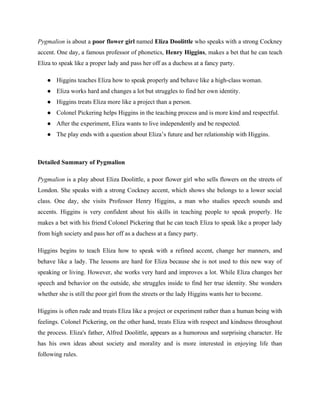
Pygmalion is about a poor flower girl named Eliza Doolittle who speaks with a strong Cockney
accent. One day, a famous professor of phonetics, Henry Higgins, makes a bet that he can teach
Eliza to speak like a proper lady and pass her off as a duchess at a fancy party.
● Higgins teaches Eliza how to speak properly and behave like a high-class woman.
● Eliza works hard and changes a lot but struggles to find her own identity.
● Higgins treats Eliza more like a project than a person.
● Colonel Pickering helps Higgins in the teaching process and is more kind and respectful.
● After the experiment, Eliza wants to live independently and be respected.
● The play ends with a question about Eliza’s future and her relationship with Higgins.
Detailed Summary of Pygmalion
Pygmalion is a play about Eliza Doolittle, a poor flower girl who sells flowers on the streets of
London. She speaks with a strong Cockney accent, which shows she belongs to a lower social
class. One day, she visits Professor Henry Higgins, a man who studies speech sounds and
accents. Higgins is very confident about his skills in teaching people to speak properly. He
makes a bet with his friend Colonel Pickering that he can teach Eliza to speak like a proper lady
from high society and pass her off as a duchess at a fancy party.
Higgins begins to teach Eliza how to speak with a refined accent, change her manners, and
behave like a lady. The lessons are hard for Eliza because she is not used to this new way of
speaking or living. However, she works very hard and improves a lot. While Eliza changes her
speech and behavior on the outside, she struggles inside to find her true identity. She wonders
whether she is still the poor girl from the streets or the lady Higgins wants her to become.
Higgins is often rude and treats Eliza like a project or experiment rather than a human being with
feelings. Colonel Pickering, on the other hand, treats Eliza with respect and kindness throughout
the process. Eliza's father, Alfred Doolittle, appears as a humorous and surprising character. He
has his own ideas about society and morality and is more interested in enjoying life than
following rules.
After the successful lessons, Eliza attends a fancy party where she fools everyone by speaking
and acting like a member of the upper class. But even though she has changed, Eliza feels
confused and frustrated because Higgins does not treat her with the respect she deserves. She
wants to be independent and make her own decisions, not just be a creation of Higgins’ teaching.
The play ends without a clear answer about Eliza and Higgins’ future, leaving the audience to
think about what really matters — whether it is speech and manners or respect, love, and self-
worth. Shaw uses this story to show how society judges people based on their language and
class, and to question the idea that changing someone’s speech is enough to change their life. He
also talks about the power struggles between men and women and the importance of personal
freedom.

Pygmalion Play by George Bernard Shaw.docx

  • 1.
    Pygmalion by GeorgeBernard Shaw About the Author – George Bernard Shaw ● Irish playwright and critic, born 1856, died 1950. ● Famous for plays that discuss social issues and class. ● Won Nobel Prize in Literature in 1925. ● Known for sharp wit and social criticism. ● Pygmalion (1913) is one of his best-known plays. Important Facts about Pygmalion 1. Author: George Bernard Shaw 2. Year of Publication: 1913 (the play was first performed in 1914) 3. Genre: Social comedy, drama 4. Setting: London, early 20th century 5. Main Characters: ○ Eliza Doolittle (poor flower girl) ○ Professor Henry Higgins (phonetics expert) ○ Colonel Pickering (Higgins’ friend) ○ Alfred Doolittle (Eliza’s father) ○ Mrs. Higgins (Higgins’ mother) 6. Inspiration: The play is inspired by the myth of Pygmalion, a sculptor who fell in love with a statue he made. Shaw used this idea to show how society tries to “sculpt” or change people. 7. Theme: The main themes are social class, transformation, power, identity, and gender roles. 8. Language Importance: The play shows how speech and accent affect a person’s place in society. 9. Title Meaning: “Pygmalion” refers to the idea of creating or transforming someone, especially in terms of appearance and manners.
  • 2.
    10. Social Message:Shaw criticizes the class system and shows how unfair society can be to poor people like Eliza. 11. Ending: The play ends ambiguously, leaving Eliza’s future uncertain. 12. Adaptations: Pygmalion inspired the famous musical and film My Fair Lady. 13. Shaw’s Nobel Prize: Shaw won the Nobel Prize in Literature in 1925, partly for plays like Pygmalion that deal with social issues. 14. Famous Quote: “The difference between a lady and a flower girl is not how she behaves, but how she is treated.” — This shows Shaw’s view on class and respect. Main Characters Character Description Eliza Doolittle A poor flower girl who wants to improve her life by learning to speak properly. Henry Higgins A phonetics expert who bets he can teach Eliza to speak like a lady. Colonel Pickering Higgins’ friend; polite and respectful, supports Eliza. Alfred Doolittle Eliza’s father, a dustman with funny views on middle-class morality. Mrs. Higgins Henry Higgins’ mother; wise and kind, she worries about Eliza and Higgins. Major Themes Theme Simple Explanation Social Class and Identity How speaking and manners affect social status. Eliza changes her speech but struggles with her identity. Transformation and Education Eliza’s change shows power and limits of education. It raises questions about true change vs appearance.
  • 3.
    Power and ControlHiggins controls Eliza’s life during training. The play questions who has power in relationships. Independence and Self- Respect Eliza wants to be independent and respected, not just a “project.” Gender Roles Shows men’s control over women and Eliza’s fight for her own voice. Important Symbols Symbol Meaning Eliza’s Speech Represents social class and identity. Changing speech changes how society treats you. The Flower Market Eliza’s old life and poverty. Symbol of where she comes from. The Embassy Ball The upper-class world Eliza tries to enter. Alfred Doolittle’s Wedding Shows different social classes and ideas about morality and responsibility. Quick Revision Points ● Eliza = poor flower girl who learns to speak like a lady. ● Higgins = phonetics expert who teaches her but treats her like a project. ● Themes: social class, power, education, identity. ● Ending is open — Eliza wants respect and independence. ● Shaw criticizes social class barriers and women’s lack of power. Summary (in Simple Words)
  • 4.
    Pygmalion is abouta poor flower girl named Eliza Doolittle who speaks with a strong Cockney accent. One day, a famous professor of phonetics, Henry Higgins, makes a bet that he can teach Eliza to speak like a proper lady and pass her off as a duchess at a fancy party. ● Higgins teaches Eliza how to speak properly and behave like a high-class woman. ● Eliza works hard and changes a lot but struggles to find her own identity. ● Higgins treats Eliza more like a project than a person. ● Colonel Pickering helps Higgins in the teaching process and is more kind and respectful. ● After the experiment, Eliza wants to live independently and be respected. ● The play ends with a question about Eliza’s future and her relationship with Higgins. Detailed Summary of Pygmalion Pygmalion is a play about Eliza Doolittle, a poor flower girl who sells flowers on the streets of London. She speaks with a strong Cockney accent, which shows she belongs to a lower social class. One day, she visits Professor Henry Higgins, a man who studies speech sounds and accents. Higgins is very confident about his skills in teaching people to speak properly. He makes a bet with his friend Colonel Pickering that he can teach Eliza to speak like a proper lady from high society and pass her off as a duchess at a fancy party. Higgins begins to teach Eliza how to speak with a refined accent, change her manners, and behave like a lady. The lessons are hard for Eliza because she is not used to this new way of speaking or living. However, she works very hard and improves a lot. While Eliza changes her speech and behavior on the outside, she struggles inside to find her true identity. She wonders whether she is still the poor girl from the streets or the lady Higgins wants her to become. Higgins is often rude and treats Eliza like a project or experiment rather than a human being with feelings. Colonel Pickering, on the other hand, treats Eliza with respect and kindness throughout the process. Eliza's father, Alfred Doolittle, appears as a humorous and surprising character. He has his own ideas about society and morality and is more interested in enjoying life than following rules.
  • 5.
    After the successfullessons, Eliza attends a fancy party where she fools everyone by speaking and acting like a member of the upper class. But even though she has changed, Eliza feels confused and frustrated because Higgins does not treat her with the respect she deserves. She wants to be independent and make her own decisions, not just be a creation of Higgins’ teaching. The play ends without a clear answer about Eliza and Higgins’ future, leaving the audience to think about what really matters — whether it is speech and manners or respect, love, and self- worth. Shaw uses this story to show how society judges people based on their language and class, and to question the idea that changing someone’s speech is enough to change their life. He also talks about the power struggles between men and women and the importance of personal freedom.