Got Motivation?
Strategies for Empowering
First-Year Students
Leah Hoops & Samuel Rowe
@StudySmarterOSU
dennislearningcenter.osu.edu dlc@osu.edu
Learning and Motivation Strategies for Success
Courses, Workshops, and Academic Coaching
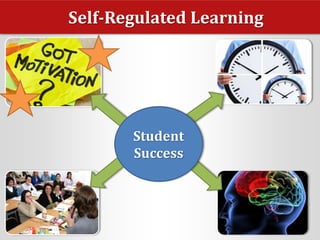
Self-Regulated Learning
Student
Success
What is Motivation?Session Overview
I. Introduction – What is Motivation?
II. Theory and Practice of Developing
Academic Motivation
III. How We Can Help
The Dennis Learning Center
Part 1
What is
Motivation?
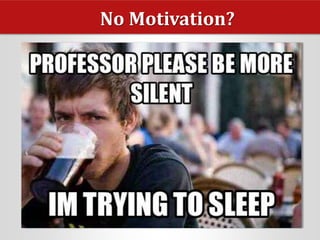
No Motivation?
What is Motivation?
“Motivation can be described as
something that energizes, directs, and
sustains behavior toward a particular goal”
(Van Blerkom, 2012, p. 3).
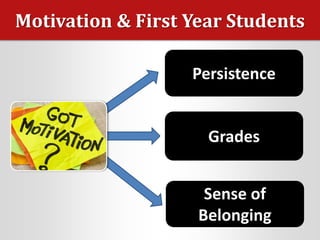
Motivation & First Year Students
Persistence
Grades
Sense of
Belonging
Part 2
Theory and
Practice
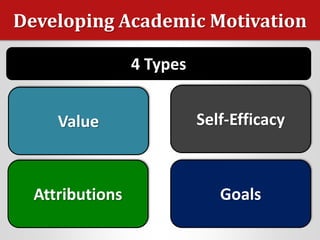
Developing Academic Motivation
4 Types
GoalsAttributions
Value Self-Efficacy
1. Value
Why should I do this?
The perceived usefulness of a task
in terms of an student’s future goals
(Eccles, 2005).
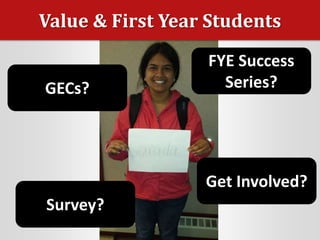
Value & First Year Students
Survey?
FYE Success
Series?GECs?
Get Involved?
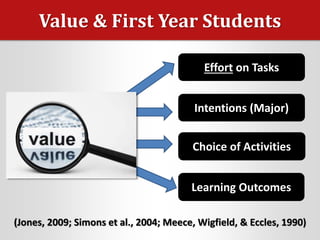
Value & First Year Students
(Jones, 2009; Simons et al., 2004; Meece, Wigfield, & Eccles, 1990)
Effort on Tasks
Intentions (Major)
Choice of Activities
Learning Outcomes
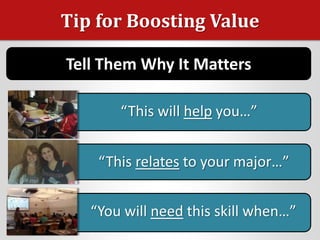
Tip for Boosting Value
Tell Them Why It Matters
“ “This will help you…”
“This relates to your major…”
“You will need this skill when…”
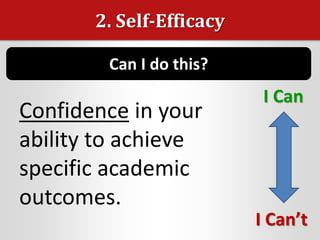
2. Self-Efficacy
Can I do this?
Confidence in your
ability to achieve
specific academic
outcomes.
I Can
I Can’t
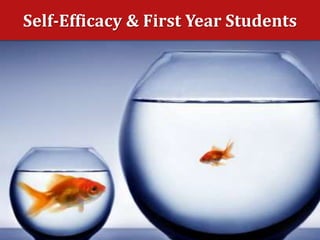
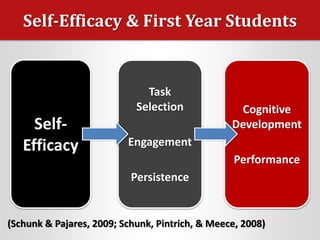
Self-Efficacy & First Year Students
Self-
Efficacy
Cognitive
Development
Performance
(Schunk & Pajares, 2009; Schunk, Pintrich, & Meece, 2008)
Task
Selection
Engagement
Persistence
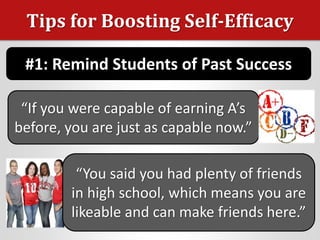
Tips for Boosting Self-Efficacy
#1: Remind Students of Past Success
“If you were capable of earning A’s
before, you are just as capable now.”
“You said you had plenty of friends
in high school, which means you are
likeable and can make friends here.”
Tips for Boosting Self-Efficacy
#2: Start With What They DO Know
EX: “What do you
currently do to take
notes in class?”
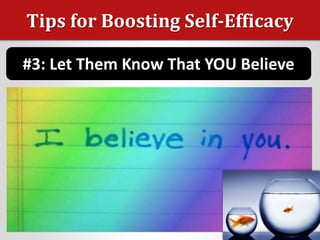
Tips for Boosting Self-Efficacy
#3: Let Them Know That YOU Believe
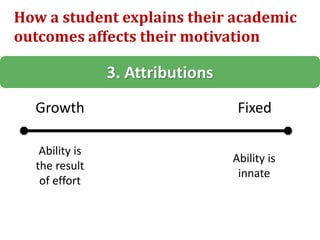
3. Attributions
How a student explains their academic
outcomes affects their motivation
Growth Fixed
Ability is
the result
of effort
Ability is
innate
Attributions
How a student explains their academic
outcomes affects their motivation
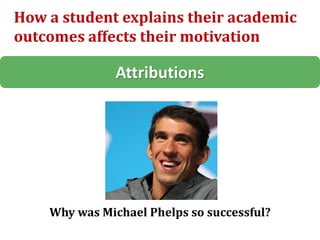
Why was Michael Phelps so successful?
Attributions
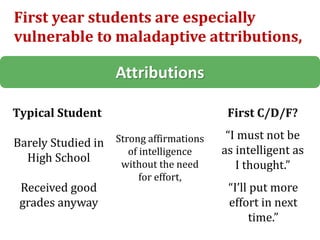
First year students are especially
vulnerable to maladaptive attributions,
Typical Student
Barely Studied in
High School
Received good
grades anyway
First C/D/F?
Strong affirmations
of intelligence
without the need
for effort,
“I must not be
as intelligent as
I thought.”
“I’ll put more
effort in next
time.”
Attributions
Fostering healthy attributions in first
year students
Rich, S. (2006). Student Performance: Does Effort Matter? Journal of Applied Finance, Vol.
16(Issue 2), P120-P120.
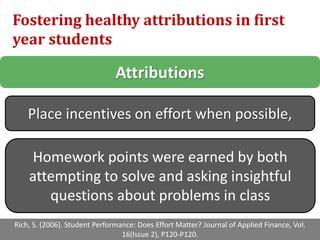
Homework points were earned by both
attempting to solve and asking insightful
questions about problems in class
Place incentives on effort when possible,
Attributions
Fostering healthy attributions in first
year students
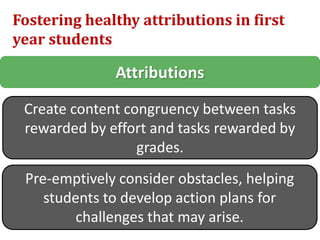
Create content congruency between tasks
rewarded by effort and tasks rewarded by
grades.
Pre-emptively consider obstacles, helping
students to develop action plans for
challenges that may arise.
Attributions
Fostering healthy attributions in first
year students
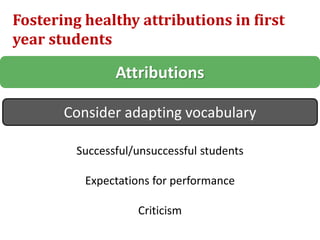
Consider adapting vocabulary
Successful/unsuccessful students
Expectations for performance
Criticism
4. Goals
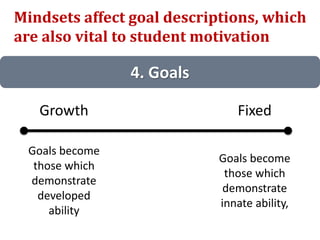
Mindsets affect goal descriptions, which
are also vital to student motivation
Growth Fixed
Goals become
those which
demonstrate
developed
ability
Goals become
those which
demonstrate
innate ability,
Goals
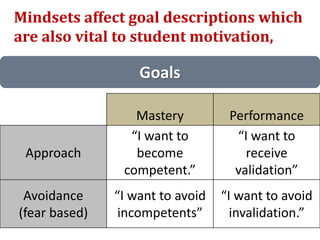
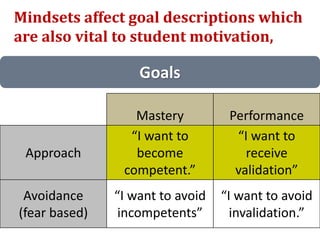
Mindsets affect goal descriptions which
are also vital to student motivation,
Mastery Performance
Approach
“I want to
become
competent.”
“I want to
receive
validation”
Avoidance
(fear based)
“I want to avoid
incompetents”
“I want to avoid
invalidation.”
Goals
Mindsets affect goal descriptions which
are also vital to student motivation,
Mastery Performance
Approach
“I want to
become
competent.”
“I want to
receive
validation”
Avoidance
(fear based)
“I want to avoid
incompetents”
“I want to avoid
invalidation.”
Goals
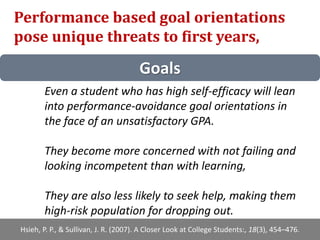
Performance based goal orientations
pose unique threats to first years,
Hsieh, P. P., & Sullivan, J. R. (2007). A Closer Look at College Students:, 18(3), 454–476.
Even a student who has high self-efficacy will lean
into performance-avoidance goal orientations in
the face of an unsatisfactory GPA.
They become more concerned with not failing and
looking incompetent than with learning,
They are also less likely to seek help, making them
high-risk population for dropping out.
Goals
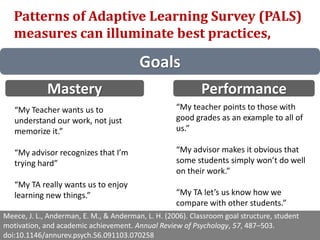
Patterns of Adaptive Learning Survey (PALS)
measures can illuminate best practices,
Meece, J. L., Anderman, E. M., & Anderman, L. H. (2006). Classroom goal structure, student
motivation, and academic achievement. Annual Review of Psychology, 57, 487–503.
doi:10.1146/annurev.psych.56.091103.070258
Mastery Performance
“My Teacher wants us to
understand our work, not just
memorize it.”
“My advisor recognizes that I’m
trying hard”
“My TA really wants us to enjoy
learning new things.”
“My teacher points to those with
good grades as an example to all of
us.”
“My advisor makes it obvious that
some students simply won’t do well
on their work.”
“My TA let’s us know how we
compare with other students.”
Summary
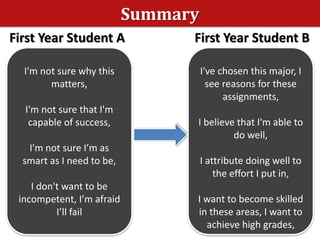
I'm not sure why this
matters,
I'm not sure that I'm
capable of success,
I'm not sure I’m as
smart as I need to be,
I don't want to be
incompetent, I’m afraid
I’ll fail
First Year Student A First Year Student B
I've chosen this major, I
see reasons for these
assignments,
I believe that I'm able to
do well,
I attribute doing well to
the effort I put in,
I want to become skilled
in these areas, I want to
achieve high grades,
Part 3
How We
Can Help
Dennis Learning Center
How we help first-year
students succeed!
Courses, Workshops, Academic Coaching
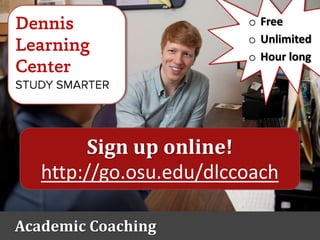
Academic Coaching
Sign up online!
http://go.osu.edu/dlccoach
o Free
o Unlimited
o Hour long
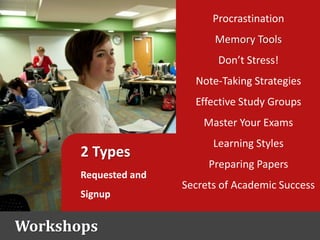
2 Types
Requested and
Signup
Procrastination
Memory Tools
Don’t Stress!
Note-Taking Strategies
Effective Study Groups
Master Your Exams
Learning Styles
Preparing Papers
Secrets of Academic Success
Workshops
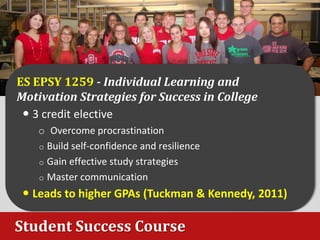
Student Success Course
ES EPSY 1259 - Individual Learning and
Motivation Strategies for Success in College
 3 credit elective
o Overcome procrastination
o Build self-confidence and resilience
o Gain effective study strategies
o Master communication
 Leads to higher GPAs (Tuckman & Kennedy, 2011)
ES EPSY Tech Courses
1159 Online Learning Strategies & Skills
o Using the web to attain academic goals
o Online tools for more effective studying,
time-management, and communication
o 2 credits, Summer (5 weeks)
1359 Technology-Enhanced Learning Strategies
Learning Collaboration & Innovation
Opportunity to engage with diverse set of professionals.
Professor D’Arcy Oaks: oaks.9@osu.edu
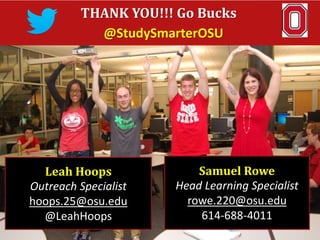
THANK YOU!!! Go Bucks
@StudySmarterOSU
Leah Hoops
Outreach Specialist
hoops.25@osu.edu
@LeahHoops
Samuel Rowe
Head Learning Specialist
rowe.220@osu.edu
614-688-4011

FYE 2015_Got Motivation combined_final

  • 1.
    Got Motivation? Strategies forEmpowering First-Year Students Leah Hoops & Samuel Rowe
  • 2.
    @StudySmarterOSU dennislearningcenter.osu.edu dlc@osu.edu Learning andMotivation Strategies for Success Courses, Workshops, and Academic Coaching
  • 3.
  • 4.
    What is Motivation?SessionOverview I. Introduction – What is Motivation? II. Theory and Practice of Developing Academic Motivation III. How We Can Help The Dennis Learning Center
  • 5.
  • 6.
  • 7.
    What is Motivation? “Motivationcan be described as something that energizes, directs, and sustains behavior toward a particular goal” (Van Blerkom, 2012, p. 3).
  • 8.
    Motivation & FirstYear Students Persistence Grades Sense of Belonging
  • 9.
  • 10.
    Developing Academic Motivation 4Types GoalsAttributions Value Self-Efficacy
  • 11.
    1. Value Why shouldI do this? The perceived usefulness of a task in terms of an student’s future goals (Eccles, 2005).
  • 12.
    Value & FirstYear Students Survey? FYE Success Series?GECs? Get Involved?
  • 13.
    Value & FirstYear Students (Jones, 2009; Simons et al., 2004; Meece, Wigfield, & Eccles, 1990) Effort on Tasks Intentions (Major) Choice of Activities Learning Outcomes
  • 14.
    Tip for BoostingValue Tell Them Why It Matters “ “This will help you…” “This relates to your major…” “You will need this skill when…”
  • 15.
    2. Self-Efficacy Can Ido this? Confidence in your ability to achieve specific academic outcomes. I Can I Can’t
  • 16.
    Self-Efficacy & FirstYear Students
  • 17.
    Self-Efficacy & FirstYear Students Self- Efficacy Cognitive Development Performance (Schunk & Pajares, 2009; Schunk, Pintrich, & Meece, 2008) Task Selection Engagement Persistence
  • 18.
    Tips for BoostingSelf-Efficacy #1: Remind Students of Past Success “If you were capable of earning A’s before, you are just as capable now.” “You said you had plenty of friends in high school, which means you are likeable and can make friends here.”
  • 19.
    Tips for BoostingSelf-Efficacy #2: Start With What They DO Know EX: “What do you currently do to take notes in class?”
  • 20.
    Tips for BoostingSelf-Efficacy #3: Let Them Know That YOU Believe
  • 21.
    3. Attributions How astudent explains their academic outcomes affects their motivation Growth Fixed Ability is the result of effort Ability is innate
  • 22.
    Attributions How a studentexplains their academic outcomes affects their motivation Why was Michael Phelps so successful?
  • 23.
    Attributions First year studentsare especially vulnerable to maladaptive attributions, Typical Student Barely Studied in High School Received good grades anyway First C/D/F? Strong affirmations of intelligence without the need for effort, “I must not be as intelligent as I thought.” “I’ll put more effort in next time.”
  • 24.
    Attributions Fostering healthy attributionsin first year students Rich, S. (2006). Student Performance: Does Effort Matter? Journal of Applied Finance, Vol. 16(Issue 2), P120-P120. Homework points were earned by both attempting to solve and asking insightful questions about problems in class Place incentives on effort when possible,
  • 25.
    Attributions Fostering healthy attributionsin first year students Create content congruency between tasks rewarded by effort and tasks rewarded by grades. Pre-emptively consider obstacles, helping students to develop action plans for challenges that may arise.
  • 26.

    Attributions Fostering healthy attributionsin first year students Consider adapting vocabulary Successful/unsuccessful students Expectations for performance Criticism
  • 27.
    4. Goals Mindsets affectgoal descriptions, which are also vital to student motivation Growth Fixed Goals become those which demonstrate developed ability Goals become those which demonstrate innate ability,
  • 28.
    Goals Mindsets affect goaldescriptions which are also vital to student motivation, Mastery Performance Approach “I want to become competent.” “I want to receive validation” Avoidance (fear based) “I want to avoid incompetents” “I want to avoid invalidation.”
  • 29.
    Goals Mindsets affect goaldescriptions which are also vital to student motivation, Mastery Performance Approach “I want to become competent.” “I want to receive validation” Avoidance (fear based) “I want to avoid incompetents” “I want to avoid invalidation.”
  • 30.
    Goals Performance based goalorientations pose unique threats to first years, Hsieh, P. P., & Sullivan, J. R. (2007). A Closer Look at College Students:, 18(3), 454–476. Even a student who has high self-efficacy will lean into performance-avoidance goal orientations in the face of an unsatisfactory GPA. They become more concerned with not failing and looking incompetent than with learning, They are also less likely to seek help, making them high-risk population for dropping out.
  • 31.
    Goals Patterns of AdaptiveLearning Survey (PALS) measures can illuminate best practices, Meece, J. L., Anderman, E. M., & Anderman, L. H. (2006). Classroom goal structure, student motivation, and academic achievement. Annual Review of Psychology, 57, 487–503. doi:10.1146/annurev.psych.56.091103.070258 Mastery Performance “My Teacher wants us to understand our work, not just memorize it.” “My advisor recognizes that I’m trying hard” “My TA really wants us to enjoy learning new things.” “My teacher points to those with good grades as an example to all of us.” “My advisor makes it obvious that some students simply won’t do well on their work.” “My TA let’s us know how we compare with other students.”
  • 32.
    Summary I'm not surewhy this matters, I'm not sure that I'm capable of success, I'm not sure I’m as smart as I need to be, I don't want to be incompetent, I’m afraid I’ll fail First Year Student A First Year Student B I've chosen this major, I see reasons for these assignments, I believe that I'm able to do well, I attribute doing well to the effort I put in, I want to become skilled in these areas, I want to achieve high grades,
  • 33.
  • 34.
    Dennis Learning Center Howwe help first-year students succeed! Courses, Workshops, Academic Coaching
  • 35.
    Academic Coaching Sign uponline! http://go.osu.edu/dlccoach o Free o Unlimited o Hour long
  • 36.
    2 Types Requested and Signup Procrastination MemoryTools Don’t Stress! Note-Taking Strategies Effective Study Groups Master Your Exams Learning Styles Preparing Papers Secrets of Academic Success Workshops
  • 37.
    Student Success Course ESEPSY 1259 - Individual Learning and Motivation Strategies for Success in College  3 credit elective o Overcome procrastination o Build self-confidence and resilience o Gain effective study strategies o Master communication  Leads to higher GPAs (Tuckman & Kennedy, 2011)
  • 38.
    ES EPSY TechCourses 1159 Online Learning Strategies & Skills o Using the web to attain academic goals o Online tools for more effective studying, time-management, and communication o 2 credits, Summer (5 weeks) 1359 Technology-Enhanced Learning Strategies Learning Collaboration & Innovation Opportunity to engage with diverse set of professionals. Professor D’Arcy Oaks: oaks.9@osu.edu
  • 39.
    THANK YOU!!! GoBucks @StudySmarterOSU Leah Hoops Outreach Specialist hoops.25@osu.edu @LeahHoops Samuel Rowe Head Learning Specialist rowe.220@osu.edu 614-688-4011

Editor's Notes

  • #4 The Dennis Learning Center specializes in Self-Regulated Learning – study skills and motivation. This includes 4 areas: Motivation Time Management – procrastination/how to best utilize your time Memory – how to learn and use new information (ex – today’s workshop, how to take effective notes) Context – or “where” to study, this includes how to learn best for subjects like reading versus math
  • #7 Note: there is NO SUCH THING as NO motivation. There is more adaptive/useful motivation versus maladaptive or harmful (low) motivation.
  • #9 Why is motivation important for first year students? Because college students’ motivation is related to their persistence, grades, and sense of belonging…outcomes critical to success in college.
  • #10 The good news is, those of us who work with first year students can help!
  • #11 We will cover 4 types of motivation Certain types of motivation are more applicable for certain students/situations. As you’re listening, think about which tips we share would work best for YOUR students.
  • #14 Value is strongly related to ….
  • #16 Top motivational predictor of student performance
  • #17 High School – big fish, small pond. Ohio State Students are best-of-the best Ohio State – little fish, big block O shaped pond. Courses are harder. Everyone is smart! In student affairs, all students were leaders in their student organizations or extracurricular activity. Now you have leaders fighting to be the top, faced with equal competitors. After earning first “low” grade in-class or losing first election in a student org, first-year students WILL ask, “Can I do it?”
  • #20 Other examples… Race, gender, concepts from high school
  • #23 Why do you suppose Michael Phelps achieved the success that he did? - How we explain success about others and ourselves illuminates the extent to which we have a growth or fixed mindset about ability, How do you suppose Michael Phelps explains his success? What if he’d just been given all the gold medals without his years of training? - similar to the kind of rapid success we see in Michael Phelps, but without the training, just gold medal after gold medal, - students in high-schools are getting A after A without the need to rise to a challenge and to push themselves,
  • #24 Typical student in my office, Strong perception of intelligence without needed effort, The meaning of Grades, Peer comparisons, Dealing with constructive criticism, The need for help, Learning methods,  ”long-term goals may be sacrificed by those with a fixed mindset in the service of securing, in the short-term, positive judgments of ability.” First D/C/F will go one of two ways, I must not be as intelligent as I thought, I can do it with a little more effort,
  • #25 I’ve had students come in that were growth mindset that had been influenced to believe their effort no longer mattered,
  • #26  Were my expectations clearly presented? Did I set and maintain a climate to learn from mistakes and failure? Did I provide the time and resources to address learner questions and confusions? Did I set a forum for students to receive authentic feedback? Did I praise effort, resourcefulness and resilience? https://usergeneratededucation.wordpress.com/
  • #27 How student performance is discussed, How expectations are communicated, (serious students should already know …) (If you don’t know X, well you just might not be cut out for Y… ) Athlete X, or Academic Y, they are so _____ strong/intelligent? Or determined/hardworking? how do we describe the success of those around us?
  • #28  - Students coming in have a high valence for performance approach/outcome goals.   - If students are too wrapped up into performance goals (they get no emotional kick back from the academic process because only when the outcome is achieved are their scores compared to others, (school remains a drag.
  • #29 Why do you suppose Michael Phelps achieved the success that he did? - We quickly turn in these instances toward trait explanations of such vast success, while effort plays a role, we’re tempted to think there is just something different about Athlete X, or Academic Y - How we explain success about others and ourselves illuminates the extent to which we have a growth or fixed mindset about ability,
  • #30 Why do you suppose Michael Phelps achieved the success that he did? - We quickly turn in these instances toward trait explanations of such vast success, while effort plays a role, we’re tempted to think there is just something different about Athlete X, or Academic Y - How we explain success about others and ourselves illuminates the extent to which we have a growth or fixed mindset about ability,
  • #31 Why do you suppose Michael Phelps achieved the success that he did? - We quickly turn in these instances toward trait explanations of such vast success, while effort plays a role, we’re tempted to think there is just something different about Athlete X, or Academic Y - How we explain success about others and ourselves illuminates the extent to which we have a growth or fixed mindset about ability,
  • #32 Why do you suppose Michael Phelps achieved the success that he did? - We quickly turn in these instances toward trait explanations of such vast success, while effort plays a role, we’re tempted to think there is just something different about Athlete X, or Academic Y - How we explain success about others and ourselves illuminates the extent to which we have a growth or fixed mindset about ability,
  • #35 Now let’s discuss how we can help you succeed at the Dennis Learning Center…
  • #36 Something students can do NOW “Need help with exam prep today? Come see us!....”
  • #37  .
  • #38 Something students can do LATER (next semester) “Need more information on how to prepare for exams and a variety of other study strategies? Take our Student Success Course – ES EPSY 1259 – next semester!”